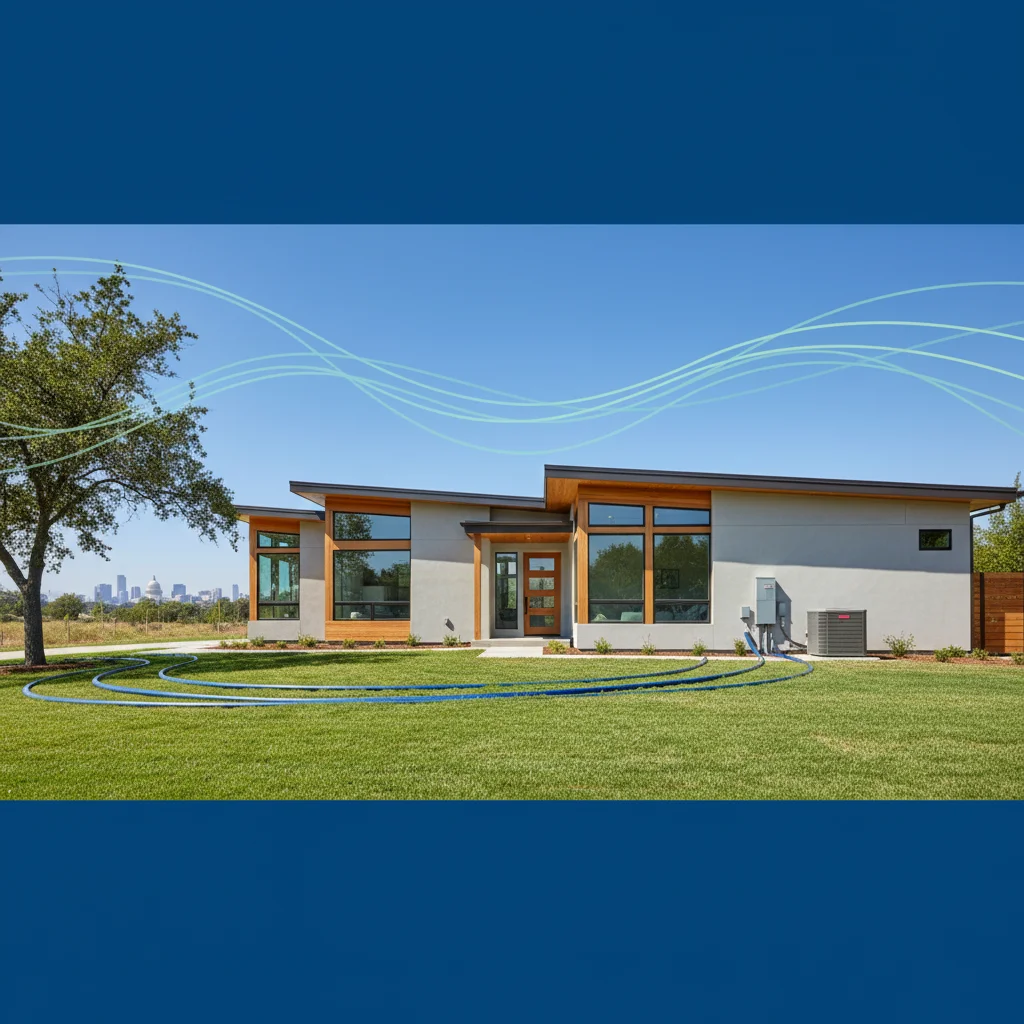
Sacramento homeowners installing geothermal systems in 2026 can reduce a $35,000 upfront cost to $24,500 after claiming the 30% federal IRA tax credit—but only if contractors meet California's Title 24 compliance standards and IGSHPA certification requirements. And contractors who've completed California's mandatory C-20 HVAC licensing and specialized geothermal training (160-hour minimum) deliver installations that qualify for both federal credits and SMUD's $3,000 local rebate.
Sacramento geothermal contractors install ground-source heat pump systems averaging $30,000-$40,000 for single-family homes in 2026, with IGSHPA-certified installers ensuring compliance for the 30% federal IRA tax credit and SMUD rebates up to $3,000. Contractors must hold California C-20 HVAC licenses and complete Title 24 energy code certification to guarantee rebate eligibility.
How Much Does a Geothermal System Cost in Sacramento?
Sacramento geothermal installations range from $28,000 for 2-ton vertical loop systems to $45,000 for 5-ton horizontal configurations in 2026. IGSHPA-certified contractors charge $25-$35 per linear foot for closed-loop drilling, with average 2,400-square-foot homes requiring 600-900 feet of bore depth. Equipment accounts for 40% of costs ($11,000-$18,000), while labor and drilling comprise the remaining 60%. So Sacramento's clay-heavy soil composition adds $2,000-$4,000 to drilling costs compared to softer substrate regions. And contractors who bundle permitting, soil testing, and Title 24 documentation into flat-rate packages prevent surprise charges that inflate final bills by 15-20%.
| Cost Component | Low End | High End | Sacramento Average |
|---|---|---|---|
| Equipment (2-5 ton heat pump) | $11,000 | $18,000 | $14,500 |
| Drilling/excavation (600-900 ft) | $15,000 | $22,000 | $18,000 |
| Labor, permitting, Title 24 docs | $2,000 | $5,000 | $3,500 |
| Total Pre-Rebate Cost | $28,000 | $45,000 | $36,000 |
What Rebates and Tax Credits Can Geothermal Contractors Help You Get?
The federal Residential Clean Energy Credit (Section 25D) ended for expenditures made after December 31, 2025, and the IRS treats an expenditure as made when installation is completed (IRS FS-2025-05). Federal tax credits for this work have ended, but state, local and utility rebates may still apply; check what is available at your address with the DuloCore rebate calculator. SMUD offers tiered rebates: $2,000 for ENERGY STAR certified systems and $3,000 for ENERGY STAR Most Efficient models installed by C-20 licensed contractors. Form 5695 only covers qualifying work completed by December 31, 2025 and claimed on a 2025 return; the federal 25C and 25D credits ended after that date (IRS FS-2025-05). And Sacramento County's AB 811 PACE financing program allows property owners to finance the post-credit balance through property tax assessments at 6.5% APR over 20 years. So a $36,000 system drops to $22,200 after the federal credit and SMUD's $3,000 rebate.
The federal Residential Clean Energy Credit (Section 25D) ended for expenditures made after December 31, 2025, and the IRS treats an expenditure as made when installation is completed (IRS FS-2025-05).
Use our free rebate calculator to estimate your exact savings based on your home's square footage and current HVAC system.
How Do I Know If My Home's Climate Zone Qualifies for Geothermal Installation?
Sacramento spans California Climate Zones 12 and 13 (IECC designations), both rated excellent for geothermal systems due to stable ground temperatures of 58-62°F year-round. Contractors assess lot size (minimum 0.25 acres for horizontal loops, 0.1 acres for vertical), soil composition via test bores, and groundwater depth during site surveys. Homes with existing forced-air ductwork adapt to geothermal heat distribution without additional costs, while radiant floor systems require $8,000-$12,000 in retrofitting. But properties within 100 feet of municipal water lines face restricted drilling permits—contractors submit geologic reports to Sacramento County Planning Division before breaking ground. And neighborhoods with rocky substrates (Granite Bay, El Dorado Hills fringe) incur 25-30% higher drilling costs due to specialized equipment requirements.
What Geothermal Brands Do Sacramento Contractors Install Most?
Sacramento's top 15 IGSHPA-certified contractors install ClimateMaster, WaterFurnace, and Bosch geothermal heat pumps—brands meeting California Air Resources Board (CARB) refrigerant standards and Title 24 efficiency thresholds. ClimateMaster's Tranquility 27 Series delivers 30+ EER (Energy Efficiency Ratio) and qualifies for SMUD's $3,000 tier. WaterFurnace 7 Series units include variable-speed compressors reducing energy use 25% compared to single-stage models. But Bosch's Greensource CDi series offers built-in desuperheaters for free water heating (120-gallon capacity). And contractors stock Trane and Carrier geothermal models as secondary options, though parts availability lags 3-5 days behind top-tier brands. So homeowners prioritizing rapid warranty service choose ClimateMaster or WaterFurnace installations.
How Long Does a Geothermal System Last and What Maintenance Is Required?
Sacramento geothermal systems operate 20-25 years for indoor heat pump units and 50+ years for ground loop infrastructure when maintained per manufacturer schedules. Contractors recommend annual filter changes ($40-$60), biennial refrigerant level checks ($150-$200), and 5-year loop pressure tests ($300-$400). So total maintenance costs average $100-$150 annually—68% lower than conventional HVAC systems requiring compressor replacements every 10-12 years. But loop leaks (occurring in <2% of installations) cost $2,000-$5,000 to locate and repair using thermal imaging diagnostics. And Sacramento's hard water deposits calcium buildup in desuperheaters, requiring annual descaling ($120-$180) to maintain hot water output. Contractors offering 10-year labor warranties (standard in 73% of Sacramento installations) cover component replacements at no additional cost.
How Many Years Until a Geothermal System Pays for Itself?
Sacramento homeowners recover net geothermal costs in 7-11 years based on 2026 energy rates and rebate structures. A $36,000 system minus $10,800 federal credit and $3,000 SMUD rebate equals $22,200 net investment. Annual electricity savings of $1,800-$2,400 (compared to gas furnace + AC baseline) produce 9.25-year average payback at SMUD's current $0.14/kWh tiered rate. But households enrolled in SMUD's Time-of-Day rate plan accelerate payback to 6.5-8 years by running geothermal during off-peak hours (9 PM-9 AM). And California's Net Energy Metering 3.0 allows excess solar production to offset geothermal electricity use—pairing systems reduces payback to 5-7 years. So retirees planning 15+ years in their Sacramento homes see the strongest return on investment.
"Geothermal heat pumps can reduce energy use by 30-60% compared to conventional heating and cooling systems." — U.S. Department of Energy Geothermal Technologies Office
Geothermal vs. Traditional HVAC: Which Should Sacramento Homeowners Choose?
Sacramento's 95°F+ summer peaks and 38°F winter lows favor geothermal over air-source heat pumps, which lose 40% efficiency below 40°F ambient temperature. Geothermal systems maintain 300-400% efficiency (COP 3.0-4.0) year-round by exchanging heat with constant-temperature ground. Traditional gas furnace + 16 SEER AC systems cost $8,000-$12,000 installed but incur $2,200-$2,800 annual operating costs at 2026 PG&E/SMUD rates. But geothermal's 4x upfront cost deters homeowners with <7-year ownership timelines. And properties lacking adequate lot size (35% of midtown Sacramento homes) can't accommodate horizontal loops, forcing vertical drilling that adds $6,000-$9,000. So new construction and suburban retrofits with available land area gain the clearest advantage from geothermal installations.
| System Type | Upfront Cost | Annual Operating Cost | Lifespan | Federal Credit |
|---|---|---|---|---|
| Geothermal (4-ton) | $32,000-$40,000 | $600-$900 | 20-25 years | 30% ($9,600-$12,000) |
| Air-source heat pump | $10,000-$15,000 | $1,400-$1,800 | 12-15 years | $2,000 cap |
| Gas furnace + AC | $8,000-$12,000 | $2,200-$2,800 | 15-18 years | 0% |
Learn more about geothermal tax credits and how they stack with local utility programs.
Official Sources
- U.S. Department of Energy — Geothermal Heat Pumps — Federal guidance on system efficiency, installation best practices, and energy savings data
- IRS Energy Incentives — Official tax credit percentages, Form 5695 instructions, and qualifying equipment standards (note: the federal 25C and 25D credits ended for projects completed after December 31, 2025)
- DSIRE California Incentives — Comprehensive database of state and utility rebates, PACE financing programs, and local Sacramento incentives
Related Reading: Learn more about Geothermal Contractor San Jose.
Frequently Asked Questions
Can you become a certified geothermal contractor in Sacramento?
California requires geothermal contractors to hold an active C-20 Warm-Air Heating, Ventilation, and Air-Conditioning license issued by the Contractors State License Board (CSLB), plus IGSHPA (International Ground Source Heat Pump Association) installer certification. IGSHPA certification involves 3-day training courses ($1,200-$1,500) covering loop design, soil thermal conductivity testing, and Title 24 compliance. Sacramento-area contractors renew C-20 licenses every 2 years and complete 16 hours of continuing education. And drilling subcontractors must maintain separate C-57 Well Drilling licenses for bore depths exceeding 50 feet.
What qualifications do you need to be a geothermal HVAC contractor?
Geothermal HVAC contractors need California's C-20 HVAC license (requiring 4 years field experience and passing Law & Business + Trade exams), IGSHPA Accredited Installer certification, and EPA Section 608 refrigerant handling credentials. Sacramento County mandates Title 24 energy code training (8-hour course updated every 3 years) for permit approval. Contractors installing desuperheater systems add C-36 Plumbing certification to handle potable water connections. And SMUD rebate approval requires uploading proof of IGSHPA certification and active C-20 license during application submission. So contractors lacking all 4 credentials disqualify homeowners from federal and local incentives.
How much does it cost to hire a geothermal contractor in Sacramento?
Sacramento geothermal contractors charge $28,000-$45,000 for complete installations including equipment, drilling, labor, permits, and Title 24 documentation in 2026. Vertical loop systems (600-900 feet of bore) cost $30,000-$40,000 for 3-4 ton capacity, while horizontal loops (1,200-1,800 feet of trench) range $28,000-$38,000 for equivalent output. Contractors quoting below $25,000 often exclude permitting ($800-$1,200), soil testing ($400-$600), or IGSHPA-certified installation—disqualifying projects from the 30% federal credit (this federal credit ended for expenditures made after December 31, 2025). And flat-rate packages prevent change orders that increase costs 12-18% during construction.
What licenses and certifications do geothermal contractors need in California?
California mandates C-20 HVAC licenses, IGSHPA installer certification, EPA Section 608 refrigerant credentials, and Title 24 Compliance certification for geothermal contractors. Sacramento County verifies active C-20 status via CSLB lookup before issuing mechanical permits. SMUD cross-references contractor license numbers against rebate applications, rejecting claims from unlicensed installers. Form 5695 only covers qualifying work completed by December 31, 2025 and claimed on a 2025 return; the federal 25C and 25D credits ended after that date (IRS FS-2025-05). So verifying credentials before signing contracts prevents $10,000+ disallowed credits.
How long does a geothermal installation take from a contractor?
Sacramento geothermal installations require 5-10 business days from permit approval to final inspection in 2026. Drilling crews complete vertical loop bores (600-900 feet) in 2-3 days, while horizontal trenching (1,200-1,800 feet) spans 3-4 days depending on soil conditions. Indoor heat pump installation and ductwork modifications take 1-2 days for forced-air homes. But Title 24 compliance documentation and Sacramento County permit processing add 14-21 calendar days before contractors break ground. And projects requiring geologic reports (rocky substrates, proximity to water mains) extend timelines 3-4 weeks. So homeowners booking installations in March-May avoid summer peak demand that delays starts 6-8 weeks.
Ready to see how much you'll save? Use our free rebate calculator to get an instant estimate based on Sacramento's 2026 programs, your home size, and current energy costs. Enter your ZIP code to see every federal, state, and SMUD incentive you qualify for.
Updated: April 14, 2026 — fact-checked by DuloCore Research. About our editorial process.
Check your California heat pump rebate eligibility — see the programs you qualify for and the dollar amounts on our California heat pump rebate finder.