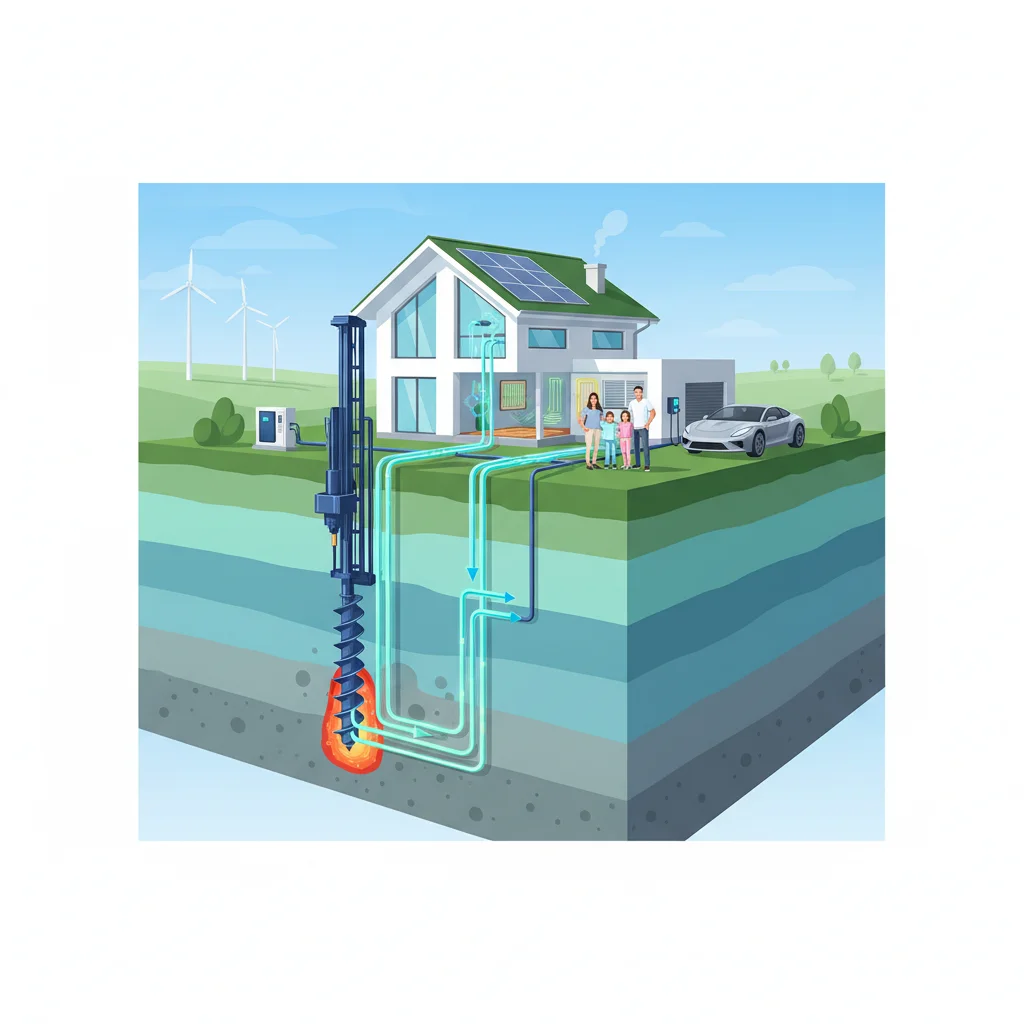
A drilling rig breaks through 400 feet of California bedrock in just three days, installing a loop system that'll heat and cool a 2,400-square-foot home for the next 50 years without burning a single therm of natural gas. The federal Residential Clean Energy Credit (Section 25D) ended for expenditures made after December 31, 2025, and the IRS treats an expenditure as made when installation is completed (IRS FS-2025-05). Federal tax credits for this work have ended, but state, local and utility rebates may still apply; check what is available at your address with the DuloCore rebate calculator.
What Is the Geothermal Drilling Process and How Does It Work?
Geothermal drilling creates vertical or horizontal boreholes between 150 and 500 feet deep, installing high-density polyethylene loops that circulate water and antifreeze solution to transfer ground temperature into homes. Drillers use rotary or percussion rigs to penetrate soil and bedrock, then insert U-shaped pipe assemblies connected to indoor heat pump units that extract thermal energy year-round at constant 50-55°F ground temperatures.
The process starts with geological surveys that identify soil composition, water table depth, and bedrock type. And drilling crews position truck-mounted rigs that bore 4-6 inch diameter holes at precise depths calculated by load requirements. Each ton of heating/cooling capacity requires 150-200 feet of vertical loop or 400-600 feet of horizontal trench. But vertical systems dominate California installations because they occupy minimal surface area—just 10 square feet per borehole compared to 1,500 square feet for horizontal loops.
So residential installations typically require 2-4 vertical boreholes spaced 15-20 feet apart. Drillers lower pre-assembled loop sections into each hole, then pump thermally-enhanced grout to seal the annular space and maximize heat transfer between pipes and surrounding earth. Or contractors connect multiple boreholes with header pipes that feed a single heat pump unit inside the home.
How Much Does Geothermal Drilling Cost for a Typical Home Installation?
Geothermal drilling costs $15,000-$35,000 for complete residential installations in California, with drilling representing 40-50% of total system expense at $15-$40 per linear foot depending on soil conditions and required depth. A standard 3-ton system serving 1,800 square feet requires 600-800 feet of vertical drilling across 3-4 boreholes, totaling $9,000-$32,000 for drilling alone before adding heat pump equipment and indoor installation.
Vertical drilling runs $3,000-$8,000 per borehole including pipe, grout, and labor. And bedrock formations increase costs 30-50% compared to soft soil drilling because carbide bits wear faster and penetration rates drop from 40 feet per hour to 15 feet per hour. But California's diverse geology creates significant regional variation—Sacramento Valley sediment drilling costs $18-$25 per foot while Sierra Nevada granite drilling reaches $35-$40 per foot.
So total system costs break down as: drilling and loop installation ($9,000-$32,000), heat pump equipment ($4,000-$8,000), and indoor installation including ductwork modifications ($2,000-$6,000). Or homeowners installing 4-ton systems for 2,400 square feet pay $20,000-$35,000 before rebates and tax credits reduce net costs to $12,000-$22,000.
What Rebates and Tax Credits Can You Get for Geothermal Drilling?
The federal Residential Clean Energy Credit (Section 25D) ended for expenditures made after December 31, 2025, and the IRS treats an expenditure as made when installation is completed (IRS FS-2025-05). California utilities offer $3,000-$5,000 in additional rebates for qualifying ground-source heat pump installations in 2026. The federal Energy Efficient Home Improvement Credit (Section 25C) ended for property placed in service after December 31, 2025 (IRS FS-2025-05).
The federal Residential Clean Energy Credit (Section 25D) ended for expenditures made after December 31, 2025, and the IRS treats an expenditure as made when installation is completed (IRS FS-2025-05).
And California's Self-Generation Incentive Program (SGIP) excludes geothermal systems, but major utilities including PG&E, SoCal Edison, and SDG&E maintain separate rebate programs. PG&E offers $4,000 for ENERGY STAR certified systems installed in 2026. But rebate funding depletes quarterly, so early applications secure higher payouts.
Use our free rebate calculator to combine federal credits with local utility incentives and calculate exact savings for your property. So a $25,000 geothermal installation qualifies for $7,500 federal credit plus $4,000 utility rebate, reducing net cost to $13,500—a 46% total discount.
| Program | Amount | Eligibility | Deadline |
|---|---|---|---|
| Federal IRA Credit | Ended Dec 31, 2025 | — | Ended Dec 31, 2025 |
| PG&E Residential Rebate | $4,000 | ENERGY STAR certified systems | Dec 31, 2026 |
| SoCal Edison HVAC Rebate | $3,000-$5,000 | Income-qualified households | Funds exhausted |
How Long Does Geothermal Drilling Take and What's the ROI Payback Period?
Geothermal drilling takes 1-3 days for typical residential installations, with complete system commissioning finished within 5-7 days, while ROI payback periods range from 5-10 years based on displaced natural gas costs averaging $1.50-$2.20 per therm in California and annual electricity savings of $800-$1,800. Drilling crews complete 3-4 vertical boreholes in a single day under optimal soil conditions, then spend an additional day installing headers and pressure-testing loop integrity.
And total installation timelines include: geological survey and permitting (2-4 weeks), drilling and loop installation (1-3 days), heat pump equipment installation (2-3 days), and system startup and balancing (1 day). But permit approval delays extend project timelines in counties requiring detailed hydrogeological reports for drilling depths exceeding 300 feet.
So annual operating cost comparisons show geothermal systems saving $900-$1,800 versus natural gas furnaces and central air conditioning in California climate zones. A $25,000 system with $7,500 federal credit and $4,000 rebate costs $13,500 net, achieving payback in 8-15 years. Or households replacing expensive propane heating see payback in just 5-7 years with propane costs reaching $3.50-$4.50 per gallon in rural counties.
"Geothermal heat pumps are the most energy-efficient, environmentally clean, and cost-effective systems for heating and cooling buildings. They can reduce energy use by 30-60% compared to conventional heating and cooling systems." — DOE Geothermal Heat Pumps
How Does Geothermal Compare to Air Source Heat Pumps and Traditional HVAC?
Geothermal systems deliver 400-600% efficiency (COP 4.0-6.0) compared to 250-350% for air-source heat pumps and 95-98% for natural gas furnaces, maintaining full heating capacity at 0°F outdoor temperatures while air-source units lose 30-50% capacity below 25°F. Ground-source systems cost $15,000-$35,000 installed versus $8,000-$18,000 for ducted air-source heat pumps, but 50-year loop lifespan and 50% lower operating costs favor geothermal for long-term ownership.
And performance differences become critical in extreme temperatures. Air-source heat pump rebates offset lower upfront costs, but backup resistance heating activates during cold snaps, erasing efficiency gains. But geothermal systems extract constant 50-55°F ground temperature regardless of outdoor conditions, eliminating supplemental heating in all California climate zones.
So total 15-year ownership costs including installation, electricity, and maintenance show geothermal costing $28,000-$42,000 versus $25,000-$38,000 for air-source systems and $32,000-$48,000 for natural gas furnace plus central AC combinations. Or geothermal becomes the lowest-cost option for properties with high heating loads and 15+ year ownership timelines.
| System Type | Install Cost | Annual Operating Cost | 15-Year Total | Efficiency |
|---|---|---|---|---|
| Geothermal | $13,500* | $600-$900 | $28,500-$42,000 | 400-600% |
| Air Source HP | $6,000* | $800-$1,200 | $25,000-$38,000 | 250-350% |
| Gas Furnace + AC | $9,000 | $1,400-$2,200 | $32,000-$48,000 | 95-98% |
*After federal credits and rebates
How Long Will Your Geothermal System Last and What Maintenance Is Required?
Geothermal ground loops last 50-100 years with zero maintenance while indoor heat pump units require replacement every 20-25 years at $4,000-$8,000 per unit, and annual maintenance costs run $150-$300 for filter changes, refrigerant checks, and loop pressure testing. Underground polyethylene pipes carry 50-year manufacturer warranties because buried systems avoid weather exposure, UV degradation, and mechanical damage that limit outdoor equipment lifespan to 15-20 years.
And maintenance requirements include: annual filter replacement ($30-$60), biannual HVAC technician inspection ($100-$150), and 5-year loop pressure testing ($200-$400). But geothermal systems eliminate outdoor condenser coil cleaning, refrigerant leak repairs, and compressor failures that plague air-source units. So lifetime maintenance costs total $4,500-$9,000 over 30 years compared to $8,000-$14,000 for air-source systems requiring outdoor unit replacements every 12-15 years.
Or homeowners replacing 25-year-old heat pump units retain existing ground loops, reducing replacement costs to $5,000-$9,000 for indoor equipment only. And modern variable-speed heat pumps improve efficiency 15-20% when connected to legacy loop fields, extending total system value beyond initial 50-year projections.
Official Sources
- DOE Geothermal Heat Pumps — Federal technical guidance on ground-source heat pump technology and performance
- IRS Energy Incentives — Official federal tax credit information for residential clean energy property (note: the federal 25C and 25D credits ended for projects completed after December 31, 2025)
- ENERGY STAR Heat Pumps — Certification requirements and qualified product directory for geothermal systems
Related Reading: Learn more about Green Home Certification Process and Window U-Factor And Shgc Explained.
Frequently Asked Questions
What is the geothermal drilling process and how deep do they drill?
Geothermal drilling uses rotary or percussion rigs to bore 4-6 inch diameter vertical holes between 150 and 500 feet deep, installing U-shaped polyethylene loops that circulate water and antifreeze to transfer ground temperature. Typical residential systems require 3-4 boreholes spaced 15-20 feet apart, with total drilling depth of 600-800 feet for a 3-ton heat pump serving 1,800 square feet. And drilling takes 1-3 days depending on soil conditions and bedrock depth.
How much does geothermal drilling cost and what rebates are available?
Geothermal drilling costs $15,000-$35,000 for complete California installations, with federal IRA credits covering 30% of total costs through 2032 and utility rebates adding $3,000-$5,000 in 2026. A typical $25,000 system qualifies for $7,500 federal credit plus $4,000 PG&E rebate, reducing net cost to $13,500. Calculate your exact savings with our rebate calculator using your property address and current heating costs.
Is my home eligible for geothermal system installation?
Properties with 10-15 square feet of accessible yard space per borehole qualify for vertical geothermal drilling, while horizontal systems require 1,500-2,500 square feet of open land for trench loops. And drilling permits require geological surveys in earthquake zones and groundwater protection areas, adding $800-$2,000 to project costs. But 85% of California single-family homes meet vertical drilling requirements with 3-4 boreholes fitting within typical side yard setbacks.
How long does the geothermal drilling process take?
Drilling and loop installation takes 1-3 days for typical residential systems, with complete heat pump commissioning finished within 5-7 days after drilling completion. And total project timelines including permits run 4-8 weeks, with geological surveys requiring 2-4 weeks before drilling begins. But experienced contractors complete turnkey installations in 6-10 business days once permits clear and equipment arrives on-site.
What is the difference between geothermal drilling and traditional HVAC installation?
Geothermal drilling installs permanent underground loop fields lasting 50-100 years versus traditional HVAC systems placing outdoor condensers with 15-20 year lifespans on concrete pads. And geothermal systems require geological surveys, drilling permits, and pressure grouting that traditional split systems avoid. But geothermal delivers 400-600% efficiency compared to 95-350% for conventional heating and cooling, saving $800-$1,800 annually on California energy bills.
Ready to see how much you can save with geothermal? Use our free rebate calculator to get instant estimates for federal tax credits, utility rebates, and total installation costs based on your home size and location. Or explore our complete guide to energy tax credits to maximize your 2026 savings across all eligible home improvements.
Last updated April 14, 2026 — reviewed by DuloCore Editorial. About our authors.
Check your California heat pump rebate eligibility — see the programs you qualify for and the dollar amounts on our California heat pump rebate finder.