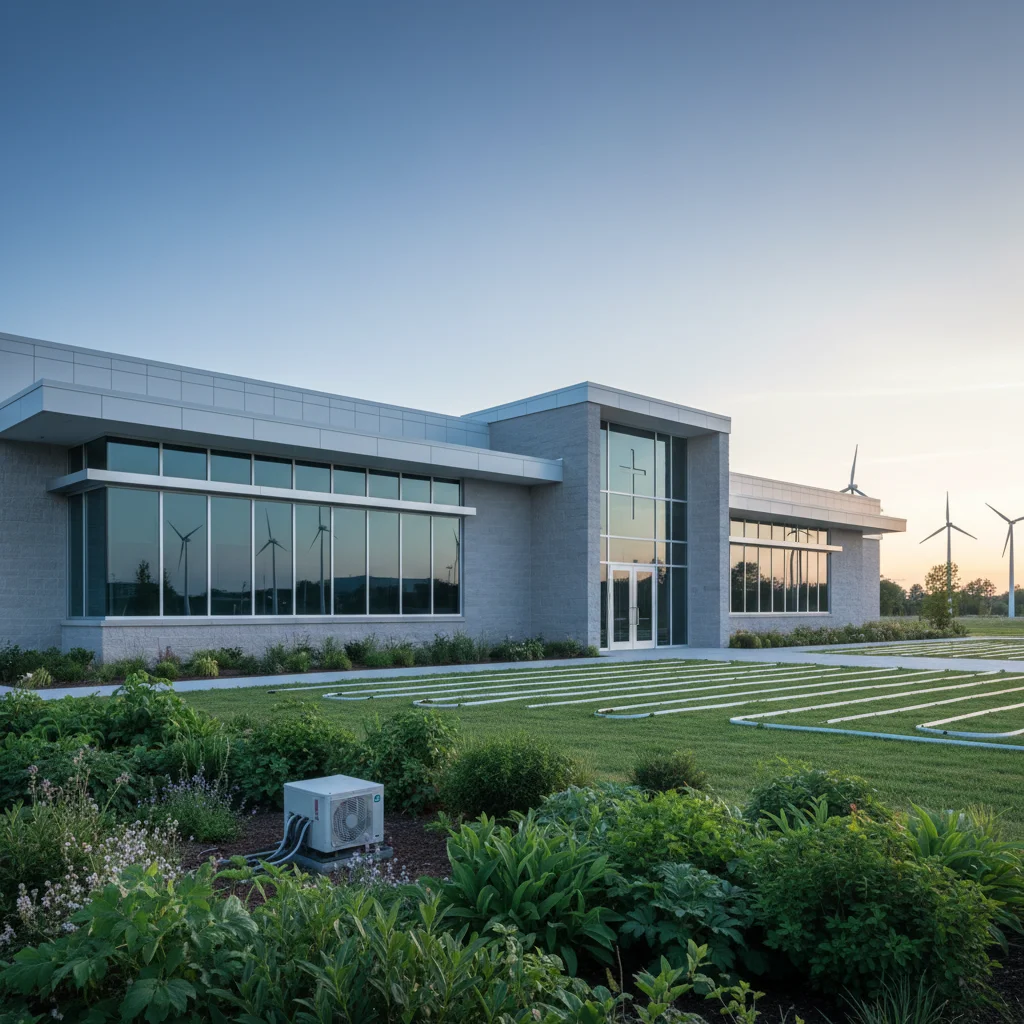
Churches and nonprofits spend $3,000-$12,000 annually on heating and cooling, often in buildings with 5,000-20,000 square feet that operate on tight budgets. Geothermal heat pumps cut energy bills by 40-70% while eliminating reliance on fossil fuels, but upfront costs of $15,000-$40,000 for commercial installations create a barrier for tax-exempt organizations that can't claim federal tax credits. And yet federal grants, state rebates, and utility incentives specifically for nonprofits cover $10,000-$25,000 of installation costs in 2026, making geothermal systems financially viable for religious and charitable organizations that prioritize long-term savings over immediate cash flow.
What Is the ROI and Payback Period for Geothermal Systems in Churches and Nonprofits?
Geothermal systems for churches and nonprofits generate ROI through energy savings of $1,800-$6,000 annually for buildings between 5,000-20,000 square feet. Payback periods range from 5-12 years depending on building size, local utility rates, and grant funding received. Organizations in California with utility rates of $0.18-$0.25/kWh see payback in 5-8 years.
Nonprofits qualify for federal grants through the USDA Rural Energy for America Program (REAP), which covers 25% of installation costs up to $1 million for rural churches and community organizations. State-level grants in California provide $3,000-$10,000 per ton of geothermal capacity through programs like the Self-Generation Incentive Program (SGIP). So a 10-ton system costing $35,000 receives $7,500-$15,000 in combined incentives, reducing net cost to $20,000-$27,500.
Churches with annual heating and cooling costs of $6,000 save $2,400-$4,200 yearly after installing geothermal systems. But organizations must secure financing through nonprofit lenders or diocesan revolving funds, as traditional banks rarely offer loans to tax-exempt entities for capital improvements. Organizations using grants plus 5-year financing at 4-6% APR achieve positive cash flow within 2-3 years when annual savings exceed loan payments of $1,800-$2,400.
Larger facilities of 15,000-20,000 square feet see faster payback because energy savings scale with building size while per-ton installation costs decrease. A 15-ton system costs $45,000-$55,000 installed, or $3,000-$3,667 per ton, versus $3,500-$4,000 per ton for 5-ton residential systems. And utility incentives based on kilowatt-hour savings provide $0.10-$0.25 per kWh saved over baseline consumption, adding $800-$2,000 in first-year rebates for high-usage buildings.
How Long Do Geothermal Systems Last and What's Their Lifespan Compared to Traditional HVAC?
Geothermal heat pumps last 20-25 years for indoor components and 50+ years for underground loop systems. Traditional HVAC systems require replacement every 10-15 years. Churches and nonprofits avoid 2-3 HVAC replacements over 30 years by installing geothermal systems, saving $20,000-$40,000 in avoided replacement costs.
Indoor heat pump units contain fewer moving parts than conventional furnaces and air conditioners, reducing mechanical failure rates by 40-60%. And manufacturers like WaterFurnace and ClimateMaster offer 10-year warranties on compressors and 5-year warranties on other components, versus 5-year warranties on traditional HVAC equipment. So maintenance costs average $150-$300 annually for geothermal systems compared to $300-$600 for conventional systems that require frequent filter changes, refrigerant recharges, and ignition system repairs.
Underground loop fields made from high-density polyethylene (HDPE) pipe withstand 50-100 years of operation without leaks or degradation. The U.S. Department of Energy confirms loop systems installed in the 1980s remain operational in 2026 with zero maintenance beyond the heat pump itself. But churches must ensure proper loop design with 1.5-2 tons of capacity per 600-900 feet of horizontal loop or 150-200 feet of vertical bore, as undersized loops cause premature heat pump failure.
Organizations planning 20-30 year facility timelines see superior lifecycle costs with geothermal systems. Total cost of ownership over 25 years equals $55,000-$75,000 for geothermal versus $85,000-$120,000 for traditional HVAC when factoring in 2 replacement cycles at $15,000-$25,000 each plus higher energy costs. And geothermal systems maintain 95-100% efficiency throughout their lifespan, while conventional systems lose 5-10% efficiency every 5 years due to wear.
What Are the Maintenance Requirements and Long-Term Operating Costs for Nonprofit Geothermal Systems?
Geothermal systems require annual maintenance costing $150-$300 for filter changes, refrigerant level checks, and electrical connection inspections. Nonprofits spend $3,000-$6,000 over 20 years on maintenance, versus $6,000-$12,000 for conventional HVAC systems with annual costs of $300-$600.
Monthly operating costs range from $80-$200 for electricity to run the heat pump and circulating pumps, compared to $150-$400 for natural gas furnaces and electric air conditioning. Churches in California with electricity rates of $0.18-$0.25/kWh pay $960-$2,400 annually for geothermal operation versus $1,800-$4,800 for traditional systems. So energy savings of $840-$2,400 per year accumulate to $16,800-$48,000 over 20 years.
But organizations must budget for circulating pump replacement every 10-15 years at $400-$800, and occasional air handler motor replacement at $300-$600. These scheduled replacements cost less than furnace heat exchanger failures ($1,500-$3,000) or compressor replacements in conventional air conditioners ($1,200-$2,500). And geothermal systems eliminate annual furnace safety inspections required for gas systems, saving $100-$150 yearly.
Organizations with part-time facility usage see greater benefits because geothermal systems respond faster to setback thermostats. Churches heating buildings 3 days per week save 30-40% more energy than conventional systems that require 4-6 hours of warm-up time versus 1-2 hours for geothermal heat pumps. So buildings operating 15-20 hours weekly pay $600-$1,200 annually for geothermal operation versus $1,200-$2,400 for traditional HVAC.
Preventive maintenance contracts with geothermal installers cost $200-$400 annually and include priority service, discounted repairs, and guaranteed response times. Nonprofits using service contracts avoid emergency repair costs of $500-$1,500 for weekend or after-hours failures. And manufacturers provide extended warranties of 10-15 years when organizations purchase maintenance plans, transferring long-term repair risk to the installer.
What Federal and State Grants Are Available for Geothermal Installation in Religious Organizations?
Federal grants through USDA REAP provide 25% of geothermal installation costs up to $1 million for rural churches and nonprofits. Organizations in communities under 50,000 population qualify for $5,000-$250,000 grants based on project size and energy savings. REAP applications require documented energy audits showing 25%+ energy reduction from geothermal systems.
California offers grants through the Building Initiative for Low-Emissions Development (BUILD) program, providing $3,000-$8,000 per ton of geothermal capacity for nonprofits replacing fossil fuel systems. A 10-ton system receives $30,000-$80,000 in BUILD funding when paired with electric panel upgrades and building envelope improvements. And organizations combining BUILD grants with utility rebates of $1,000-$3,000 per ton reduce net installation costs by 50-70%.
The federal Residential Clean Energy Credit (Section 25D) ended for expenditures made after December 31, 2025, and the IRS treats an expenditure as made when installation is completed (IRS FS-2025-05). Federal tax credits for this work have ended, but state, local and utility rebates may still apply; check what is available at your address with the DuloCore rebate calculator.
The federal Residential Clean Energy Credit (Section 25D) ended for expenditures made after December 31, 2025, and the IRS treats an expenditure as made when installation is completed (IRS FS-2025-05).
State-level programs like the California Energy Commission's Food Production Investment Program provide grants of $10,000-$100,000 for community centers and food banks installing geothermal systems. Religious organizations operating food pantries or community kitchens qualify for these grants when demonstrating energy savings of 30%+ compared to baseline usage. And utility companies offer 0% financing for geothermal installations with loan forgiveness of 20-40% when organizations meet energy savings targets over 3-5 years.
How Do Geothermal Systems Compare Financially to Other Renewable Energy Options for Nonprofits?
Geothermal systems cost $3,500-$4,000 per ton installed for nonprofits, totaling $15,000-$40,000 for 5-10 ton systems serving buildings under 10,000 square feet. Solar panels cost $2.50-$3.50 per watt installed, requiring $35,000-$70,000 for 15-20 kW systems producing equivalent energy savings. But geothermal systems provide both heating and cooling, while solar requires separate HVAC equipment costing $8,000-$15,000.
Organizations evaluating total energy costs find geothermal systems deliver 100% heating and cooling needs, while solar panels offset 40-80% of electricity usage depending on roof orientation and shading. A church paying $6,000 annually for energy reduces costs to $1,800-$3,000 with geothermal, versus $3,000-$4,200 with solar plus conventional HVAC. So geothermal systems save $1,200-$2,400 more annually than solar-only installations.
Air-source heat pumps cost $4,000-$8,000 installed for nonprofits, or 50-70% less than geothermal systems, but deliver 30-50% lower efficiency in heating mode when outdoor temperatures drop below 32°F. Churches in Northern California with winter lows of 25-35°F see geothermal systems maintain coefficient of performance (COP) of 3.5-4.5, extracting 3.5-4.5 units of heat per unit of electricity consumed. Air-source systems drop to COP of 2.0-2.5 in freezing weather, increasing operating costs by $600-$1,200 annually.
Combined solar-plus-geothermal installations eliminate 90-100% of energy costs but require upfront investments of $50,000-$110,000. Nonprofits using grants reduce net costs further, and eliminated utility bills of $4,000-$8,000 annually accumulate toward payback. And organizations in California can apply state rebates of $10,000-$20,000 to both solar and geothermal components; federal tax credits no longer apply (IRS FS-2025-05).
Wind turbines cost $1.50-$2.50 per watt installed but require minimum wind speeds of 10-12 mph average and tall towers of 80-120 feet, making them unsuitable for urban churches and nonprofits with limited property. Geothermal systems work in all locations with adequate land for loop fields or budget for vertical drilling, providing predictable energy savings regardless of weather or seasonal variation. So organizations prioritizing reliability over renewable portfolio diversity choose geothermal systems as primary energy solutions.
What Is the Installation Timeline and Process for Geothermal Systems in Churches?
Geothermal installation takes 4-12 weeks from site assessment to system commissioning. Horizontal loop systems require 1-2 acres of open land and 3-5 days of excavation, while vertical bore systems fit on 0.25-0.5 acres with 5-10 days of drilling. Churches planning summer installations avoid winter ground freezing that extends timelines by 2-4 weeks.
Initial site assessment costs $300-$800 and includes soil testing, thermal conductivity analysis, and load calculations for building heating and cooling requirements. Organizations provide 3 years of utility bills to establish baseline energy usage and calculate required system capacity. And installers design loop fields using Manual J load calculations showing peak heating and cooling demands in BTUs per hour, ensuring systems meet 100% of building needs without oversizing.
Permitting takes 2-6 weeks depending on local building departments and environmental regulations. Vertical bore systems require well drilling permits and groundwater protection compliance, adding $200-$500 in permit fees. But horizontal loop systems often qualify for standard HVAC permits at $100-$300, with inspections focused on electrical connections and refrigerant handling rather than underground infrastructure.
Loop field installation consumes 60-70% of project timeline. Horizontal systems use trenching equipment to dig 4-6 feet deep channels in 6-foot wide paths, laying HDPE pipe in continuous loops of 400-600 feet per ton of capacity. Vertical systems drill 4-inch diameter boreholes to 150-250 feet depth, spacing holes 15-20 feet apart to prevent thermal interference. And drilling costs $8-$15 per foot, totaling $9,000-$22,500 for 10-ton systems requiring 1,200-1,500 feet of total bore depth.
Indoor heat pump installation takes 2-3 days and includes removing existing HVAC equipment, mounting new air handlers in mechanical rooms or basements, and connecting refrigerant lines to loop fields. Organizations using multi-zone systems install 2-4 air handlers serving different areas of buildings, enabling independent temperature control for sanctuaries, offices, and classrooms. And electricians upgrade panels to 200-400 amps to support heat pump loads of 30-80 amps at 240 volts.
Commissioning requires 1-2 days of system testing, including loop pressure tests at 100 PSI, refrigerant charge verification, and thermal response monitoring over 24-48 hours. Installers train facility managers on thermostat programming, filter replacement schedules, and seasonal maintenance procedures. Organizations receive operation manuals with emergency contact information and warranty documentation covering 5-10 years for parts and labor.
Official Sources
- DOE Geothermal Heat Pumps — Federal guidance on geothermal system efficiency, costs, and performance data
- USDA REAP Grants — Rural Energy for America Program funding for renewable energy projects including geothermal systems
- DSIRE California Incentives — Comprehensive database of state and utility rebates for renewable energy installations
Related Reading: Learn more about Solar Rebates For Nonprofits.
Frequently Asked Questions
Can churches and nonprofits qualify for geothermal system rebates?
Churches and nonprofits qualify for federal USDA REAP grants providing 25% of installation costs, state BUILD program grants of $3,000-$8,000 per ton, and utility rebates of $1,000-$3,000 per ton in California. The federal Residential Clean Energy Credit (Section 25D) ended for expenditures made after December 31, 2025, and the IRS treats an expenditure as made when installation is completed (IRS FS-2025-05). And tax-exempt entities combine multiple funding sources to reduce net costs by 50-70%.
What is the maximum rebate amount available for nonprofit geothermal installations?
Maximum rebates reach $250,000 through USDA REAP for large nonprofit facilities in rural areas, with typical grants of $10,000-$50,000 for church installations. California BUILD program provides up to $80,000 for 10-ton systems at $8,000 per ton. Organizations can stack USDA grants of 25% with state rebates; federal tax credits no longer apply (IRS FS-2025-05).
How long does it take to receive a geothermal rebate for a church or nonprofit organization?
USDA REAP grants disburse within 60-90 days of project completion and final inspection. State BUILD program rebates pay within 90-120 days of submitting final invoices and commissioning reports. And utility rebates arrive in 30-60 days after verifying installation through meter data showing reduced energy consumption of 25%+ versus baseline.
What documentation do churches and nonprofits need to apply for geothermal rebates?
Applications require IRS determination letters proving 501(c)(3) tax-exempt status, energy audits documenting 25%+ energy savings, detailed installation quotes from licensed contractors, and 3 years of utility bills establishing baseline usage. USDA REAP grants need feasibility studies showing project economics, while BUILD program applications require Title 24 energy compliance calculations. And organizations submit W-9 forms, bank account information for direct deposit, and proof of liability insurance covering $1-2 million.
Are geothermal systems more cost-effective than traditional HVAC for nonprofits?
Geothermal systems save $1,800-$6,000 annually on energy costs versus traditional HVAC, with payback periods of 5-12 years for installations costing $15,000-$40,000. Nonprofits using grants and rebates reducing net costs to $10,000-$25,000 achieve payback in 3-7 years. Organizations planning 20+ year facility timelines save $35,000-$90,000 over system lifetime through eliminated HVAC replacements every 10-15 years and lower maintenance costs of $150-$300 annually versus $300-$600 for conventional systems.
Ready to calculate your church or nonprofit's potential savings? Use our free rebate calculator to estimate installation costs, available grants, and annual energy savings for your facility. Get personalized results based on your building size, location, and current utility bills in under 2 minutes.
Last updated April 14, 2026 — reviewed by DuloCore Editorial. About our authors.
Check your California heat pump rebate eligibility — see the programs you qualify for and the dollar amounts on our California heat pump rebate finder.