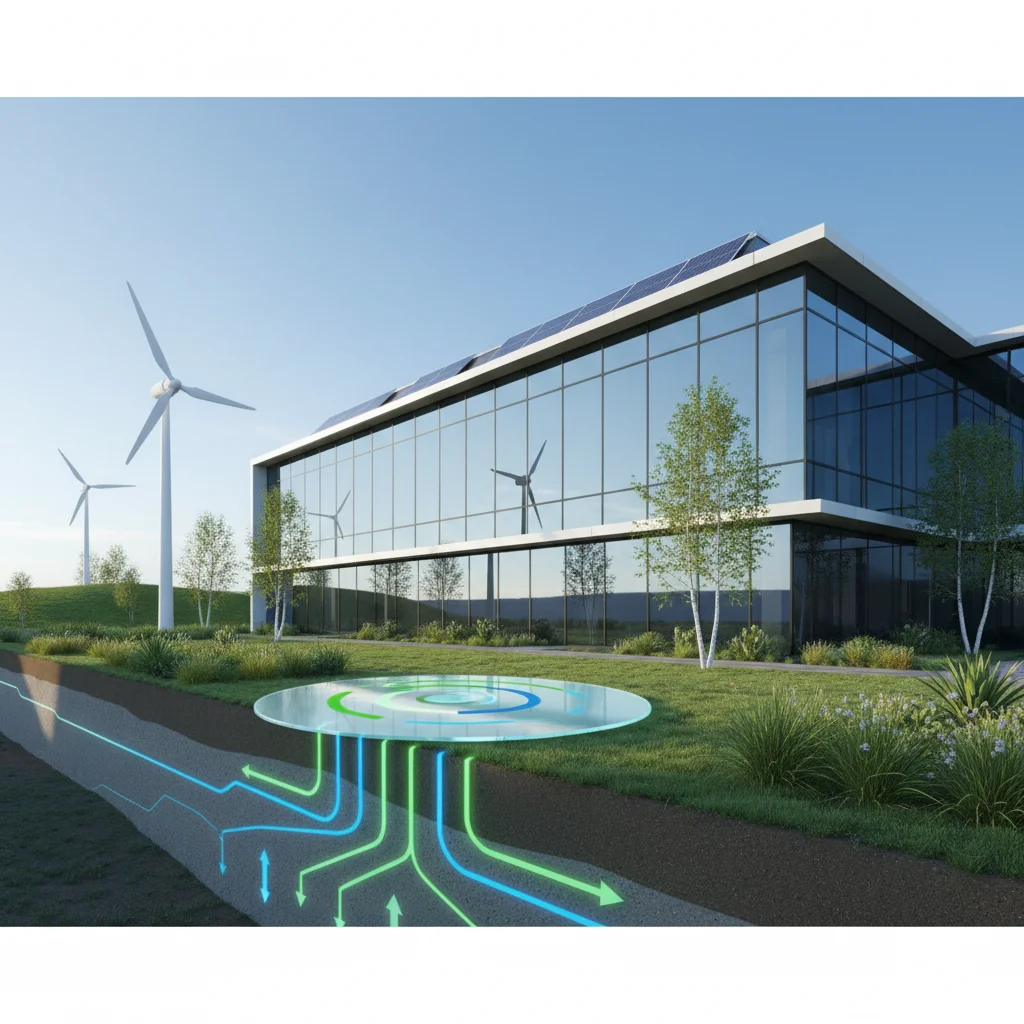
Commercial buildings waste $40 billion annually on heating and cooling costs that geothermal systems cut by 30-50%. The federal home energy tax credits (Sections 25C and 25D) ended for projects completed after December 31, 2025 (IRS FS-2025-05). Federal tax credits for this work have ended, but state, local and utility rebates may still apply; check what is available at your address with the DuloCore rebate calculator.
What's the ROI and payback period for geothermal systems in commercial buildings?
Commercial geothermal systems deliver 300-600% efficiency ratings and payback periods between 5-10 years for most installations. A 50,000-square-foot office building saves $15,000-$30,000 annually on energy costs. The IRA provides 30% federal investment tax credits through 2032, reducing upfront capital by $150,000-$300,000 on typical $500,000-$1,000,000 installations. Buildings with high heating and cooling demands—like hospitals, schools, and multi-tenant offices—see faster returns of 4-6 years.
"Geothermal heat pumps are the most energy-efficient, environmentally clean, and cost-effective space conditioning systems available." — U.S. Department of Energy
And maintenance costs drop 25-50% compared to rooftop units or boilers. So buildings in extreme climates—both hot and cold—achieve the strongest ROI because geothermal systems eliminate the need for separate heating and cooling equipment. But the payback calculation depends on local utility rates, which vary from $0.08 to $0.30 per kWh across U.S. markets.
How does geothermal compare to other commercial heating and cooling alternatives?
Geothermal systems cost $20-$30 per square foot installed versus $10-$15 for conventional rooftop units. But operational savings over 20 years total $300,000-$600,000 for a 50,000-square-foot building. Traditional gas boilers and electric chillers consume 3-5 times more energy per ton of heating or cooling delivered. And geothermal loops require no combustion, eliminating natural gas hookups and reducing insurance premiums by 10-15% in some markets.
Air-source heat pumps cost less upfront at $12-$18 per square foot but deliver only 200-300% efficiency versus geothermal's 400-600%. Or VRF (variable refrigerant flow) systems offer zoning flexibility but still rely on outdoor condensers that lose efficiency below 30°F. So geothermal eliminates weather-dependent performance swings entirely. Buildings in California see 12-year paybacks, while properties in Illinois or Massachusetts break even in 6-8 years due to higher heating loads and utility rates. Check your state's energy tax credits to compare total lifecycle costs.
What's the typical lifespan and long-term durability of commercial geothermal systems?
Geothermal ground loops last 50-100 years with zero maintenance beyond occasional fluid checks. Indoor heat pump equipment requires replacement every 20-25 years—double the lifespan of conventional rooftop units at 10-15 years. And loop fields remain functional indefinitely because buried polyethylene pipes don't corrode or degrade when installed 6-10 feet underground. So buildings with 30-year ownership horizons avoid multiple equipment replacement cycles.
"Ground-source heat pumps have a lifespan of 20-25 years for the indoor components and 50+ years for the ground loop." — EPA Energy Star Program
But ground loops in contaminated soil or unstable geology face risks of shifting or cracking. Or buildings with limited land area use vertical boreholes drilled 150-400 feet deep instead of horizontal trenches. So site assessments cost $5,000-$15,000 upfront but prevent $50,000-$100,000 in repairs later. Annual service contracts run $2,000-$4,000 versus $5,000-$8,000 for traditional HVAC systems.
What are the upfront costs and financing options for commercial geothermal installation?
Commercial geothermal systems cost $500,000-$2,000,000 installed depending on building size and loop configuration. A 50,000-square-foot office pays $1,000,000-$1,500,000 for a closed-loop horizontal system or $1,500,000-$2,000,000 for vertical boreholes in urban areas with limited space. And drilling costs account for 40-60% of total project expenses at $15-$30 per linear foot for vertical loops. So site conditions—soil type, bedrock depth, water table level—directly impact final pricing.
The federal Residential Clean Energy Credit (Section 25D) ended for expenditures made after December 31, 2025, and the IRS treats an expenditure as made when installation is completed (IRS FS-2025-05). Or C-PACE (Commercial Property Assessed Clean Energy) financing spreads costs over 15-25 years through property tax assessments with no money down. And many utilities offer $50,000-$200,000 rebates for commercial geothermal projects. Use our free rebate calculator to find your savings based on building type and location.
Energy service agreements (ESAs) allow third-party financing where developers install systems at no upfront cost and building owners pay a fixed monthly rate below current utility bills. But loan terms require 10-20 year commitments with early termination penalties of $50,000-$150,000.
Are commercial buildings eligible for tax credits and rebates on geothermal systems?
The federal Residential Clean Energy Credit (Section 25D) ended for expenditures made after December 31, 2025, and the IRS treats an expenditure as made when installation is completed (IRS FS-2025-05). The credit drops to 26% in 2033 and 22% in 2034 before expiring. And buildings must begin construction by December 31, 2034 to claim credits—installations can finish later. So a $1,000,000 system generates $300,000 in tax liability reduction.
State programs vary widely. California offers SGIP (Self-Generation Incentive Program) rebates of $0.50-$1.50 per watt for geothermal heat pumps paired with storage. Or New York's NYSERDA provides $200,000-$500,000 incentives for commercial retrofits. And Massachusetts utilities pay $150-$400 per ton of installed capacity. Check DSIRE for 2026 state and local programs.
But buildings using MACRS depreciation must reduce the depreciable basis by 50% of the IRA credit amount. Or tax-exempt nonprofits and government buildings can't use tax credits but qualify for direct-pay provisions starting in 2026. So schools, hospitals, and municipal facilities receive cash payments equal to 30% of project costs within 90 days of IRS filing.
What's the installation process and timeline for commercial geothermal projects?
Commercial geothermal installations take 6-18 months from design to commissioning. Site assessment and soil testing require 4-8 weeks to analyze thermal conductivity, groundwater levels, and bedrock depth. And engineering design adds 8-12 weeks for load calculations, loop sizing, and permit applications. So buildings in California with streamlined permitting finish faster than properties in jurisdictions requiring environmental impact studies.
Loop field installation takes 6-12 weeks depending on system type. Horizontal loops need 1-2 acres of open land and excavate trenches 6-10 feet deep using backhoes or trenchers. Or vertical boreholes drill 150-400 feet deep at 15-20 feet per hour, requiring 4-8 weeks for 20-40 holes on a 50,000-square-foot building. And indoor equipment installation adds 4-8 weeks for heat pump units, distribution piping, and controls integration.
Buildings remain operational during most installation phases. But final tie-ins require 3-5 day shutdowns for existing HVAC disconnection. And commissioning takes 2-4 weeks to verify performance, balance zones, and train facility staff. So schools typically install systems during summer break, while office buildings schedule work for evenings and weekends to minimize tenant disruption.
Official Sources
- DOE Geothermal Heat Pumps — Federal energy efficiency guidance and commercial system specifications
- DSIRE Commercial Incentives — State-by-state rebate and tax credit database for commercial properties (note: the federal 25C and 25D credits ended for projects completed after December 31, 2025)
- EPA Energy Star Commercial Buildings — Performance benchmarks and certification for commercial geothermal systems
Frequently Asked Questions
Do geothermal systems qualify for commercial building tax credits?
Yes. The federal Residential Clean Energy Credit (Section 25D) ended for expenditures made after December 31, 2025, and the IRS treats an expenditure as made when installation is completed (IRS FS-2025-05). The credit reduces to 26% in 2033 and 22% in 2034. Buildings must begin construction by December 31, 2034 to claim credits. Tax-exempt entities like schools and hospitals qualify for direct-pay cash equivalents starting in 2026.
How much can a commercial building owner save with a geothermal system?
A 50,000-square-foot office building saves $15,000-$30,000 annually on energy costs compared to conventional HVAC systems. And geothermal systems reduce operational expenses by $2-$4 per square foot with 300-600% efficiency ratings. Buildings in extreme climates achieve faster payback periods of 4-6 years versus 8-12 years in mild regions. Total lifecycle savings over 25 years reach $300,000-$750,000 for typical installations.
What is the installation process for geothermal heating in commercial buildings?
Installation takes 6-18 months from site assessment through commissioning. Site testing requires 4-8 weeks, engineering design adds 8-12 weeks, and loop field drilling or trenching takes 6-12 weeks. Indoor equipment installation adds 4-8 weeks. Buildings remain operational during most phases but require 3-5 day shutdowns for final HVAC tie-ins. Schools install during summer break while offices schedule work for evenings and weekends.
Are there specific deadlines for geothermal system installation to claim rebates?
Federal IRA tax credits require construction to begin by December 31, 2034, but installations can finish later. State and utility programs have annual funding cycles with deadlines between March and December for 2026 applications. California's SGIP operates on first-come funding until budgets deplete. New York's NYSERDA sets quarterly application windows. And many utilities require pre-approval before starting construction to lock in incentive rates.
How does geothermal compare to traditional HVAC systems for commercial properties?
Geothermal systems cost $20-$30 per square foot installed versus $10-$15 for conventional rooftop units. But operational savings total $300,000-$600,000 over 20 years for a 50,000-square-foot building. Traditional gas boilers and electric chillers consume 3-5 times more energy per ton delivered. Geothermal ground loops last 50-100 years versus 10-15 years for rooftop equipment, eliminating multiple replacement cycles over building lifespans.
Ready to calculate your commercial geothermal savings? Use our rebate calculator to estimate federal tax credits, state incentives, and annual energy cost reductions based on your building size and location. Get a detailed ROI analysis in under 2 minutes.
Updated: April 14, 2026 — fact-checked by DuloCore Research. About our editorial process.
Check your California heat pump rebate eligibility — see the programs you qualify for and the dollar amounts on our California heat pump rebate finder.