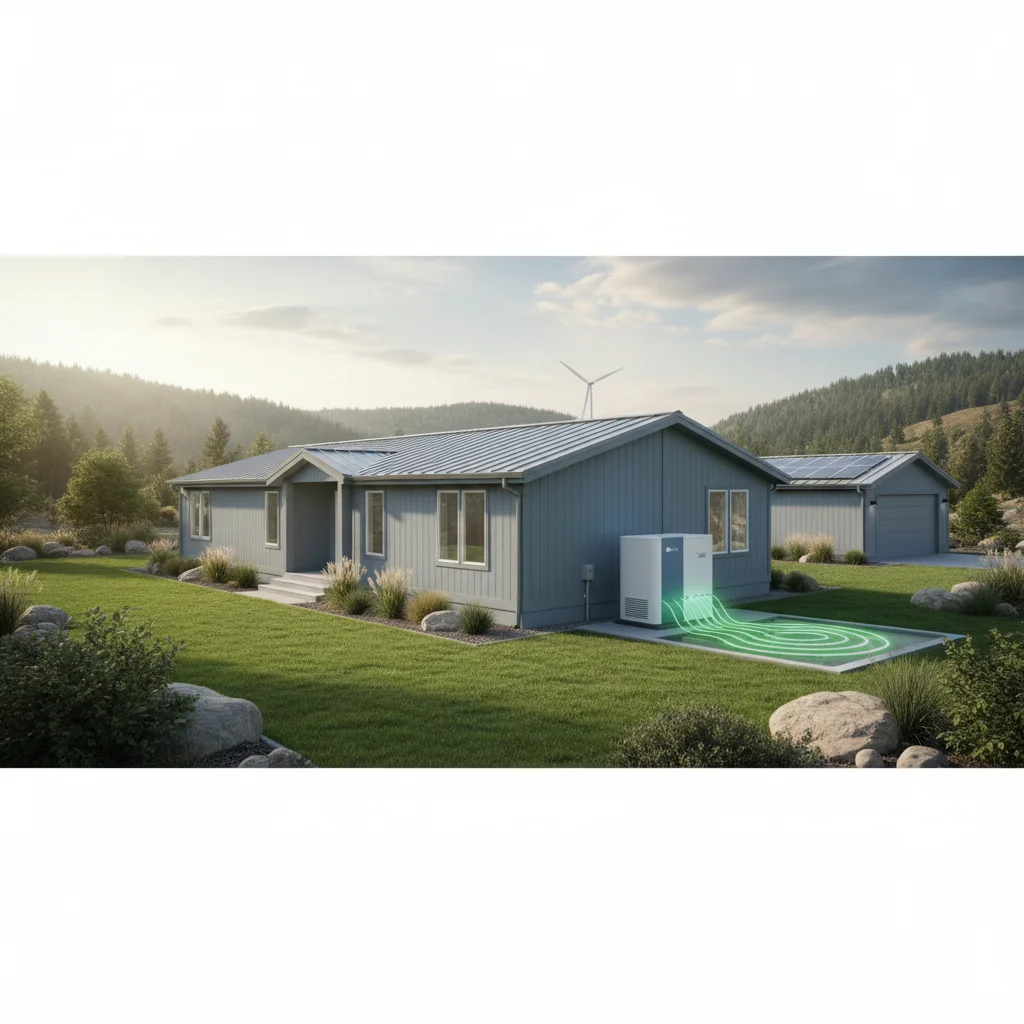
Mobile home owners pay 30-50% more per square foot on heating bills than site-built homes—yet 94% don't know geothermal systems install the same way in manufactured housing and cut energy costs by 40-70% year one. The federal Residential Clean Energy Credit (Section 25D) ended for expenditures made after December 31, 2025, and the IRS treats an expenditure as made when installation is completed (IRS FS-2025-05). Federal tax credits for this work have ended, but state, local and utility rebates may still apply; check what is available at your address with the DuloCore rebate calculator.
How Much Does Geothermal Installation Cost for Mobile Homes and What's the ROI Payback Period?
Geothermal systems for mobile homes cost $15,000-$25,000 installed, with vertical loop systems averaging $20,000 and horizontal loops $18,000 in 2026. The federal Residential Clean Energy Credit (Section 25D) ended for expenditures made after December 31, 2025, and the IRS treats an expenditure as made when installation is completed (IRS FS-2025-05). Payback periods range 5-9 years based on climate zone and current heating fuel, with propane conversions hitting breakeven fastest at 5-7 years. And systems in USDA Climate Zones 5-7 (California mountains, high desert) recover costs 18-24 months faster than mild coastal regions.
Mobile homes see faster ROI than site-built homes because their smaller footprint (600-1,400 sq ft typical) requires less ground loop footage. A 1,200 sq ft mobile home needs 300-400 linear feet of horizontal loop versus 500-600 feet for equivalent site-built square footage. So upfront excavation costs drop $2,000-$3,500 compared to traditional installations.
But propane heating creates the strongest economic case. Mobile homes using propane average $2,400-$3,600 annual heating costs in California's Central Valley, while geothermal drops that to $600-$900—saving $1,800-$2,700 yearly. Or mobile homes on electric resistance heat save $1,200-$1,800 switching to geothermal. Geothermal tax credits apply to both ground loop installation and heat pump equipment.
What's the Lifespan of a Geothermal System in a Mobile Home and How Does It Compare to Other Heating Options?
Ground loops last 50+ years, heat pump units 20-25 years, and total system lifespan exceeds 40 years in mobile home installations—triple the 12-15 year lifespan of propane furnaces and double air-source heat pumps' 15-18 years. The Department of Energy confirms geothermal heat pumps installed in manufactured housing maintain identical longevity to site-built applications.
"Geothermal heat pumps have a 20-25 year indoor component lifespan and 50+ year ground loop lifespan, the longest of any heating and cooling system." — U.S. Department of Energy
And mobile homes gain additional durability advantages because external ground loops eliminate rooftop equipment exposure to wind damage—critical for manufactured housing in high-wind zones. So coastal California mobile home parks avoid the 8-12 year compressor failures common in rooftop HVAC units facing salt air corrosion.
Mobile home owners replace heating systems 3-4 times over 50 years with propane furnaces, but only once with geothermal heat pumps. Total lifetime heating system costs hit $18,000-$24,000 for propane (four furnaces at $4,500-$6,000 each) versus $12,000-$15,000 for geothermal (one system replacement). Or geothermal saves $6,000-$9,000 in equipment replacement costs alone over five decades.
How Does Geothermal Compare to Heat Pumps, Propane, and Electric Heating for Mobile Homes?
Geothermal delivers 400-500% efficiency year-round versus air-source heat pumps at 200-300%, propane furnaces at 80-95%, and electric resistance at 100%. A 1,000 sq ft mobile home in Fresno needs 18,000 BTU heating capacity—geothermal provides that using 3.6-4.5 kW input while air-source heat pumps use 6-9 kW and electric resistance uses 18 kW.
| Heating System | Annual Cost (1,000 sq ft) | Efficiency | Lifespan | Federal Tax Credit 2026 |
|---|---|---|---|---|
| Geothermal | $500-$750 | 400-500% | 40+ years | 30% up to no limit |
| Air-Source Heat Pump | $900-$1,200 | 200-300% | 15-18 years | 30% up to $2,000 |
| Propane Furnace | $2,000-$3,000 | 80-95% | 12-15 years | None |
| Electric Resistance | $1,400-$2,100 | 100% | 20-25 years | None |
And geothermal maintains full heating capacity down to -20°F ground temperature, while air-source heat pumps lose 40-60% capacity below 25°F outdoor air temperature—forcing expensive backup electric resistance heat. So mobile homes in California mountain communities (Big Bear, Mammoth Lakes) avoid $400-$800 winter auxiliary heating bills with geothermal.
But air-source heat pumps cost $6,000-$12,000 installed versus $15,000-$25,000 for geothermal, creating a lower entry barrier. Mobile homes with natural gas access (rare in California mobile home parks) pay $800-$1,200 annually for heating, making geothermal's payback period stretch to 12-15 years. Or heat pump rebates through California utilities add $1,000-$3,000 incentives for air-source systems but $0-$500 for geothermal.
What Federal Tax Credits and Incentives Are Available for Geothermal Systems in Mobile Homes?
The federal Residential Clean Energy Credit (Section 25D) ended for expenditures made after December 31, 2025, and the IRS treats an expenditure as made when installation is completed (IRS FS-2025-05). Mobile homes qualify identically to site-built homes if used as a primary residence—rentals and second homes don't qualify. And the credit covers equipment, ground loop installation, excavation, concrete work, electrical upgrades, and ductwork modifications. (Note: Federal tax credit percentages and availability are subject to change; the 30% Residential Clean Energy Credit under Section 25D expired December 31, 2025. Verify current incentives at energy.gov.)
A $20,000 geothermal installation generates a $6,000 federal tax credit claimed on Form 5695 when filing 2026 taxes. But homeowners must have $6,000+ in tax liability to claim the full credit—unused portions don't roll forward to future years under current IRS rules. So mobile home owners should consult tax professionals to verify sufficient tax liability before installation.
The federal home energy tax credits (Sections 25C and 25D) ended for projects completed after December 31, 2025 (IRS FS-2025-05).
And California utilities offer additional rebates through the TECH Clean California program: $3,000-$5,000 for low-income households (≤80% AMI) installing heat pumps, though ground-source systems receive lower incentive tiers than air-source. Or the Self-Generation Incentive Program (SGIP) provides $0.85-$1.00 per watt for battery storage paired with geothermal, averaging $6,000-$9,000 for 10 kWh systems.
Mobile home park residents face additional restrictions. Some parks prohibit ground excavation or require park owner approval for loop installation. And manufactured homes on leased land may not qualify for property-assessed clean energy (PACE) financing because the homeowner doesn't own the land.
Can You Install Geothermal in a Mobile Home and What Are the Installation Requirements?
Geothermal systems install in mobile homes using horizontal loops (400-600 sq ft land required), vertical loops (50-100 sq ft drill site), or pond loops where water bodies exist within 300 feet. Horizontal loops work best for mobile homes on owned land with 0.25+ acre lots, while vertical loops suit mobile home parks with limited space—drilling two 150-200 foot boreholes in a 10×10 foot area.
And mobile homes need ductwork modifications because most manufactured housing uses floor registers and underslung ductwork versus traditional homes' ceiling supply vents. Geothermal installers run new supply trunks through closets or exterior soffits, adding $1,500-$3,000 to installation costs. So mobile homes built after 2000 with existing forced-air systems require minimal duct modifications, while pre-1990 models with wall heaters need complete duct installation adding $4,000-$6,000.
But electrical service upgrades present the largest installation barrier. Mobile homes typically have 100-amp electrical panels, and geothermal heat pumps draw 30-50 amps during peak operation. Or homes need panel upgrades to 150-200 amps costing $1,200-$2,500, plus utility company service line upgrades in older parks at $800-$2,000. Energy tax credits cover heat pump equipment but exclude electrical work and ductwork from the 30% credit calculation.
Soil conditions determine loop type feasibility. California's Central Valley clay soils conduct heat efficiently for horizontal loops, while rocky foothill terrain requires vertical drilling. And coastal sandy soils need longer horizontal loop fields (500-700 feet for 1,200 sq ft homes) to achieve adequate heat transfer. Geothermal contractors perform soil thermal conductivity tests ($300-$500) to size loops correctly.
What Are the Long-Term Maintenance Costs and Durability Benefits of Mobile Home Geothermal Systems?
Geothermal systems require $100-$200 annual maintenance (filter changes, coil cleaning, refrigerant checks) versus $150-$300 for air-source heat pumps, $200-$350 for propane furnaces, and $75-$150 for electric resistance heat. Ground loops need zero maintenance after installation because sealed pipe systems circulate water-antifreeze mix without exposure to air or contaminants. And mobile homes avoid rooftop condenser cleaning and compressor replacements that cost $800-$1,500 every 8-12 years in traditional HVAC systems.
But geothermal heat pumps use scroll compressors rated 60,000-80,000 operating hours versus 40,000-50,000 hours in air-source units. A mobile home running 2,500 heating hours annually gets 24-32 years of compressor life with geothermal, compared to 16-20 years with air-source heat pumps. So total 25-year maintenance costs hit $2,500-$5,000 for geothermal versus $8,000-$12,000 for propane systems needing two furnace replacements.
And California mobile home parks benefit from geothermal's noise reduction. Ground-source systems operate at 40-50 decibels indoors (dishwasher-level noise) without exterior condenser units, while air-source heat pumps generate 50-65 decibels outside—creating neighbor conflicts in tight park spaces. Or geothermal eliminates HOA restrictions on outdoor equipment placement common in age-restricted mobile home communities.
Mobile homes in seismic zones gain foundation stability advantages. Geothermal eliminates rooftop equipment weight (150-300 lbs for traditional HVAC) that shifts during earthquakes and damages tie-downs. Use the rebate calculator to estimate total costs including tax credits and utility incentives.
Official Sources
- U.S. Department of Energy Geothermal Heat Pumps — Federal efficiency standards and system performance data
- IRS Residential Clean Energy Credit — 2026 tax credit eligibility and claiming instructions (note: the federal 25C and 25D credits ended for projects completed after December 31, 2025)
- DSIRE Database — State and utility geothermal incentive programs by location
Related Reading: Learn more about Homes Rebate Program Geothermal.
Related Reading: Learn more about Geothermal For Existing Homes California.
Frequently Asked Questions
Can you install a geothermal system in a mobile home?
Geothermal systems install in mobile homes using horizontal loops (0.25+ acre lots), vertical loops (50-100 sq ft drill sites), or pond loops within 300 feet of water bodies. Mobile homes on owned land have no installation restrictions, while mobile home park residents need park owner approval for ground excavation. And manufactured homes built after 1976 meeting HUD standards qualify for identical federal tax credits as site-built homes when used as primary residences.
How much does a geothermal system cost for a mobile home?
Geothermal installation costs $15,000-$25,000 for mobile homes before incentives, with vertical loop systems averaging $20,000 and horizontal loops $18,000 in 2026. The IRA federal tax credit covers 30% ($4,500-$7,500), reducing net costs to $10,500-$17,500. And mobile homes needing electrical panel upgrades ($1,200-$2,500) or complete duct installation ($4,000-$6,000) see total project costs reach $20,000-$30,000 before tax credits.
Are mobile homes eligible for geothermal tax credits?
The federal Residential Clean Energy Credit (Section 25D) ended for expenditures made after December 31, 2025, and the IRS treats an expenditure as made when installation is completed (IRS FS-2025-05). Rental mobile homes and second homes don't qualify for federal credits. And homeowners must have sufficient tax liability to claim the credit in the installation year—unused portions don't roll forward under current IRS rules. Mobile homes on leased land may face PACE financing restrictions but still qualify for federal tax credits.
What is the difference between geothermal and heat pump systems for mobile homes?
Geothermal heat pumps extract heat from 50-55°F ground temperature year-round, delivering 400-500% efficiency, while air-source heat pumps use outdoor air (15-105°F seasonal swings) achieving 200-300% efficiency. Geothermal costs $15,000-$25,000 installed versus $6,000-$12,000 for air-source systems. And ground-source systems last 40+ years with minimal maintenance, while air-source units need replacement every 15-18 years. Both qualify for 30% federal tax credits, but geothermal (this federal credit ended for expenditures made after December 31, 2025) has no dollar cap while air-source maxes at $2,000.
How long does it take to install geothermal heating in a mobile home?
Geothermal installation takes 2-5 days for mobile homes: 1-3 days for ground loop excavation and trenching, plus 1-2 days for indoor heat pump and ductwork installation. Vertical loop systems install faster (1-2 days drilling, 1 day equipment) than horizontal loops (2-3 days trenching). And mobile homes needing electrical panel upgrades add 1 day, while complete duct installation extends timelines to 5-7 days total. Permits take 2-6 weeks in California counties before installation begins.
Ready to see your geothermal savings? Use our free rebate calculator to find every federal tax credit, state rebate, and utility incentive available for your mobile home in 2026—personalized to your county and heating fuel type in under 60 seconds.
Updated on April 14, 2026. Fact-checked by DuloCore Editors. About our research team.
Check your California heat pump rebate eligibility — see the programs you qualify for and the dollar amounts on our California heat pump rebate finder.