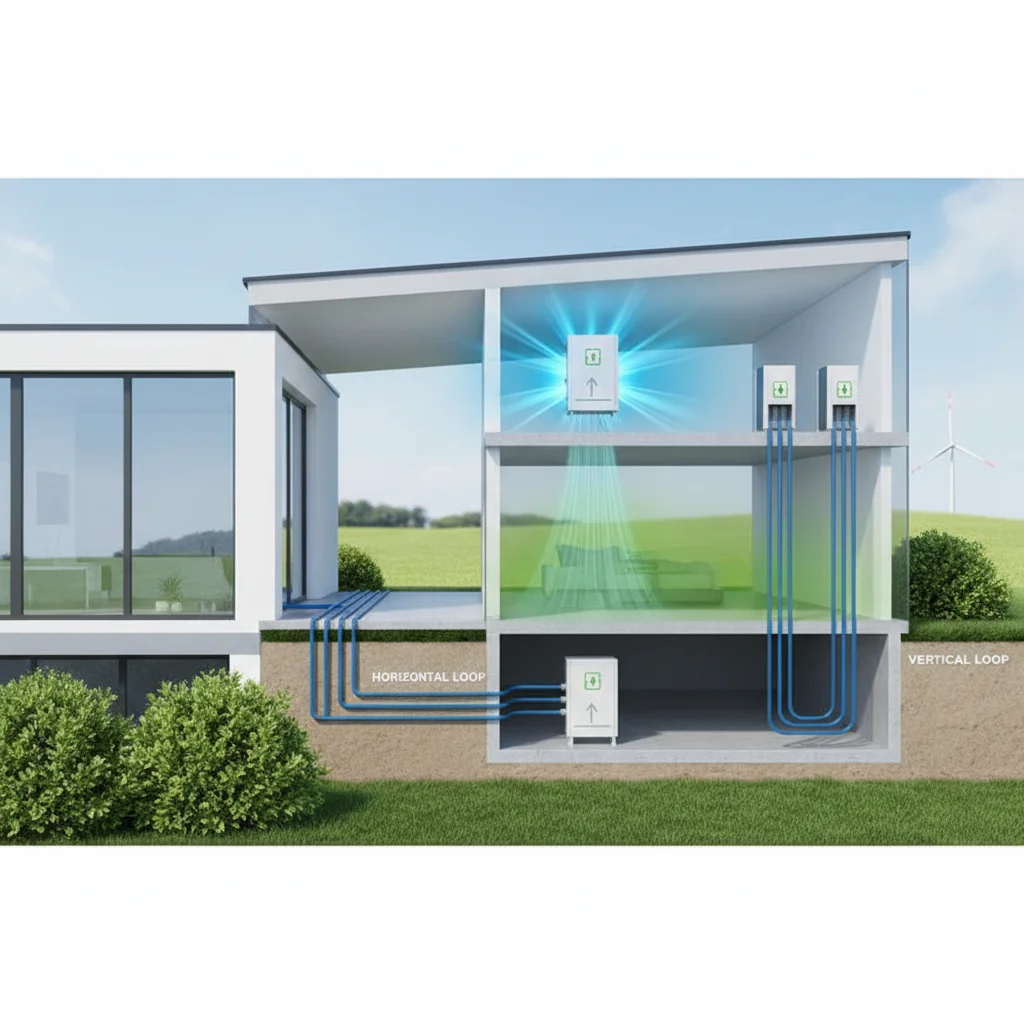
The federal Residential Clean Energy Credit (Section 25D) ended for expenditures made after December 31, 2025, and the IRS treats an expenditure as made when installation is completed (IRS FS-2025-05). Federal tax credits for this work have ended, but state, local and utility rebates may still apply; check what is available at your address with the DuloCore rebate calculator. And the choice between horizontal, vertical, pond, or open-loop systems determines not just upfront costs ranging from $10,000 to $30,000, but also efficiency ratings that vary by 15-25% depending on soil composition and water table depth.
What Are the Main Types of Geothermal Heat Pumps and How Do They Compare?
Geothermal heat pumps extract heat from the ground using four primary loop configurations: horizontal closed-loop systems buried 4-6 feet deep across 1,500-3,000 square feet, vertical closed-loop systems drilled 150-400 feet into the ground on properties with limited land, pond closed-loop systems submerged 8-12 feet below water surfaces, and open-loop systems that pump groundwater directly through heat exchangers before returning it to aquifers.
Horizontal loops cost $10,000-$20,000 and require 0.25-0.5 acres of land for installation. Vertical loops cost $20,000-$30,000 but need only 400-500 square feet of land area because contractors drill multiple boreholes 20 feet apart. Pond systems cost $12,000-$22,000 when homeowners own waterfront property with sufficient depth year-round. Open-loop systems cost $8,000-$15,000 but depend on consistent groundwater availability and local discharge regulations.
And soil conditions affect performance across all types. Clay soils with high moisture content transfer heat 30% more efficiently than dry sandy soils. But rocky terrain increases vertical drilling costs by $3,000-$8,000 because specialized equipment is needed to penetrate bedrock formations.
So homeowners in suburban areas with 0.5+ acres typically install horizontal loops, while urban properties under 0.25 acres require vertical systems. Properties adjacent to lakes or ponds save $5,000-$10,000 by using existing water bodies instead of excavating trenches or drilling boreholes.
How Much Does Each Geothermal Heat Pump Type Cost to Install?
Closed-loop horizontal systems cost $10,000-$20,000 for 2,000-square-foot homes, including excavation of 400-600 feet of trenches, HDPE pipe installation, and heat pump equipment rated at 3-5 tons capacity. Closed-loop vertical systems cost $20,000-$30,000 because drilling companies charge $10-$15 per foot for boreholes reaching 150-400 feet deep through soil and bedrock.
Pond systems cost $12,000-$22,000 when homeowners already own waterfront property, saving $4,000-$8,000 on excavation compared to horizontal trenching. Open-loop systems cost $8,000-$15,000 but require two wells drilled 50-200 feet deep for water extraction and return, plus compliance with state groundwater discharge permits.
"Geothermal heat pump systems cost $2,500 per ton of capacity on average, with installation labor accounting for 40-50% of total project costs." — U.S. Department of Energy
And regional labor rates affect final costs by 25-40%. Contractors in California's Bay Area charge $80-$120 per hour compared to $50-$70 per hour in Central Valley markets. The federal Residential Clean Energy Credit (Section 25D) ended for expenditures made after December 31, 2025, and the IRS treats an expenditure as made when installation is completed (IRS FS-2025-05).
So a $25,000 vertical loop system drops to $17,500 after claiming the 30% IRA federal credit. California homeowners can stack this with heat pump rebates from utilities offering $1,000-$3,000 for high-efficiency geothermal installations rated above 20 SEER2. (Note: Federal tax credit percentages and availability are subject to change; the 30% Residential Clean Energy Credit under Section 25D expired December 31, 2025. Verify current incentives at energy.gov.)
What's the ROI Payback Period for Different Geothermal Heat Pump Systems?
Geothermal heat pump systems achieve payback periods of 5-10 years depending on installation costs, energy savings, and available incentives. Horizontal closed-loop systems in moderate climates reach payback in 7-9 years because $10,000-$20,000 upfront costs are offset by $1,800-$2,500 annual savings on heating and cooling bills.
Vertical systems reach payback in 8-10 years despite higher $20,000-$30,000 installation costs because efficiency ratings of 400-500% COP deliver $2,200-$3,000 annual energy savings compared to natural gas furnaces and central air conditioning. And colder climates accelerate payback to 5-7 years when heating degree days exceed 5,000 annually because geothermal systems replace expensive propane or oil heating costing $3,000-$5,000 per year.
But warmer climates like Southern California see payback periods stretch to 10-12 years because heating demand drops below 2,000 degree days annually, reducing energy savings to $1,200-$1,800 per year. So homeowners in Sacramento with 3,000 heating degree days and $2,400 annual HVAC costs reach payback in 6-7 years after federal credits.
Open-loop systems achieve the fastest payback of 4-6 years when groundwater is readily available because $8,000-$15,000 installation costs are lower than closed-loop alternatives. But maintenance costs for well pumps and water filtration systems add $200-$400 annually, extending payback by 6-12 months compared to closed-loop configurations requiring minimal maintenance.
For help estimating your specific payback timeline, use our free rebate calculator to model installation costs and available incentives.
How Long Do Different Geothermal Heat Pump Types Last?
Geothermal heat pump indoor units last 20-25 years before requiring replacement, while ground loop systems last 50+ years when installed with high-density polyethylene pipe rated for underground use. And horizontal closed-loop systems installed 4-6 feet deep avoid frost heave damage in cold climates, extending lifespan to 50-75 years without excavation or repair.
Vertical loop boreholes last 75-100 years because sealed HDPE pipe buried 150-400 feet underground remains protected from surface freeze-thaw cycles, UV degradation, and mechanical damage. But open-loop systems require well pump replacements every 8-12 years at costs of $800-$1,500 because submersible pumps wear out from continuous groundwater circulation.
"Ground loop heat exchangers have expected lifespans exceeding 50 years, significantly outlasting conventional HVAC systems that require replacement every 15-20 years." — ENERGY STAR
So homeowners who install geothermal systems in 2026 can expect the ground loops to remain functional until 2076-2126, while indoor heat pump units require replacement 2-3 times over the same period. And manufacturers like WaterFurnace and ClimateMaster offer 10-year compressor warranties and 5-year parts warranties covering heat pump components.
But water quality affects open-loop system longevity because groundwater with dissolved minerals or sand accelerates heat exchanger corrosion, reducing lifespan to 15-20 years without annual maintenance including acid cleaning and filter replacements costing $300-$600 per service visit.
Which Geothermal Heat Pump Type Offers the Best Efficiency Ratings?
Vertical closed-loop geothermal heat pumps achieve the highest efficiency ratings of 400-500% COP (Coefficient of Performance) because deep boreholes access stable ground temperatures of 50-60°F year-round, regardless of outdoor air temperatures ranging from 10°F to 110°F. And systems rated at 20-30 SEER2 cooling and 10-12 HSPF2 heating deliver 3-5 times more energy output per kWh of electricity consumed compared to conventional air-source heat pumps rated at 15 SEER2 and 8 HSPF2.
Horizontal closed-loop systems achieve 350-450% COP efficiency because shallow burial depths of 4-6 feet expose pipes to seasonal ground temperature fluctuations of 40-70°F, reducing heat transfer efficiency by 10-15% compared to vertical systems accessing constant deep-earth temperatures. But horizontal loops still outperform air-source heat pumps by 250-300% when soil moisture content remains consistent throughout the year.
Pond systems achieve 400-480% COP efficiency when water depths exceed 8-12 feet below the freeze line, matching vertical loop performance at 30-40% lower installation costs. Open-loop systems achieve the highest instantaneous efficiency of 450-550% COP because groundwater pumped directly through heat exchangers maintains constant 50-55°F temperatures without thermal lag from buried pipe loops.
So homeowners prioritizing maximum efficiency should install vertical or open-loop systems achieving 400-550% COP. And ENERGY STAR certified geothermal heat pumps must achieve minimum ratings of 17.1 EER cooling, 3.6 COP heating, and 21 SEER2 total efficiency to qualify for federal tax credits and utility rebates.
What Rebates and Tax Credits Are Available for Geothermal Heat Pumps in California?
The federal IRA energy tax credits provide 30% of installation costs up to unlimited amounts for geothermal heat pump systems installed through December 31, 2032. And California homeowners installing systems costing $20,000 claim $6,000 federal credits directly on Form 5695 filed with 2026 tax returns, reducing net project costs from $20,000 to $14,000.
California utilities offer additional rebates of $1,000-$3,000 for ENERGY STAR certified geothermal heat pumps rated above 20 SEER2 and 10 HSPF2. PG&E customers receive $2,500 rebates for whole-home geothermal installations replacing natural gas furnaces and central air conditioning. Southern California Edison offers tiered incentives of $1,000-$2,000 based on system efficiency ratings and square footage served.
The federal Residential Clean Energy Credit (Section 25D) ended for expenditures made after December 31, 2025, and the IRS treats an expenditure as made when installation is completed (IRS FS-2025-05).
But income-qualified households earning 80-150% of area median income can access additional support through California's TECH Clean California program offering $3,000-$5,000 incentives for heat pump installations. And low-income households below 80% AMI qualify for $6,000-$10,000 incentives covering 50-80% of total project costs through the state's Equity and Resilience Electrification program.
So Sacramento homeowners installing a $22,000 geothermal system claim $6,600 federal credit plus $2,500 utility rebate, reducing net costs to $12,900 for 40% total savings. Local municipalities including San Francisco and San Jose offer additional property tax exemptions for renewable energy installations, preventing geothermal systems from increasing assessed home values and property taxes for 10-20 years.
For more details on available programs, check the official geothermal tax credit requirements and use our calculator to estimate your total savings.
Official Sources
- U.S. Department of Energy Geothermal Heat Pumps — Federal technical guidance on system types, efficiency ratings, and installation best practices.
- ENERGY STAR Heat Pumps — Certification requirements and qualified product database for federal tax credit eligibility. (note: the federal 25C and 25D credits ended for projects completed after December 31, 2025)
- DSIRE USA — Comprehensive database of state and utility rebate programs updated quarterly with current incentive amounts and deadlines.
Frequently Asked Questions
What are the different types of geothermal heat pumps?
Geothermal heat pumps use four primary configurations: horizontal closed-loop systems buried 4-6 feet deep across 0.25-0.5 acres costing $10,000-$20,000, vertical closed-loop systems drilled 150-400 feet into boreholes costing $20,000-$30,000, pond systems submerged 8-12 feet in existing water bodies costing $12,000-$22,000, and open-loop systems pumping groundwater directly through heat exchangers costing $8,000-$15,000 when wells and discharge permits are available.
How much does a geothermal heat pump cost compared to other systems?
Geothermal heat pumps cost $10,000-$30,000 installed depending on loop type, compared to $5,000-$10,000 for conventional air-source heat pumps and $4,000-$8,000 for natural gas furnace and AC combinations. But federal tax credits covering 30% of geothermal costs reduce net expenses to $7,000-$21,000, and annual energy savings of $1,800-$3,000 achieve payback in 5-10 years compared to 15-20+ years for conventional HVAC systems.
Are geothermal heat pumps eligible for tax credits or rebates?
Geothermal heat pumps qualify for federal IRA tax credits covering 30% of installation costs through 2032 with no maximum dollar limit, plus California utility rebates of $1,000-$3,000 for ENERGY STAR certified systems. Income-qualified households below 150% area median income receive additional state incentives of $3,000-$10,000 through TECH Clean California and Equity Electrification programs. Property tax exemptions in cities like San Francisco prevent geothermal installations from increasing assessed home values for 10-20 years.
How long does it take to install a geothermal heat pump system?
Horizontal closed-loop installations require 2-5 days for excavation, pipe installation, and backfilling across 0.25-0.5 acres. Vertical systems take 3-7 days because drilling contractors bore 3-6 holes reaching 150-400 feet deep at rates of 50-100 feet per day. Pond installations complete in 1-3 days when coils are placed in existing water bodies. Open-loop systems take 3-5 days for drilling two wells 50-200 feet deep, installing pumps, and connecting heat exchangers to indoor units.
What is the difference between closed-loop and open-loop geothermal systems?
Closed-loop systems circulate antifreeze solution through sealed HDPE pipes buried horizontally 4-6 feet deep, vertically 150-400 feet deep, or submerged 8-12 feet in ponds, costing $10,000-$30,000 with 50+ year loop lifespans. Open-loop systems pump groundwater directly from wells through heat exchangers before returning it to aquifers, costing $8,000-$15,000 but requiring well pump replacements every 8-12 years and compliance with state discharge permits. Closed-loop systems work everywhere, while open-loop systems need sufficient groundwater availability of 3-5 gallons per minute per ton of capacity.
Ready to calculate your geothermal savings? Use our free rebate calculator to estimate installation costs, federal tax credits, utility rebates, and energy savings for your specific home and climate zone. Get personalized results in 60 seconds showing payback period and total lifetime savings compared to conventional HVAC systems.
Last updated: April 14, 2026. Reviewed by the DuloCore Editorial Team. About our authors.
Check your California heat pump rebate eligibility — see the programs you qualify for and the dollar amounts on our California heat pump rebate finder.