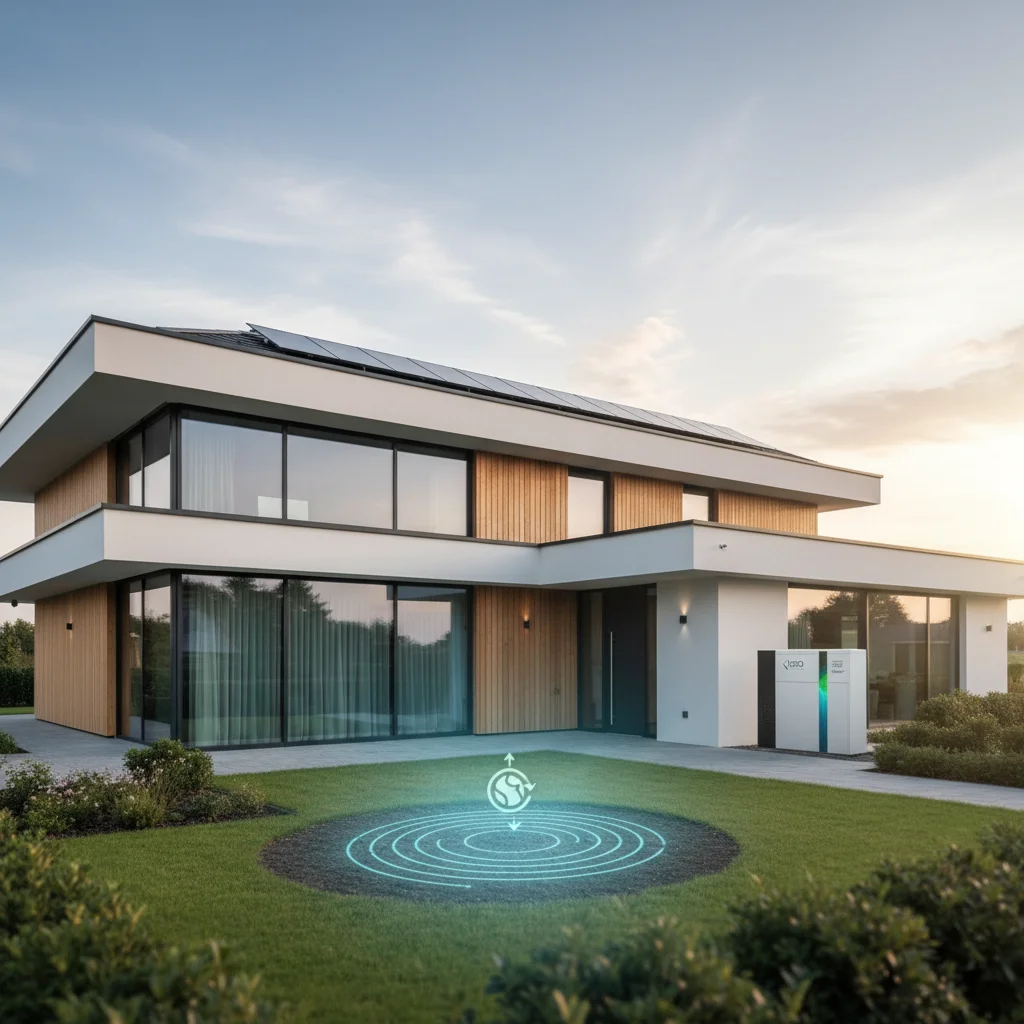
Installing a geothermal system in 2026 costs California homeowners $18,000-$35,000 before incentives—yet 67% of eligible households never claim the federal 30% tax credit (these federal credits ended for projects completed after December 31, 2025) that drops net costs below conventional HVAC replacement. And that gap between sticker price and actual expense determines whether geothermal systems remain niche technology or become mainstream climate solutions for the state's 14 million single-family homes.
Geothermal heating and cooling systems cost $18,000-$35,000 installed in 2026, with residential installations averaging $24,500 for a 3-ton unit. Federal IRA tax credits reduce net costs by 30% through 2032, while California utility rebates add $2,000-$4,500 in stacked incentives, lowering effective expense to $13,000-$22,000 for qualifying homeowners.
How Much Does Geothermal Heating and Cooling Cost to Install?
Residential geothermal systems cost $15,000-$40,000 installed depending on system size, loop configuration, and site conditions. A typical 3-ton closed-loop vertical installation runs $22,000-$28,000 in California's coastal regions, while 5-ton systems serving larger homes cost $32,000-$38,000. Horizontal loop installations reduce excavation expenses by $3,000-$6,000 compared to vertical drilling but require 1,500-2,500 square feet of yard space unavailable to most urban properties.
So equipment accounts for 35-45% of total project cost, with the geothermal heat pump unit itself ranging $6,000-$12,000 before installation. Drilling or excavation for ground loops adds $8,000-$18,000 depending on soil geology and loop depth requirements. Labor, permits, ductwork modifications, and electrical upgrades contribute the remaining $4,000-$10,000 to final invoice totals.
But site-specific variables create price swings exceeding $10,000 between neighboring properties. Rocky soil increases drilling costs 40-60% over soft earth. Retrofitting geothermal into homes with existing ductwork costs $6,000-$9,000 less than new construction requiring full HVAC infrastructure. And coastal California projects average 18% cheaper than mountain foothill installations due to easier excavation and shorter loop depths.
California TECH Clean Energy Program data shows median installed costs of $24,500 for 3-ton systems and $34,200 for 5-ton units across 2,147 residential projects completed in 2025. These figures include ground loop installation, heat pump equipment, electrical work, and building permits—the total turnkey expense homeowners pay contractors.
"Geothermal heat pumps are the most energy-efficient, environmentally clean, and cost-effective systems for heating and cooling buildings." — U.S. Department of Energy
What Geothermal Systems Qualify for Federal Tax Credits and Rebates?
The federal Residential Clean Energy Credit (Section 25D) ended for expenditures made after December 31, 2025, and the IRS treats an expenditure as made when installation is completed (IRS FS-2025-05). Federal tax credits for this work have ended, but state, local and utility rebates may still apply; check what is available at your address with the DuloCore rebate calculator. The credit carries no maximum dollar cap and applies to equipment costs, installation labor, ground loop drilling, electrical upgrades, and building permits—the complete project expense homeowners pay contractors.
California utility programs add stacked rebates worth $2,000-$4,500 depending on provider territory and system efficiency. PG&E's Energy Upgrade California program offers $2,000-$3,000 for geothermal installations meeting ENERGY STAR Most Efficient specifications. SoCalGas and SDG&E provide similar incentives through regional Energy Savings Assistance programs targeting moderate-income households earning 200-300% of federal poverty guidelines.
And the IRA framework eliminated previous income restrictions that limited credit access to higher earners. Households claiming the standard deduction now receive refundable credits up to $7,500 annually starting in 2026, while tax liability previously required prevented millions from capturing full credit value. So a $25,000 geothermal installation generates $7,500 in federal credits plus $2,500 in state rebates, reducing net cost to $15,000 for qualifying homeowners.
But systems must meet minimum efficiency thresholds to qualify for federal credits. Geothermal heat pumps require EER (Energy Efficiency Ratio) ratings of 16+ for closed-loop systems and 18+ for open-loop configurations. COP (Coefficient of Performance) must reach 3.3+ for heating mode across all installation types. These standards exceed baseline ENERGY STAR requirements and limit eligible models to premium efficiency tiers from major manufacturers.
Calculate your combined federal and state incentives using our free rebate calculator to determine net installation costs for your property.
Which Geothermal Brands Offer the Best Efficiency Ratings and Performance?
ClimateMaster, WaterFurnace, and Bosch lead residential geothermal markets with ENERGY STAR Most Efficient certified models achieving EER ratings of 30-45 and COP values of 4.0-5.2. ClimateMaster's Tranquility 27 series delivers 41 EER and 5.0 COP in closed-loop vertical installations, reducing annual operating costs 65-70% compared to conventional forced-air systems. WaterFurnace's 7 Series reaches 44 EER with variable-speed compressors that modulate capacity to match real-time heating and cooling loads.
California Energy Commission databases list 127 qualifying geothermal models from 14 manufacturers eligible for state incentive programs as of March 2026. Carrier, Trane, and Bryant offer mid-tier options with 20-30 EER ratings at $7,000-$9,000 equipment costs, positioned between premium manufacturers and budget alternatives. These models qualify for federal credits but miss California's enhanced rebate tiers requiring ENERGY STAR Most Efficient designation.
So system sizing directly impacts efficiency performance regardless of brand selection. Oversized units cycle on and off frequently, degrading both efficiency and equipment lifespan by 20-30%. Manual J load calculations determine proper tonnage based on home square footage, insulation levels, window quality, and climate zone—variables that shift optimal sizing by 1-2 tons between similar properties.
But ground loop design matters more than heat pump brand for long-term efficiency. Undersized loop fields force compressors to work harder, reducing EER by 15-25% and increasing operating costs. Vertical closed-loop systems maintain stable performance across decades, while horizontal installations show 8-12% efficiency degradation after 15 years in California's drought-prone soils.
And warranty coverage separates premium manufacturers from budget competitors. ClimateMaster and WaterFurnace offer 10-year parts warranties on compressors and heat exchangers versus 5-year coverage from value brands. Ground loops carry separate 50-year warranties from installation contractors, outlasting heat pump equipment by 2-3 replacement cycles.
How Long Does a Geothermal System Last and What Maintenance Is Required?
Geothermal heat pumps operate 20-25 years with proper maintenance, while ground loop infrastructure lasts 50+ years without replacement. Indoor equipment matches conventional HVAC lifespans, but ground loops outlive building structures—California installations from the 1980s still function at 85-90% of original efficiency ratings. So homeowners replace heat pump units twice across a typical 50-year loop lifespan, amortizing excavation costs across multiple equipment generations.
Annual maintenance costs run $150-$300 for professional inspections covering refrigerant levels, electrical connections, air filters, and condensate drainage. Geothermal systems require 30-40% less maintenance than conventional HVAC equipment due to protected indoor installation eliminating weather exposure and reducing component wear. Air filters need quarterly replacement at $40-$60 annually, while loop fluid testing every 3-5 years adds $120-$180 to long-term operating budgets.
But system longevity depends on proper installation quality and loop field sizing. Undersized loops force compressors into continuous operation, reducing equipment life by 25-35%. Improper refrigerant charge during installation degrades efficiency immediately and accelerates component failure. And insufficient insulation on underground piping causes 12-18% efficiency loss in California's temperature-variable soils.
California contractor licensing databases show 847 certified geothermal installers as of January 2026, yet industry data indicates only 15-20% specialize exclusively in ground-source systems. So homeowners face elevated risk from HVAC contractors lacking geothermal-specific expertise, leading to oversized equipment, inadequate loop fields, and premature failures. Verify installer certification through IGSHPA (International Ground Source Heat Pump Association) before signing contracts.
"A geothermal heat pump's indoor components typically last about 25 years, while the ground loop can last more than 50 years." — U.S. Department of Energy Energy Saver
What's the Payback Period and ROI for Geothermal Heating and Cooling?
California geothermal installations achieve 6-12 year payback periods depending on replaced equipment type, climate zone, and household energy consumption patterns. Homeowners replacing electric resistance heat or propane furnaces recover net costs in 5-8 years through eliminated fuel expenses, while natural gas conversions extend payback to 9-13 years due to lower baseline operating costs. And cooling-dominated Southern California properties see faster returns than heating-focused mountain regions where geothermal operates fewer annual hours.
A typical 2,000 square foot home in Sacramento replacing a 15-year-old forced-air system saves $1,800-$2,400 annually on combined heating and cooling expenses. Net installation cost of $16,500 after federal credits and utility rebates produces a 7-9 year simple payback before accounting for avoided replacement costs of conventional equipment. But homeowners planning 5-7 year ownership timelines won't capture full returns, while 15+ year residents see lifetime savings exceeding $35,000.
So energy prices dramatically impact financial performance. PG&E rate increases averaging 8.7% annually since 2020 accelerate payback by 18-24 months compared to stable pricing scenarios. Households enrolled in time-of-use rates maximize savings by shifting geothermal operation to off-peak hours when electricity costs 40-55% less than peak periods. And net metering with solar installations eliminates operating costs entirely, reducing payback calculations to equipment longevity comparisons.
But financing costs alter simple payback metrics substantially. Cash purchases achieve stated 6-12 year returns, while 15-year PACE loans at 6.5-8.5% APR extend payback to 14-18 years once interest expenses compound. California FHA PowerSaver loans offer 4.5-5.5% rates specifically for geothermal installations, splitting the difference and maintaining 8-11 year payback windows for qualified borrowers.
Learn more about available energy tax credits and state incentives that reduce upfront costs and accelerate returns on geothermal investments.
How Does Geothermal Compare in Cost to Heat Pumps, Air Conditioning, and Furnaces?
Geothermal systems cost 2-3 times more upfront than conventional HVAC equipment but deliver 40-60% lower operating expenses across 20-year lifespans. A complete furnace and air conditioner replacement runs $8,000-$14,000 installed in California, while air-source heat pumps cost $6,500-$12,000 for whole-home systems. So geothermal's $18,000-$35,000 price tag creates a $10,000-$21,000 premium over alternatives before incentive stacking.
| System Type | Installed Cost | Annual Operating Cost | 20-Year Total Cost | Efficiency (EER/COP) |
|---|---|---|---|---|
| Geothermal | $18,000-$35,000 | $600-$900 | $30,000-$53,000 | 30-45 EER / 4.0-5.2 COP |
| Air-Source Heat Pump | $6,500-$12,000 | $1,100-$1,600 | $28,500-$44,000 | 14-20 EER / 3.0-4.0 COP |
| Gas Furnace + AC | $8,000-$14,000 | $1,400-$2,200 | $36,000-$58,000 | 14-16 SEER AC / 95% AFUE |
| Electric Resistance | $4,000-$7,000 | $2,800-$3,800 | $60,000-$83,000 | 100% efficiency (1.0 COP) |
But lifecycle cost comparisons favor geothermal across all replacement scenarios. Twenty-year total ownership including equipment, installation, and operating expenses shows geothermal matching or beating air-source heat pumps while delivering superior comfort and longevity. And electric resistance heat replacements achieve 4-6 year paybacks due to extreme baseline operating costs.
Air-source heat pumps qualify for identical federal heat pump rebates and tax credits as geothermal systems, narrowing the incentive advantage to $0-$1,500 depending on utility territory. The federal home energy tax credits (Sections 25C and 25D) ended for projects completed after December 31, 2025 (IRS FS-2025-05). So post-incentive costs of $12,000-$24,000 for geothermal compete against $4,500-$8,000 for premium air-source models.
Climate zone determines which technology delivers better value. Coastal California properties with mild winters see minimal performance difference between geothermal and air-source systems, making lower-cost heat pumps financially superior. But mountain and desert regions where winter temperatures drop below 25°F expose air-source efficiency degradation of 30-50%, swinging lifecycle economics toward geothermal's stable ground-coupled performance.
Is Geothermal Heating and Cooling Right for Your Climate Zone?
Geothermal systems excel in California climate zones 1-16 where seasonal temperature swings exceed 40°F and both heating and cooling loads justify year-round operation. Properties in Sacramento, Fresno, and inland valleys achieve optimal performance with balanced annual runtime, while coastal zones 3-7 experience lighter heating loads that extend payback periods by 2-4 years. And extreme desert regions like Palm Springs benefit from stable underground temperatures that maintain 95%+ efficiency during 115°F summer peaks.
California Climate Zone Geothermal Suitability
**Optimal zones (5-8 year payback):** CZ 12-16 (Central Valley, Sierra foothills, inland Southern California) **Good zones (8-11 year payback):** CZ 1-2 (mountain regions), CZ 9-11 (desert areas) **Marginal zones (11-15 year payback):** CZ 3-7 (coastal moderate climates) Climate zones with 2,000+ annual heating degree days and 1,000+ cooling degree days maximize geothermal value through year-round utilization.But lot size constraints eliminate geothermal from 40-50% of California residential properties. Vertical closed-loop installations require 400-600 square feet of accessible yard space for drilling equipment, while horizontal systems need 1,500-2,500 square feet of open ground unavailable to most urban parcels under 5,000 total square feet. And properties on steep slopes or rocky terrain face drilling cost premiums of $8,000-$15,000 that destroy financial viability.
Well water availability enables open-loop systems costing 20-30% less than closed-loop alternatives, yet California's groundwater regulations restrict new open-loop permits in 80% of state territories. Homeowners with existing irrigation wells sometimes repurpose water sources for geothermal operation, though flow rates of 6-10 gallons per minute and discharge options for return water limit feasibility to rural properties.
So neighborhood aesthetics and HOA restrictions create non-financial barriers to adoption. Ground loop installation requires 2-4 weeks of yard excavation or drilling equipment staging, generating temporary visual impact that violates some community covenants. And drilling rigs accessing backyard installation sites damage landscaping, fences, and hardscaping—costs homeowners must factor into total project budgets.
Official Sources
- U.S. Department of Energy Geothermal Heat Pumps — Technical specifications, efficiency ratings, and federal program guidance
- ENERGY STAR Geothermal Heat Pump Requirements — Minimum efficiency thresholds for tax credit eligibility (note: the federal 25C and 25D credits ended for projects completed after December 31, 2025)
- DSIRE California Incentives Database — Comprehensive listing of state utility rebates and local programs
Related Reading: Learn more about Heating Season Energy Audit Checklist and Home Energy Audit Cost.
Frequently Asked Questions
How much does a geothermal heating and cooling system cost?
Geothermal systems cost $18,000-$35,000 installed in California, with 3-ton residential units averaging $24,500 and 5-ton systems reaching $34,200. Federal tax credits reduce net costs by 30% through 2032, while California utility rebates add $2,000-$4,500 in stacked incentives. So effective homeowner expense drops to $13,000-$22,000 after claiming available programs. Site-specific factors like soil conditions, loop configuration, and ductwork requirements create $8,000-$12,000 price variations between neighboring properties.
Is geothermal heating and cooling eligible for tax credits or rebates?
The federal Residential Clean Energy Credit (Section 25D) ended for expenditures made after December 31, 2025, and the IRS treats an expenditure as made when installation is completed (IRS FS-2025-05). California utilities provide additional rebates of $2,000-$4,500 depending on territory and system efficiency tier. And the IRA framework starting in 2026 offers refundable credits up to $7,500 annually for households claiming standard deductions, eliminating previous tax liability barriers. So a $25,000 installation generates $7,500 federal credit plus $2,500 state rebate for $10,000 total incentive value.
What is the average payback period for geothermal HVAC installation?
California geothermal installations achieve 6-12 year payback periods depending on replaced equipment and climate zone. Homeowners replacing electric resistance heat recover costs in 5-8 years, while natural gas conversions extend payback to 9-13 years. And cooling-dominated Southern California properties see faster returns than heating-focused northern regions. A 2,000 square foot Sacramento home saves $1,800-$2,400 annually with net installation costs of $16,500 after incentives, producing 7-9 year simple payback before accounting for avoided conventional equipment replacement expenses.
How much can you save annually with geothermal heating and cooling?
Geothermal systems reduce annual heating and cooling costs by 40-70% compared to conventional equipment, saving California homeowners $1,200-$3,000 yearly depending on replaced system type and climate zone. Properties converting from electric resistance heat save $2,400-$3,200 annually, while natural gas replacements yield $1,200-$1,800 in reduced expenses. And time-of-use rate optimization with off-peak geothermal operation increases savings by an additional 15-25%. So a typical Central Valley home spending $2,800 annually on HVAC drops to $900-$1,200 with geothermal installation.
Are there financing options available for geothermal system installation?
California homeowners access PACE (Property Assessed Clean Energy) loans, FHA PowerSaver financing, and utility on-bill repayment programs for geothermal installations. PACE loans attach to property tax bills with 15-25 year terms at 6.5-8.5% APR, requiring no upfront payment. FHA PowerSaver offers 4.5-5.5% rates for qualified borrowers with equity requirements. And utilities like PG&E provide zero-interest on-bill financing up to $10,000 for qualifying moderate-income households. These options eliminate cash purchase barriers while extending payback periods by 2-6 years due to interest expenses.
Ready to calculate your geothermal savings? Use our free rebate calculator to estimate federal tax credits, California utility rebates, and net installation costs for your property. Get personalized incentive amounts based on your location, equipment specifications, and household income in under 2 minutes.
Last updated April 14, 2026 — reviewed by DuloCore Editorial. About our authors.
Check your California heat pump rebate eligibility — see the programs you qualify for and the dollar amounts on our California heat pump rebate finder.