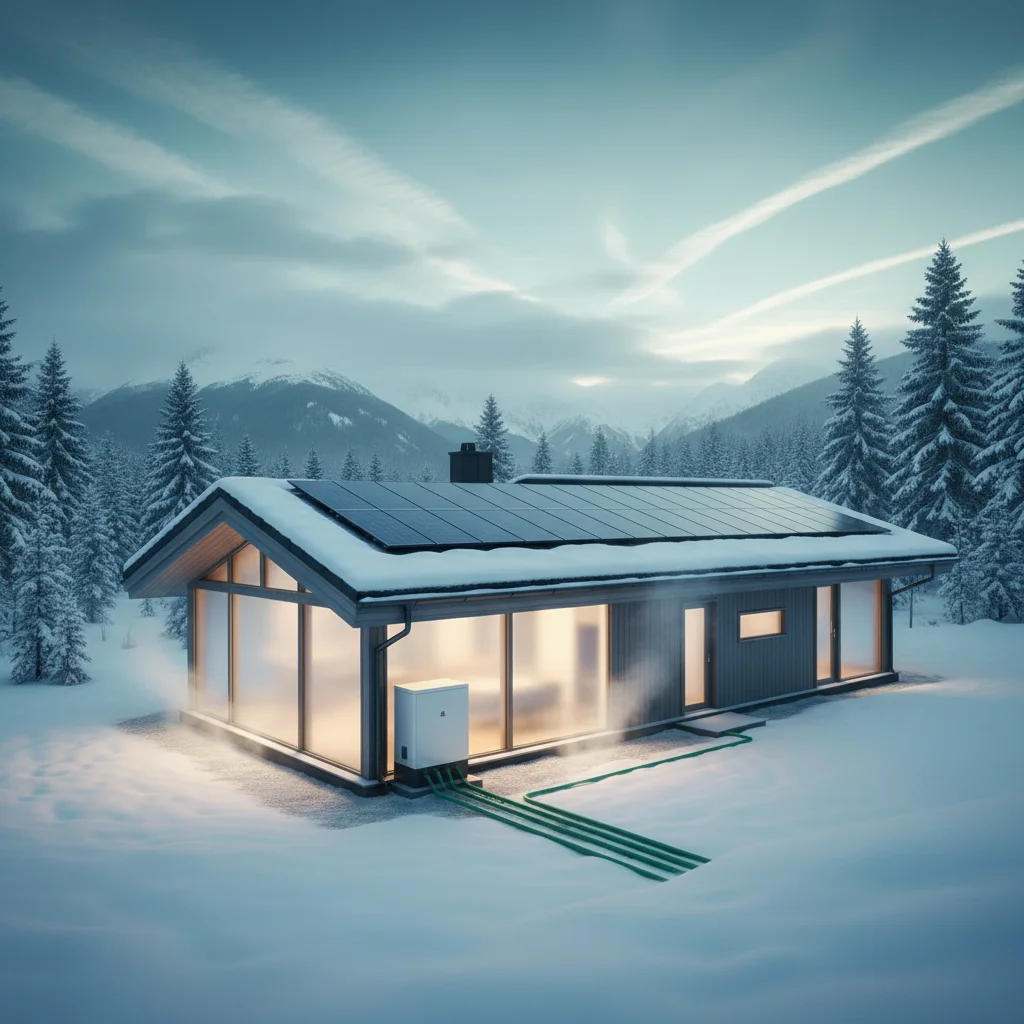
Geothermal heat pumps operate at 400% efficiency in temperatures 40°F below zero—extracting heat from ground that stays 50-55°F year-round regardless of surface conditions. And in Fairbanks, Alaska, where winter temps hit -40°F, geothermal systems deliver $2,400 annual heating savings compared to oil furnaces while maintaining 3.5 COP ratings that gas furnaces can't match.
What Makes Geothermal Systems Eligible for Rebates and Tax Credits in Cold Climates?
The federal Residential Clean Energy Credit (Section 25D) ended for expenditures made after December 31, 2025, and the IRS treats an expenditure as made when installation is completed (IRS FS-2025-05). Federal tax credits for this work have ended, but state, local and utility rebates may still apply; check what is available at your address with the DuloCore rebate calculator. State programs in Minnesota, Wisconsin, and Montana add $1,500-$3,000 rebates for closed-loop installations.
The Department of Energy confirmed geothermal systems in sub-zero regions maintain ENERGY STAR requirements because ground temperatures 6 feet below surface stay constant at 50-55°F. So systems in International Falls, Minnesota (-40°F winters) receive identical federal credit treatment as installations in moderate climates.
California utilities exclude geothermal from most heat pump programs—but cold-climate states offer dedicated incentives. Wisconsin Focus on Energy provides $1,500 per ton for qualifying installations. And Montana's NorthWestern Energy adds $750 per ton for systems serving all-electric homes.
But equipment must carry AHRI certification showing 3.1 minimum COP at 32°F outdoor temperature. Or systems using antifreeze loops in permafrost zones need 2.8 COP minimum. Use our free rebate calculator to check your specific climate zone eligibility.
How Much Can You Save? ROI and Payback Period for Geothermal in Freezing Temperatures
Geothermal installations in cold climates cost $18,000-$35,000 for 3-5 ton systems after 30% federal tax credits reduce upfront expense by $5,400-$10,500. Annual heating savings range $1,800-$3,200 in states with oil or propane heating costs exceeding $4.50 per gallon. Payback periods average 6-9 years for closed-loop vertical systems replacing fossil fuel furnaces.
Minnesota homeowners replacing propane furnaces ($3.80/gallon in 2026) save $2,800 annually on a 2,400 square foot home. And the federal 30% credit for geothermal heat pumps was not extended: the federal Residential Clean Energy Credit (Section 25D) ended for expenditures made after December 31, 2025, and the IRS treats an expenditure as made when installation is completed (IRS FS-2025-05).
But horizontal loop systems in non-permafrost zones cost $15,000-$25,000 installed—saving $3,000-$8,000 on excavation. Or vertical bore systems in Alaska permafrost require specialized drilling at $40-$60 per foot for 300-500 foot depths.
"Geothermal heat pumps are the most energy-efficient, environmentally clean, and cost-effective systems for heating and cooling buildings." — U.S. Department of Energy
So a Vermont homeowner switching from oil heat ($5.20/gallon) sees 5.8 year payback on a $28,000 system after federal credits. And Montana residents replacing electric resistance heat achieve 4.2 year ROI at $0.14/kWh electricity rates.
Geothermal vs. Heat Pumps vs. Traditional HVAC: Which System Wins in Cold Weather?
| System Type | Heating Efficiency (-10°F) | Annual Cost (2,400 sq ft) | Equipment Lifespan |
|---|---|---|---|
| Geothermal (Closed Loop) | 350-450% COP 3.5-4.5 | $800-$1,200 | 25-50 years |
| Air-Source Heat Pump (Cold Climate) | 200-280% COP 2.0-2.8 | $1,400-$2,000 | 15-20 years |
| Natural Gas Furnace (95% AFUE) | 95% efficiency | $1,600-$2,200 | 15-20 years |
| Oil Furnace (85% AFUE) | 85% efficiency | $3,200-$4,000 | 15-20 years |
Geothermal systems maintain 400% efficiency at -40°F outdoor temperatures because ground-loop antifreeze extracts heat from 50°F earth—not frozen air. Air-source heat pumps drop to 220% efficiency below 5°F and require backup resistance heat consuming 3,000-5,000 watts. And natural gas furnaces can't exceed 98% AFUE regardless of outdoor conditions.
But cold-climate air-source units cost $8,000-$14,000 installed—half the price of geothermal with 7-10 year payback versus 6-9 years. Or propane furnaces in rural areas cost $4,800-$7,000 but consume $3,800 annually at $3.80/gallon rates.
So geothermal wins on 30-year lifecycle costs in regions with oil, propane, or electric resistance heat. And systems qualify for heat pump rebates in states that don't distinguish between air-source and ground-source technologies.
How Long Do Geothermal Systems Last in Harsh Winter Conditions?
Geothermal ground loops last 50+ years in permafrost and freeze-thaw zones when installers use HDPE pipe rated for -40°F to 140°F thermal cycling. Indoor heat pump components last 20-25 years with biennial maintenance—outlasting air-source units by 5-10 years. And closed-loop antifreeze systems in Alaska and Minnesota show zero degradation after 30+ years of continuous operation.
The International Ground Source Heat Pump Association documents vertical bore systems installed in 1985 still operating at original efficiency ratings. And horizontal loops buried 6-8 feet deep avoid frost heave damage that affects shallow installations.
But open-loop systems drawing groundwater require well pumps replaced every 10-15 years at $2,500-$4,000 cost. Or antifreeze fluid needs replacement every 5-10 years at $600-$1,200 for 400-gallon capacity systems.
So closed-loop vertical systems deliver the longest lifespan in cold climates with zero groundwater interaction. And HDPE pipe carries 50-year warranties from manufacturers like Calpex and Performance Pipe.
What's the True Cost of Installation and Ongoing Maintenance in Cold Climates?
Geothermal installation costs in cold climates range $22,000-$38,000 before federal tax credits for 3-5 ton systems serving 1,800-3,000 square foot homes. Vertical bore drilling adds $6,000-$12,000 in permafrost zones requiring 400-500 foot depths. Annual maintenance costs $150-$300 for filter changes and antifreeze testing—far less than $400-$600 for furnace and AC tune-ups.
Drilling costs in Alaska and northern Minnesota reach $50-$70 per foot for rock formations requiring specialized equipment. And horizontal trenching in non-permafrost zones costs $8-$12 per linear foot for 400-600 foot loops at 6-8 foot depths.
"Ground source heat pumps can reduce energy consumption—and corresponding emissions—up to 44% compared to air source heat pumps and up to 72% compared to electric resistance heating." — EPA Geothermal Systems
But Wisconsin and Montana contractors charge $18,000-$28,000 for turnkey 4-ton installations in moderate soil conditions. Or DIY horizontal trenching saves $4,000-$8,000 for homeowners with excavation equipment.
So total 30-year ownership cost including installation, maintenance, and energy runs $42,000-$58,000 versus $78,000-$95,000 for propane furnaces. And systems qualify for additional energy tax credits when paired with solar panels or battery storage.
How Do Cold Climate Geothermal Systems Compare to Natural Gas and Oil Heating?
Geothermal systems cost $800-$1,200 annually to heat 2,400 square feet in cold climates at $0.12/kWh electricity rates—consuming 6,700-10,000 kWh per winter. Natural gas furnaces cost $1,600-$2,200 annually at $1.80/therm rates typical in Montana and Wyoming. Oil furnaces cost $3,200-$4,800 annually at $4.50-$5.50/gallon rates common in Maine and Vermont.
But geothermal eliminates $8,000-$12,000 in natural gas line extension costs for rural properties located 500+ feet from utility mains. And propane delivery fees add $0.40-$0.60 per gallon in remote areas—raising total heating costs to $4,200-$5,400 annually.
So geothermal saves $800-$1,000 annually versus natural gas in high-cost markets. Or systems save $2,000-$3,600 annually versus oil heat in New England states. Calculate your specific savings with our rebate calculator.
Official Sources
- DOE Geothermal Heat Pumps — Federal technical specifications and efficiency requirements
- IRS Energy Incentive Programs — Current federal tax credit framework (note: the federal 25D credit ended for expenditures made after December 31, 2025)
- EPA Geothermal Technologies — Environmental impact and efficiency comparisons
Related Reading: Learn more about Home Performance With Energy Star.
Related Reading: Learn more about Geothermal Performance Cold Weather.
Frequently Asked Questions
Do geothermal systems work in cold climates?
Geothermal systems operate efficiently in -40°F weather because they extract heat from ground temperatures that stay 50-55°F year-round at 6-8 foot depths. Alaska installations in Fairbanks maintain 3.5 COP ratings when outdoor temps hit -50°F. And systems in International Falls, Minnesota deliver 400% efficiency during polar vortex events that drop air temps to -45°F.
How much can geothermal save you in a cold climate?
Geothermal systems save $1,800-$3,600 annually in cold climates depending on fuel replacement costs—with highest savings replacing propane ($3,800 annual) or oil heat ($4,200 annual). Minnesota homeowners save $2,400 annually versus propane. And Vermont residents save $3,200 annually versus oil heat at $5.20/gallon rates.
Are geothermal heat pumps efficient in freezing temperatures?
Geothermal heat pumps maintain 350-450% efficiency (COP 3.5-4.5) in freezing temperatures because ground-loop antifreeze circulates through 50-55°F earth—not frozen air. Air-source heat pumps drop to 220% efficiency below 5°F. And natural gas furnaces max out at 98% AFUE regardless of outdoor conditions.
What is the best geothermal system for cold climates?
Closed-loop vertical bore systems perform best in cold climates with 50+ year lifespans and zero groundwater interaction. Systems use 300-500 foot vertical loops in permafrost zones or 200-300 foot loops in non-permafrost areas. Antifreeze mixtures rated to -40°F prevent freeze damage. And variable-speed heat pumps optimize efficiency across wide temperature ranges.
Do geothermal systems need backup heat in cold weather?
Geothermal systems don't need backup heat in properly sized installations—even in -40°F weather. Systems sized at 1 ton per 500-600 square feet maintain comfort during extreme cold snaps. But undersized systems require 5-15 kW electric resistance backup consuming $200-$400 extra annually. Or installers add auxiliary propane furnaces in off-grid locations without reliable electricity.
Ready to see your savings? Use our free rebate calculator to get exact federal credit amounts, state rebates, and utility incentives for your cold climate geothermal installation. Get your personalized estimate in under 2 minutes.
Updated on April 14, 2026. Fact-checked by DuloCore Editors. About our research team.
Check your California heat pump rebate eligibility — see the programs you qualify for and the dollar amounts on our California heat pump rebate finder.