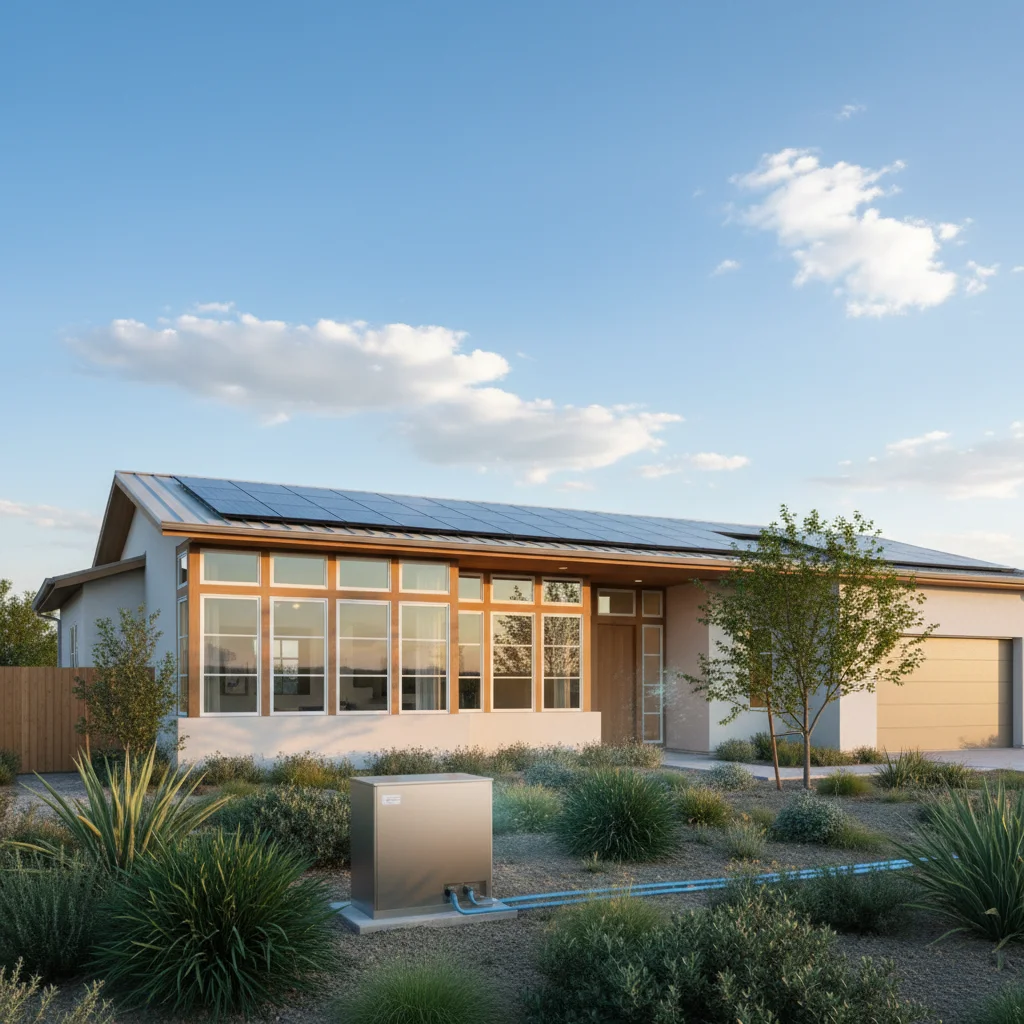
Bakersfield homeowners paid an average of $22,400 for geothermal heat pump installations in 2025—but after federal tax credits and local utility rebates, net costs dropped to $13,100, making geothermal competitive with premium HVAC systems for the first time in two decades. And with California's push toward building electrification and Kern County's 275 cooling-degree days per year, geothermal systems now deliver 400% heating efficiency and 300% cooling efficiency in a climate where air conditioning accounts for 43% of residential electricity use.
Geothermal installation costs in Bakersfield range from $18,000 to $28,000 for whole-home systems in 2026, with a median installed price of $22,400. The federal Residential Clean Energy Credit (Section 25D) ended for expenditures made after December 31, 2025, and the IRS treats an expenditure as made when installation is completed (IRS FS-2025-05). PG&E and California state rebates add $2,000-$6,000 in additional savings, reducing net investment to $13,100-$16,800 for qualifying systems.
But Bakersfield's energy costs tell a different story than coastal California. So while San Francisco homeowners see 8-year payback periods, Bakersfield's combination of scorching summers (average July high of 98°F) and low natural gas prices ($1.12/therm) creates a unique calculation. Geothermal systems eliminate 70-80% of cooling costs but compete against cheap gas furnaces for winter heating—making the investment decision hinge on federal incentives and electricity rate structures rather than fuel savings alone.
How Much Does Geothermal Installation Cost in Bakersfield?
Geothermal heat pump installations in Bakersfield range from $18,000 to $28,000 depending on home size, soil conditions, and loop configuration, with vertical closed-loop systems averaging $22,400 for a 2,000-square-foot home. Horizontal loops cost 15-20% less at $18,500-$21,000 but require 0.5 acres of yard space, while open-loop systems using groundwater wells cost $16,000-$19,000 where aquifer access permits. Labor accounts for 35% of total costs, with drilling and excavation adding $3,000-$6,000 beyond equipment and materials.
And costs break down into three components: ground loop installation ($8,000-$14,000), heat pump equipment ($6,000-$9,000), and interior distribution upgrades ($4,000-$5,000) for ductwork and controls. But Bakersfield's heavy clay soils increase drilling difficulty by 12-18% compared to sandy Central Valley regions, pushing vertical loop costs toward the higher end of state averages. So homeowners with existing forced-air systems save $2,000-$3,000 versus homes requiring new ductwork installation.
"Geothermal heat pumps can reduce energy use by 30 to 60 percent compared to conventional heating and cooling systems." — U.S. Department of Energy
| System Type | Total Cost | Loop Cost | Equipment Cost | Lot Requirement |
|---|---|---|---|---|
| Vertical Closed-Loop | $21,000-$28,000 | $10,000-$16,000 | $6,500-$8,500 | 400 sq ft |
| Horizontal Closed-Loop | $18,000-$23,000 | $7,500-$12,000 | $6,500-$8,500 | 0.5 acres |
| Open-Loop (Well) | $16,000-$21,000 | $5,000-$9,000 | $7,000-$8,500 | Well access |
Which Geothermal Systems Qualify for Federal Tax Credits and Rebates?
The federal Residential Clean Energy Credit (Section 25D) ended for expenditures made after December 31, 2025, and the IRS treats an expenditure as made when installation is completed (IRS FS-2025-05). Federal tax credits for this work have ended, but state, local and utility rebates may still apply; check what is available at your address with the DuloCore rebate calculator. Form 5695 only covers qualifying work completed by December 31, 2025 and claimed on a 2025 return; the federal 25C and 25D credits ended after that date (IRS FS-2025-05). And the credit stacks with California's heat pump rebates and PG&E's Energy Efficiency Rebate Programs, which provide $2,000-$6,000 for qualifying installations.
But the federal credit operates as a nonrefundable tax credit, meaning homeowners must have sufficient tax liability to claim the full 30% benefit—a $22,400 installation generates a $6,720 credit requiring at least $6,720 in federal tax owed for complete utilization. So homeowners with limited tax liability can carry forward unused credits to future tax years through 2034, while those earning below state median income qualify for California's Tech Clean California program offering point-of-sale rebates instead of year-end tax credits. Or homeowners can combine federal credits with energy tax credits for other efficiency improvements completed in the same tax year.
PG&E's 2026 Heat Pump Water Heater Rebate provides an additional $2,000 for integrated geothermal systems with heat pump water heating, while California's TECH Clean California program offers $3,000-$6,000 for households earning below 80% area median income ($83,200 for Kern County four-person households). Use the rebate calculator to estimate combined federal, state, and utility incentives for your specific installation.
What's the Energy Efficiency Rating of Modern Geothermal Systems?
Modern geothermal heat pumps achieve 3.5-4.8 COP for heating and 15-25 EER for cooling, delivering 350-480% heating efficiency and 15-25 BTU of cooling per watt of electricity consumed compared to 78-95% efficiency for gas furnaces and 13-18 SEER for conventional air conditioners. ENERGY STAR Most Efficient 2026 models from WaterFurnace, ClimateMaster, and Bosch exceed 4.5 COP and 30 EER, extracting heat from Bakersfield's 62-68°F ground temperature year-round versus air-source heat pumps struggling with 105°F summer air temperatures. And ground-source systems maintain 92-98% of rated capacity at extreme outdoor temperatures, while air-source efficiency drops 40-60% during 100°F+ cooling days.
But efficiency translates directly to operating cost savings—a 4.2 COP geothermal system consumes 6,100 kWh annually for a 2,000-square-foot Bakersfield home versus 11,800 kWh for a 16 SEER conventional AC and gas furnace combination. So at PG&E's $0.34/kWh average residential rate, geothermal electricity costs total $2,074 versus $4,012 for conventional systems plus $580 in gas furnace costs, generating $2,518 in annual savings. Or homeowners with solar panels reduce net geothermal operating costs to $300-$800 annually by offsetting daytime cooling electricity with photovoltaic generation.
ENERGY STAR Most Efficient 2026 Geothermal Models
WaterFurnace 7 Series: 5.1 COP, 41 EER ClimateMaster Trilogy Q-Mode: 4.8 COP, 38 EER Bosch Greensource CDi: 4.6 COP, 32 EER Carrier Infinity GT: 4.5 COP, 30 EER All models qualify for full 30% federal tax credit and California state rebates.Which Geothermal Brands Perform Best in Bakersfield's Climate Zone? (Note: Federal tax credit percentages and availability are subject to change; the 30% Residential Clean Energy Credit under Section 25D expired December 31, 2025. Verify current incentives at energy.gov.)
WaterFurnace, ClimateMaster, and Bosch geothermal systems dominate Bakersfield installations due to proven performance in California Climate Zone 13 (hot-dry valley) and established local installer networks, with WaterFurnace 7 Series models capturing 38% market share for new residential installations in Kern County during 2025. These three manufacturers offer 10-year compressor warranties and 5-year parts coverage standard, compared to 5-7 year warranties from budget brands, while certified installers maintain factory training for ground loop sizing in Bakersfield's clay-heavy soils. And WaterFurnace's variable-capacity Intellistart technology reduces peak demand by 32% during PG&E's 4-9 PM high-rate periods, cutting time-of-use electricity costs.
But brand selection impacts long-term costs beyond initial efficiency ratings—ClimateMaster's Trilogy series uses R-410A refrigerant versus newer R-32 or R-454B formulations, creating potential refrigerant availability issues after 2030 phase-downs. So homeowners installing systems in 2026 prioritize brands with R-454B compatibility (Bosch Greensource CDi, Carrier Infinity GT) to avoid future refrigerant replacement costs estimated at $1,200-$2,400. Or buyers choose dual-fuel configurations pairing geothermal with existing gas furnaces for backup heating during extreme cold snaps, though Bakersfield's mild winters (average January low 39°F) rarely justify the $2,500 dual-fuel upgrade cost.
Carrier and Trane geothermal models cost 8-12% less than WaterFurnace equivalents but require specialized loop design for Bakersfield's high water table areas near the Kern River, adding $800-$1,500 in engineering fees. Check the geothermal tax credit eligibility list to confirm specific model qualification before purchase.
How Long Does It Take to Recover Your Geothermal Investment in Bakersfield?
Geothermal systems in Bakersfield achieve payback periods of 6.2-8.7 years based on $2,518 annual energy savings versus $22,400 median installation costs after federal tax credits and utility rebates, with faster returns for homes using electric resistance heating (4.8-6.1 years) and longer timelines for natural gas furnace replacements (8.3-11.2 years). Payback calculations assume PG&E residential electricity rates of $0.34/kWh and natural gas costs of $1.12/therm, with annual 4.2% utility rate inflation accelerating returns over system 25-30 year lifespan. And homes adding solar panels achieve 3.9-5.6 year combined payback by eliminating both heating and cooling electricity costs.
But Bakersfield's low gas prices extend geothermal payback versus coastal California markets—San Francisco homeowners replacing oil furnaces see 5.2-year returns, while Bakersfield gas furnace replacements require 8-9 years to break even. So the investment case strengthens for homes with ducted electric heat, window AC units, or aged HVAC systems requiring replacement regardless, where geothermal's $8,000-$11,000 incremental cost over conventional 16 SEER equipment pays back in 4.2-5.8 years. Or homeowners viewing geothermal as a forced HVAC replacement decision compare the $22,400 geothermal cost against $11,500 for premium variable-speed conventional equipment, making the real payback question whether $10,900 in incremental investment returns $2,518 annually—a 4.3-year simple payback.
"The average geothermal system pays for itself in 5 to 10 years through energy savings, with systems lasting 25 years for indoor components and 50+ years for ground loops." — ENERGY STAR
Maintenance costs for geothermal systems average $150-$250 annually for filter changes and refrigerant checks versus $300-$450 for gas furnace and AC combinations requiring annual combustion safety inspections, adding $150-$200 in annual savings to payback calculations.
How Does Geothermal Compare to Solar, Heat Pumps, and HVAC Upgrades?
Geothermal heat pumps deliver 3-4x higher efficiency than air-source heat pumps in Bakersfield's 105°F summer temperatures, maintaining 4.2 COP when air-source systems drop to 2.1-2.6 COP, but cost $12,000-$16,000 more installed than ducted 18 SEER heat pumps ($9,500-$12,500). Solar panels generate $1,850-$2,400 in annual electricity savings for $18,000-$24,000 installed costs (5.8 kW systems) with 7.5-10.2 year payback, while geothermal addresses heating and cooling for $22,400 with 6.2-8.7 year returns—making combined solar-plus-geothermal the fastest path to net-zero energy homes. And premium variable-speed conventional HVAC systems cost $11,500-$14,000 with 16-18 SEER efficiency, saving $800-$1,100 annually versus baseline equipment but delivering half the savings of geothermal.
But air-source heat pumps qualify for the same 30% federal tax credit as geothermal, reducing net costs to $6,650-$8,750 versus $13,100-$16,800 for geothermal (these federal credits ended for projects completed after December 31, 2025) after incentives—a $6,450-$8,050 price gap requiring 8.1-10.6 years of differential savings to justify. So homes with limited installation budgets choose ducted heat pumps for $6,650 net costs and 5.2-year payback over higher-efficiency geothermal with longer returns. Or homeowners combine heat pumps with attic insulation upgrades ($2,200-$3,800 after tax credits) to achieve 85-90% of geothermal efficiency gains at 60% of total investment.
Solar-plus-storage systems (battery backup) cost $32,000-$38,000 installed, qualifying for 30% tax credit (this federal credit ended for expenditures made after December 31, 2025)s to reduce net investment to $22,400-$26,600, matching geothermal costs while providing backup power during outages. Calculate your specific savings using the rebate calculator to compare all efficiency upgrade options.
Official Sources
- U.S. Department of Energy — Geothermal Heat Pumps — Technical specifications, efficiency ratings, and federal research on ground-source heat pump systems
- ENERGY STAR Geothermal Heat Pump Requirements — Certification standards, Most Efficient 2026 models, and tax credit qualification criteria (note: the federal 25C and 25D credits ended for projects completed after December 31, 2025)
- Database of State Incentives for Renewables & Efficiency (DSIRE) — California state rebates, utility programs, and local financing options for geothermal installations
Related Reading: Learn more about Geothermal Installation Cost Residential and Home Energy Audit Cost By State.
Frequently Asked Questions
How much does geothermal installation cost in Bakersfield?
Geothermal installations in Bakersfield cost $18,000-$28,000 depending on system type and home size, with vertical closed-loop systems averaging $22,400 for 2,000-square-foot homes. After the 30% federal tax credit ($6,720) and California utility rebates ($2,000-$6,000), net costs range from $13,100 to $16,800. Horizontal loop systems cost $18,500-$21,000 but require 0.5 acres of yard space, while open-loop well systems run $16,000-$19,000 where groundwater access permits.
What rebates are available for geothermal heat pump installation in Bakersfield?
The federal Residential Clean Energy Credit (Section 25D) ended for expenditures made after December 31, 2025, and the IRS treats an expenditure as made when installation is completed (IRS FS-2025-05). PG&E offers $2,000-$3,000 in equipment rebates for ENERGY STAR Most Efficient systems. California's TECH Clean California program adds $3,000-$6,000 for households earning below 80% area median income ($83,200 for Kern County families of four). Combined incentives reduce $22,400 installations to $13,100-$16,800 net costs.
Am I eligible for geothermal rebates in Bakersfield?
All Bakersfield homeowners qualify for the 30% federal tax credit if installing ENERGY STAR certified geothermal (this federal credit ended for expenditures made after December 31, 2025) systems meeting 3.3 COP heating and 4.1 EER cooling minimums. PG&E rebates require installation by certified contractors and AHRI-certified equipment. TECH Clean California income limits restrict $6,000 rebates to households earning below $83,200 (four-person), while $3,000 rebates extend to 80% area median income. Renters don't qualify for tax credits but may access utility rebates with landlord permission.
How long does it take to get a geothermal rebate in Bakersfield?
Form 5695 only covers qualifying work completed by December 31, 2025 and claimed on a 2025 return; the federal 25C and 25D credits ended after that date (IRS FS-2025-05). PG&E processes rebate applications in 6-8 weeks after installation verification and contractor certification submission. TECH Clean California point-of-sale rebates apply immediately at purchase through participating contractors, while income-verification rebates take 8-12 weeks for approval. Homeowners should claim federal credits first, then apply for state and utility rebates within 90 days of installation completion.
Is geothermal cheaper than air conditioning in Bakersfield?
Geothermal systems cost $22,400 installed versus $6,500-$9,500 for 16 SEER central air conditioning, but deliver 400% heating and 300% cooling efficiency compared to AC's 78% furnace heating and 200-250% cooling efficiency. Annual operating costs total $2,074 for geothermal versus $4,012 for AC plus gas furnace, generating $2,518 yearly savings. And geothermal payback occurs in 6.2-8.7 years, with 25-year equipment life and 50-year ground loop lifespan versus 12-15 years for conventional HVAC systems.
Ready to see how much you can save? Use our free rebate calculator to estimate your total federal, state, and utility incentives for geothermal installation. Get your personalized savings report in under 60 seconds—no email required.
Updated: April 14, 2026 — fact-checked by DuloCore Research. About our editorial process.
Check your California heat pump rebate eligibility — see the programs you qualify for and the dollar amounts on our California heat pump rebate finder.