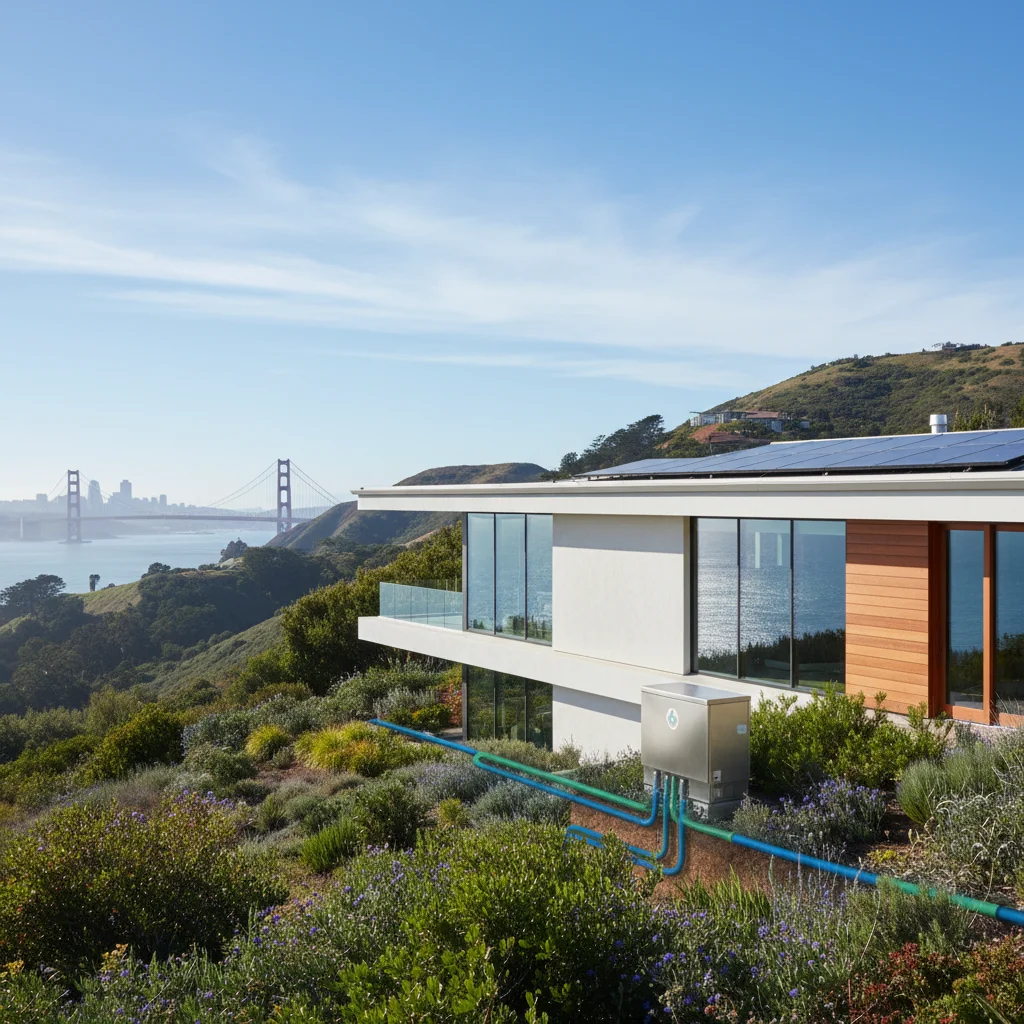
Bay Area homeowners spend between $25,000 and $45,000 installing residential geothermal heat pump systems in 2026, but federal tax credits and state rebates recover $10,000 to $15,000 of those costs within 12 months. And despite San Francisco's mild climate making geothermal less intuitive than solar, ground-source heat pumps deliver 400% heating efficiency year-round—triple the performance of conventional natural gas furnaces. The Bay Area's shallow bedrock and high water tables create installation challenges that push costs 15-20% above national averages, yet qualified systems still achieve full payback within 8-12 years through utility savings.
Geothermal installation costs in the Bay Area range from $25,000 to $45,000 for residential systems, with average installations at $32,000 in 2026. The federal Energy Efficient Home Improvement Credit (Section 25C) ended for property placed in service after December 31, 2025 (IRS FS-2025-05). California's TECH Clean California program offers $3,000-$5,000 rebates for qualifying heat pump systems, reducing net costs to $17,500-$28,500.
How Much Does Geothermal Installation Cost in the Bay Area?
Geothermal installation costs in the Bay Area average $32,000 for a 3-ton residential system in 2026, with total project costs ranging from $25,000 to $45,000 depending on property size and soil conditions. Horizontal loop installations cost $25,000-$35,000 for properties with adequate land, while vertical bore systems required for smaller urban lots reach $35,000-$45,000 due to drilling costs of $15-$25 per linear foot.
So what drives Bay Area costs 15-20% higher than the $20,000-$30,000 national average? Bedrock depth, permitting fees averaging $1,200-$2,500 in San Francisco and San Jose, and labor rates of $85-$125 per hour create regional cost premiums. But combined federal and state incentives recover 35-45% of installation costs, bringing net investment to $17,500-$28,500. The geothermal tax credit covers 30% of equipment and installation costs with no maximum cap, while TECH Clean California rebates add $3,000-$5,000 for systems meeting efficiency requirements. And utility bill reductions of $1,800-$2,800 annually create positive cash flow within the first decade.
What Geothermal Systems Qualify for Bay Area Rebates and Tax Credits?
Geothermal heat pump systems qualifying for the federal 30% tax credit (this federal credit ended for expenditures made after December 31, 2025) and California state rebates must meet ENERGY STAR Most Efficient specifications with Energy Efficiency Ratio (EER) of 17.1 or higher and Coefficient of Performance (COP) of 3.6 or higher for closed-loop systems. Open-loop systems require EER of 21.1 and COP of 4.1 to qualify for maximum incentive stacking.
TECH Clean California rebates of $3,000-$5,000 apply exclusively to ducted heat pump systems installed in homes replacing natural gas or propane heating equipment. And income-qualified households earning below 80% area median income ($112,400 for a family of four in San Francisco County) access enhanced rebates reaching $8,000 through the Equitable Building Decarbonization program. But systems must achieve Heating Seasonal Performance Factor (HSPF) of 10 or higher for Northern California climate zones to qualify. Use our free rebate calculator to determine your exact incentive amounts based on household income and system specifications.
How Efficient Are Geothermal Heat Pumps for Bay Area Climates?
Geothermal heat pumps deliver 400-500% heating efficiency in Bay Area climates, maintaining COP values of 4.0-5.0 year-round compared to 250-300% efficiency for air-source heat pumps and 95-98% for high-efficiency natural gas furnaces. Ground temperatures at 6-foot depth remain constant at 58-62°F throughout the year in coastal California, enabling geothermal systems to extract heat energy without the performance degradation air-source systems experience during cold snaps.
Bay Area's Mediterranean climate creates ideal operating conditions for geothermal technology despite mild heating loads. And systems sized for cooling demand automatically provide sufficient heating capacity for the region's temperate winters, avoiding the oversizing issues common in heating-dominant climates. But shallow water tables in parts of San Mateo and Santa Clara counties enable lower-cost horizontal loop installations that maximize efficiency through enhanced ground coupling. Homes replacing natural gas heating save $1,800-$2,800 annually on energy costs, while properties converting from electric resistance heating save $2,200-$3,400. Or for comprehensive savings projections across heating and cooling seasons, consult heat pump rebates documentation covering efficiency comparisons.
Which Geothermal Brands Perform Best in Northern California?
Three manufacturers dominate Northern California geothermal installations based on local contractor surveys and warranty claim data from 2024-2025: WaterFurnace, ClimateMaster, and Bosch. WaterFurnace 7 Series systems achieve EER ratings of 41.0 and COP of 5.0, qualifying for maximum federal and state incentives while carrying 10-year compressor warranties and optional labor coverage through certified installers.
| Brand | Model | EER | COP | Warranty | Avg. Cost |
|---|---|---|---|---|---|
| WaterFurnace | 7 Series | 41.0 | 5.0 | 10 years | $28,000-$38,000 |
| ClimateMaster | Trilogy 45 Q-Mode | 44.1 | 4.9 | 10 years | $26,000-$36,000 |
| Bosch | Greensource SM Series | 32.0 | 4.2 | 10 years | $24,000-$34,000 |
ClimateMaster Trilogy systems feature QuietMode technology reducing sound levels to 58 decibels, addressing noise concerns in dense urban neighborhoods. And Bosch Greensource units integrate with existing hydronic radiant floor systems common in Bay Area remodels. But all three brands require certified installers maintaining manufacturer training credentials—contractor certification directly correlates with long-term system performance and warranty claim approval rates exceeding 95%. So verify installer credentials through manufacturer databases before contract signing.
How Long Until Geothermal Saves You Money? (ROI & Payback Period)
Geothermal systems in the Bay Area achieve payback within 8-12 years for homes replacing natural gas heating, with simple payback periods calculated by dividing net installation cost after incentives by annual utility savings. Bay Area homeowners investing $32,000 in geothermal installations recover $9,600 through federal tax credits and $4,000 through state rebates, reducing net cost to $18,400. And annual savings of $2,200 on combined heating and cooling bills create 8.4-year simple payback.
But payback timelines vary significantly by replaced equipment and household energy consumption. Homes converting from electric resistance heating achieve 6-8 year payback through annual savings of $2,800-$3,400, while properties replacing 15+ SEER air conditioners and 95% AFUE furnaces extend payback to 10-14 years due to smaller efficiency gains. Or for detailed ROI calculations incorporating PG&E's tiered rate structure and projected natural gas price increases of 3-5% annually, consult energy tax credits analysis tools. So households planning 15+ year occupancy achieve lifetime savings of $35,000-$55,000, while properties sold within 5-7 years transfer remaining savings to new owners through increased resale value.
What's the Lifespan of a Geothermal System and What Maintenance Do You Need?
Geothermal heat pump indoor components last 20-25 years with annual maintenance, while ground loop piping carries 50-year design life and manufacturer warranties extending 25-50 years. Bay Area installations completed in 2026 using high-density polyethylene (HDPE) piping meet IGSHPA standards for corrosion resistance and joint integrity, with predicted loop life exceeding 75 years in California's non-freezing soil conditions.
Annual maintenance costs $150-$300 for filter changes, refrigerant level checks, and loop pressure testing every 12-24 months. But geothermal systems contain 40% fewer moving parts than conventional HVAC equipment, reducing service call frequency by 60-75% compared to natural gas furnaces requiring annual combustion safety inspections. And compressor replacements occurring at 15-20 year intervals cost $3,500-$5,500 installed—significantly less than full system replacement. So total lifetime maintenance costs of $8,000-$12,000 over 25 years remain 30-40% below the $12,000-$18,000 spent maintaining and replacing conventional systems during the same period.
Required Maintenance Schedule
- **Monthly**: Check air filter condition (replace every 1-3 months) - **Annually**: Professional inspection including refrigerant charge, electrical connections, condensate drain, and thermostat calibration ($150-$250) - **Every 3-5 years**: Loop pressure test and heat transfer fluid analysis ($200-$400) - **Every 15-20 years**: Compressor replacement if needed ($3,500-$5,500)Geothermal vs. Heat Pumps vs. Traditional HVAC: Which Is Right for the Bay Area?
Bay Area homeowners choosing between geothermal, air-source heat pumps, and traditional HVAC systems face tradeoffs between upfront cost, long-term savings, and installation constraints. Geothermal systems cost $25,000-$45,000 installed but deliver 400-500% heating efficiency and 25-year equipment life, while air-source heat pumps require $8,000-$18,000 investment for 300-350% efficiency and 15-18 year lifespan.
| System Type | Installation Cost | Annual Operating Cost | Efficiency | Lifespan | 25-Year Total Cost |
|---|---|---|---|---|---|
| Geothermal | $25,000-$45,000 | $600-$900 | 400-500% | 25 years | $40,000-$67,500 |
| Air-Source Heat Pump | $8,000-$18,000 | $900-$1,400 | 300-350% | 15 years | $38,500-$53,000 |
| Natural Gas Furnace + AC | $8,000-$14,000 | $1,800-$2,600 | 95-98% / 16 SEER | 15-20 years | $53,000-$79,000 |
Traditional natural gas furnaces paired with central air conditioning cost $8,000-$14,000 upfront but incur annual operating costs of $1,800-$2,600, creating 25-year total ownership costs of $53,000-$79,000. And air-source heat pumps achieve lowest total cost at $38,500-$53,000 over 25 years for moderate-use households, while geothermal systems deliver lowest operating costs for high-consumption properties or homes occupied 15+ years. But properties lacking 400+ square feet for horizontal loops or $10,000+ budgets for vertical drilling default to air-source solutions qualifying for identical heat pump rebates and tax credits.
Official Sources
- DOE Geothermal Heat Pumps — Federal guidance on geothermal technology, efficiency standards, and incentive programs
- ENERGY STAR Geothermal Specifications — Equipment qualification requirements for federal tax credits and efficiency ratings (note: the federal 25C and 25D credits ended for projects completed after December 31, 2025)
- DSIRE California Incentives — Comprehensive database of state and utility rebate programs including TECH Clean California
Frequently Asked Questions
How much does geothermal installation cost in the Bay Area?
Geothermal installation costs range from $25,000 to $45,000 in the Bay Area in 2026, with average residential systems at $32,000 for 3-ton capacity. Horizontal loop systems cost $25,000-$35,000 for properties with adequate land, while vertical bore installations required for smaller urban lots reach $35,000-$45,000. Federal tax credits cover 30% of total costs, and California rebates add $3,000-$5,000, reducing net investment to $17,500-$28,500 after all incentives.
What rebates are available for geothermal systems in California?
California's TECH Clean California program offers $3,000-$5,000 rebates for qualifying geothermal heat pump systems in 2026, with enhanced rebates reaching $8,000 for income-qualified households earning below 80% area median income. Systems must replace natural gas or propane heating equipment and achieve ENERGY STAR Most Efficient specifications with EER of 17.1+ and COP of 3.6+ for closed-loop installations. Federal tax credits covering 30% of installation costs stack with state rebates, creating combined savings of $12,000-$18,000 on typical installations.
Is geothermal heating worth the cost for Bay Area homes?
Geothermal heating achieves 8-12 year payback for Bay Area homes through annual utility savings of $1,800-$2,800, creating lifetime savings of $35,000-$55,000 over 25-year equipment life. Homes occupied 15+ years maximize return on investment, while properties sold within 5-7 years transfer remaining savings to buyers through increased resale value. But air-source heat pumps costing $8,000-$18,000 deliver lower total ownership costs for moderate-use households planning shorter occupancy, making geothermal ideal for high-consumption properties or long-term residents.
How long does it take to install a geothermal system?
Geothermal installations require 3-7 days for complete residential projects in the Bay Area, with ground loop installation consuming 1-3 days and indoor equipment setup requiring 1-2 days. Vertical bore systems extend timelines to 5-7 days due to drilling operations requiring specialized equipment and multiple drill sites for adequate heat exchange capacity. And permitting processes add 2-4 weeks before installation begins in San Francisco and San Jose, while inspections and final approvals require 3-5 business days after completion.
Can I get a tax credit for geothermal installation in 2026?
The federal Residential Clean Energy Credit (Section 25D) ended for expenditures made after December 31, 2025, and the IRS treats an expenditure as made when installation is completed (IRS FS-2025-05). Bay Area homeowners installing $32,000 systems claim $9,600 credits on 2026 tax returns filed in 2027, reducing net installation cost to $22,400 before state rebates.
Ready to calculate your exact savings? Use our free rebate calculator to see how much you'll save with geothermal installation in your Bay Area home. Get instant estimates for federal tax credits, state rebates, and 25-year utility savings based on your specific property and energy usage.
Last updated April 14, 2026 — reviewed by DuloCore Editorial. About our authors.
Check your California heat pump rebate eligibility — see the programs you qualify for and the dollar amounts on our California heat pump rebate finder.