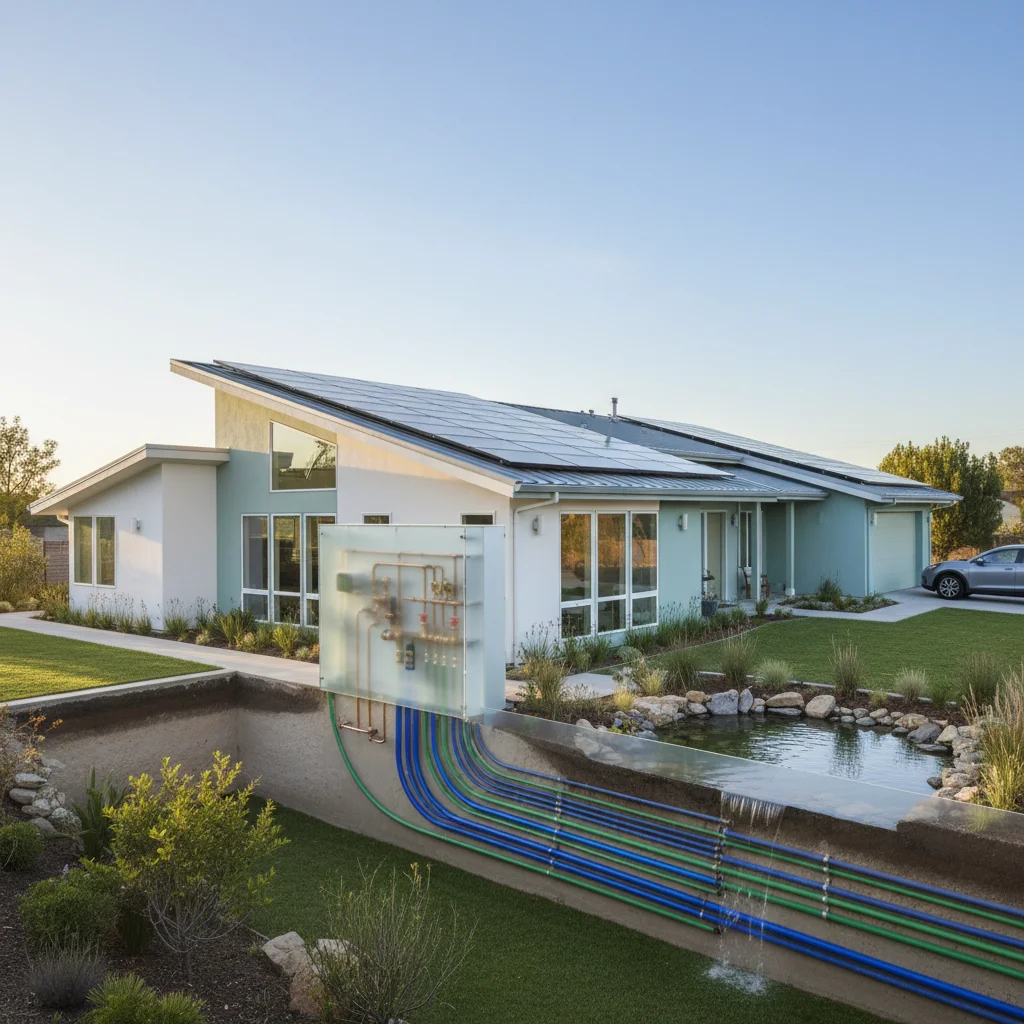
A 2,000-square-foot home in Sacramento replacing a 15-year-old gas furnace with a geothermal heat pump system cuts annual heating and cooling costs by $1,847—but only if the homeowner navigates a fragmented landscape of state and utility rebates, since the federal credit ended for expenditures made after December 31, 2025 (IRS FS-2025-05).
Geothermal installation costs in California range from $18,000 to $35,000 before incentives, with utility rebates adding $2,000 to $4,000 in most service territories; no federal tax credit applies after December 31, 2025 (IRS FS-2025-05). Net costs after utility rebates typically fall between $14,000 and $33,000 for residential systems.
How Much Does Geothermal Installation Cost in California?
Residential geothermal heat pump systems in California cost $18,000 to $35,000 installed, with ground loop configuration driving most price variation. Vertical closed-loop systems—required in urban lots under 0.5 acres—average $28,000 to $35,000 due to drilling costs of $15 to $25 per vertical foot. Horizontal loop installations on larger rural properties cost $18,000 to $25,000, while pond/lake loop systems drop to $15,000 to $20,000 where water bodies exist on-site.
And the heat pump equipment itself represents just 40% of total project costs. A 5-ton WaterFurnace Series 7 unit with desuperheater costs $9,200, but ground loop installation adds $8,000 to $18,000 depending on soil composition, drilling depth (150 to 400 feet per ton), and municipal permitting fees that range from $350 in Fresno County to $1,200 in San Francisco.
California Energy Commission data shows installation costs drop $2,400 per home in regions with sandy loam soil versus decomposed granite bedrock. And coastal climate zones 3 and 4 require smaller system capacity than inland valley zones 12-16, reducing equipment costs by 20% for identical square footage.
What Rebates and Tax Credits Can California Homeowners Claim for Geothermal Systems?
California homeowners combining federal tax credits with utility rebates reduce net geothermal costs by $8,000 to $18,000 in 2026. The federal Residential Clean Energy Credit (Section 25D) ended for expenditures made after December 31, 2025, and the IRS treats an expenditure as made when installation is completed (IRS FS-2025-05). Check current state, local and utility incentives for your address with the DuloCore rebate calculator.
State incentives layer on top of federal credits. The Self-Generation Incentive Program (SGIP) provides $1.00 per therm of displaced natural gas for ground-source heat pumps, averaging $2,400 for typical 3-ton systems. And Pacific Gas & Electric's Energy Efficiency Rebate adds $2,000 for ENERGY STAR Most Efficient certified units, while Southern California Edison offers $1,500 for systems exceeding 17 EER.
But equity programs multiply these amounts. SGIP Equity Resiliency allocates $4,500 for low-income homeowners in high-fire-threat districts, stacking with federal credits for combined savings of $12,000 on a $25,000 system. Calculate your specific savings with our free rebate calculator that aggregates 43 California utility programs.
| Program | Amount | Eligibility | Deadline |
|---|---|---|---|
| Federal Residential Clean Energy Credit | Ended Dec 31, 2025 | — | Ended Dec 31, 2025 |
| SGIP Ground-Source Heat Pump | $1.00/therm displaced | California residents, CARB-approved equipment | Ongoing (budget-dependent) |
| PG&E Energy Efficiency Rebate | $2,000 | ENERGY STAR Most Efficient certified | December 31, 2026 |
| SGIP Equity Resiliency | Up to $4,500 additional | Income-qualified, high-fire-threat districts | Ongoing (budget-dependent) |
Which Geothermal Brands and Equipment Qualify for California Incentives?
Federal tax credits cover any geothermal heat pump meeting ENERGY STAR certification, but California utility rebates require ENERGY STAR Most Efficient designation—a threshold only 23 residential models achieved in 2026. WaterFurnace Series 7, ClimateMaster Tranquility 30, and Bosch Greensource CDi series qualify across all major utility territories.
And equipment specifications determine rebate tier. Systems must achieve minimum 17.1 EER (Energy Efficiency Ratio) and 4.1 COP (Coefficient of Performance) for base SGIP eligibility, but units exceeding 21 EER unlock additional $800 bonuses from select utilities. The WaterFurnace 7 Series 700A11 reaches 30.4 EER in closed-loop configuration, qualifying for maximum rebate tiers from PG&E, SCE, and SDG&E.
But desuperheater integration matters for California applications. Units with factory-integrated hot water assist—standard on ClimateMaster Trilogy and optional on Carrier GT-PX—generate additional utility incentives of $300 to $600 by reducing electric water heating demand. So homeowners stacking geothermal tax credit benefits with water heating rebates see total incentives increase 12% to 18% versus heat-only configurations.
What's the Efficiency Rating of Modern Geothermal Systems and How Does It Affect Your Costs?
Modern geothermal heat pumps deliver 400% to 500% efficiency versus 95% for high-efficiency gas furnaces, converting one unit of electricity into four to five units of heating or cooling. The industry measures this as COP (heating mode) and EER (cooling mode)—and California's top-tier systems reach 5.3 COP and 41 EER in laboratory testing.
But real-world performance varies by ground loop design. Vertical closed-loop systems in coastal regions maintain 4.8 COP year-round due to stable 58°F to 62°F ground temperatures at 200-foot depth. Horizontal loops in Central Valley climates drop to 3.9 COP during 105°F summer peaks when shallow ground temperatures rise to 75°F.
And efficiency directly determines operating costs. A 5-ton WaterFurnace system with 4.5 COP uses 6,240 kWh annually in Sacramento's climate zone 12, costing $1,123 at $0.18/kWh. The same home's previous gas furnace (80% AFUE) consumed $2,340 in natural gas and $780 in AC electricity—so the geothermal retrofit saves $1,997 annually even before energy tax credits reduce net installation costs.
"Ground-source heat pumps are the most energy-efficient heating and cooling systems available, using 25% to 50% less electricity than conventional systems." — U.S. Department of Energy
How Long Until Your Geothermal System Pays for Itself Through Energy Savings?
Geothermal systems in California achieve full payback in 5 to 12 years depending on replaced equipment and utility rates. Homes replacing electric resistance heat or propane furnaces—common in rural Shasta and Siskiyou counties where propane costs $3.80/gallon—recover installation costs in 5 to 7 years through $2,800+ annual savings.
But natural gas replacement extends payback periods. A Fresno home switching from 92% AFUE gas heat saves $1,340 annually at PG&E's $2.47/therm rate, requiring 9 years to offset a $22,000 net-of-incentives geothermal system. And the equation changes with utility rate structures—SCE's tiered pricing penalizes high-usage gas customers at $3.12/therm in Tier 3, accelerating payback to 7 years for the same retrofit.
A $28,000 system installed in 2026 yields $8,400 in tax credits plus $3,000 in utility rebates, reducing net cost to $16,600. The federal Residential Clean Energy Credit (Section 25D) ended for expenditures made after December 31, 2025, and the IRS treats an expenditure as made when installation is completed (IRS FS-2025-05). Our rebate calculator models payback scenarios across 17 California climate zones and 31 utility territories.
Is Geothermal Right for Your California Climate Zone? Installation Requirements by Region
California's 16 climate zones create distinct geothermal performance profiles. Coastal zones 3, 5, and 6—covering San Francisco, Monterey, and San Diego—require just 2.5 to 3 tons of capacity per 2,000 square feet due to mild 50°F to 75°F annual temperature swings. And stable ground temperatures of 58°F to 62°F maintain peak efficiency year-round.
But inland valley zones 12, 13, and 14 demand 4 to 5 tons for identical homes facing 28°F winter lows and 108°F summer peaks. Sacramento and Fresno installations require 300 to 400 feet of vertical loop per ton versus 200 to 250 feet in coastal regions, adding $4,000 to $8,000 in drilling costs. And desert zones 15 and 16 see ground temperatures rise to 72°F at standard 200-foot depth, reducing cooling efficiency by 18% versus coastal benchmarks.
So lot size constrains system type. Urban infill properties under 5,000 square feet require vertical closed-loop drilling—feasible in all soil types but restricted by municipal setback requirements of 5 to 10 feet from property lines. Rural parcels over one acre accommodate horizontal loops with trenching costs of $6 to $12 per linear foot, and properties with ponds or lakes access the lowest-cost open-loop systems drawing 1.5 gallons per minute per ton.
Geothermal vs. Heat Pumps, Solar, and Traditional HVAC: Which System Costs Less?
Geothermal systems cost $18,000 to $35,000 installed versus $8,000 to $15,000 for air-source heat pumps and $12,000 to $18,000 for gas furnace plus central AC. But lifecycle costs reverse this order within 6 to 10 years as geothermal's 400% to 500% efficiency compounds savings.
And the comparison shifts with solar integration. A 6 kW solar array costs $15,000 after federal credits, generating 8,400 kWh annually in Sacramento—enough to offset 85% of a geothermal system's electricity use. Combined geothermal-solar installations reduce net energy costs to $180 annually versus $2,340 for gas heat and grid AC, creating 30-year savings of $64,800 that dwarf the $33,000 combined system cost.
But heat pump rebates narrow the gap for air-source alternatives. California's Tech Clean initiative provides $3,000 to $8,000 for ducted heat pumps, reducing installed costs to $5,000 to $10,000 for ENERGY STAR units. Air-source systems deliver 300% to 380% efficiency—still superior to gas but 25% less efficient than geothermal—creating annual operating cost gaps of $420 to $680 that extend to $12,600 to $20,400 over 30-year equipment life.
| System Type | Installed Cost (After Incentives) | Annual Operating Cost | 10-Year Total Cost | Efficiency Rating |
|---|---|---|---|---|
| Geothermal heat pump | $11,000–$22,000 | $900–$1,200 | $20,000–$34,000 | 400–500% (COP 4.0–5.0) |
| Air-source heat pump | $5,000–$10,000 | $1,320–$1,680 | $18,200–$26,800 | 300–380% (HSPF 10–13) |
| Gas furnace + AC | $6,000–$12,000 | $2,100–$2,800 | $27,000–$40,000 | 92–96% AFUE / 16 SEER |
| Solar + geothermal | $24,000–$37,000 | $180–$400 | $25,800–$41,000 | Net-zero capable |
Official Sources
- U.S. Department of Energy Geothermal Heat Pumps — Federal efficiency standards, performance data, and installation guidelines
- Database of State Incentives for Renewables & Efficiency — Comprehensive California geothermal rebate and tax credit directory updated monthly (note: the federal 25C and 25D credits ended for projects completed after December 31, 2025)
- ENERGY STAR Ground-Source Heat Pumps — Equipment certification requirements and qualified product lists
Frequently Asked Questions
How much does a geothermal installation cost in California?
Geothermal installation costs range from $18,000 to $35,000 before incentives, with vertical closed-loop systems averaging $28,000 to $35,000 and horizontal loops costing $18,000 to $25,000. Ground conditions and lot size drive pricing—drilling through granite bedrock adds $4,000 to $7,000 versus sandy soil, and urban lots under 0.5 acres require vertical installations. After federal tax credits (30%) and utility rebates ($2,000 to $4,000), net costs fall to $11,000 to $22,000 for most residential projects.
What rebates are available for geothermal heat pump installation in California?
California homeowners no longer get a federal tax credit (the federal 25D credit ended for expenditures made after December 31, 2025, IRS FS-2025-05), but can access state SGIP rebates averaging $2,400 ($1.00 per therm of displaced gas), and utility-specific incentives of $1,500 to $2,000 from PG&E, SCE, and SDG&E. Equity programs add $4,500 for income-qualified households in high-fire-threat districts.
Am I eligible for geothermal rebates in California?
The federal Residential Clean Energy Credit (Section 25D) ended for expenditures made after December 31, 2025, and the IRS treats an expenditure as made when installation is completed (IRS FS-2025-05). State SGIP and utility rebates require California residency and CARB-approved equipment meeting minimum 17.1 EER and 4.1 COP ratings. Income-qualified households earning below 80% area median income access additional SGIP Equity funds, and high-fire-threat district residents receive priority allocations. Equipment must be new (not retrofitted) and installed by licensed contractors.
How long does it take to get a geothermal rebate in California?
Form 5695 only covers qualifying work completed by December 31, 2025 and claimed on a 2025 return; the federal 25C and 25D credits ended after that date (IRS FS-2025-05). State SGIP rebates process in 45 to 90 days after installation verification and utility meter data confirm natural gas displacement. Utility rebates from PG&E, SCE, and SDG&E typically arrive 30 to 60 days after submitting required documentation including paid invoices and equipment spec sheets.
Is geothermal heating cheaper than air conditioning in California?
Geothermal systems cost $900 to $1,200 annually to heat and cool 2,000 square feet in California versus $2,100 to $2,800 for separate gas furnace and central AC. Annual savings of $1,320 to $1,880 accumulate to $39,600 to $56,400 over 30-year equipment life. Coastal climate zones see smaller heating loads, reducing savings to $1,100 to $1,400 annually, while inland valley homes replacing electric resistance heat or propane save $2,400 to $3,200 yearly. Operating costs drop further when paired with solar panels generating the system's 6,000 to 8,000 kWh annual electricity consumption.
Ready to calculate your geothermal savings? Use our free rebate calculator to find every federal, state, and utility incentive available for your California address. Enter your zip code to see real-time rebate amounts, equipment recommendations, and projected payback periods based on your current heating and cooling costs. Get your personalized geothermal incentive report in under 60 seconds.
Updated: April 14, 2026 — fact-checked by DuloCore Research. About our editorial process.
Check your California heat pump rebate eligibility — see the programs you qualify for and the dollar amounts on our California heat pump rebate finder.