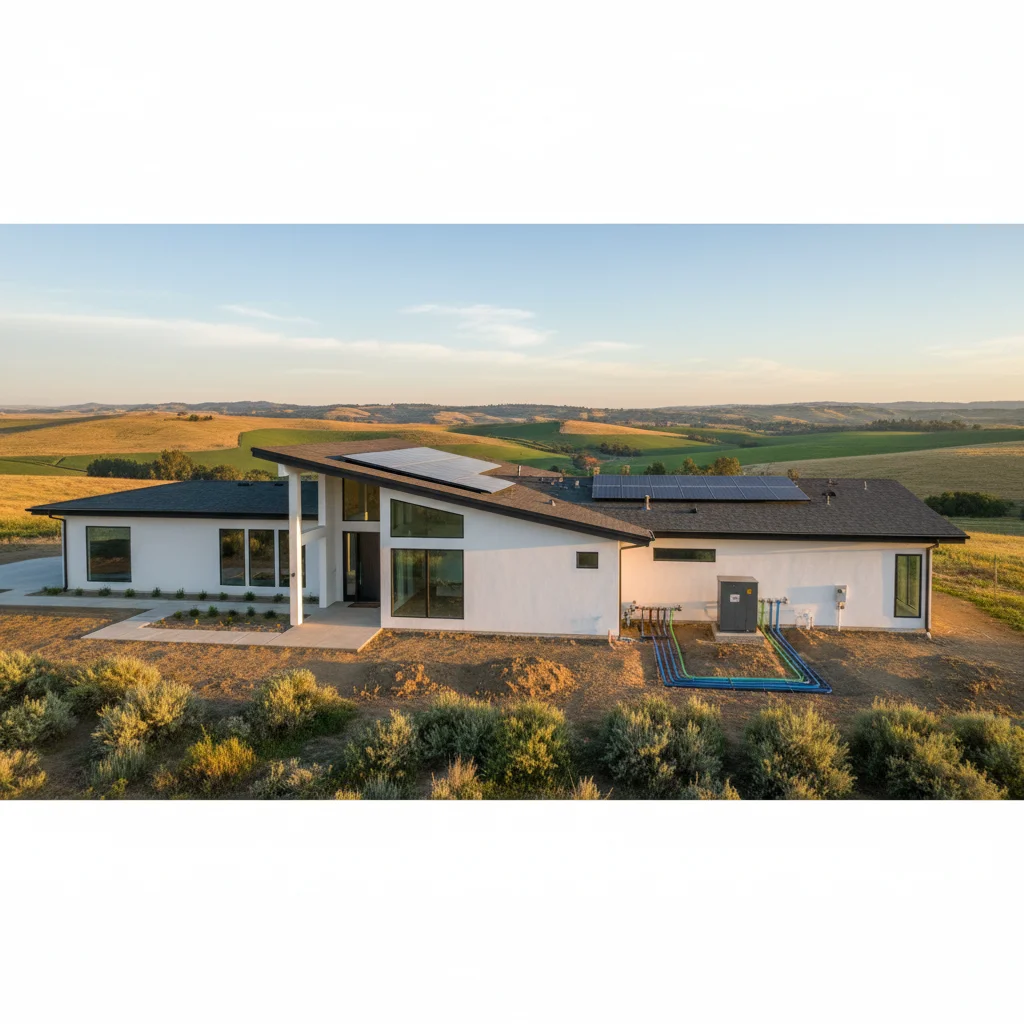
California homeowners installing geothermal systems in the Central Valley paid $18,000 to $35,000 in 2026 before rebates—but the 30% federal tax credit and utility rebates cut those costs to as low as $10,500 for qualifying ENERGY STAR systems. The gap between upfront price and net cost represents the difference between a luxury upgrade and a financially viable home improvement that pays for itself in 7 to 12 years.
Geothermal installation costs in the Central Valley range from $18,000 to $35,000 before incentives; the federal tax credit ended for expenditures made after December 31, 2025 (IRS FS-2025-05), so only state and utility rebates reduce that price.
But here's the tension: the Central Valley's extreme temperature swings—summers topping 105°F and winters dropping to 32°F—create ideal conditions for geothermal efficiency gains of 300-500% over traditional HVAC. Yet fewer than 2% of Central Valley homeowners install geothermal systems, leaving $15,000 to $25,000 in combined federal and utility incentives unclaimed annually. The cost barrier isn't the system—it's understanding which configurations qualify for maximum rebates.
How Much Does Geothermal Installation Cost in the Central Valley?
Ground-source heat pump installations in the Central Valley cost $18,000 to $35,000 depending on system size, loop type, and property geology. Horizontal loop systems average $18,000 to $25,000 for homes under 2,500 square feet, while vertical bore systems requiring drilling reach $28,000 to $35,000.
Loop type drives 40-60% of total cost variation. Horizontal systems require 400-600 feet of trenching at $10-$15 per linear foot, totaling $4,000-$9,000 for excavation alone. Vertical systems drill 150-300 feet deep at $15-$30 per foot, adding $4,500-$9,000 in boring costs but occupying 75% less yard space. And soil composition matters—clay-heavy Central Valley soils reduce drilling difficulty by 15-20% compared to rocky terrain, lowering vertical bore costs by $2,000-$4,000.
Equipment accounts for $8,000 to $14,000 of total project cost. ENERGY STAR Most Efficient models like the WaterFurnace 7 Series (EER 41.2) cost $12,000-$14,000 installed, while standard-efficiency units (EER 16-20) start at $8,000. But higher-efficiency models qualify for both the 30% federal tax credit and utility rebates, reducing net cost by $5,600-$8,400 per installation.
Labor and permitting add $4,000 to $7,000. HVAC contractors in Fresno, Stockton, and Modesto charge $85-$125 per hour for geothermal installations, with typical projects requiring 40-60 labor hours. And permitting fees range from $300 to $800 depending on jurisdiction.
Use our free rebate calculator to estimate your net installation cost after federal and utility incentives.
What Geothermal Systems Qualify for California Rebates in 2026?
Ground-source heat pump systems meeting ENERGY STAR Most Efficient criteria qualify for the 30% federal tax credit and California utility rebates totaling $2,000 to $4,000. PG&E, SMUD, and TID offer rebates for systems with Energy Efficiency Ratio (EER) ratings of 17.1 or higher.
| Program | Rebate Amount | Efficiency Requirement | Application Deadline |
|---|---|---|---|
| Federal Tax Credit (IRA) | Ended Dec 31, 2025 | — | Ended Dec 31, 2025 |
| PG&E Energy Upgrade California | $2,000-$4,000 | EER ≥17.1, COP ≥3.6 | Rolling (subject to budget) |
| SMUD Residential Energy Assistance | $1,500 per ton | ENERGY STAR Most Efficient | June 30, 2027 |
The federal Residential Clean Energy Credit (Section 25D) ended for expenditures made after December 31, 2025, and the IRS treats an expenditure as made when installation is completed (IRS FS-2025-05). Federal tax credits for this work have ended, but state, local and utility rebates may still apply; check what is available at your address with the DuloCore rebate calculator.
California utility rebates require pre-approval and third-party verification. PG&E's Energy Upgrade California program mandates HERS rater inspection before and after installation, adding $400-$600 in verification costs but unlocking $2,000-$4,000 in rebates for systems achieving 15% or greater whole-home energy savings. And SMUD rebates pay $1,500 per ton of cooling capacity for systems sized between 3 and 5 tons.
Eligible equipment includes closed-loop systems (horizontal, vertical, or pond configurations) and open-loop systems drawing from wells or surface water. So homeowners with existing wells can reduce loop installation costs by $5,000-$8,000 while still qualifying for full federal and utility incentives.
"Ground-source heat pumps reduce heating and cooling energy use by 30-70% compared to conventional systems, making them one of the most efficient residential technologies available." — U.S. Department of Energy
Which Geothermal Brands Offer the Best Efficiency Ratings for Central Valley Homes?
WaterFurnace 7 Series and ClimateMaster Trilogy Q-Mode systems achieve EER ratings above 40, qualifying for maximum federal and utility rebates while delivering 400-500% heating efficiency in the Central Valley's climate zone 13. These models cost $12,000-$16,000 installed but generate $8,400-$11,200 in combined tax credits and rebates.
WaterFurnace dominates high-efficiency installations with EER 41.2 (heating COP 5.0) on the 7 Series and EER 38.1 on the 5 Series. ClimateMaster's Trilogy Q-Mode reaches EER 40.8 with variable-speed compressors that reduce electricity consumption by 20-30% during shoulder seasons when full capacity isn't needed. And Bosch's Greensource CDi Series delivers EER 30.4 at a lower price point of $10,000-$12,000 installed.
Brand reliability varies significantly. WaterFurnace and ClimateMaster offer 10-year compressor warranties and maintain 95%+ customer satisfaction ratings across 20+ years of residential installations. But lesser-known brands like Enertech and Hydron-Module lack extensive dealer networks in the Central Valley, complicating warranty service and routine maintenance.
Central Valley climate considerations favor two-stage or variable-speed compressors. Summer cooling loads in Fresno and Bakersfield reach 4-5 tons for typical 2,000-square-foot homes, while winter heating demands drop to 2-3 tons. So variable-capacity systems like the ClimateMaster Tranquility 30 reduce cycling frequency by 40-50%, extending compressor lifespan from 15 to 20+ years.
For detailed federal credit eligibility by model, see our geothermal tax credit guide.
How Long Does It Take to Recover Your Geothermal Installation Investment?
Central Valley homeowners recover geothermal installation costs in 7 to 12 years through combined energy savings and incentive payments, with annual utility bill reductions of $1,200 to $2,400 offsetting net system costs of $10,500 to $24,500 after federal and state rebates.
Payback period depends on replaced system efficiency and energy usage patterns. Homes replacing 15-20 SEER air conditioners and 80% AFUE furnaces see 50-65% annual energy cost reductions, recovering net investment in 7-9 years. But properties upgrading from newer 18-20 SEER heat pumps achieve only 25-35% savings, extending payback to 11-14 years.
Electricity rates accelerate return on investment. PG&E's tiered pricing structure penalizes high summer usage at $0.42-$0.51 per kWh, while geothermal systems shift cooling loads to more efficient ground-loop heat exchange. And SMUD's flat-rate structure ($0.14-$0.16 per kWh) reduces savings potential by 30-40% compared to PG&E territory.
| Scenario | Net Cost After Rebates | Annual Savings | Payback Period |
|---|---|---|---|
| 2,000 sq ft home, PG&E, replacing 14 SEER AC + 80% furnace | $14,000 | $2,100 | 6.7 years |
| 2,500 sq ft home, SMUD, replacing 16 SEER heat pump | $18,500 | $1,400 | 13.2 years |
| 3,000 sq ft home, PG&E, replacing 15 SEER AC + 92% furnace | $22,000 | $2,600 | 8.5 years |
Net metering doesn't apply to geothermal systems—only solar generates sellable credits. But pairing geothermal with solar panels creates energy-neutral homes where annual utility costs drop below $200, recovering combined system investment in 8-12 years versus 15-20 years for solar-only installations. Learn more about combining systems in our energy tax credits article.
Is Geothermal Better Than Heat Pumps or HVAC for Central Valley Climate Zones?
Geothermal systems outperform air-source heat pumps by 30-40% in heating efficiency and 15-20% in cooling efficiency in the Central Valley's climate zone 13, where summer temperatures exceed 100°F for 60-90 days annually. Ground temperatures remain stable at 58-62°F year-round, allowing geothermal systems to maintain COP 3.5-5.0 even during extreme weather.
Air-source heat pumps lose 25-35% efficiency when outdoor temperatures drop below 40°F or rise above 95°F, forcing supplemental resistance heating or reduced cooling capacity. So Central Valley homeowners using air-source systems pay 40-60% higher heating bills during December-February cold snaps and 20-30% higher cooling costs during July-August heat waves compared to geothermal installations.
Upfront cost differences narrow after incentives. Air-source heat pumps cost $8,000-$14,000 installed and qualify for the $2,000 federal heat pump tax credit plus $500-$1,500 utility rebates, yielding net costs of $5,500-$10,500. Geothermal systems cost $18,000-$35,000 before rebates but drop to $10,500-$24,500 after the 30% federal credit (this federal credit ended for expenditures made after December 31, 2025) and $2,000-$4,000 utility rebates. And the $4,000-$14,000 net cost premium recovers in 5-9 years through superior efficiency.
Traditional HVAC systems (gas furnace + central AC) cost $6,000-$12,000 installed but carry operating costs of $1,800-$3,200 annually in the Central Valley. Geothermal reduces those costs to $600-$1,200 annually while eliminating combustion risks and reducing maintenance frequency from annual to biannual service intervals.
For specific air-source alternatives, review our heat pump rebates comparison guide.
How Long Will Your Geothermal System Last and What Maintenance Do You Need?
Ground-source heat pump indoor components last 20 to 25 years while underground loops function for 50+ years with zero maintenance, creating lifecycle costs 40-50% lower than air-source systems requiring replacement every 12-15 years. Annual maintenance costs $150-$300 for filter changes and refrigerant checks.
Compressor and heat exchanger warranties range from 10 years (parts only) to 10 years (parts and labor) depending on manufacturer. WaterFurnace and ClimateMaster offer the longest coverage, while budget brands like Enertech limit labor coverage to 1-2 years. And extended warranties add $800-$1,500 upfront but eliminate out-of-pocket compressor replacement costs of $3,000-$5,000.
Loop longevity depends on installation quality and pipe material. High-density polyethylene (HDPE) loops installed by certified IGSHPA contractors last 50-100 years without leaks or performance degradation. But cross-linked polyethylene (PEX) systems and poorly backfilled trenches fail within 15-25 years, requiring $8,000-$15,000 in excavation and replacement costs.
Routine maintenance includes: - Annual filter replacement ($30-$50 for MERV 11-13 filters) - Biannual refrigerant pressure checks ($100-$150 per service call) - Loop fluid testing every 3-5 years ($200-$300 to verify antifreeze concentration) - Desuperheater descaling ($150-$250 annually if integrated with hot water heating)
Central Valley's hard water requires more frequent descaling than coastal regions. Homes with total dissolved solids (TDS) above 400 ppm need annual descaling versus 18-24 month intervals for TDS below 200 ppm.
Official Sources
- U.S. Department of Energy Geothermal Heat Pumps — Federal efficiency data and technology overviews
- Database of State Incentives for Renewables & Efficiency — Comprehensive state and utility rebate program listings
- ENERGY STAR Most Efficient Geothermal Heat Pumps — Qualifying equipment specifications and federal tax credit guidance (note: the federal 25C and 25D credits ended for projects completed after December 31, 2025)
Frequently Asked Questions
What is the average cost of geothermal installation in the Central Valley?
The average cost ranges from $18,000 to $35,000 before incentives, with horizontal loop systems averaging $20,000-$25,000 and vertical bore systems reaching $28,000-$35,000. After applying the 30% federal tax credit and $2,000-$4,000 in utility rebates, net costs drop to $10,500-$24,500. Installation expenses include equipment ($8,000-$14,000), loop installation ($4,000-$9,000), labor ($3,000-$5,000), and permitting ($300-$800).
How much money can you get back from geothermal rebates in California?
California homeowners receive 30% of total installation costs back through the federal Residential Clean Energy Credit with no upper dollar limit, plus $2,000-$4,000 in utility rebates from PG&E, SMUD, or TID for ENERGY STAR Most Efficient systems. A typical $22,000 installation generates $6,600 in federal tax credits and $3,000 in utility rebates, totaling $9,600 in combined incentives. The federal Residential Clean Energy Credit (Section 25D) ended for expenditures made after December 31, 2025, and the IRS treats an expenditure as made when installation is completed (IRS FS-2025-05).
Are you eligible for geothermal tax credits if you already have HVAC installed?
The federal home energy tax credits (Sections 25C and 25D) ended for projects completed after December 31, 2025 (IRS FS-2025-05). The federal Residential Clean Energy Credit (Section 25D) ended for expenditures made after December 31, 2025, and the IRS treats an expenditure as made when installation is completed (IRS FS-2025-05). But the credit applies only to geothermal equipment costs, not HVAC removal or disposal fees.
When is the deadline to claim geothermal installation rebates in California?
The federal Residential Clean Energy Credit (Section 25D) ended for expenditures made after December 31, 2025, and the IRS treats an expenditure as made when installation is completed (IRS FS-2025-05). California utility rebates operate on annual or rolling budgets—PG&E's Energy Upgrade California program accepts applications through December 2027 subject to funding availability, while SMUD's Residential Energy Assistance program runs through June 30, 2027. Homeowners should apply for utility rebates within 90 days of installation completion to secure available funding.
How does the cost of geothermal compare to traditional air conditioning systems?
Geothermal systems cost $18,000-$35,000 installed compared to $6,000-$12,000 for traditional central air conditioning plus gas furnace combinations. But after the 30% federal tax credit and utility rebates, net geothermal (these federal credits ended for projects completed after December 31, 2025) costs of $10,500-$24,500 compete with premium 20+ SEER air-source heat pump installations costing $12,000-$16,000 after incentives. Annual operating costs favor geothermal by $1,200-$2,000, recovering the upfront premium in 7-12 years while delivering 50+ year loop lifespan versus 12-15 year AC replacement cycles. (Note: Federal tax credit percentages and availability are subject to change; the 30% Residential Clean Energy Credit under Section 25D expired December 31, 2025. Verify current incentives at energy.gov.)
Ready to calculate your exact savings? Use our free rebate calculator to see how much you'll save on geothermal installation in the Central Valley with current federal tax credits and utility rebates. Enter your home size, existing HVAC type, and zip code to get a personalized cost breakdown in under 60 seconds.
Last updated: April 14, 2026. Reviewed by the DuloCore Editorial Team. About our authors.
Check your California heat pump rebate eligibility — see the programs you qualify for and the dollar amounts on our California heat pump rebate finder.