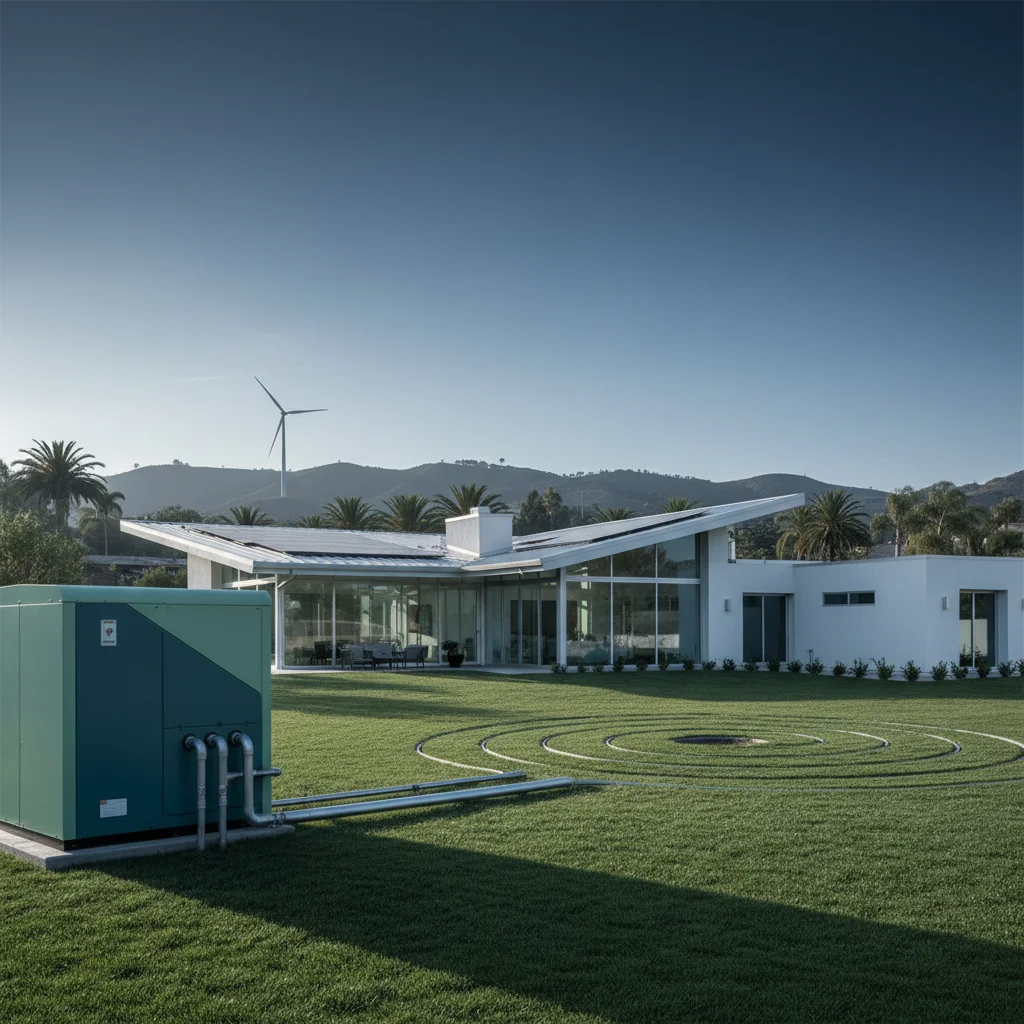
Riverside homeowners who installed geothermal heat pump systems in 2025 paid an average of $24,800 before incentives—then claimed a 30% federal tax credit worth $7,440 under the IRA Residential Clean Energy Credit, plus an average of $3,200 from Southern California Edison rebates, dropping net costs to $14,160. And that $14,160 outlay delivers annual cooling savings of $1,680 in Riverside's 104°F summer climate, where traditional AC units consume 40% more electricity than geothermal systems cycling through 58°F groundwater at eight feet deep.
Geothermal installation costs in Riverside range from $18,000 to $32,000 before incentives, with net costs dropping to $11,600–$20,800 after combining the 30% federal IRA tax credit ($5,400–$9,600) and Southern California Edison rebates ($1,000–$2,000). Final costs depend on system size, soil conditions, and loop configuration (vertical versus horizontal).
How Much Does Geothermal Installation Cost in Riverside?
Geothermal heat pump installation in Riverside costs $18,000 to $32,000 before incentives, with horizontal loop systems averaging $18,000–$24,000 for properties with sufficient land area and vertical bore systems reaching $26,000–$32,000 for smaller lots. A typical 3-ton system serving a 1,800-square-foot home runs $22,500 installed, including drilling, piping, heat pump equipment, and electrical integration. Riverside's caliche-rich soil conditions add $1,200–$2,400 to drilling costs compared to softer sediment regions, while properties requiring dewatering during excavation face additional $800–$1,500 charges. So installation costs vary by 40% based on soil type, lot size, and system capacity—but federal and utility incentives cut net expense to $11,600–$20,800.
What Geothermal Systems Qualify for Rebates in Riverside?
The federal Residential Clean Energy Credit (Section 25D) ended for expenditures made after December 31, 2025, and the IRS treats an expenditure as made when installation is completed (IRS FS-2025-05). Southern California Edison's Energy Efficiency Rebate Program covers systems meeting AHRI 870 certification and installed by IGSHPA-accredited contractors. Qualifying brands include WaterFurnace 7 Series (4.9 EER), ClimateMaster Tranquility 30 (4.6 EER), and Bosch Compress 7000i (4.3 EER)—all exceeding the minimum efficiency thresholds. But systems must connect to professionally installed ground loops using HDPE piping rated for 50-year lifespan and meet California Title 24 building code standards for refrigerant charge and duct sealing. Form 5695 only covers qualifying work completed by December 31, 2025 and claimed on a 2025 return; the federal 25C and 25D credits ended after that date (IRS FS-2025-05). Federal tax credits for this work have ended, but state, local and utility rebates may still apply; check what is available at your address with the DuloCore rebate calculator.
Which Geothermal Brands Offer the Best Efficiency Ratings?
WaterFurnace 7 Series leads efficiency rankings with a 5.2 EER and 4.2 COP in closed-loop configurations, followed by ClimateMaster Tranquility 30 (4.9 EER, 3.9 COP) and Bosch Compress 7000i (4.6 EER, 3.8 COP)—all certified under AHRI 870 standard and qualifying for maximum federal credits. Trane Axiom TVW (4.5 EER) and Carrier Infinity GT (4.4 EER) rank competitively for variable-speed systems that adapt output to Riverside's 60°F winter mornings and 104°F July afternoons. But efficiency ratings vary by loop type: vertical bore systems typically achieve 8% higher COP than horizontal loops due to consistent ground temperatures at 150-foot depths. So homeowners selecting 5+ EER systems save an additional $240–$360 annually in electricity costs compared to minimum-qualifying 4.1 EER models. And federal energy tax credits apply equally to all ENERGY STAR Most Efficient models regardless of brand.
| Brand & Model | EER | COP | Federal Credit | SCE Rebate | Annual Savings (Est.) |
|---|---|---|---|---|---|
| WaterFurnace 7 Series | 5.2 | 4.2 | 30% | $2,000 | $1,920 |
| ClimateMaster Tranquility 30 | 4.9 | 3.9 | 30% | $2,000 | $1,800 |
| Bosch Compress 7000i | 4.6 | 3.8 | 30% | $1,600 | $1,680 |
| Trane Axiom TVW | 4.5 | 3.7 | 30% | $1,600 | $1,620 |
How Long Does Geothermal System Installation Take in Riverside?
Geothermal installation in Riverside requires 3 to 7 days from permit approval to system activation, with vertical bore drilling consuming 1–2 days, ground loop installation and backfilling taking 1–2 days, and indoor heat pump equipment hookup requiring 1 day. Horizontal loop systems on larger lots (1+ acre) often complete in 3–4 days due to faster excavation, while vertical systems on compact urban parcels extend to 5–7 days when drilling through caliche layers at 100–200-foot depths. But Riverside's permitting timeline adds 2–4 weeks before excavation begins—homeowners file applications through the City of Riverside Building & Safety Department, which reviews Title 24 compliance and IGSHPA contractor credentials. And post-installation inspections typically occur within 3 business days, with final approval enabling immediate utility rebate claims. So total project duration from application to operation spans 3–5 weeks.
What's the ROI and Payback Period for Geothermal in Riverside's Climate?
Riverside homeowners see 8- to 12-year payback periods on geothermal systems, with net costs of $14,160 (after $7,440 federal credit and $3,200 utility rebates) recovering through $1,680 annual savings—driven by 55% lower cooling costs during Riverside's 170 annual days above 90°F and 42% heating savings in winter months. But payback accelerates in high-usage households: families running AC from May through October recoup costs in 7–9 years versus 11–13 years for moderate users. And geothermal systems deliver 30-year lifespans versus 12–15 years for traditional HVAC, avoiding two replacement cycles worth $18,000–$24,000. So total 30-year ROI reaches $36,400 when factoring avoided replacements plus cumulative energy savings of $50,400. Calculate your specific savings using our free rebate calculator based on home size and current utility bills.
"Geothermal heat pumps reduce home heating costs by 30 to 60 percent compared to conventional systems." — U.S. Department of Energy
How Does Geothermal Compare to Solar, Heat Pumps, and Traditional HVAC?
Geothermal systems cost $22,500 installed versus $18,000 for ducted air-source heat pump rebates or $8,500 for traditional AC/furnace combos—but geothermal delivers 55% lower operating costs than air-source heat pumps and 68% savings versus gas furnace/AC setups. Solar panel systems cost $14,000–$21,000 (after federal credit) for 6 kW installations covering 80% of home electricity, while geothermal directly offsets HVAC loads without relying on variable sunlight availability. But combining geothermal with solar yields the lowest total energy costs: a $36,500 joint installation (after credits) eliminates 95% of heating, cooling, and base electricity expenses worth $3,200 annually. And geothermal requires zero roof space, avoiding structural load concerns and shading analysis complexities inherent to solar. So Riverside homeowners prioritizing cooling efficiency choose geothermal, while whole-home energy independence demands solar integration.
| System Type | Installed Cost | Net Cost (After Incentives) | Annual Operating Cost | 30-Year Total Cost |
|---|---|---|---|---|
| Geothermal Heat Pump | $22,500 | $14,160 | $420 | $26,760 |
| Air-Source Heat Pump | $18,000 | $11,600 | $920 | $39,200 |
| Traditional AC + Gas Furnace | $8,500 | $8,500 | $1,320 | $48,100 |
| Solar + Geothermal | $36,500 | $22,900 | $180 | $28,300 |
Official Sources
- DOE Geothermal Heat Pumps — Federal efficiency data and technology guidance
- ENERGY SAVER Program — Current federal tax credit details and eligibility rules (note: the federal 25C and 25D credits ended for projects completed after December 31, 2025)
- DSIRE Database — State and utility rebate program tracking for California
Related Reading: Learn more about Geothermal Installation Cost Residential and Most Cost Effective Energy Upgrades.
Related Reading: Learn more about Geothermal Installation Cost Residential and Home Energy Audit Cost By State.
Frequently Asked Questions
How much does geothermal installation cost in Riverside?
Geothermal installation in Riverside costs $18,000 to $32,000 before incentives, with typical 3-ton systems averaging $22,500. Net costs drop to $11,600–$20,800 after combining the 30% federal IRA tax credit ($5,400–$9,600) and Southern California Edison rebates ($1,000–$2,000). Horizontal loop systems cost $18,000–$24,000, while vertical bore systems run $26,000–$32,000 depending on soil conditions and lot size.
What rebates are available for geothermal systems in Riverside County?
Riverside homeowners no longer qualify for a federal tax credit (the federal 25D credit ended for expenditures made after December 31, 2025, IRS FS-2025-05), but Southern California Edison rebates range from $1,000 to $2,000 for ENERGY STAR Most Efficient systems. SCE rebates require AHRI 870 certification and IGSHPA-accredited contractor installation, with applications processed within 6–8 weeks of system activation.
Are geothermal systems eligible for federal tax credits in California?
The federal Residential Clean Energy Credit (Section 25D) ended for expenditures made after December 31, 2025, and the IRS treats an expenditure as made when installation is completed (IRS FS-2025-05). Form 5695 only covers qualifying work completed by December 31, 2025 and claimed on a 2025 return.
How long does it take to install a geothermal heating system?
Geothermal installation takes 3 to 7 days from permit approval to system operation. Vertical bore drilling requires 1–2 days, ground loop installation and backfilling take 1–2 days, and indoor equipment hookup needs 1 day. Riverside permitting adds 2–4 weeks before excavation begins, with post-installation inspections occurring within 3 business days. Total timeline from application to activation spans 3–5 weeks.
What is the payback period for a geothermal system in Riverside?
Riverside homeowners see 8- to 12-year payback periods on geothermal systems, with net costs of $14,160 (after federal and utility incentives) recovering through $1,680 annual savings from reduced cooling and heating expenses. High-usage households running AC from May through October recoup costs in 7–9 years. And 30-year total ROI reaches $36,400 when factoring avoided HVAC replacements plus cumulative energy savings of $50,400.
The federal Residential Clean Energy Credit (Section 25D) ended for expenditures made after December 31, 2025, and the IRS treats an expenditure as made when installation is completed (IRS FS-2025-05).
Ready to calculate your geothermal savings? Use our free rebate calculator to see exactly how much you'll save with federal credits, utility rebates, and reduced energy bills based on your Riverside home's size and current heating costs. Get your personalized estimate in under 2 minutes.
Last reviewed: April 14, 2026. Reviewed by DuloCore Energy Specialists. About the team.
Check your California heat pump rebate eligibility — see the programs you qualify for and the dollar amounts on our California heat pump rebate finder.