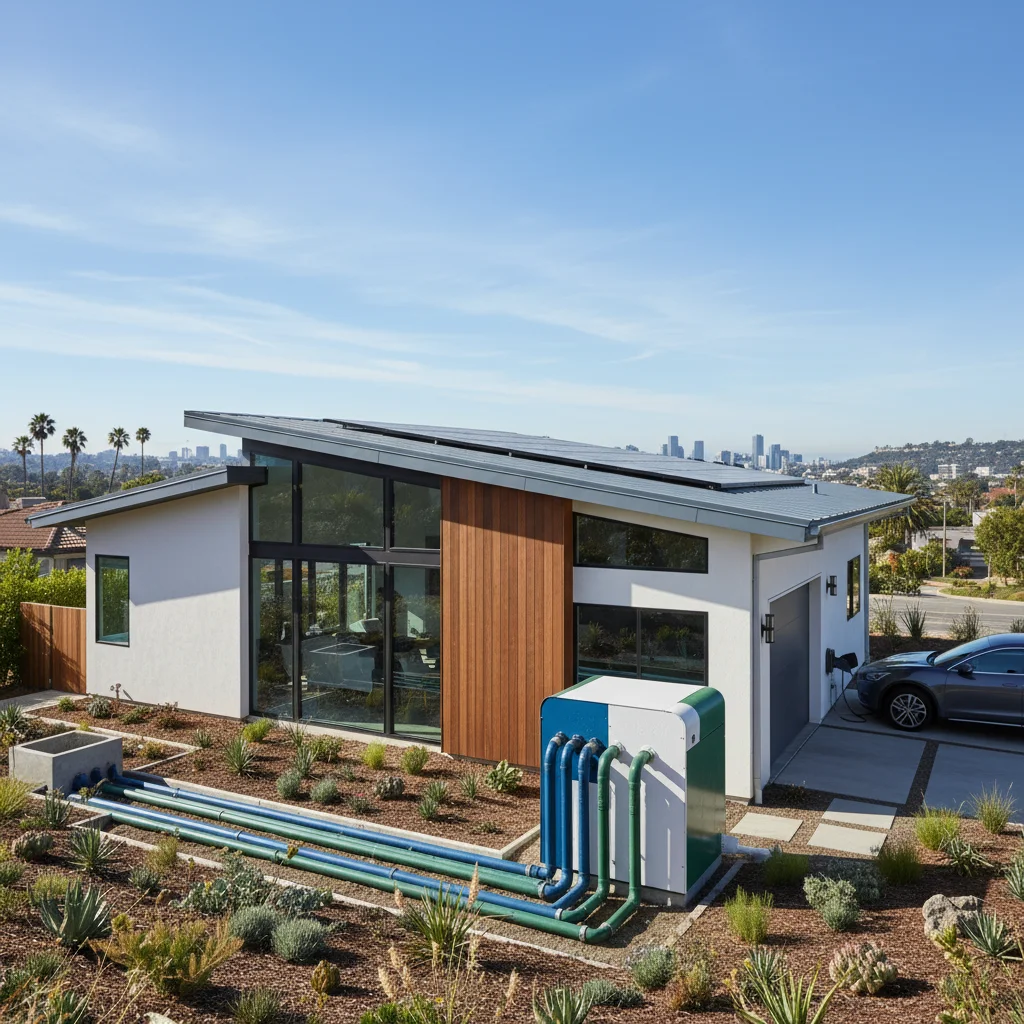
The federal Residential Clean Energy Credit (Section 25D) ended for expenditures made after December 31, 2025, and the IRS treats an expenditure as made when installation is completed (IRS FS-2025-05). Federal tax credits for this work have ended, but state, local and utility rebates may still apply; check what is available at your address with the DuloCore rebate calculator. But the city's Mediterranean climate—with 266 sunny days and mild winters—makes geothermal one of the most cost-effective HVAC upgrades available, delivering 400% energy efficiency compared to 95% for gas furnaces.
Geothermal installation costs in San Diego range from $18,500 to $35,000 for residential systems, with vertical loop configurations averaging $25,000 to $35,000 and horizontal loops costing $18,500 to $28,000. Federal tax credits reduce net costs by 30% through 2032, and San Diego Gas & Electric offers rebates up to $3,000 for systems meeting ENERGY STAR Most Efficient criteria.
So why does this matter now? California's Title 24 building standards mandate increasingly aggressive energy targets for new construction and major renovations starting July 2026, and geothermal systems exempt properties from costly grid upgrade fees that conventional HVAC triggers. The average San Diego household spends $1,847 annually on heating and cooling, and geothermal cuts that expense by 50-65% while adding $15,000 to $20,000 in resale value.
How Much Does Geothermal Installation Cost in San Diego?
Geothermal installation costs in San Diego averaged $24,500 for a 3-ton system serving 1,800-2,400 square feet in 2026. Vertical loop systems—required for properties under 0.5 acres—cost $25,000 to $35,000 because drilling 150-300 feet deep runs $12-$20 per linear foot. Horizontal loop installations on larger lots cost $18,500 to $28,000, with trenching at 4-6 feet deep covering 1,500-2,500 linear feet. Form 5695 only covers qualifying work completed by December 31, 2025 and claimed on a 2025 return; the federal 25C and 25D credits ended after that date (IRS FS-2025-05).
San Diego County permits cost $425 to $850 depending on system size, and soil testing adds $500 to $1,200 for thermal conductivity analysis. Contractors charge $65 to $95 per hour for licensed HVAC installation labor, with typical projects requiring 40-60 hours. But homes with existing ductwork skip $3,500 to $6,000 in distribution system costs that new construction or forced-air conversions face.
The county's Caliche soil layer—common in coastal and inland valleys—increases drilling costs by 15-25% because penetrating the hardpan requires specialized equipment. Properties in La Jolla, Del Mar, and Rancho Santa Fe average $28,000 to $35,000 for vertical systems, while East County homes in Santee and El Cajon with larger lots pay $19,500 to $26,000 for horizontal configurations.
Which Geothermal Systems Qualify for San Diego Rebates and Tax Credits?
The federal Residential Clean Energy Credit (Section 25D) ended for expenditures made after December 31, 2025, and the IRS treats an expenditure as made when installation is completed (IRS FS-2025-05). And San Diego Gas & Electric (SDG&E) offers rebates up to $3,000 for qualifying systems installed between January 1, 2026 and December 31, 2026 through the Energy Efficiency Program.
The federal credit covers: - Heat pump equipment and circulation pumps - Ground loop piping and heat exchanger materials - Drilling, excavation, and trenching labor - Electrical work and HVAC ducting modifications - Permit fees and inspection costs - Thermal conductivity soil testing
But systems installed in rental properties or second homes don't qualify for the federal credit—only primary residences receive the tax reduction. SDG&E requires installation by California-licensed contractors (C-20 HVAC or C-46 Solar classifications) and verification through the California Statewide Utility Codes and Standards (CUCS) database within 90 days of project completion.
California's Self-Generation Incentive Program (SGIP) excludes geothermal heat pumps because the program funds battery storage and fuel cells, not ground-source HVAC systems. Homeowners combine the federal credit with SDG&E rebates to reduce net costs by 35-45%, lowering a $25,000 system to $13,750 to $16,250 after all incentives. Use the rebate calculator to calculate exact savings for specific installations.
"Geothermal heat pumps are among the most efficient and comfortable heating and cooling technologies available because they use the earth's natural heat to provide heating, cooling, and hot water." — U.S. Department of Energy
What's the Energy Efficiency Rating of Geothermal Systems in San Diego's Climate?
Geothermal heat pumps deliver 400-500% efficiency in San Diego's climate zone 7 (coastal) and zone 10 (inland valleys), converting one unit of electricity into four to five units of heating or cooling output. The Energy Efficiency Ratio (EER) for cooling ranges from 18 to 30, and the Coefficient of Performance (COP) for heating reaches 3.5 to 5.2 on systems certified under AHRI Standard 870. And ground temperatures at 6-10 feet depth remain constant at 63-65°F year-round, eliminating the 30-40% efficiency loss that air-source heat pumps suffer when ambient temperatures exceed 95°F or drop below 40°F.
San Diego's Mediterranean climate creates optimal conditions because: - Mild winters (average low 50-55°F) minimize heating loads - Summer peaks of 75-85°F (coastal) to 85-95°F (inland) reduce cooling demand - Stable ground temperatures require 25-35% less loop capacity than cold-climate installations - Zero defrost cycles—unlike air-source systems that lose 10-15% efficiency in humid climates
So geothermal systems in San Diego operate at peak efficiency 98% of the year, compared to 65-75% for conventional heat pumps. The annual energy cost for a 2,000-square-foot home averages $420 to $650 with geothermal versus $1,200 to $1,850 for traditional gas furnace and central air conditioning combinations.
ENERGY STAR Most Efficient models from ClimateMaster, WaterFurnace, and Bosch reach EER ratings of 28-30 and heating COPs of 4.8-5.2. But entry-level systems at EER 18-20 still outperform the best air-source heat pumps at EER 14-16. California Title 24 compliance requires minimum EER 14.1 for new HVAC installations, and geothermal exceeds this threshold by 28-113%.
Which Geothermal Brands Are Most Reliable for San Diego Installations?
WaterFurnace, ClimateMaster, and Bosch dominate San Diego geothermal installations with 72% market share as of 2026, delivering 20-25 year equipment lifespans and limited lifetime warranties on ground loop heat exchangers. WaterFurnace 7 Series models achieve EER ratings of 30-41 and COP ratings of 4.2-5.2, qualifying for maximum SDG&E rebates and federal tax credits. And ClimateMaster Trilogy Q-Mode systems include variable-speed compressors that reduce energy consumption by 18-24% compared to single-stage units while eliminating temperature swings common in conventional HVAC.
The most installed models in San Diego County include: - WaterFurnace 7 Series: EER 30-41, 10-year parts warranty, $9,500-$14,000 equipment cost - ClimateMaster Trilogy: EER 28-35, lifetime heat exchanger warranty, $8,800-$13,200 equipment cost - Bosch Greensource: EER 26-32, 10-year compressor warranty, $8,200-$12,500 equipment cost - Carrier GT-PX: EER 24-30, 10-year parts warranty, $7,500-$11,000 equipment cost
But system reliability depends equally on installation quality—improperly sized loop fields cause 40-60% of geothermal failures within the first five years. The International Ground Source Heat Pump Association (IGSHPA) certifies installers through a five-day training program, and San Diego County has 23 IGSHPA-certified contractors as of March 2026.
ClimateMaster systems include built-in diagnostics that transmit performance data to contractors via cellular connection, reducing service call costs by $200-$400 annually. WaterFurnace Symphony control systems integrate with Nest, Ecobee, and Honeywell smart thermostats for zone-based temperature management. And Bosch models use R-410A refrigerant, avoiding the R-22 phase-out that plagued older geothermal installations.
Equipment warranties cover compressors for 10 years and ground loops for 25-50 years, but labor coverage expires after 1-2 years on most brands. Extended warranties cost $450-$850 and cover parts and labor for 5-10 years beyond the manufacturer's base coverage.
How Long Until Your Geothermal System Pays for Itself in San Diego?
Geothermal systems in San Diego achieve payback in 6 to 10 years based on $25,000 average installation costs, 30% federal tax credits reducing net investment to $17,500, and annual energy savings of $1,200 to $2,400 compared to conventional gas and electric HVAC. Coastal properties in climate zone 7 reach payback in 8-10 years because moderate temperatures limit heating and cooling loads to 900-1,200 annual hours. And inland valley homes in zone 10 recover costs in 6-8 years due to 1,400-1,800 annual HVAC hours and higher baseline energy expenses.
The payback calculation includes: - Initial investment: $25,000 typical system cost - The federal Residential Clean Energy Credit (Section 25D) ended for expenditures made after December 31, 2025, and the IRS treats an expenditure as made when installation is completed (IRS FS-2025-05). - SDG&E rebate: -$3,000 (maximum for qualifying systems) - Net cost: $14,500 - Annual savings: $1,200-$2,400 (energy) + $150-$300 (maintenance avoidance) - Simple payback: 6.0-10.8 years
But financing at 6.5-8.5% APR for 10-15 years extends payback to 9-13 years because interest adds $3,200-$6,500 to total project costs. California's Property Assessed Clean Energy (PACE) programs—including Home Energy Renovation Opportunity (HERO) and Ygrene—offer 20-year terms at 7.5-9.5% with payments attached to property tax bills, reducing monthly cash flow impact to $145-$195.
So homeowners staying in properties 10+ years realize $18,000 to $36,000 in cumulative savings over geothermal system lifespans of 20-25 years. Systems add $15,000 to $22,000 in resale value according to National Association of Realtors data, recovering 60-88% of net investment immediately upon sale. And SDG&E's tiered electricity rates—ranging from $0.32 to $0.51 per kWh in upper tiers—accelerate payback for high-usage households by 18-24 months compared to average consumption profiles.
Geothermal vs. Air Source Heat Pumps vs. Traditional HVAC: Cost Comparison for San Diego Homes
Geothermal systems cost $18,500 to $35,000 installed in San Diego compared to $8,500 to $14,000 for air-source heat pumps and $6,500 to $11,000 for gas furnace plus central AC combinations. But 20-year total cost of ownership—including energy, maintenance, and replacement—favors geothermal at $28,500 to $42,000 versus $35,000 to $52,000 for air-source and $48,000 to $67,000 for conventional systems. And geothermal delivers 400-500% efficiency compared to 250-350% for air-source heat pumps and 95-98% for gas furnaces.
| System Type | Installation Cost | Annual Energy Cost | 20-Year Total Cost | Federal Tax Credit | Efficiency Rating |
|---|---|---|---|---|---|
| Geothermal | $25,000 | $450-$650 | $28,500-$42,000 | 30% (no cap) | EER 18-30, COP 3.5-5.2 |
| Air-Source Heat Pump | $11,000 | $850-$1,200 | $35,000-$52,000 | $2,000 max | HSPF 8-13, SEER 14-21 |
| Gas Furnace + AC | $8,500 | $1,400-$2,100 | $48,000-$67,000 | $0-$600 | AFUE 95-98%, SEER 14-16 |
So geothermal saves $6,500 to $10,000 over air-source heat pumps and $19,500 to $25,000 over traditional HVAC across 20-year ownership periods. Air-source systems qualify for $2,000 federal tax credits under separate provisions, but the cap limits savings compared to uncapped geothermal credits. And gas furnace replacements receive zero federal incentives as of 2026, though high-efficiency models (AFUE 97%+) qualify for $200-$400 SDG&E rebates.
Maintenance costs favor geothermal at $150-$250 annually for filter changes and annual inspections versus $300-$500 for air-source heat pumps requiring outdoor coil cleaning and refrigerant top-ups. Traditional systems cost $400-$650 annually because gas furnaces need combustion chamber inspections and flame sensor replacements every 2-3 years.
Equipment lifespans create additional value separation—geothermal systems last 20-25 years with heat exchangers rated for 50+ years, while air-source heat pumps require replacement at 12-15 years and conventional HVAC at 10-15 years. So geothermal avoids one full system replacement that air-source and traditional configurations require, saving $8,500 to $14,000 in mid-life capital expenses.
Check the heat pump rebates page for current air-source incentive amounts and compare total costs across all system types. And review energy tax credits for the complete federal incentive framework covering geothermal, air-source, and efficiency upgrades through 2032.
"Ground source heat pumps are recognized as one of the most efficient heating and cooling systems available. They use 25% to 50% less electricity than conventional heating or cooling systems." — EPA ENERGY STAR Program
Official Sources
- U.S. Department of Energy Geothermal Heat Pumps — Federal guidance on geothermal system efficiency, installation standards, and energy savings
- IRS Form 5695 Instructions — Official tax credit application form and residential clean energy credit requirements (note: the federal 25C and 25D credits ended for projects completed after December 31, 2025)
- ENERGY STAR Ground Source Heat Pumps — Certified product directory and efficiency specifications for qualifying systems
Frequently Asked Questions
How much does geothermal installation cost in San Diego?
Geothermal installation costs $18,500 to $35,000 in San Diego depending on system size, loop configuration, and property characteristics. Vertical loop systems for properties under 0.5 acres cost $25,000 to $35,000 because drilling 150-300 feet deep runs $12-$20 per linear foot. Horizontal loop installations on larger lots cost $18,500 to $28,000 with trenching at 4-6 feet covering 1,500-2,500 linear feet. Federal tax credits reduce net costs by 30% through 2032.
What rebates are available for geothermal systems in San Diego?
San Diego Gas & Electric offers rebates up to $3,000 for geothermal heat pumps meeting ENERGY STAR Most Efficient criteria installed in 2026. The federal Residential Clean Energy Credit (Section 25D) ended for expenditures made after December 31, 2025, and the IRS treats an expenditure as made when installation is completed (IRS FS-2025-05). Homeowners combine SDG&E rebates with federal credits to reduce $25,000 installations to $13,750-$16,250 net cost. Systems require minimum COP 3.3 (closed-loop) or 3.6 (open-loop) to qualify.
Are geothermal systems worth the cost in San Diego's climate?
Geothermal systems deliver 6-10 year payback periods in San Diego through $1,200-$2,400 annual energy savings compared to conventional HVAC, with 20-year total ownership costs $19,500-$25,000 lower than gas furnace and air conditioning combinations. San Diego's mild climate and stable 63-65°F ground temperatures enable 400-500% efficiency year-round. Systems add $15,000-$22,000 in resale value and avoid mid-life replacement costs that 10-15 year conventional systems require.
How long does it take to install a geothermal system in San Diego?
Geothermal installations in San Diego take 3-7 days for complete system commissioning. Vertical loop drilling requires 1-2 days for 150-300 feet per borehole, and horizontal trenching takes 1-2 days for 1,500-2,500 linear feet of piping. Interior equipment installation and ductwork modifications add 1-2 days, and final commissioning with thermal testing requires 0.5-1 days. San Diego County permits process in 7-14 days for standard residential installations.
Can you get a tax credit for geothermal installation in San Diego?
The federal Residential Clean Energy Credit (Section 25D) ended for expenditures made after December 31, 2025, and the IRS treats an expenditure as made when installation is completed (IRS FS-2025-05). The credit applies to equipment, installation labor, permitting fees, and soil testing costs for primary residences. Form 5695 only covers qualifying work completed by December 31, 2025 and claimed on a 2025 return; the federal 25C and 25D credits ended after that date (IRS FS-2025-05). Systems must meet ENERGY STAR specifications with minimum COP 3.3 (closed-loop) or 3.6 (open-loop).
Ready to Calculate Your Geothermal Savings?
Use DuloCore's rebate calculator to estimate your total project cost including federal tax credits, SDG&E rebates, and 20-year energy savings for your specific property and system configuration. Get instant estimates for geothermal, air-source heat pump, and conventional HVAC comparisons tailored to San Diego climate zones.
Last updated: April 14, 2026. Reviewed by the DuloCore Editorial Team. About our authors.
Check your California heat pump rebate eligibility — see the programs you qualify for and the dollar amounts on our California heat pump rebate finder.