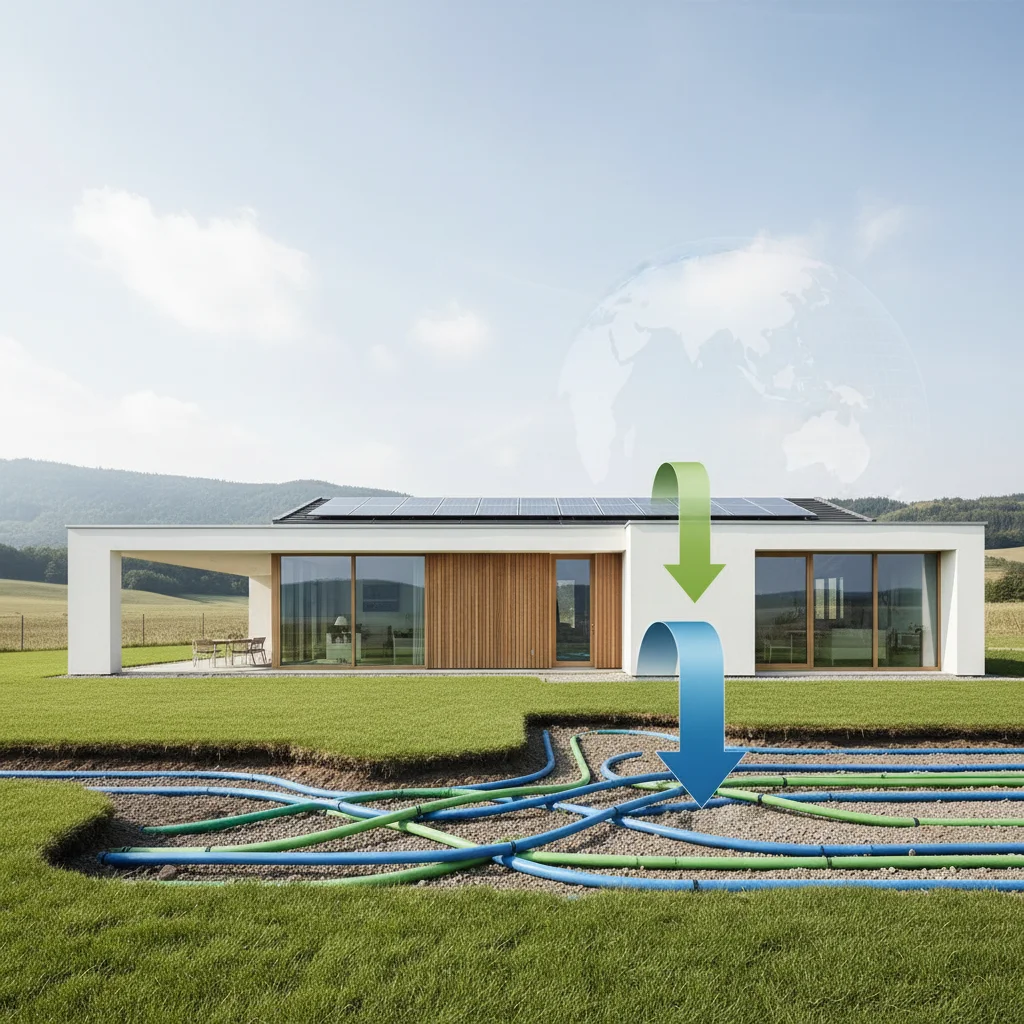
A geothermal loop field sized just 10% too small can cut your heat pump's efficiency by 30% and add $3,000 to your annual heating bills. And a loop field sized 20% too large wastes $8,000 to $12,000 in unnecessary drilling costs with zero performance gain. The difference between a properly sized loop field and a poorly sized one isn't just comfort—it's thousands of dollars in wasted energy and upfront installation costs that never pay back.
What Size Geothermal Loop Field Do You Actually Need for Your Home?
Geothermal loop field sizing in 2026 requires calculating total home heating and cooling loads in BTUs per hour, then matching those loads to ground thermal conductivity measured in BTU per hour per foot per degree Fahrenheit. A 2,000-square-foot home in California typically needs 48,000 BTU/hour of heating capacity, translating to 400 to 600 feet of vertical loop depth or 1,200 to 1,800 feet of horizontal loop length depending on soil composition.
So what determines whether your property gets a 400-foot or 600-foot vertical loop? Ground thermal conductivity varies from 0.6 BTU/hr/ft/°F in dry sand to 2.4 BTU/hr/ft/°F in saturated granite. A certified geothermal installer conducts a thermal conductivity test by drilling a small test bore, installing a temporary loop, running fluid through it at known temperatures, and measuring heat transfer rates over 48 hours. The test costs $1,500 to $3,000 but prevents over-sizing or under-sizing that costs $5,000 to $15,000 to fix after installation.
But thermal conductivity isn't the only variable. Your home's Manual J heat load calculation—required by ACCA (Air Conditioning Contractors of America) standards—determines peak heating and cooling demand. And peak demand varies with insulation quality, window efficiency, air leakage rates, and climate zone. A poorly insulated 2,000-square-foot home in Sacramento might need 60,000 BTU/hour, while a well-insulated home of the same size needs just 36,000 BTU/hour—a 40% difference in loop field size and cost.
Or consider climate impact: ground temperatures 10 feet below the surface stay between 50°F and 60°F year-round in California, but peak summer outdoor temperatures hit 105°F in the Central Valley and peak winter lows drop to 30°F in the Sierras. The wider the gap between ground temperature and peak outdoor temperature, the longer the loop field needs to be to reject or absorb enough heat. California's Mediterranean climate typically requires 150 to 200 feet of vertical bore per ton of heating capacity, while horizontal loops in the same climate need 400 to 600 feet per ton due to shallower depth and lower thermal stability.
So a 3-ton geothermal heat pump—standard for a 1,800 to 2,200-square-foot California home—requires 450 to 600 feet of vertical bore or 1,200 to 1,800 feet of horizontal trench. Accurate sizing is critical to avoid overspending; the federal geothermal tax credit (Section 25D) ended for expenditures made after December 31, 2025 (IRS FS-2025-05).
How Much Does Geothermal Loop Field Sizing and Installation Really Cost?
Vertical loop fields in California cost $15 to $35 per foot of bore depth in 2026, with total costs ranging from $12,000 to $25,000 for a typical residential installation. Horizontal loop fields cost $10 to $20 per foot of trench length, totaling $8,000 to $18,000 for the same heating capacity. And those figures don't include the heat pump unit itself, which adds another $6,000 to $12,000 depending on brand and efficiency rating.
The price spread depends on drilling conditions. Drilling through soft sediment costs $15 to $20 per foot, while drilling through granite or bedrock costs $30 to $35 per foot due to slower drilling speeds and faster drill bit wear. A 500-foot vertical bore in soft clay costs $7,500 to $10,000, while the same depth in granite costs $15,000 to $17,500. Geothermal installers charge $2,000 to $4,000 for site mobilization, equipment rental, and thermal conductivity testing before drilling begins.
But horizontal loops cut drilling costs by 40% to 50% if you have enough land. A horizontal loop field requires 400 to 600 feet of trench per ton of capacity, with trenches 6 to 10 feet deep and 2 to 4 feet wide. A 3-ton system needs 1,200 to 1,800 feet of trench, requiring 0.25 to 0.5 acres of open land with no trees, pavement, or structures. Trenching costs $6 to $12 per linear foot including excavation, pipe installation, and backfill—totaling $7,200 to $21,600 for a full horizontal loop.
So total installed costs for a 3-ton geothermal system with vertical loop field range from $24,000 to $42,000 before incentives. Federal tax credits no longer apply (IRS FS-2025-05). California's TECH Clean California program offers additional rebates of $3,000 to $7,000 for qualified low-income and moderate-income households, cutting net costs to $21,000 to $35,000. Use our free rebate calculator to estimate your specific savings based on household income and location.
And financing matters. The average geothermal system saves $800 to $1,500 per year on heating and cooling costs compared to natural gas furnaces and central air conditioning. At $1,200 annual savings, a $25,000 system pays back in 20.8 years—longer than most homeowners expect. But PACE (Property Assessed Clean Energy) financing programs in California let homeowners finance geothermal systems through property tax assessments with 20-year terms at 5% to 7% interest, keeping monthly payments below monthly energy savings from day one.
Which Federal and State Rebates Can You Claim for a Geothermal Loop Field?
The federal Residential Clean Energy Credit (Section 25D) ended for expenditures made after December 31, 2025, and the IRS treats an expenditure as made when installation is completed (IRS FS-2025-05). Federal tax credits for this work have ended, but state, local and utility rebates may still apply; check what is available at your address with the DuloCore rebate calculator. (Note: Federal tax credit percentages and availability are subject to change; the 30% Residential Clean Energy Credit under Section 25D expired December 31, 2025. Verify current incentives at energy.gov.)
California's TECH Clean California program offers additional incentives of $3,000 to $7,000 for heat pump installations in 2026, with higher rebates for low-income and moderate-income households earning up to 80% of area median income. A household earning $65,000 in Sacramento qualifies for $5,000 in TECH rebates, cutting net costs to $25,000 on a $30,000 system. But TECH rebates apply only to air-source heat pumps and ductless mini-splits as of April 2026, excluding ground-source geothermal systems from state-level rebates.
So California homeowners installing geothermal systems have no statewide rebates offsetting loop field costs, and federal tax credits no longer apply (IRS FS-2025-05). Municipal utility districts offer local rebates ranging from $500 to $2,000 per ton of installed geothermal capacity—SMUD (Sacramento Municipal Utility District) pays $1,500 per ton for geothermal heat pumps installed in 2026, adding $4,500 to a 3-ton system's total incentives. And PG&E offers $500 to $1,000 per ton for customers in its service territory, though rebate funds often run out by mid-year due to high demand.
| Program | Incentive Amount | Eligibility | Application Deadline |
|---|---|---|---|
| Federal IRA Tax Credit | Ended Dec 31, 2025 | — | Ended Dec 31, 2025 |
| SMUD Geothermal Rebate | $1,500 per ton | SMUD customers | December 31, 2026 (subject to fund availability) |
| PG&E Heat Pump Rebate | $500–$1,000 per ton | PG&E customers | December 31, 2026 (subject to fund availability) |
And timing matters. Utility rebates require applications before installation begins, with 60 to 90 days processing time and funds allocated on a first-come, first-served basis. Check the latest energy tax credits and heat pump rebates to confirm 2026 program availability before signing contracts.
How Does Geothermal Loop Sizing Compare to Air-Source Heat Pumps and Traditional HVAC?
Geothermal heat pumps achieve 300% to 500% efficiency by moving heat between stable 50°F to 60°F ground temperatures and indoor air, while air-source heat pumps achieve 200% to 350% efficiency by moving heat between variable outdoor air temperatures and indoor air. A geothermal system delivers 4 units of heat for every 1 unit of electricity consumed, compared to 2.5 to 3 units for air-source heat pumps and 0.95 units for natural gas furnaces.
But air-source heat pumps cost $8,000 to $15,000 installed—$12,000 to $27,000 less than geothermal systems with loop fields. And air-source systems don't require drilling or trenching, making them easier to install in 3 to 5 days compared to 10 to 15 days for geothermal installations. So air-source heat pumps dominate California's residential heat pump market in 2026, with geothermal systems accounting for less than 5% of annual heat pump installations despite higher efficiency.
Or compare to natural gas furnaces and central air conditioning. A 95% AFUE gas furnace costs $4,000 to $7,000 installed, and a 16 SEER central air conditioner costs $4,500 to $8,000 installed—totaling $8,500 to $15,000 for both systems. Annual operating costs for gas heating and electric cooling average $1,200 to $1,800 in California's Central Valley, compared to $600 to $900 for geothermal heat pumps and $800 to $1,300 for air-source heat pumps. So geothermal systems save $600 to $900 annually over gas furnaces.
And climate matters. Geothermal systems outperform air-source heat pumps in extreme cold because ground temperatures stay stable while outdoor air temperatures drop. But California's mild winters rarely drop below 30°F in most population centers, reducing geothermal's efficiency advantage. Air-source heat pumps maintain 200% to 250% efficiency down to 20°F outdoor temperatures with modern cold-climate technology, closing the performance gap that once made geothermal the only viable heat pump option in cold climates.
How Long Will Your Geothermal Loop Field Last, and What Maintenance Is Required?
Geothermal ground loops installed with high-density polyethylene (HDPE) pipe last 50 to 100 years with zero maintenance because the sealed loop stays buried underground with no moving parts and no exposure to weather, sunlight, or physical damage. The heat pump unit itself lasts 20 to 25 years—similar to high-efficiency gas furnaces and air conditioners—but requires annual filter changes, refrigerant level checks, and blower motor lubrication costing $150 to $300 per year.
But the loop field's longevity depends on installation quality. HDPE pipe must be thermally fused at joints to create leak-proof connections that last decades. Mechanical fittings and clamps degrade within 10 to 20 years, leading to fluid leaks that reduce heat transfer efficiency by 20% to 40% and cost $3,000 to $8,000 to locate and repair underground. Certified geothermal installers pressure-test loop fields to 100 PSI for 24 hours before backfilling trenches or grouting boreholes, catching leaks before they're buried under 10 feet of soil.
And fluid composition matters. Geothermal loops circulate water mixed with 15% to 25% propylene glycol antifreeze to prevent freezing during winter heating cycles when ground temperatures drop. Propylene glycol degrades over 10 to 15 years, losing freeze protection and becoming acidic enough to corrode heat exchanger coils. Flushing and replacing loop fluid costs $500 to $1,200 and extends heat pump lifespan by 5 to 10 years.
So total 25-year ownership costs for a geothermal system include $30,000 initial installation, $3,750 to $7,500 in annual maintenance ($150 to $300 per year for 25 years), $500 to $1,200 in fluid replacement at year 15, and $8,000 to $12,000 to replace the heat pump unit at year 25. Total 25-year costs sum to $42,250 to $50,700. Compare that to gas furnaces and central AC, which require $4,000 to $7,000 for furnace replacement at year 15, $4,500 to $8,000 for AC replacement at year 15, and $300 to $500 annual maintenance—totaling $20,500 to $35,500 over 25 years. Geothermal's higher upfront costs offset some but not all of its efficiency savings unless energy prices rise faster than 3% annually.
What Are the Installation Steps and Timeline for Properly Sizing Your Loop Field?
Geothermal loop field installation starts with a Manual J heat load calculation that measures home size, insulation levels, window efficiency, air leakage, and local climate to determine peak heating and cooling demand in BTUs per hour. The calculation takes 2 to 4 hours and costs $300 to $600 if performed by a certified HVAC contractor. And the Manual J determines heat pump tonnage—a 2,000-square-foot well-insulated California home typically needs 2.5 to 3 tons, while a poorly insulated home of the same size needs 3.5 to 4 tons.
Next comes thermal conductivity testing. A geothermal installer drills a 150- to 300-foot test bore, installs a temporary loop, circulates heated fluid through the loop for 48 hours, and measures temperature changes to calculate ground thermal conductivity. The test costs $1,500 to $3,000 and takes 3 to 5 days including drilling, testing, and analysis. Test results show whether your soil conducts 0.6 BTU/hr/ft/°F (dry sand, requiring long loop fields) or 2.4 BTU/hr/ft/°F (saturated rock, requiring short loop fields).
But many installers skip thermal conductivity testing and use rule-of-thumb sizing: 150 to 200 feet of vertical bore per ton in California's climate. A 3-ton system gets 450 to 600 feet of bore depth without testing. And that works 70% of the time—but the other 30% of installations end up 20% oversized (wasting $3,000 to $6,000 on unnecessary drilling) or 15% undersized (cutting efficiency by 25% and adding $500 to $800 to annual operating costs). Thermal conductivity testing pays for itself within 3 to 5 years by preventing sizing errors.
So the full installation timeline runs 10 to 15 days: - Day 1–2: Manual J heat load calculation and system design - Day 3–7: Thermal conductivity testing and loop field sizing - Day 8–12: Drilling vertical bores or excavating horizontal trenches - Day 13–14: Installing loop field piping and grouting boreholes - Day 15: Installing heat pump unit, connecting to loop field, and commissioning system
And permitting adds 2 to 8 weeks before drilling begins. California requires well permits for vertical geothermal bores deeper than 25 feet, with permits costing $500 to $1,500 and taking 4 to 6 weeks to process. Horizontal loop fields don't require well permits but need building permits for excavation and HVAC installation, adding 2 to 4 weeks to the schedule. Plan on 3 to 4 months from initial consultation to system commissioning.
Official Sources
- DOE Geothermal Heat Pumps — Federal guidance on geothermal system sizing, efficiency, and rebates
- ENERGY STAR Federal Tax Credits — Federal IRA tax credit details and eligibility requirements for geothermal systems (note: the federal 25C and 25D credits ended for projects completed after December 31, 2025)
- DSIRE California Incentives — Database of state and local rebates for renewable energy and heat pumps
Frequently Asked Questions
What size geothermal loop field do I need for my home?
A typical 2,000-square-foot California home needs 400 to 600 feet of vertical bore or 1,200 to 1,800 feet of horizontal trench for a 3-ton geothermal heat pump. The exact size depends on your home's Manual J heat load calculation, ground thermal conductivity, and climate zone. Homes with poor insulation need 20% to 40% larger loop fields than well-insulated homes of the same size. A certified geothermal installer conducts thermal conductivity testing to determine precise sizing.
How much does a geothermal loop field installation cost?
Vertical loop fields cost $15 to $35 per foot of bore depth, totaling $12,000 to $25,000 for a typical residential system in California. Horizontal loop fields cost $10 to $20 per foot of trench, totaling $8,000 to $18,000. Add $6,000 to $12,000 for the heat pump unit, bringing total installed costs to $24,000 to $42,000. The federal Residential Clean Energy Credit (Section 25D) ended for expenditures made after December 31, 2025, and the IRS treats an expenditure as made when installation is completed (IRS FS-2025-05).
Can I use a smaller loop field to save money?
Undersizing a loop field by 15% cuts upfront costs by $2,000 to $4,000 but reduces heat pump efficiency by 20% to 30%, adding $500 to $900 per year to operating costs. The efficiency penalty costs more over 5 to 7 years than the upfront savings. And undersized loop fields wear out heat pumps 5 to 10 years faster by forcing compressors to run at higher temperatures and pressures.
How long does it take to install a geothermal loop field?
Drilling and installing a vertical loop field takes 5 to 10 days for a typical residential system, while excavating and installing a horizontal loop field takes 7 to 12 days. Add 2 to 4 days for thermal conductivity testing and 1 to 2 days for heat pump installation and commissioning. Total project time runs 10 to 15 days from drilling start to system operation, plus 2 to 8 weeks for permitting before work begins.
What's the difference between vertical and horizontal loop field sizing?
Vertical loop fields install 150 to 200 feet of bore per ton of heating capacity in 4- to 6-inch diameter holes drilled 150 to 500 feet deep. Horizontal loop fields install 400 to 600 feet of trench per ton in 6- to 10-foot-deep trenches spanning 0.25 to 0.5 acres. Vertical loops cost 30% to 50% more but work on smaller lots, while horizontal loops cost less but require large open yards with no trees or pavement.
Ready to calculate your geothermal rebates? Use our free rebate calculator to estimate state rebates and utility incentives for your home. Get your personalized savings estimate in under 2 minutes.
Updated: April 14, 2026 — fact-checked by DuloCore Research. About our editorial process.
Check your California heat pump rebate eligibility — see the programs you qualify for and the dollar amounts on our California heat pump rebate finder.