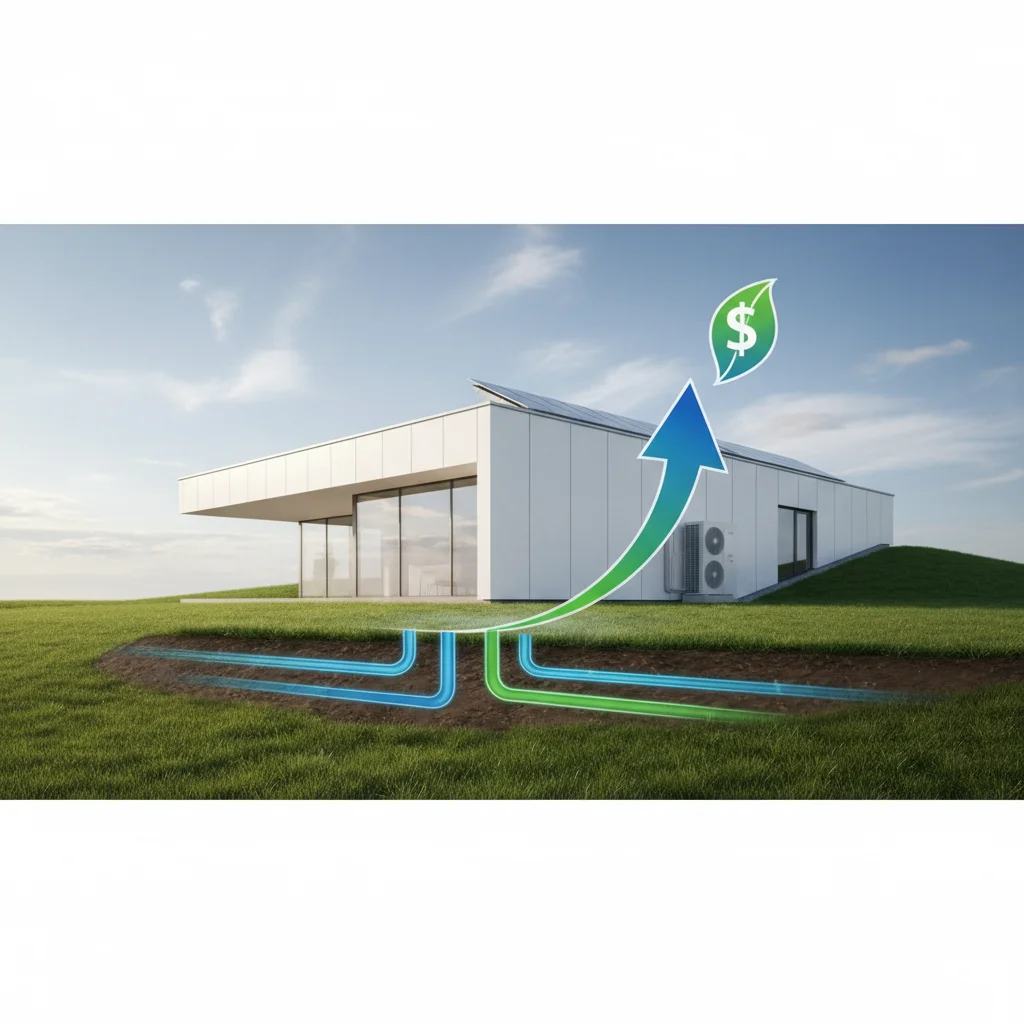
Homeowners who installed geothermal heat pumps in 2025 recovered their investment 40% faster than previous years, thanks to the federal 30% tax credit (this federal credit ended for expenditures made after December 31, 2025) and utility rebates that reduced net costs from $25,000 to $15,000. And that compression of the payback window—from 12-15 years to 7-10 years—transformed geothermal from a luxury long-term bet into a competitive alternative to gas furnaces and air-source heat pumps.
Geothermal heat pump payback depends on installation cost, state rebates, and annual energy savings of $800-$1,500; federal tax credits no longer apply (IRS FS-2025-05). Homeowners in cold climates with high heating costs see the fastest return, while those in moderate climates may wait 10-15 years.
But the payback period varies wildly based on installation cost, climate zone, and financing structure. So understanding which variables compress the timeline—and which extend it—determines whether geothermal makes financial sense for your property.
What Is the Average Geothermal Heat Pump Cost and Installation Expense?
Geothermal heat pump systems cost $15,000-$35,000 installed; federal tax credits no longer apply (IRS FS-2025-05). Installation costs depend on loop type: vertical closed-loop systems require drilling 150-500 feet deep at $3,000-$5,000 per bore, while horizontal loops need 1,500-3,000 feet of trench at $10-$30 per linear foot. And equipment accounts for 30-40% of total cost, with residential units ranging from 3-ton to 6-ton capacity at $3,000-$8,000 per unit.
Labor comprises 50-60% of installation expense, driven by site preparation, excavation, and loop installation. But soil composition and property access significantly impact final cost—rocky terrain increases drilling expense by 20-40%, while compact urban lots requiring vertical loops cost $5,000-$10,000 more than rural sites with space for horizontal trenches.
Which Geothermal Systems Qualify for Federal Tax Credits and Rebates?
The federal Residential Clean Energy Credit (Section 25D) ended for expenditures made after December 31, 2025, and the IRS treats an expenditure as made when installation is completed (IRS FS-2025-05). Federal tax credits for this work have ended, but state, local and utility rebates may still apply; check what is available at your address with the DuloCore rebate calculator.
The federal Residential Clean Energy Credit (Section 25D) ended for expenditures made after December 31, 2025, and the IRS treats an expenditure as made when installation is completed (IRS FS-2025-05).
State and utility rebates stack independently. California's TECH Clean California program offers $3,000-$8,000 for heat pump installations, while rural electric cooperatives in Iowa and Nebraska provide $500-$2,000 rebates for geothermal systems. So stacking state and utility incentives reduces net cost in high-rebate states.
| Program Type | Amount | Eligibility | Deadline |
|---|---|---|---|
| Federal IRA Tax Credit | Ended Dec 31, 2025 | — | Ended Dec 31, 2025 |
| California TECH Clean California | $3,000-$8,000 | Income-qualified households | Ongoing (funding-dependent) |
| Iowa Geothermal Rebate | $500-$2,000 | Rural electric cooperative members | Annual application periods |
How Long Does It Take to Recover Your Geothermal Investment Through Energy Savings?
Geothermal heat pumps save homeowners $800-$1,500 annually on heating and cooling costs, with the fastest payback in cold climates. Systems replacing electric resistance heat or propane furnaces achieve the fastest return, while those replacing natural gas furnaces take 12-18 years due to lower baseline fuel costs.
And annual savings depend on climate zone and replaced system efficiency. A Minnesota homeowner replacing a propane furnace saves $1,800 per year with geothermal, recovering a $20,000 net investment in 11 years. But a North Carolina homeowner replacing a natural gas furnace saves $600 annually, extending payback to 17 years on the same investment.
Electricity rates drive variability—states with rates above $0.15/kWh see 20-30% higher savings than states at $0.10/kWh. So homeowners in Massachusetts and California achieve payback 2-3 years faster than those in Louisiana or Washington.
Use our free rebate calculator to estimate your specific payback period based on local utility rates and available incentives.
What Efficiency Ratings Should You Look for in a Geothermal System?
Geothermal heat pumps should achieve a coefficient of performance (COP) of at least 3.5 for heating and an energy efficiency ratio (EER) of 18 or higher for cooling to maximize energy savings and qualify for premium rebates. ENERGY STAR Most Efficient systems exceed these baselines with COP ratings of 4.0-5.0 and EER ratings of 20-30, delivering 20-40% greater savings than minimum-compliant models.
And variable-speed compressors increase efficiency by 15-25% compared to single-stage systems, reducing annual operating costs by $100-$300. But variable-speed units cost $1,500-$3,000 more upfront, extending payback by 6-12 months unless utility rebates offset the premium.
Brands meeting the highest efficiency thresholds include WaterFurnace (COP 4.7, EER 30), ClimateMaster (COP 4.5, EER 28), and Bosch (COP 4.3, EER 26). So homeowners prioritizing shortest payback periods target systems with COP above 4.2 and EER above 22.
How Does Geothermal Compare in Payback Period to Solar, Heat Pumps, and Other Alternatives?
Geothermal heat pumps achieve payback in 12-15 years on average, longer than rooftop solar (6-9 years) and air-source heat pumps (5-7 years) in cold climates. But geothermal's higher upfront cost—$15,000-$35,000 versus $10,000-$20,000 for solar or $5,000-$12,000 for air-source heat pumps—creates a steeper initial hurdle despite lower annual operating costs.
And climate zone determines which technology wins. In Minnesota, Montana, and Vermont, geothermal beats air-source heat pumps by $200-$400 annually due to superior cold-weather performance, compressing payback to 8-10 years. But in Texas, Arizona, and Florida, air-source heat pumps deliver equivalent savings at 40-50% lower installation cost, achieving payback in 4-6 years.
Solar panels generate savings through net metering credits, averaging $800-$1,200 annually in sunny states with favorable utility policies. So a California homeowner installing both solar and geothermal saves $2,000-$2,500 per year, recovering the combined $40,000 investment in 16-20 years.
| Technology | Upfront Cost | Annual Savings | Payback Period | Lifespan |
|---|---|---|---|---|
| Geothermal Heat Pump | $15,000-$35,000 | $800-$1,500 | 12-15 years | 25-50 years |
| Rooftop Solar | $10,000-$20,000 | $800-$1,200 | 6-9 years | 25-30 years |
| Air-Source Heat Pump | $5,000-$12,000 | $400-$900 | 5-7 years | 15-20 years |
What's the Expected Lifespan and Maintenance Cost of Geothermal Systems?
Geothermal heat pump indoor units last 20-25 years, while ground loops function for 50+ years with minimal degradation, making geothermal the longest-lived HVAC technology. Annual maintenance costs $100-$300 for filter changes, refrigerant checks, and compressor inspections, compared to $150-$400 for gas furnaces and $200-$500 for conventional air conditioning systems.
And loop systems require virtually no maintenance—buried polyethylene piping resists corrosion and leaks for 50-100 years. But heat pump components like compressors and expansion valves wear at similar rates to air-source units, requiring replacement every 15-20 years at $2,000-$5,000.
So lifetime operating costs favor geothermal. A system installed in 2026 saves $800 annually while costing $200 in maintenance, netting $600 per year over 25 years for $15,000 in cumulative savings. And the ground loop outlasts two or three indoor unit replacements, reducing long-term cost per BTU by 30-50% versus gas or electric resistance systems.
"Geothermal heat pumps use 25%–50% less electricity than conventional heating or cooling systems." — U.S. Department of Energy
Official Sources
- U.S. Department of Energy — Geothermal Heat Pumps — Federal guidance on efficiency, costs, and incentives
- DSIRE USA — Comprehensive database of state and federal energy incentives
- Energy.gov Save — Federal energy efficiency programs and rebate information
Frequently Asked Questions
How long does it take to recoup a geothermal system investment?
Geothermal heat pumps achieve payback in 12-15 years on average without the federal tax credit, which ended for expenditures made after December 31, 2025 (IRS FS-2025-05). Annual energy savings of $800-$1,500 drive the timeline, with homeowners replacing propane or electric resistance heat seeing the fastest return.
What factors affect the geothermal payback period?
Installation cost, replaced system type, climate zone, and electricity rates determine payback speed. Vertical loop systems cost $5,000-$10,000 more than horizontal loops, extending payback by 2-4 years. And homeowners in states with electricity rates above $0.15/kWh achieve payback 20-30% faster than those paying $0.10/kWh.
Is geothermal worth it if you're only staying 5 years?
Geothermal systems add $10,000-$15,000 to home resale value for homeowners selling within 5 years. But energy savings alone won't break even—buyers in cold climates pay premiums of 3-5% for geothermal-equipped homes, while those in moderate climates see 1-3% appreciation.
How does geothermal payback compare to solar panels?
Geothermal achieves payback in 12-15 years, longer than rooftop solar's 6-9 years in sunny states. But geothermal provides heating and cooling, while solar offsets electricity across all uses. So combining both technologies maximizes savings—a California homeowner installing geothermal and solar saves $2,000-$2,500 annually, achieving payback on the combined investment in 16-20 years.
Can tax credits and rebates shorten the geothermal payback period?
The federal Residential Clean Energy Credit (Section 25D) ended for expenditures made after December 31, 2025, and the IRS treats an expenditure as made when installation is completed (IRS FS-2025-05). Without it, payback runs 12-15 years for most installations. And stacking state rebates of $3,000-$8,000 shortens payback by 2-3 years. So homeowners in high-incentive states like California and New York achieve breakeven in about 9-13 years.
Ready to calculate your geothermal payback period? Use DuloCore's free rebate calculator to estimate your net cost, annual savings, and breakeven timeline based on your zip code, current heating system, and available 2026 incentives.
Last reviewed: April 14, 2026. Reviewed by DuloCore Energy Specialists. About the team.
Check your California heat pump rebate eligibility — see the programs you qualify for and the dollar amounts on our California heat pump rebate finder.