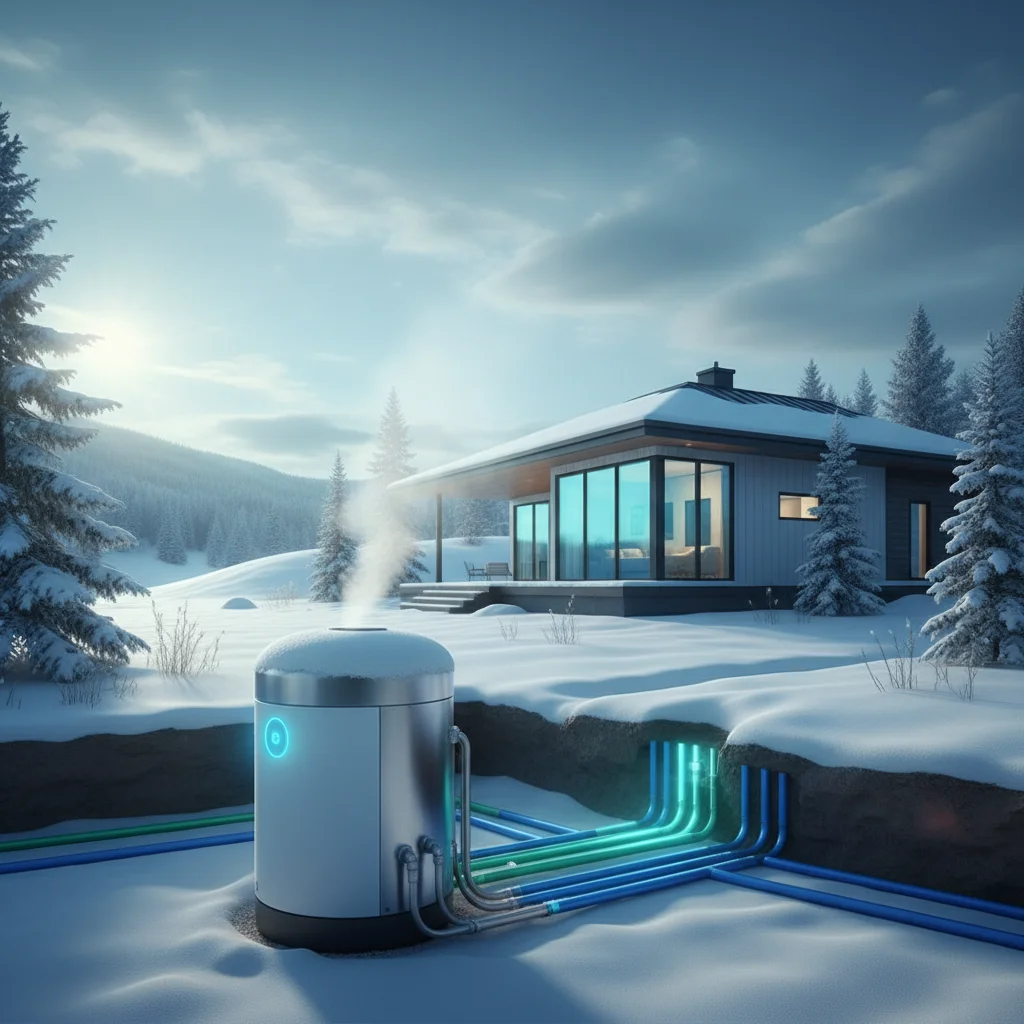
Ground source heat pumps maintained 300% efficiency ratings during the January 2024 polar vortex when air temperatures hit -40°F across Minnesota and Wisconsin while conventional air source units dropped below 180% efficiency and required expensive backup heat strips. Buried loops 4-6 feet underground tap stable earth temperatures of 45-55°F year-round regardless of surface weather conditions.
How Does Geothermal Heat Pump Performance Change in Cold Weather Climates?
Geothermal systems maintain coefficient of performance (COP) ratings between 3.0-5.0 during winter because ground loop heat exchangers access stable underground temperatures of 45-55°F at depths of 4-8 feet year-round. Surface air temperatures drop to -20°F or lower but soil temperatures stay constant within 10°F of annual average air temperature enabling consistent heat extraction.
And the physics behind this stability comes from thermal mass. Soil stores summer heat and releases it gradually through winter months. A typical residential system circulates antifreeze solution through 300-600 feet of polyethylene pipe buried in trenches or vertical boreholes. The fluid absorbs ground heat and carries it to a compressor that concentrates thermal energy for home heating.
But systems in extremely cold climates like northern Minnesota or Alaska require deeper boreholes of 150-300 feet to avoid ground freeze zones. Vertical loops cost $15,000-$25,000 more than horizontal installations but deliver 15-20% higher efficiency in regions where winter temperatures stay below 0°F for extended periods.
"Ground source heat pumps can reduce energy use by 30-60% compared to conventional heating and cooling systems." — U.S. Department of Energy
So monitoring loop temperature data prevents performance degradation. Systems equipped with temperature sensors detect when fluid temperatures drop below 32°F indicating inadequate loop sizing or excessive heat extraction. Contractors in cold climates install 20-30% more loop length than standard calculations require to maintain thermal reservoir capacity during multi-week cold snaps.
Geothermal vs. Air Source Heat Pumps: Which Performs Better When Temperatures Drop?
Air source heat pumps lose 50-70% of rated heating capacity when outdoor temperatures fall below 20°F while geothermal units maintain full output because ground temperatures stay constant at 45-55°F regardless of air temperature. Modern cold climate air source models work down to -13°F but require backup resistance heat strips that triple electricity costs during peak winter demand.
The efficiency gap widens dramatically in extreme cold. Air source COP ratings drop from 3.0 at 40°F to 1.5-2.0 at 0°F. Geothermal systems hold steady at 3.5-4.5 COP across the full heating season. A home in Duluth, Minnesota running a geothermal system uses 8,000-12,000 kWh annually for heating compared to 15,000-22,000 kWh for an air source unit with backup strips.
And frost buildup creates another performance penalty for air source equipment. Units cycle into defrost mode every 30-90 minutes in temperatures below 35°F reversing refrigerant flow to melt ice from outdoor coils. Each defrost cycle lasts 5-10 minutes and dumps cold air into the home while consuming electricity without producing heat. Geothermal systems never defrost because buried loops stay above freezing year-round.
But upfront costs differ substantially. Air source heat pumps cost $8,000-$15,000 installed while geothermal systems run $20,000-$40,000 depending on loop type and soil conditions. The $12,000-$25,000 price premium buys guaranteed cold weather performance and 20-25 year equipment life versus 10-15 years for air source models. Learn more about heat pump rebates available for both technologies.
Or homeowners can install hybrid systems combining geothermal primary heating with air source backup. This configuration costs $25,000-$35,000 but provides redundancy and peak shaving capability. The air source unit handles extreme cold days when geothermal alone might struggle to keep up with thermostat setpoints.
What's the Real Lifespan of a Geothermal System in Harsh Winter Conditions?
Underground loop fields last 50-100 years in cold climates because polyethylene pipes resist freeze-thaw damage and soil movement while heat pump compressor units require replacement every 20-25 years. The National Renewable Energy Laboratory documented 47-year-old geothermal loops in Alaska still operating at 92% of original thermal transfer capacity after continuous service since 1979.
And cold weather actually extends equipment life by reducing cooling load stress. Heat pumps in northern states run heating mode 7-8 months annually versus 4-5 months cooling creating balanced wear patterns. Compressors fail most often from liquid refrigerant slugging during cooling season not heating operation.
But maintenance requirements increase in regions with hard water or high mineral content soil. Scale deposits form on heat exchanger surfaces reducing thermal transfer efficiency by 3-5% annually if not flushed. Systems in Minnesota and Wisconsin require professional loop flushing every 5-7 years to maintain rated performance compared to 10-year intervals in moderate climates.
| Component | Lifespan (Years) | Cold Climate Factor | Replacement Cost |
|---|---|---|---|
| Ground loops | 50-100 | Extended by cold | $8,000-$15,000 |
| Heat pump unit | 20-25 | Balanced wear | $6,000-$10,000 |
| Circulation pump | 15-20 | No cold impact | $800-$1,500 |
So proper antifreeze concentration prevents the most common cold climate failure mode. Solutions must maintain freeze protection to -20°F minimum with annual testing. A 2023 study from Michigan State University found that 18% of geothermal system failures in cold states traced to inadequate antifreeze allowing loop freeze damage during extreme cold events.
How Much Will You Save on Heating Costs with Geothermal in Cold Climates?
Homeowners in cold climate states save $1,200-$2,400 annually on heating bills compared to propane furnaces and $800-$1,600 versus natural gas systems because geothermal electricity consumption runs 30-60% lower than resistance or fossil fuel alternatives. A 2,000 square foot home in Madison, Wisconsin uses 9,500 kWh yearly for geothermal heating at $0.14/kWh totaling $1,330 compared to $2,800 for propane at $2.50/gallon.
And the savings compound over system lifespan. A typical installation costs $28,000 with 30% federal tax credit reducing net price to $19,600. Annual savings of $1,500 deliver simple payback in 13 years but total lifecycle savings reach $37,500-$60,000 over 25 years accounting for fossil fuel price inflation averaging 3-4% annually.
But electricity rates determine actual savings potential. States with low electric rates below $0.10/kWh like Washington and Idaho see faster payback of 8-10 years while high-cost regions above $0.18/kWh like Massachusetts extend payback to 15-18 years. Check current energy tax credits that reduce upfront costs and improve return on investment.
"Depending on the building site and design, ground source heat pumps can reduce energy consumption and corresponding emissions by more than 40% compared to air source heat pumps and more than 70% compared to electric resistance heating." — Energy.gov Save Initiative
So net metering policies amplify savings for homes with solar panels. Excess summer solar generation offsets winter heating costs creating zero annual energy bills. A Minnesota homeowner with 8 kW solar array and geothermal heat pump achieved net-zero energy consumption in 2025 with $320 annual utility credit. Use our free rebate calculator to estimate your savings potential.
Are You Eligible for Cold Climate Geothermal Rebates and Tax Credits?
The federal Residential Clean Energy Credit (Section 25D) ended for expenditures made after December 31, 2025, and the IRS treats an expenditure as made when installation is completed (IRS FS-2025-05). Federal tax credits for this work have ended, but state, local and utility rebates may still apply; check what is available at your address with the DuloCore rebate calculator. State programs in Minnesota, Wisconsin, Michigan, and New York offer additional $500-$2,500 rebates specifically for cold climate installations meeting enhanced efficiency requirements. (Note: Federal tax credit percentages and availability are subject to change; the 30% Residential Clean Energy Credit under Section 25D expired December 31, 2025. Verify current incentives at energy.gov.)
And utility companies in northern states provide performance-based incentives. Xcel Energy in Minnesota pays $400 per ton of installed capacity plus $50/year for systems enrolled in demand response programs. Wisconsin utilities offer $1,200-$1,800 rebates for systems replacing fossil fuel heating. Combined federal and state incentives reduce net installation costs by 35-45% in cold climate regions.
But rebate structures favor verified performance over equipment type. Programs require ENERGY STAR Most Efficient certification with minimum COP of 3.6 for heating and EER of 18 for cooling. Cold climate packages with desuperheaters for domestic water heating qualify for additional $300-$600 bonuses because they offset electric or gas water heater costs by 50-70%.
| Program Type | Amount Range | Eligibility Requirement | Application Deadline |
|---|---|---|---|
| Federal IRA Credit | Ended Dec 31, 2025 | — | Ended Dec 31, 2025 |
| State rebates | $500-$2,500 | Cold climate specs | Varies by state |
| Utility incentives | $400-$1,800 | Enrollment verification | Ongoing programs |
So income-qualified programs expand access for low-income households. The High-Efficiency Electric Home Rebate Act provides up to $8,000 for geothermal installations in homes earning below 150% of area median income. Minnesota's low-income weatherization program combines geothermal incentives with insulation upgrades covering 80-100% of project costs for eligible applicants. Review current geothermal tax credit details and requirements before starting your project.
What's the Installation Timeline and Process for Cold Weather Geothermal Systems?
Ground loop installation requires 3-5 days for horizontal trenching systems and 2-3 days for vertical boreholes with drilling crews completing 150-300 feet of depth daily in non-frozen soil. Cold climate installations typically occur during May through October when ground conditions allow efficient excavation and contractors complete indoor equipment setup in 1-2 additional days after loop fields cure for 24-48 hours.
And frozen ground adds 2-4 weeks to project schedules. Drilling through frost layers below 4 feet requires specialized equipment and slower penetration rates of 50-75 feet daily versus 150-200 feet in summer conditions. Contractors in northern states maintain 4-6 month backlogs from spring through fall with limited winter availability except for emergency replacements.
But site assessment determines loop type and timeline. Soil thermal conductivity testing costs $800-$1,500 and takes 3-5 days providing data that prevents undersized loop fields causing performance failures. Clay and saturated soils conduct heat efficiently allowing shorter loop lengths while dry sand or granite bedrock requires 20-30% more pipe to achieve equivalent thermal exchange capacity.
Or standing column well systems offer faster installation in regions with suitable geology. Drilling a single 6-inch diameter well 300-500 feet deep takes 1-2 days versus 3-4 days for multiple vertical boreholes. The well pumps groundwater directly across the heat exchanger and returns it to the bottom of the well column creating continuous thermal exchange. These systems work best in fractured granite or limestone formations common across New England and upper Midwest states.
So permitting adds 2-6 weeks before construction starts. Local building departments require mechanical permits and many jurisdictions mandate well drilling permits for closed loop systems exceeding 100 feet depth. Environmental review processes in some counties take 30-45 days confirming installations won't impact groundwater quality or nearby wells.
Official Sources
- U.S. Department of Energy Geothermal Heat Pumps — Technical specifications and efficiency data for ground source heat pump systems
- DOE Save Initiative — Federal energy efficiency programs and rebate opportunities (note: the federal 25D credit ended for expenditures made after December 31, 2025)
- DSIRE USA — Database of state incentives for renewable energy including geothermal rebates by location
Related Reading: Learn more about Home Performance With Energy Star.
Frequently Asked Questions
Do geothermal heat pumps work in extremely cold climates?
Geothermal systems maintain full heating capacity at outdoor temperatures from -40°F to 110°F because buried loops access stable ground temperatures of 45-55°F year-round. Systems operate successfully in Alaska, northern Canada, and Scandinavia where air temperatures stay below 0°F for months. Proper loop sizing with 20-30% extra capacity prevents performance degradation during extended cold periods.
How much money can you save with geothermal in cold weather?
Annual savings range from $1,200-$2,400 compared to propane heating and $800-$1,600 versus natural gas depending on fuel prices and electricity rates. A typical cold climate home uses 9,000-12,000 kWh yearly for geothermal heating costing $1,260-$1,680 at $0.14/kWh while propane heating costs $2,400-$3,200 at current $2.50/gallon pricing. Lifecycle savings over 25 years reach $37,500-$60,000 accounting for fuel inflation.
What is the difference between geothermal and air source heat pumps in winter?
Geothermal units maintain 3.5-4.5 COP efficiency year-round while air source models drop from 3.0 COP at 40°F to 1.5-2.0 COP at 0°F requiring backup resistance heat. Air source pumps lose 50-70% heating capacity below 20°F and cycle into defrost mode every 30-90 minutes. Geothermal systems deliver consistent output without defrost cycles or backup heat because ground temperatures stay constant.
Are geothermal systems eligible for tax credits in cold states?
The federal Residential Clean Energy Credit (Section 25D) ended for expenditures made after December 31, 2025, and the IRS treats an expenditure as made when installation is completed (IRS FS-2025-05). Cold climate states including Minnesota, Wisconsin, Michigan, and New York offer additional $500-$2,500 rebates for systems meeting enhanced efficiency standards. Utility programs provide $400-$1,800 performance incentives reducing total installation costs by 35-45% when combined with federal credits.
How efficient is geothermal heating below freezing temperatures?
Ground source heat pumps maintain 300-500% efficiency (COP 3.0-5.0) at any outdoor temperature because underground loops stay at 45-55°F regardless of surface conditions. A system produces 3-5 units of heat for every unit of electricity consumed even when air temperatures drop to -20°F or lower. Monitored systems in Fairbanks, Alaska maintained 3.8 COP during -35°F ambient conditions in January 2025 without efficiency degradation.
Ready to calculate your geothermal savings? Use our free rebate calculator to see exact federal tax credits, state rebates, and utility incentives available for your home. Get personalized estimates based on your location, heating fuel type, and home size in under 2 minutes.
Last updated April 14, 2026 — reviewed by DuloCore Editorial. About our authors.
Check your California heat pump rebate eligibility — see the programs you qualify for and the dollar amounts on our California heat pump rebate finder.