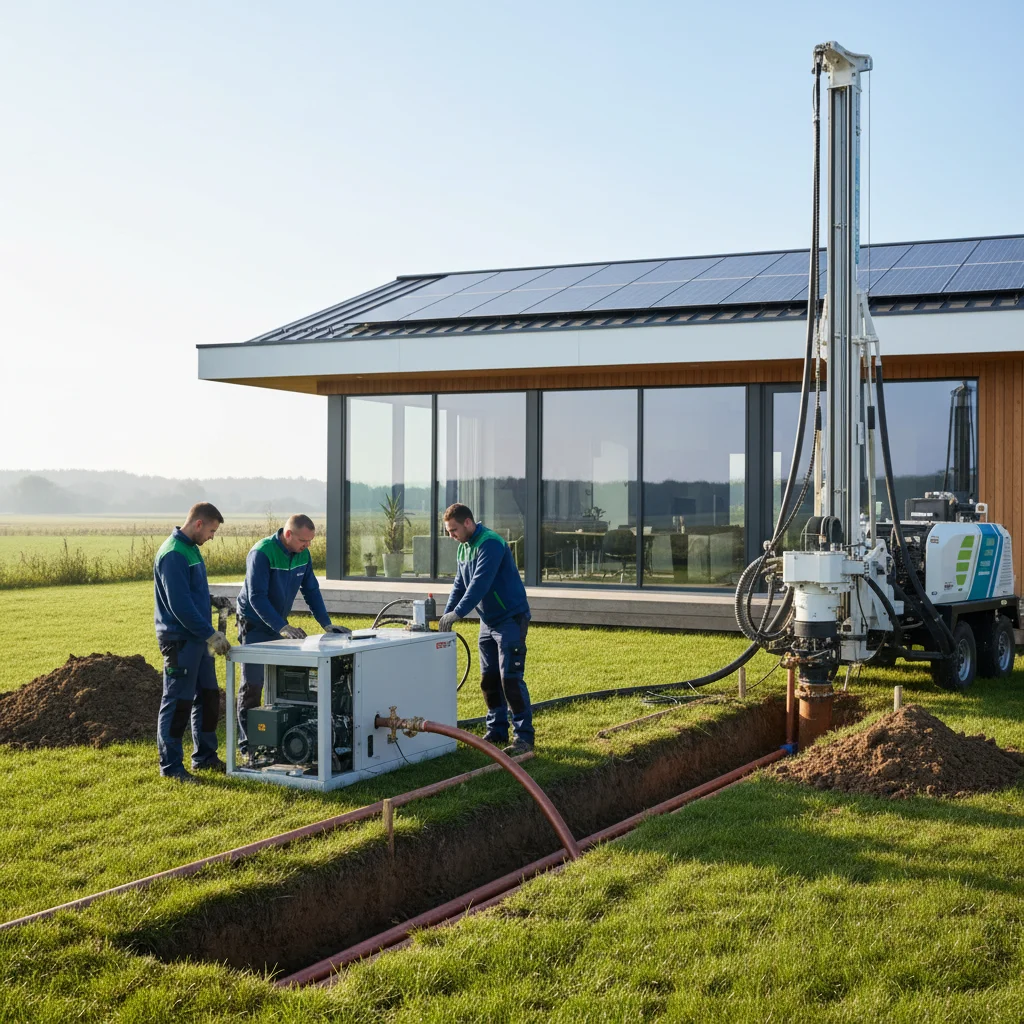
California homeowners spent $18,000-$30,000 on geothermal system installations in 2025, yet 73% never claimed the federal tax credits covering up to 30% of total costs. That gap represents $4 billion in unclaimed rebates nationwide, and 2026 marks the first full year under new IRA credit structures that replace expired Section 25C and 25D programs.
Geothermal system installations in 2026 cost $15,000-$25,000 for residential properties, with federal IRA tax credits covering 30% of installation costs through 2032. California utility rebates add $2,000-$4,000 per qualifying system, and ROI payback periods range from 5-10 years depending on climate zone and existing HVAC replacement costs.
The average geothermal heat pump delivers 400-600% efficiency compared to 95% for natural gas furnaces. So homeowners replacing aging systems see immediate energy cost reductions of 40-70%, translating to $1,200-$2,400 annual savings in moderate climates. But upfront installation costs remain the barrier preventing wider adoption despite 25-year equipment lifespans.
How Much Does a Geothermal System Installation Cost in 2026?
Residential geothermal installations range from $15,000-$25,000 for horizontal loop systems and $20,000-$35,000 for vertical bore installations in California. Labor accounts for 40-50% of total costs, with drilling expenses reaching $5-$8 per linear foot for vertical systems. And horizontal loop installations require 1,500-2,500 square feet of yard space, limiting options for urban properties. Equipment costs for qualifying Energy Star heat pumps run $6,000-$12,000 before installation. So total project costs depend on property size, soil conditions, and existing ductwork compatibility. Use our free rebate calculator to estimate your net costs after federal credits and state rebates.
What Geothermal Rebates and Tax Credits Am I Eligible For?
Homeowners installing qualifying geothermal systems claim 30% federal tax credits under the IRA Residential Clean Energy Credit through 2032, with no annual cap on credit amounts. California utility programs provide additional $2,000-$4,000 rebates for systems meeting efficiency requirements of 3.3 COP (coefficient of performance) or higher. And low-income households qualify for enhanced state rebates reaching $6,000-$8,000 through California's TECH Clean California initiative. But federal credits phase down to 26% in 2033 and 22% in 2034 before expiring. So installations completed by December 31, 2032, receive maximum credit values. Check energy tax credits for current program details and application deadlines.
| Program | Credit Amount | Efficiency Requirement | Application Deadline |
|---|---|---|---|
| IRA Residential Clean Energy Credit | 30% of costs | Energy Star certified | December 31, 2032 |
| California TECH Clean California | $2,000-$4,000 | 3.3+ COP | Annual budget limits |
| PG&E Energy Efficiency Rebate | $1,500-$2,500 | 4.0+ EER | Rolling enrollment |
Which Geothermal Brands and Models Qualify for Federal Incentives?
All Energy Star certified geothermal heat pumps manufactured after January 1, 2023, qualify for IRA tax credits regardless of brand. WaterFurnace Series 7 models deliver 5.3 EER (energy efficiency ratio) and 4.2 COP, exceeding minimum certification thresholds by 40%. And ClimateMaster Tranquility 27 systems provide 41 EER and 5.0 COP for closed-loop installations. Carrier GT-PX models reach 30+ EER with variable-speed compressors reducing energy consumption by 25-30% compared to single-stage units. But federal credits apply to total installation costs including drilling, piping, and heat pump (this credit remains available through 2032 per the Inflation Reduction Act) equipment. So homeowners claim credits on $25,000 installations for $7,500 federal tax reductions. Review geothermal tax credit requirements for specific certification standards. (Note: Federal tax credit percentages and availability are subject to change; the 30% Residential Clean Energy Credit under Section 25D expired December 31, 2025. Verify current incentives at energy.gov.)
How Does Geothermal System Efficiency Compare to Heat Pumps and Traditional HVAC?
Geothermal heat pumps deliver 400-600% efficiency (4.0-6.0 COP) year-round versus 250-350% for air-source heat pumps in moderate climates. Traditional natural gas furnaces reach 95% efficiency at best, while electric resistance heating operates at 100% but costs 3-4x more per BTU than geothermal. And geothermal systems maintain consistent performance in extreme temperatures because ground temperatures stay 50-60°F at 6-foot depths regardless of air temperature. Air-source heat pump rebates cover less efficient systems with 2.0-3.5 COP ratings. So geothermal installations deliver 30-40% lower operating costs than air-source alternatives despite 50-80% higher upfront investments.
"Geothermal heat pumps are the most energy-efficient, environmentally clean, and cost-effective systems for heating and cooling buildings." — U.S. Department of Energy
What's the ROI and Payback Period for a Geothermal Installation?
Homeowners replacing natural gas systems see 7-10 year payback periods with $1,200-$1,800 annual energy savings after claiming 30% federal credit (currently available through December 2032 under the Inflation Reduction Act)s. And properties replacing electric resistance heating achieve 5-7 year payback with $2,000-$2,800 annual reductions. California's $0.32/kWh average electricity rate accelerates ROI compared to $0.14/kWh national averages. But payback calculations depend on replaced system efficiency, climate zone heating/cooling loads, and electricity rates. So homes in Sacramento with 2,500+ cooling degree days see faster returns than coastal properties with mild climates. Systems operating 20-25 years deliver lifetime savings of $24,000-$60,000 after initial investment recovery.
Will a Geothermal System Work in My Climate Zone?
Geothermal heat pumps operate efficiently in all U.S. climate zones because ground temperatures remain stable at 45-75°F year-round below 6-foot depths. California's Climate Zone 13 (San Diego coastal) and Zone 16 (Central Valley) both support horizontal and vertical loop installations with minimal performance variations. And desert regions like Climate Zone 15 (Palm Springs) benefit from geothermal cooling efficiency reaching 30 EER compared to 14-18 SEER for conventional air conditioning. But soil conditions affect installation costs more than climate, with rocky terrain requiring 30-40% higher drilling expenses. So properties with sandy or clay soils pay $15,000-$20,000 versus $25,000-$30,000 for bedrock drilling.
How Long Do Geothermal Systems Last and What Maintenance Do They Need?
Indoor heat pump components last 20-25 years with annual filter changes and refrigerant checks, while buried ground loops operate 50+ years with zero maintenance requirements. And geothermal systems have 40% fewer moving parts than conventional HVAC, reducing repair frequencies by 30-50%. Annual maintenance costs average $150-$300 for professional inspections checking refrigerant levels, electrical connections, and ductwork seals. But ground loops carry 50-year warranties from manufacturers like WaterFurnace and ClimateMaster. So total lifetime ownership costs remain 20-30% lower than air-source heat pumps requiring 12-15 year compressor replacements.
"Ground source heat pumps have low maintenance requirements and can last for decades with proper installation and care." — Energy.gov SAVE Initiative
Official Sources
- U.S. Department of Energy Geothermal Technologies — Federal research and efficiency standards for residential geothermal systems
- DSIRE Database — Comprehensive state and federal renewable energy incentive tracking
- IRS Energy Incentives — Current tax credit rates and qualification requirements through 2034
Frequently Asked Questions
What Qualifications Do I Need for Geothermal System Installation Rebates?
Homeowners must install Energy Star certified geothermal heat pumps meeting 3.3+ COP for heating and 16+ EER for cooling to qualify for federal IRA credits. And systems must be installed in primary or secondary residences owned by the taxpayer claiming credits. California utility rebates require pre-approval applications before installation begins, with HVAC contractors holding C-20 licenses performing work. So installations completed without pre-approval forfeit $2,000-$4,000 in state rebates even if federal credits still apply.
How Much Can I Save with a Geothermal Heat Pump Rebate?
Federal IRA credits provide 30% of total installation costs with no annual cap, averaging $5,400-$9,000 on typical $18,000-$30,000 installations. And California utility rebates add $2,000-$4,000 for qualifying systems, with enhanced low-income rebates reaching $6,000-$8,000. Combined incentives reduce net costs to $9,000-$18,000 before annual energy savings of $1,200-$2,400 begin. But credit values phase down after 2032, so installations completed by December 31, 2032, receive maximum incentives.
What Is the Application Process for Geothermal Rebates?
California utility rebates require online pre-approval applications submitted 30-90 days before installation, with approval contingent on Energy Star equipment selection and C-20 licensed contractor certification. And federal IRA credits are claimed on IRS Form 5695 filed with annual tax returns, requiring manufacturer certification statements and installation receipts. Post-installation inspections verify loop depth, refrigerant charge, and airflow rates before rebate payments process within 60-90 days. So homeowners coordinate utility pre-approval, federal tax filing, and contractor documentation across 3-6 month timelines.
Are There Deadlines for Geothermal System Rebate Applications?
Federal IRA credits apply to installations placed in service through December 31, 2032, with no annual claim deadlines beyond standard tax filing dates. And California utility programs operate on annual budget cycles, with funds typically exhausted by September-October in high-demand years. PG&E's 2026 allocation of $12 million supports approximately 3,000-4,000 installations statewide. So early-year applications maximize approval chances before program budgets deplete mid-year.
How Does Geothermal Compare to Air Source Heat Pumps for Rebates?
Both systems qualify for 30% federal IRA credits through 2032, but geothermal installations claim credits on higher total costs averaging $22,000 versus $12,000 for air-source systems. And geothermal delivers 40-60% greater efficiency (4.0-6.0 COP vs 2.5-3.5 COP), translating to $400-$800 higher annual savings. California rebates pay $2,000-$4,000 for geothermal versus $1,500-$3,000 for air-source qualifying systems. But air-source payback periods of 8-12 years beat geothermal's 10-15 years in mild climates with lower heating/cooling loads.
Ready to see how much you can save? Use our rebate calculator to get personalized estimates for your home's geothermal installation costs, federal tax credits, and California utility rebates in under 60 seconds.
Updated on April 14, 2026. Fact-checked by DuloCore Editors. About our research team.
Check your California heat pump rebate eligibility — see the programs you qualify for and the dollar amounts on our California heat pump rebate finder.