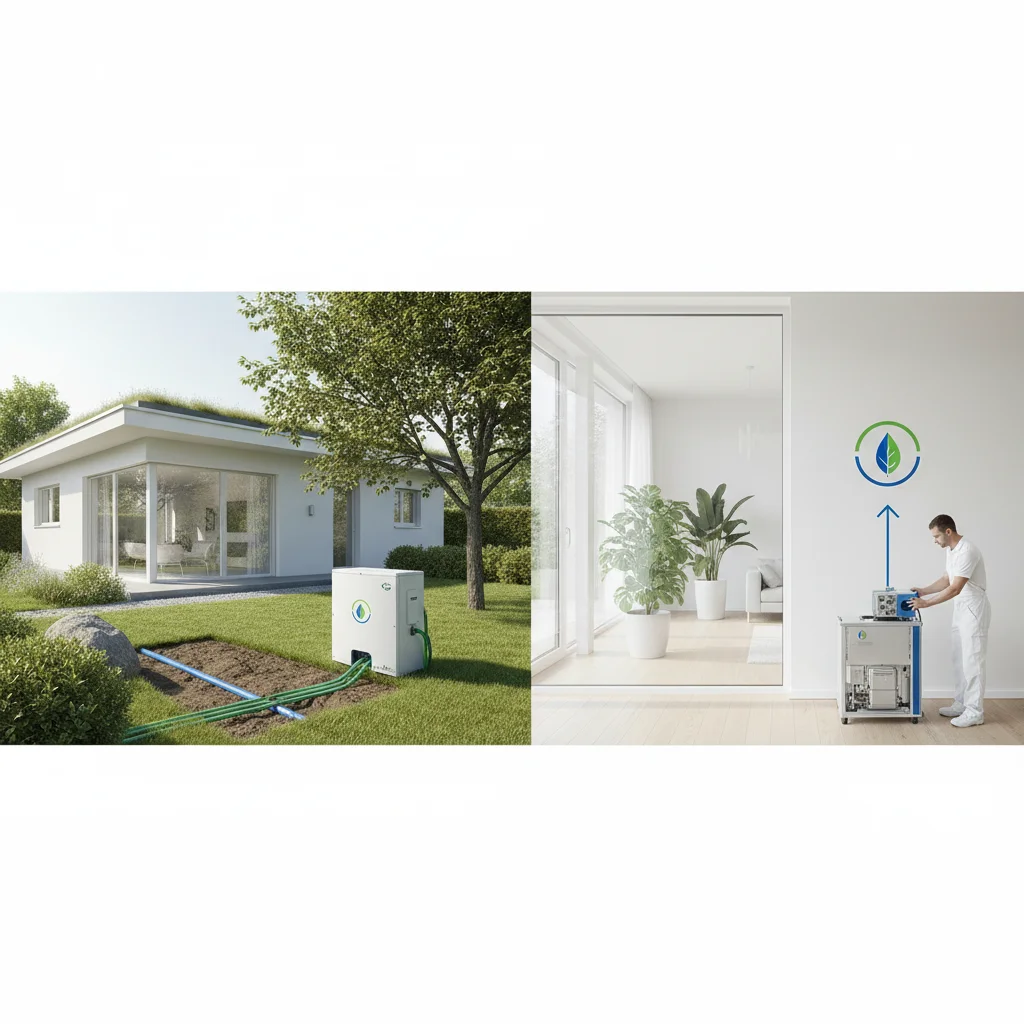
A 20-year-old geothermal heat pump operating in Sacramento County saved its owner $1,847 in annual energy costs—then failed during a July heatwave because the homeowner skipped a $250 maintenance check. And the replacement indoor components alone cost $4,200, wiping out three years of energy savings in a single invoice.
Geothermal system maintenance requires annual inspections ($150-$400), filter changes every 1-3 months, and loop fluid testing every 3-5 years. Systems receiving professional servicing last 25+ years for indoor components and 50+ years for ground loops, compared to 15-20 years for neglected units.
So what makes geothermal maintenance different from furnace tune-ups? Ground-source heat pumps circulate antifreeze solution through buried pipes while compressing refrigerant indoors—two closed-loop systems that fail silently until efficiency drops 30% or catastrophic breakdowns occur. Homeowners who schedule annual maintenance spend $2,800-$4,200 over a system's 25-year lifespan, while those who wait for failures spend $8,500-$12,000 on emergency repairs and early replacements.
How Much Does Geothermal System Maintenance Cost Per Year?
Annual geothermal maintenance contracts cost $150-$400 in California markets, covering filter inspection, refrigerant pressure checks, electrical connection testing, and condensate drain flushing. DIY filter replacements add $40-$120 annually for MERV 11-16 filters changed every 1-3 months depending on dust exposure. And ground loop fluid testing every 3-5 years costs $200-$350 to verify antifreeze concentration and detect leaks before efficiency losses occur.
But homeowners skipping professional inspections face $800-$1,500 compressor replacements when refrigerant leaks go undetected, versus $120 repairs caught during routine checks. Service contracts from WaterFurnace and ClimateMaster dealers include priority emergency response and parts discounts averaging 15-20% below retail pricing.
So total annual ownership costs—combining $250 average maintenance with $0.04/kWh electricity in California—equal $450-$650 for a 4-ton residential system, compared to $1,200-$1,800 for natural gas furnace operation and maintenance.
| Maintenance Task | Frequency | DIY Cost | Professional Cost |
|---|---|---|---|
| Filter replacement | 1-3 months | $10-$30 | Included in contract |
| Annual inspection | 12 months | N/A | $150-$400 |
| Loop fluid test | 3-5 years | N/A | $200-$350 |
What Geothermal Brands Qualify for State Rebates?
The federal Residential Clean Energy Credit (Section 25D) ended for expenditures made after December 31, 2025, and the IRS treats an expenditure as made when installation is completed (IRS FS-2025-05). Federal tax credits for this work have ended, but state, local and utility rebates may still apply; check what is available at your address with the DuloCore rebate calculator. And California's Tech Clean California program offers $3,000-$4,000 rebates for systems meeting ENERGY STAR Most Efficient specifications—requiring EER ratings above 16.2 and COP above 3.3 in cooling mode.
But maintenance records affect rebate eligibility. The Bay Area Air Quality Management District requires proof of annual professional servicing for systems over 3 years old to qualify for $2,500 heat pump replacement rebates. Or systems lacking documented maintenance since installation get rejected during eligibility verification.
Stacking California utility incentives on a $25,000 installation adds $5,500-$7,000 in total savings. Use our free rebate calculator to estimate state and utility incentives for your specific system.
Brand-Specific Rebate Requirements
WaterFurnace 7 Series and ClimateMaster Trilogy systems automatically meet ENERGY STAR Most Efficient thresholds. Bosch and Trane require selecting premium efficiency models with EER ≥17 and COP ≥3.6 to qualify for maximum state rebates.How Long Do Geothermal Systems Last and What's the Typical Lifespan?
Ground loop piping lasts 50+ years when buried 4-6 feet deep in thermally stable soil, while indoor heat pump components operate 20-25 years with annual maintenance. But compressors and expansion valves fail after 15-18 years in systems with deferred servicing, cutting lifespan by 30-40% compared to manufacturer projections.
And antifreeze degradation accelerates failures. Loop fluid losing 10% propylene glycol concentration from leaks reduces heat transfer efficiency by 18%, forcing compressors to run 25% longer per heating cycle. So testing every 3-5 years catches contamination before energy bills spike $300-$500 annually.
Or consider replacement economics: a $6,500 indoor unit replacement at year 20 versus $22,000 full system reinstallation gives properly maintained systems a 25-year total cost of ownership 40% lower than neglected units requiring early burial loop replacement.
"Geothermal heat pumps can last more than 20 years with proper maintenance, while ground loops can last over 50 years." — U.S. Department of Energy
What's the ROI and Payback Period for Geothermal System Maintenance Investment?
Annual $250 maintenance spending prevents $1,200-$3,500 in premature component failures, generating 4.8x-14x returns over a system's lifespan. And maintained systems achieve 8-12 year payback periods on the initial $20,000-$30,000 installation through $1,800-$2,400 annual energy savings, versus 15-20 year payback for neglected units operating at 70% efficiency.
But regional electricity rates change the math. California homeowners paying $0.30/kWh save $2,100 annually switching from natural gas to geothermal, while $0.12/kWh markets in the Central Valley see $1,400 savings. So maintenance preserving peak efficiency protects the investment justification.
Or quantify it differently: a $4,000 maintenance investment over 20 years prevents $8,500 in emergency repairs and sustains $42,000-$48,000 in cumulative energy savings compared to conventional HVAC. Calculate your specific savings with our rebate calculator using your utility rates and system size.
| Maintenance Level | 20-Year Energy Savings | Repair Costs | Net Benefit |
|---|---|---|---|
| Annual professional | $44,000 | $2,500 | $41,500 |
| DIY only | $36,000 | $8,500 | $27,500 |
| Deferred | $28,000 | $12,000 | $16,000 |
Is Your Climate Zone Suitable for Geothermal Heating and Cooling?
California's Climate Zones 3, 12, and 13 (Central Valley, inland valleys) provide 58-62°F stable ground temperatures year-round, delivering 350-420% heating efficiency compared to 95% natural gas furnaces. But coastal Zone 6 (San Francisco Bay) and mountain Zone 16 (Sierra foothills) require larger loop fields—adding $8,000-$12,000 installation costs—to overcome lower soil thermal conductivity.
And soil moisture matters more than air temperature. Clay and saturated soils transfer heat 2.5x faster than dry sand, allowing 400-foot vertical loops in Sacramento versus 800-foot requirements in Riverside's sandy terrain. So site assessments testing thermal conductivity determine loop sizing and maintenance accessibility.
Or consider hybrid systems: Zone 16 homeowners pair geothermal with backup propane for 10-15 days annually when outdoor temperatures drop below 15°F, maintaining 85% geothermal operation while avoiding oversized loop fields that never reach capacity.
"Ground source heat pumps are efficient in all climates and can significantly reduce heating and cooling costs." — EPA
Zone-Specific Maintenance Considerations
Coastal zones require annual condensate pump cleaning due to higher humidity. Inland zones need quarterly filter changes during wildfire season when particulates clog MERV 13+ filters in 6-8 weeks versus typical 3-month intervals.How Does Geothermal Maintenance Compare to Traditional HVAC Upkeep?
Geothermal systems require $150-$400 annual professional inspections versus $80-$150 for gas furnace tune-ups, but eliminate $600-$900 air conditioning maintenance and biennial $1,200 condenser coil replacements. And closed-loop refrigerant systems leak at 1/5 the rate of outdoor AC units exposed to weather and vibration.
But geothermal maintenance requires specialized technicians certified by IGSHPA (International Ground Source Heat Pump Association) or manufacturer programs—limiting service availability in rural counties to 20-40 mile service radiuses versus ubiquitous HVAC contractors. So response times for emergency repairs average 24-48 hours compared to same-day furnace service.
Or compare lifecycle maintenance costs: 20-year geothermal totals of $4,200 (annual inspections plus one $800 compressor repair) beat $9,500 for gas furnace and AC combinations requiring three inducer motor replacements, two condensers, and annual dual-system servicing.
Check heat pump rebates for incentives covering maintenance contracts and efficiency upgrades that reduce long-term servicing needs.
Official Sources
- DOE Geothermal Heat Pumps — Federal efficiency standards and technology overview
- ENERGY STAR Geothermal Specifications — Rebate-eligible efficiency thresholds and certified products
- DSIRE Database — State and utility incentive programs by ZIP code
Related Reading: Learn more about Spring Energy Audit Maintenance.
Related Reading: Learn more about Geothermal System Lifespan.
Frequently Asked Questions
How often should a geothermal system be serviced?
Professional inspections once annually catch 85% of efficiency-reducing issues before they cause failures, according to DOE operational studies. Filter changes every 1-3 months and loop fluid testing every 3-5 years complete the maintenance schedule. And systems in high-dust environments or with well water require quarterly filter inspections versus standard 90-day intervals.
What is the average cost of geothermal system maintenance?
Annual contracts cost $150-$400 for professional inspections plus $40-$120 for DIY filter replacements, totaling $190-$520 per year. Loop fluid testing every 3-5 years adds $200-$350 to the maintenance budget. So 5-year total costs range from $1,150-$2,950 depending on service contract pricing and filter quality selections.
Can I perform geothermal system maintenance myself?
Homeowners safely change filters, clean condensate pans, and inspect outdoor loop manifolds for leaks, covering 40% of routine maintenance tasks. But refrigerant pressure testing, electrical diagnostics, and loop fluid sampling require EPA Section 608 certification and specialized equipment costing $2,500-$4,000. And DIY repairs void manufacturer warranties on systems less than 10 years old.
How long does a geothermal system last with proper maintenance?
Indoor components operate 20-25 years with annual servicing, while ground loops last 50+ years when installed below frost lines in stable soil. But deferred maintenance shortens compressor life to 12-15 years as refrigerant leaks and electrical faults cause overheating. So $4,000 in maintenance over 20 years preserves a $25,000 asset versus $18,000 replacement costs at year 15.
What are the main components of geothermal system maintenance?
Annual inspections verify refrigerant charge within 5% of specifications, test electrical connections for voltage drops exceeding 3%, flush condensate drains, and lubricate circulator pumps. Filter replacements maintain static pressure below 0.5" water column. And loop fluid testing confirms 20-30% propylene glycol concentration preventing freeze damage and corrosion. Skipping any task reduces system efficiency 8-15% within 2-3 years.
Ready to maximize your geothermal system's lifespan and savings? Use our free rebate calculator to find California utility incentives covering maintenance costs and efficiency upgrades. Get your personalized savings estimate in 60 seconds.
Updated: April 14, 2026 — fact-checked by DuloCore Research. About our editorial process.
Check your California heat pump rebate eligibility — see the programs you qualify for and the dollar amounts on our California heat pump rebate finder.