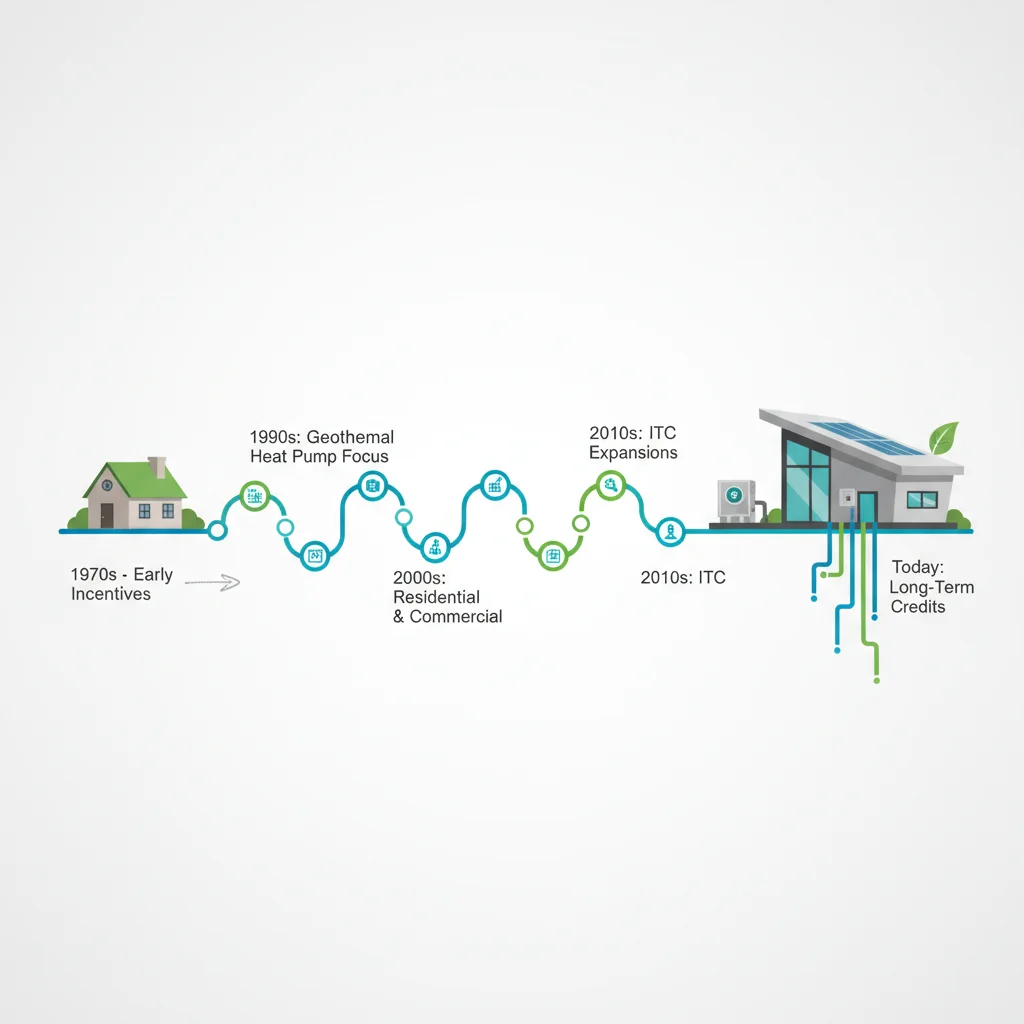
The federal Residential Clean Energy Credit (Section 25D) ended for expenditures made after December 31, 2025, and the IRS treats an expenditure as made when installation is completed (IRS FS-2025-05). Federal tax credits for this work have ended, but state, local and utility rebates may still apply; check what is available at your address with the DuloCore rebate calculator. And the percentage homeowners could claim depended entirely on when they installed their system.
What Was the Original Geothermal Tax Credit Percentage and When Did It Start?
The federal geothermal tax credit launched in 1980 under the Energy Tax Act at 10% of installation costs, capped at $2,200 per system. Congress authorized the credit to reduce dependence on foreign oil following the 1979 energy crisis. The original program expired in 1985 after homeowners claimed $87 million in credits across 39,500 installations.
The federal Residential Clean Energy Credit (Section 25D) ended for expenditures made after December 31, 2025, and the IRS treats an expenditure as made when installation is completed (IRS FS-2025-05).
How Did the Credit Amount and Annual Cap Change Over Time?
| Program Period | Credit Percentage | Annual Cap | Equipment Cap | Filing Form |
|---|---|---|---|---|
| 1980-1985 | 10% | $2,200 | $2,200 | Form 5695 |
| 2006-2019 | 30% | None | None | Form 5695 |
| 2020-2021 | 26% | None | None | Form 5695 |
| 2022-2025 | 30% | None | None | Form 5695 |
| 2026 onward | Ended (IRS FS-2025-05) | — | — | — |
The 2005 revival eliminated all caps, allowing homeowners to claim 30% of total installation costs with no maximum. A $25,000 geothermal system installed in 2025 qualified for $7,500 in credits. But systems installed in 2020-2021 during the phase-down period only received 26%, or $6,500 on the same installation.
So the difference between installing in 2019 versus 2020 cost homeowners $1,000 per $25,000 spent. The federal Residential Clean Energy Credit (Section 25D) ended for expenditures made after December 31, 2025, and the IRS treats an expenditure as made when installation is completed (IRS FS-2025-05).
Which Equipment Types Were Eligible Under Each Version of the Credit?
Original 1980-1985 credits covered only ground-source heat pumps with a minimum Coefficient of Performance (COP) of 2.5. The 2005 revival expanded eligibility to any geothermal system meeting Energy Star specifications, including vertical loops, horizontal loops, pond loops, and open-loop configurations.
Requirements in effect until the credit ended mandated ENERGY STAR Most Efficient certification with minimum Energy Efficiency Ratio (EER) of 17.1 for closed-loop systems and 20.2 for open-loop systems. Ductless mini-split geothermal systems qualified if they met the same EER thresholds.
"Qualified geothermal heat pump property expenditures must be for equipment that uses the ground or ground water as a thermal energy source to heat a dwelling or as a thermal energy sink to cool a dwelling." — IRS Form 5695 Instructions
What Income Limits Applied to Geothermal Tax Credit Eligibility?
The original 1980-1985 credit imposed no income restrictions. The federal Energy Efficient Home Improvement Credit (Section 25C) ended for property placed in service after December 31, 2025 (IRS FS-2025-05).
Claiming the credit required sufficient tax liability. The geothermal credit was non-refundable, meaning it reduced the tax bill to zero but did not generate a refund. So homeowners with $5,000 in tax liability could claim only $5,000 of a $7,500 credit, carrying the remaining $2,500 forward to future tax years.
How Do You File for the Geothermal Tax Credit and What Forms Are Required?
Form 5695 only covers qualifying work completed by December 31, 2025 and claimed on a 2025 return; the federal 25C and 25D credits ended after that date (IRS FS-2025-05). You'll need manufacturer certification statements proving ENERGY STAR Most Efficient compliance, total installation costs including labor and materials, and the installation completion date.
The certification statement must include manufacturer name, product model number, and confirmation of qualifying efficiency ratings. Keep all receipts and documentation for 7 years in case of audit. And file the credit in the tax year when installation completes, not when you signed the contract or made the deposit.
Use our free rebate calculator to estimate your total state and utility incentives before installation.
Can You Stack the Geothermal Credit With Other Energy Tax Credits?
The federal Residential Clean Energy Credit (Section 25D) ended for expenditures made after December 31, 2025, and the IRS treats an expenditure as made when installation is completed (IRS FS-2025-05). California's Self-Generation Incentive Program (SGIP) provides $0.50 per watt for ground-source heat pumps, adding $2,500 to a 5-ton system. (Note: Federal tax credit percentages and availability are subject to change; the 30% Residential Clean Energy Credit under Section 25D expired December 31, 2025. Verify current incentives at energy.gov.)
Check your local utility for heat pump rebates.
Official Sources
- IRS Form 5695 — Official tax credit filing form and instructions (note: the federal 25C and 25D credits ended for projects completed after December 31, 2025)
- DOE Geothermal Heat Pumps — Federal efficiency standards and eligible equipment types
- ENERGY STAR Tax Credits — Federal tax credit equipment requirements (note: the federal 25C and 25D credits ended for projects completed after December 31, 2025)
Frequently Asked Questions
When did the federal geothermal tax credit start?
The federal geothermal tax credit started in 1980 under the Energy Tax Act at 10% of installation costs, capped at $2,200 per system. The program expired in 1985, then relaunched in 2005 at 30% with no cap under the Energy Policy Act. The federal Residential Clean Energy Credit (Section 25D) ended for expenditures made after December 31, 2025, and the IRS treats an expenditure as made when installation is completed (IRS FS-2025-05).
What is the current geothermal tax credit percentage for 2026?
The federal Residential Clean Energy Credit (Section 25D) ended for expenditures made after December 31, 2025, and the IRS treats an expenditure as made when installation is completed (IRS FS-2025-05).
Has the geothermal tax credit amount changed over the years?
The federal Residential Clean Energy Credit (Section 25D) ended for expenditures made after December 31, 2025, and the IRS treats an expenditure as made when installation is completed (IRS FS-2025-05). The credit's rate changed several times before it ended.
What geothermal systems qualify for the tax credit?
Ground-source heat pumps meeting ENERGY STAR Most Efficient certification qualified, including vertical loops, horizontal loops, pond loops, and open-loop configurations. Closed-loop systems needed minimum Energy Efficiency Ratio (EER) of 17.1, while open-loop systems required EER of 20.2. And ductless mini-split geothermal systems qualified if they met the same efficiency thresholds. The federal Residential Clean Energy Credit (Section 25D) ended for expenditures made after December 31, 2025, and the IRS treats an expenditure as made when installation is completed (IRS FS-2025-05).
When does the geothermal tax credit expire?
The federal Residential Clean Energy Credit (Section 25D) ended for expenditures made after December 31, 2025, and the IRS treats an expenditure as made when installation is completed (IRS FS-2025-05).
Ready to calculate your total geothermal savings? Use our free rebate calculator to combine state incentives and utility rebates for your specific address and system size. Get your personalized estimate in 60 seconds.
Last updated: April 14, 2026. Reviewed by the DuloCore Editorial Team. About our authors.
Check your California heat pump rebate eligibility — see the programs you qualify for and the dollar amounts on our California heat pump rebate finder.