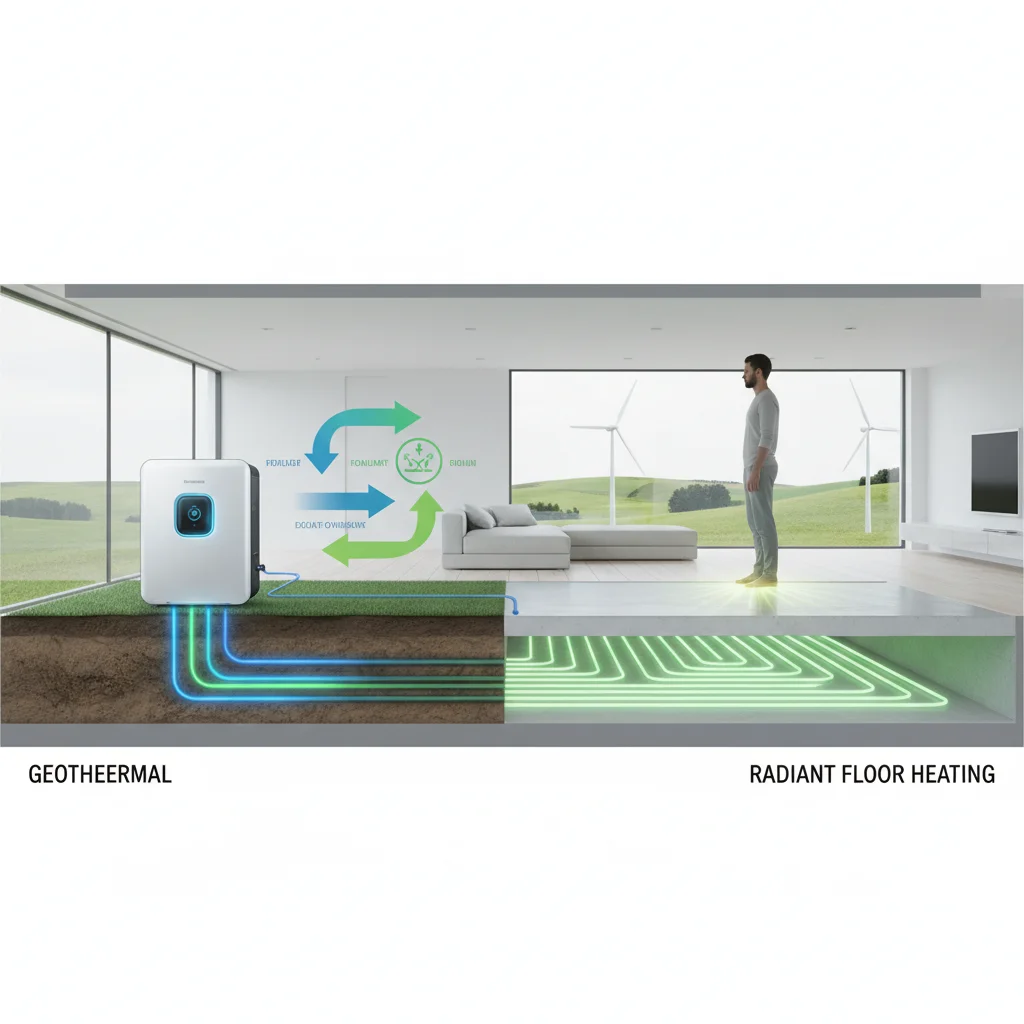
The federal Residential Clean Energy Credit (Section 25D) ended for expenditures made after December 31, 2025, and the IRS treats an expenditure as made when installation is completed (IRS FS-2025-05). Federal tax credits for this work have ended, but state, local and utility rebates may still apply; check what is available at your address with the DuloCore rebate calculator. Geothermal systems extract heat from underground temperatures that remain constant at 50-60°F year-round, while radiant floor heating circulates warm water through pipes embedded in concrete slabs. And the IRA framework extends credits for both technologies, but eligibility requirements differ by system efficiency and installation specifications.
What are the rebate-eligible specifications for geothermal and radiant floor heating systems?
The federal Residential Clean Energy Credit (Section 25D) ended for expenditures made after December 31, 2025, and the IRS treats an expenditure as made when installation is completed (IRS FS-2025-05). Radiant floor heating systems qualify when paired with high-efficiency boilers rated at 95% AFUE or heat pumps meeting Energy Star specifications through 2026 programs.
California's TECH Clean California initiative provides point-of-sale rebates ranging from $3,000 to $8,000 for ducted heat pump installations that include radiant floor compatibility. Geothermal installations receive the maximum rebate tier when they replace natural gas furnaces in disadvantaged communities. But homeowners must verify system specifications through AHRI certification directories before claiming credits. Form 5695 only covers qualifying work completed by December 31, 2025 and claimed on a 2025 return; the federal 25C and 25D credits ended after that date (IRS FS-2025-05).
"Geothermal heat pumps can reduce energy consumption by 30-60% compared to conventional heating systems" — U.S. Department of Energy
So the challenge isn't choosing between two heating technologies—it's understanding which system delivers measurable energy savings that justify $15,000 to $50,000 in upfront costs. And federal data shows geothermal installations save homeowners an average of $1,200 annually on heating bills, while radiant floor systems paired with conventional boilers save $400 to $600 in California climate zones 2-4.
How do the ROI and payback periods compare between geothermal and radiant floor heating?
Geothermal systems deliver payback periods of 5 to 10 years with average installation costs of $18,000 to $25,000 after federal tax credits, while radiant floor heating systems paired with natural gas boilers reach payback in 8 to 15 years on installations costing $10,000 to $18,000. But geothermal systems provide both heating and cooling, eliminating the need for separate air conditioning equipment that costs $5,000 to $8,000 to install.
California homeowners in PG&E territory pay $0.38 per therm for natural gas versus $0.28 per kWh for electricity in 2026. Geothermal heat pumps operating at 400% efficiency deliver four units of heat per unit of electricity consumed. Radiant floor systems paired with 95% AFUE boilers lose 5% of fuel energy through combustion exhaust. And geothermal systems maintain consistent efficiency regardless of outdoor temperature, while boiler-based radiant systems experience 10-15% efficiency degradation when outdoor temperatures drop below 40°F.
Use our free rebate calculator to model your specific payback period based on current utility rates and federal tax credit eligibility.
| System Type | Average Installation Cost | Annual Energy Savings | Payback Period | Federal Tax Credit (30%) |
|---|---|---|---|---|
| Geothermal heat pump (closed-loop) | $25,000 | $1,200 | 7 years | $7,500 |
| Radiant floor + gas boiler | $15,000 | $500 | 12 years | $450 (boiler only) |
| Radiant floor + electric heat pump | $18,000 | $900 | 8 years | $5,400 |
What heating alternatives should homeowners consider alongside geothermal and radiant systems?
Ducted heat pump systems deliver comparable efficiency to geothermal installations at 50% lower upfront costs of $8,000 to $15,000 including federal tax credits. Mini-split heat pumps provide zoned heating for $4,000 to $7,000 per zone with 300% seasonal efficiency ratings. But neither alternative qualifies for the maximum TECH Clean California rebate tiers reserved for ground-source geothermal installations in disadvantaged communities.
Hybrid systems combining radiant floor heating with air-source heat pumps optimize efficiency by using radiant zones for primary living spaces and ducted distribution for bedrooms. And these configurations cost $22,000 to $32,000 installed but deliver 15-20% greater efficiency than single-technology systems. Solar thermal panels paired with radiant floor heating eliminate natural gas consumption for $12,000 to $18,000 in equipment costs, but California net metering changes in 2023 reduced payback advantages for solar thermal compared to photovoltaic systems.
Pellet stoves and wood boilers qualify for $300 biomass stove tax credits but require manual fuel loading and produce particulate emissions restricted in South Coast and Bay Area air quality districts.
How long do geothermal and radiant floor heating systems typically last?
Geothermal ground loops carry 50-year warranties with expected lifespans exceeding 75 years for polyethylene piping installed in closed-loop configurations. Heat pump compressors and indoor components last 20 to 25 years before requiring replacement at costs of $3,500 to $6,000. Radiant floor heating pipes embedded in concrete slabs last 35 to 50 years with zero maintenance requirements. But boilers driving radiant systems require replacement every 15 to 20 years at costs of $4,000 to $7,000 for Energy Star certified models.
"Ground source heat pump systems have long lifespans—25 years for inside components and 50+ years for ground loops" — Energy.gov Geothermal Technologies
Maintenance costs for geothermal systems average $150 to $300 annually for filter changes and refrigerant checks. Radiant floor systems require annual boiler inspections costing $200 to $400 plus descaling treatments every 3 to 5 years in hard water regions. And geothermal systems eliminate the 10% annual efficiency degradation that affects gas boilers after 10 years of operation.
What are the upfront costs and long-term savings for each heating method?
Geothermal closed-loop systems cost $18,000 to $30,000 installed depending on soil conditions and loop field size, with 30% federal tax credits reducing net costs to $12,600 to $21,000. Open-loop geothermal (this federal credit ended for expenditures made after December 31, 2025) installations accessing groundwater cost $15,000 to $22,000 but face permitting restrictions in California counties with groundwater sustainability plans. Radiant floor heating installations cost $8 to $16 per square foot for $12,000 to $24,000 in typical 1,500-square-foot applications. (Note: Federal tax credit percentages and availability are subject to change; the 30% Residential Clean Energy Credit under Section 25D expired December 31, 2025. Verify current incentives at energy.gov.)
California homeowners replacing natural gas furnaces with geothermal systems save $1,200 to $1,800 annually on combined heating and cooling costs. Radiant floor heating reduces energy consumption by 15-30% compared to forced-air systems but doesn't provide air conditioning. And geothermal systems eliminate the $150 monthly summer electricity bills associated with central air conditioning in Sacramento and Central Valley climate zones.
TECH Clean California rebates stack with federal tax credits, providing $3,000 to $8,000 in additional incentives for heat pump installations. Disadvantaged community residents receive priority processing and maximum rebate tiers. So total incentives reach $15,000 to $18,000 for qualifying geothermal installations, reducing net costs below $10,000 in some projects.
How do installation complexity and timeline differ between these two systems?
Geothermal installations require 3 to 5 days for drilling vertical boreholes 150 to 400 feet deep or excavating horizontal loop fields covering 1,500 to 2,500 square feet of yard space. Drilling costs $10 to $30 per foot depending on soil and rock conditions. Radiant floor installations require 5 to 10 days for removing existing flooring, installing pipe loops at 6 to 12-inch spacing, and pouring 1.5 to 2 inches of self-leveling concrete before refinishing floors.
And geothermal projects face county permit requirements for well drilling and HVAC equipment, adding 2 to 4 weeks for approval in California jurisdictions. Radiant floor projects require building permits for plumbing and structural modifications but typically receive approval within 7 to 10 business days. But both systems require coordination with energy tax credits documentation and contractor certification before claiming federal incentives.
Geothermal installations add 400 to 800 pounds to electrical service requirements, potentially requiring panel upgrades costing $2,000 to $4,000. Radiant floor systems require minimal electrical capacity when paired with gas boilers but demand 50-amp circuits for electric heat pump configurations.
Official Sources
- DOE Geothermal Heat Pumps — Federal efficiency standards and rebate program information
- IRS Energy Tax Credits — Federal tax credit eligibility and documentation requirements (note: the federal 25C and 25D credits ended for projects completed after December 31, 2025)
- DSIRE California Programs — Comprehensive database of state and utility rebate programs
Related Reading: Learn more about Radiant Barrier Energy Savings and Radiant Floor Heating Energy Audit.
Frequently Asked Questions
What is the difference between geothermal and radiant floor heating?
Geothermal systems extract heat from underground temperatures through buried pipe loops and distribute conditioned air through ducts or hydronic radiators. Radiant floor heating circulates warm water through pipes embedded in floor slabs to heat rooms through infrared radiation. Geothermal provides both heating and cooling with 400% efficiency ratings, while radiant floor heating delivers winter comfort with 85-95% efficiency depending on heat source. The federal home energy tax credits (Sections 25C and 25D) ended for projects completed after December 31, 2025 (IRS FS-2025-05).
How much can you save with geothermal heating compared to radiant floor heating?
Geothermal systems save California homeowners $1,200 to $1,800 annually compared to natural gas furnaces and air conditioning. Radiant floor heating paired with gas boilers saves $400 to $600 annually compared to forced-air furnaces. But geothermal systems eliminate separate cooling costs averaging $900 to $1,400 per year in California climate zones 3-5. So total energy cost reductions reach $2,100 to $3,200 annually for geothermal installations replacing both heating and cooling equipment. Check current heat pump rebates to maximize your installation savings.
Which heating system qualifies for energy tax credits?
The federal Residential Clean Energy Credit (Section 25D) ended for expenditures made after December 31, 2025, and the IRS treats an expenditure as made when installation is completed (IRS FS-2025-05). Radiant floor heating systems qualify for credits when paired with Energy Star certified boilers rated at 95% AFUE or higher, with credits limited to $600 for boiler equipment only. Electric heat pumps powering radiant floor systems qualify for the full 30% credit on heat pump costs but not on floor installation expenses. California TECH Clean California rebates provide $3,000 to $8,000 for ducted heat pump installations but exclude traditional radiant floor boiler systems.
How long does it take to install geothermal versus radiant floor heating?
Geothermal installations require 3 to 5 days for ground loop installation plus 1 to 2 days for indoor equipment connection and commissioning. Permitting adds 2 to 4 weeks in California jurisdictions. Radiant floor installations take 5 to 10 days including floor removal, pipe installation, concrete pouring, and floor refinishing. But radiant floor projects require 7-day concrete curing periods before refinishing. Total project timelines span 4 to 6 weeks for geothermal systems and 3 to 4 weeks for radiant floor installations in typical residential applications.
What are the upfront costs for geothermal and radiant floor heating systems?
Geothermal closed-loop systems cost $18,000 to $30,000 before federal tax credits reduce net costs to $12,600 to $21,000. Open-loop geothermal installations cost $15,000 to $22,000 with net costs of $10,500 to $15,400 after credits. Radiant floor heating installations cost $12,000 to $24,000 for 1,500-square-foot homes. The federal Residential Clean Energy Credit (Section 25D) ended for expenditures made after December 31, 2025, and the IRS treats an expenditure as made when installation is completed (IRS FS-2025-05). And TECH Clean California adds $3,000 to $8,000 in rebates for qualifying geothermal heat pump installations.
Ready to calculate your heating system savings? Use our rebate calculator to compare geothermal and radiant floor heating costs with current federal tax credits and California incentive programs. Get personalized payback estimates based on your home size, climate zone, and existing equipment.
Updated on April 14, 2026. Fact-checked by DuloCore Editors. About our research team.
Check your California heat pump rebate eligibility — see the programs you qualify for and the dollar amounts on our California heat pump rebate finder.