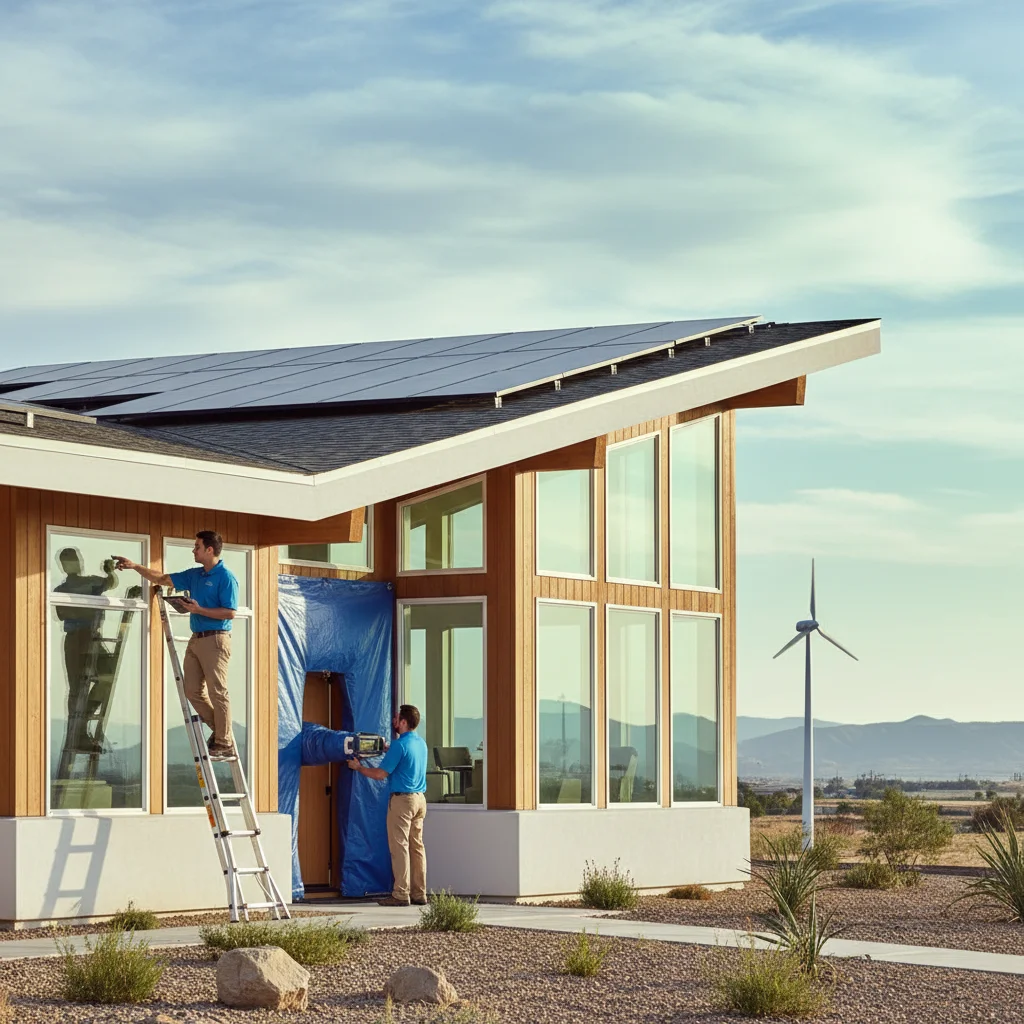
Bakersfield homeowners spend an average of $1,800 annually on wasted energy from air leaks, inefficient HVAC systems, and poor insulation. And most don't realize a single $300 professional energy audit identifies exactly where that money disappears—while qualifying them for rebates worth up to $14,000 in 2026.
How Much Does a Home Energy Audit Cost in Bakersfield?
Professional home energy audits in Bakersfield cost $200-$500 for comprehensive assessments including blower door tests, thermal imaging, and appliance efficiency analysis. Utility-sponsored audits through Pacific Gas & Electric cost $0-$75 for qualifying income-eligible households. Mobile home audits cost $150-$300 due to simpler building envelope testing.
The price varies based on home size and testing depth. A 1,200-square-foot home typically costs $250 for a basic audit. But homes exceeding 2,500 square feet cost $400-$500 because auditors spend 3-4 hours conducting comprehensive diagnostics. And that investment pays back fast—the average audit identifies $2,400 in annual energy waste.
Bakersfield's climate drives specific audit priorities. Auditors focus on cooling efficiency since homes use air conditioning 150+ days per year. So thermal imaging concentrates on attic insulation gaps where summer heat penetrates most aggressively. Duct leakage testing matters more here than in coastal California cities because Bakersfield's extreme temperature swings from 38°F winter lows to 112°F summer highs stress HVAC systems harder.
Professional audits deliver data DIY approaches miss. Blower door tests measure exact air exchange rates at 50 pascals of pressure. Thermal cameras detect temperature differentials as small as 0.1°F. So homeowners get quantified savings projections for each recommended upgrade instead of vague improvement suggestions.
Use our free rebate calculator to estimate total savings after combining audit findings with available 2026 incentive programs.
What's the Timeline for Getting a Home Energy Audit in Bakersfield?
Home energy audit scheduling in Bakersfield takes 1-3 weeks from initial contact to completed report delivery. The on-site inspection requires 2-4 hours depending on home size and complexity. Auditors deliver written reports with prioritized recommendations within 5-7 business days after the visit.
Peak demand occurs May through August when homeowners prepare for extreme summer temperatures. So scheduling during off-peak months from October through March often secures appointments within 5-7 days instead of waiting 2-3 weeks. And auditors conduct more thorough inspections when not rushing between multiple daily appointments.
But winter audits provide advantages beyond faster scheduling. Thermal imaging shows heat loss patterns more clearly when indoor-outdoor temperature differentials exceed 30°F. So February audits in Bakersfield—when overnight lows hit 38°F—reveal insulation gaps that summer inspections miss.
Report depth varies by provider. Basic audits deliver 3-5 page summaries listing obvious deficiencies. Comprehensive assessments generate 15-25 page reports with room-by-room analysis, payback period calculations for each upgrade, and prioritized action plans. The detailed reports matter most for homeowners planning staged improvements over 2-3 years rather than immediate whole-house retrofits.
Pacific Gas & Electric schedules utility-sponsored audits within 2-4 weeks through their Home Upgrade program. Or independent certified auditors book faster but charge the full $300-$500 fee. Home energy audits identify specific improvements that maximize rebate eligibility before installation begins.
Are You Eligible for Energy Audit Rebates and Incentives in Bakersfield?
Bakersfield homeowners qualify for audit rebates through Pacific Gas & Electric's Energy Savings Assistance Program, which provides $0 audits for households earning up to 250% of federal poverty guidelines—$78,000 for a family of four in 2026. The Inflation Reduction Act Home Efficiency Rebates cover up to $160 of audit costs for moderate-income households earning 80-150% of area median income.
Income verification requires recent tax returns or pay stubs covering the past 90 days. And homeowners must own and occupy the property as their primary residence. Rental properties don't qualify for residential rebate programs even when owner-occupied.
Stacking multiple programs maximizes savings. A qualifying household combines the PG&E free audit with IRA rebates covering subsequent improvements—$8,000 for heat pump installation, $4,000 for electrical panel upgrades, and $1,600 for insulation. But the audit must occur first to document baseline energy use and qualify improvements.
"Home energy assessments identify cost-effective improvements that reduce energy waste and lower utility bills while improving home comfort." — U.S. Department of Energy
The California Public Utilities Commission requires certified Building Performance Institute or Residential Energy Services Network auditors for rebate qualification. So verify certification before scheduling to avoid invalidating rebate claims. Independent auditors list credentials on websites or provide BPI certification numbers upon request.
Timing matters for rebate stacking. The audit establishes the baseline efficiency score required for IRA Home Efficiency Rebate calculations. So homeowners complete the audit, receive the report, then apply for improvement rebates within 180 days to maintain eligibility. Calculate your total rebate potential with our rebate calculator before scheduling the audit.
Can You Stack Multiple Energy Efficiency Incentives and Rebates?
Bakersfield homeowners stack federal tax credits with state rebates and utility incentives to reduce out-of-pocket costs by 50-70% on major efficiency upgrades. The federal Energy Efficient Home Improvement Credit (Section 25C) ended for property placed in service after December 31, 2025 (IRS FS-2025-05). Federal tax credits for this work have ended, but state, local and utility rebates may still apply; check what is available at your address with the DuloCore rebate calculator.
Federal credits combine with California's TECH Clean California initiative offering $3,000-$7,000 rebates for heat pump installations in single-family homes. And Pacific Gas & Electric adds $500-$2,000 incentives for high-efficiency HVAC upgrades meeting SEER2 ratings above 16. So a $12,000 heat pump installation costs $4,200 after combining all available programs.
But stacking rules vary by program. Federal tax credits apply to equipment costs including installation labor. State rebates cover equipment only, excluding labor. So homeowners must track costs separately on invoices to maximize both benefits without double-claiming.
Income limits affect stacking potential. IRA Home Efficiency Rebates provide up to $14,000 for moderate-income households but phase out at 150% of area median income—$142,500 for Bakersfield families in 2026. Households exceeding income thresholds still access federal tax credits and utility rebates worth $5,000-$8,000 combined.
And timing restrictions apply. State and utility rebates require applications before installation begins. So homeowners apply for California and PG&E programs first, complete installation, then claim federal credits when filing taxes.
The audit report justifies all rebate applications by documenting pre-improvement efficiency levels. Upgrade to heat pump rebates after the audit confirms existing HVAC systems operate below minimum efficiency thresholds. Or explore energy tax credits to understand federal benefit calculations before starting projects.
Home Energy Audit Process: What to Expect in Bakersfield
Professional energy audits begin with a 30-minute interview documenting utility bills, occupant comfort complaints, and previous home improvements. Auditors then conduct a room-by-room visual inspection identifying obvious air leaks around windows, doors, electrical outlets, and plumbing penetrations.
Blower door testing follows the visual inspection. Auditors seal all exterior doors and windows, install a calibrated fan in the main entry, and depressurize the home to 50 pascals. The test measures air changes per hour—homes exceeding 7 ACH50 require immediate air sealing before other improvements deliver full benefits.
Thermal imaging occurs during blower door operation when pressure differentials pull outside air through leaks. Infrared cameras display temperature variations in real-time, revealing insulation gaps in walls, attics, and floors. So auditors photograph problem areas and include images in the final report with specific repair recommendations.
Duct leakage testing applies to homes with forced-air HVAC systems—most Bakersfield residences. Auditors pressurize ductwork to 25 pascals and measure leakage rates. Ducts losing more than 10% of airflow waste $200-$400 annually in Bakersfield's climate where air conditioning runs 1,500+ hours per summer.
Combustion safety testing checks gas furnaces, water heaters, and fireplaces for carbon monoxide spillage. Auditors measure flue draft pressure and CO levels in ambient air. And homes with attached garages receive extra scrutiny since vehicle exhaust infiltrates living spaces through shared walls.
The written report prioritizes improvements by payback period. Air sealing typically delivers 1-3 year paybacks. Attic insulation pays back in 3-5 years. HVAC replacement extends to 7-12 years depending on existing system age and efficiency. So homeowners tackle quick wins first, then plan major upgrades when equipment reaches end of useful life.
How Do Bakersfield Energy Audits Compare to DIY Energy Assessments?
Professional audits cost $300-$500 but deliver quantified savings projections and rebate qualification documentation that DIY assessments can't provide. Certified auditors use $15,000-$25,000 diagnostic equipment including calibrated blower doors, thermal cameras, duct testers, and combustion analyzers. DIY approaches rely on visual inspection and $20-$50 infrared thermometers that detect surface temperatures but miss air leakage patterns.
Blower door tests measure whole-house air tightness to 0.1 CFM precision. Homeowners conducting DIY assessments identify obvious gaps around windows and doors but miss the 30-40% of air leakage occurring in attics, crawl spaces, and wall cavities. So professional audits find $800-$1,200 in additional annual savings beyond DIY discoveries.
Rebate eligibility requires third-party certification. The Inflation Reduction Act Home Efficiency Rebates mandate Building Performance Institute-certified auditor reports documenting pre- and post-improvement HERS Index scores. And California TECH Clean California rebates require similar professional documentation. So DIY audits save the $300 upfront cost but forfeit $8,000-$14,000 in available rebates.
But DIY assessments help homeowners prepare for professional audits. Walking the home with an infrared thermometer before scheduling identifies problem areas to discuss with auditors. And reviewing 12 months of utility bills reveals seasonal usage patterns that guide audit priorities—high summer bills indicate cooling efficiency problems while winter spikes suggest heating waste.
Online calculators estimate potential savings but lack site-specific accuracy. The Department of Energy's Home Energy Saver tool provides national average projections. Professional audits deliver room-level analysis accounting for Bakersfield's specific climate, local utility rates averaging $0.28/kWh, and individual home construction details.
"Professional home energy assessments use diagnostic equipment and expertise that identify savings opportunities DIY methods miss, typically finding 30-50% more improvement potential." — Database of State Incentives for Renewables & Efficiency
The audit report becomes a long-term roadmap. Homeowners complete high-priority items immediately, then revisit the report when replacing failed equipment or planning renovations. So the $300-$500 investment guides efficiency decisions over 10-15 years instead of just addressing immediate concerns.
Official Sources
- U.S. Department of Energy - Home Energy Assessments — Federal guidance on professional energy audits and efficiency improvements
- DSIRE - Database of State Incentives for Renewables & Efficiency — Comprehensive database of federal, state, and utility rebate programs
- Pacific Gas & Electric - Home Upgrade Program — Utility-sponsored audit and rebate programs for Northern and Central California
Related Reading: Learn more about Energy Audit Biggest Energy Wasters Home and Energy Audit Case Studies Residential.
Frequently Asked Questions
How much does a home energy audit cost in Bakersfield?
Professional home energy audits in Bakersfield cost $200-$500 depending on home size and testing depth. Pacific Gas & Electric provides $0-$75 audits for income-qualified households through the Energy Savings Assistance Program. Comprehensive audits for homes exceeding 2,500 square feet cost $400-$500 because they require 3-4 hours of on-site testing including blower door, thermal imaging, and duct leakage diagnostics.
What is included in a professional home energy audit?
Professional audits include blower door testing measuring whole-house air leakage, thermal imaging identifying insulation gaps, duct leakage testing for forced-air HVAC systems, combustion safety analysis for gas appliances, and appliance efficiency assessment. Auditors deliver written reports within 5-7 days prioritizing improvements by payback period and documenting baseline efficiency for rebate applications. Reports specify upgrade costs, annual savings projections, and rebate qualification requirements.
Are home energy audits free in Bakersfield?
Free audits are available for Bakersfield households earning up to 250% of federal poverty guidelines—$78,000 for a family of four in 2026—through Pacific Gas & Electric's Energy Savings Assistance Program. Moderate-income households earning 80-150% of area median income qualify for IRA Home Efficiency Rebates covering up to $160 of audit costs. Households exceeding income limits pay $300-$500 for independent certified auditor assessments.
How long does a home energy audit take?
On-site energy audits require 2-4 hours depending on home size and testing complexity. Auditors spend 30 minutes on initial interviews and utility bill review, 60-90 minutes on blower door and thermal imaging testing, 30-45 minutes on duct leakage analysis, and 15-30 minutes on combustion safety checks. Written reports arrive within 5-7 business days after the inspection.
Do I need a home energy audit to qualify for rebates in Bakersfield?
The Inflation Reduction Act Home Efficiency Rebates require professional energy audit reports documenting baseline HERS Index scores before improvements and predicted post-upgrade scores. California TECH Clean California rebates mandate similar pre-installation assessments by BPI-certified auditors. Federal tax credits don't require audits but professional reports help maximize eligible improvement claims and prioritize projects by payback period and rebate availability.
Ready to reduce your energy bills by $1,800-$2,400 annually? Use our free rebate calculator to discover how much you'll save on a professional energy audit plus qualified improvements in Bakersfield. Get your personalized savings estimate in under 60 seconds—no signup required.
Updated on April 14, 2026. Fact-checked by DuloCore Editors. About our research team.