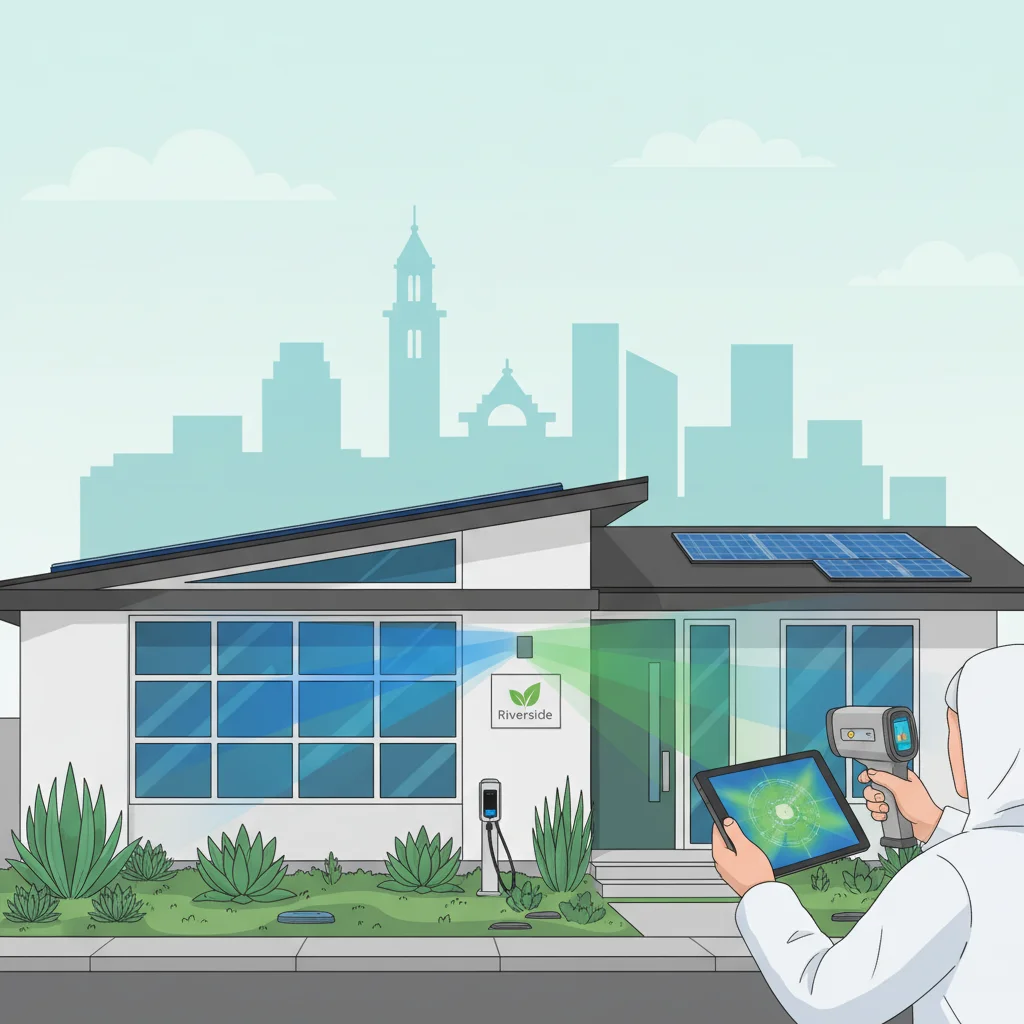
Riverside homeowners paid an average of $450 for professional energy audits in 2025, but more than 60% qualified for free assessments through utility programs they never knew existed. And with California's 2026 Building Energy Benchmarking and Disclosure Program now requiring energy performance data for property sales, the cost of skipping an audit just went up.
What Does a Home Energy Audit Cost in Riverside, California?
Home energy audits in Riverside, California range from free to $600 depending on provider type and home size in 2026. Southern California Edison (SCE) covers 100% of audit costs for qualifying residential customers through the Energy Savings Assistance Program. Private certified energy auditors charge $350-$600 for comprehensive assessments including blower door tests and thermal imaging.
The price difference comes down to scope. SCE's no-cost audits include basic visual inspection, appliance assessment, and minor weatherization measures installed on-site at zero charge. But private auditors deliver detailed reports with infrared cameras that detect hidden air leaks, moisture intrusion patterns, and insulation gaps that utility programs miss.
Home size drives the upper end of pricing. A 1,200-square-foot bungalow typically costs $350-$400 to audit. But a 3,000-square-foot two-story home with attic access challenges and complex ductwork pushes costs to $550-$600. And most auditors add $75-$100 for properties with crawl spaces requiring specialized inspection equipment.
So the real question isn't cost—it's whether you need the forensic-level detail that justifies paying $500 when free options exist. Homeowners planning heat pump rebates or applying for federal energy tax credits need the documentation that only comprehensive paid audits provide.
How Do Energy Audit Costs Stack With Other Home Improvement Expenses?
Energy audit costs represent 2-3% of typical home efficiency upgrade budgets in Riverside's market. A $450 audit fee compares to $15,000-$25,000 for complete HVAC replacement, $8,000-$12,000 for attic insulation upgrades, and $3,500-$6,000 for air sealing and duct work improvements that audits identify.
And the return on that $450 investment shows up fast. Riverside homeowners who completed recommended efficiency measures saved an average of $1,240 annually on utility bills according to 2025 California Energy Commission data. So the audit pays for itself in 4.3 months through reduced electricity and gas costs.
But here's where audit costs get strategic. The federal Home Efficiency Rebates program—part of the Inflation Reduction Act extending through 2032—requires a pre-upgrade energy assessment to qualify for up to $8,000 in rebates. So that $450 audit unlocks access to rebate pools that wouldn't exist otherwise.
Compare that to diagnostic fees for other home systems. HVAC contractors charge $89-$150 for seasonal tune-ups that check refrigerant levels and clean coils. Plumbers bill $150-$200 for camera inspections of sewer lines. A whole-home energy audit delivers building envelope analysis, equipment efficiency ratings, and a prioritized improvement roadmap for roughly 3x the value.
What's the Timeline and Deadline for Getting an Energy Audit in Riverside?
Home energy audits in Riverside take 2-3 hours for standard assessments and 3-5 hours for comprehensive evaluations with detailed diagnostics. Scheduling availability ranges from 3-7 days for private auditors to 2-6 weeks for SCE's free residential program depending on seasonal demand. No universal deadline exists, but specific rebate programs impose pre-approval requirements that create de facto audit deadlines.
And timing matters for rebate eligibility. California's Home Upgrade program requires audits completed within 180 days before rebate applications. The federal Home Efficiency Rebates—administered through state energy offices starting late 2026—mandate pre-upgrade energy modeling that most auditors complete during standard assessments.
So homeowners planning equipment replacements before summer 2026 need audits scheduled by March to hit the 180-day window. But those targeting fall installations have more flexibility to wait for SCE appointment slots that cost nothing versus paying $450-$600 for immediate private service.
Seasonal demand spikes affect wait times. January through March sees the shortest scheduling delays as Riverside residents focus on indoor projects before summer heat arrives. But May through August stretches SCE program wait times to 4-8 weeks when air conditioning failures create urgent replacement needs that skip the audit step entirely.
Property sale timelines create hard deadlines under California's 2026 disclosure requirements. Sellers must provide energy performance documentation at point of sale. And buyers increasingly request recent audit reports during escrow negotiations, making the 2-week turnaround for private auditors worth the $450-$600 cost to avoid transaction delays.
Do You Need Pre-Approval Before Scheduling a Home Energy Audit?
Pre-approval requirements for home energy audits in Riverside depend on program type and payment method in 2026. SCE's Energy Savings Assistance Program requires income verification before scheduling no-cost audits—households must earn below 250% of federal poverty guidelines. But private auditor appointments need no pre-approval, just payment confirmation at booking.
And the income threshold translates to specific dollar amounts. A two-person Riverside household qualifies for free SCE audits with annual income below $52,450 in 2026. Four-person households qualify at $79,450 or less. Documentation requirements include recent tax returns, pay stubs covering the past 60 days, or benefit award letters from state assistance programs.
So homeowners above income limits skip the approval process entirely by hiring private certified energy auditors who schedule same-week appointments with no financial screening. But those who qualify for SCE's program unlock not just free audits but on-the-spot installation of LED bulbs, low-flow showerheads, weatherstripping, and door sweeps at zero cost.
Federal rebate programs layer additional pre-approval rules. The Home Efficiency Rebates require registered contractor involvement and energy modeling software that meets Department of Energy standards. And participating auditors must hold Building Performance Institute (BPI) or RESNET certification—credentials that only 40% of Riverside's private auditors currently maintain.
Pre-approval becomes mandatory when stacking multiple incentives. Homeowners combining SCE rebates with federal tax credits and state programs need audit reports that document baseline energy consumption before improvements. Use the rebate calculator to model how pre-audit baseline data affects final rebate amounts across stacked programs.
How Do Riverside Energy Audit Costs Compare to Other California Cities?
Riverside energy audit costs fall 8-12% below California's coastal metro averages but run 15-20% higher than Central Valley cities in 2026. Los Angeles and San Diego auditors charge $500-$700 for comprehensive residential assessments compared to Riverside's $350-$600 range. But Fresno and Bakersfield prices drop to $300-$450 for equivalent service scope.
And the price gaps reflect cost-of-living differences and auditor density. Riverside County hosts 47 certified residential energy auditors competing for customers across a population of 2.4 million. So supply-demand dynamics push prices down compared to San Francisco's 89 auditors serving 870,000 residents where scarcity drives rates to $600-$850.
Free utility program availability creates the biggest comparative advantage. SCE covers Riverside with no-cost audit access for qualifying households. But homeowners in SMUD territory around Sacramento or PG&E zones in Northern California face different income thresholds and program structures that affect out-of-pocket costs.
"California's investor-owned utilities delivered 847,000 no-cost home energy assessments in 2025, with Southern California Edison accounting for 312,000 of those audits." — California Public Utilities Commission
So Riverside residents enjoy middle-tier pricing with above-average access to zero-cost alternatives. A homeowner earning $55,000 annually pays full private rates in Riverside but might qualify for partial subsidies through different utility programs in other California regions with higher income limits.
Climate zone differences affect audit complexity and cost. Riverside's IECC Climate Zone 3B designation means auditors focus on cooling efficiency and solar heat gain compared to Zone 5 assessments in mountain communities that prioritize heating system performance and insulation R-values. But those climate-driven scope differences rarely change bottom-line pricing more than $50-$75.
What State Incentives and Rebates Can Offset Your Energy Audit Costs?
California offers zero direct rebates for standalone energy audit costs in 2026, but efficiency upgrade rebates ranging from $2,000-$8,000 create indirect audit cost recovery through improved project economics. The California Energy Commission's Home Upgrade program covers post-improvement verification testing—effectively reimbursing the audit function when homeowners complete recommended measures within program timelines.
And the math works like this. A $450 audit identifies attic insulation gaps and duct leaks. Homeowners complete those upgrades for $6,000. The Home Upgrade program rebates $2,000 for verified improvements. So the effective audit cost drops to zero when measured against project savings that wouldn't exist without the initial assessment.
Federal programs add another offset layer. The Inflation Reduction Act's Home Efficiency Rebates—launching in California by late 2026—provide up to $8,000 for whole-home retrofits that reduce energy consumption by 20% or more. But qualification requires DOE-approved energy modeling that certified auditors deliver as part of comprehensive assessments.
"Households investing in home energy upgrades supported by professional audits see 37% higher energy savings compared to those making improvements without diagnostic testing." — U.S. Department of Energy
So the $450-$600 audit fee functions as the unlocking mechanism for $10,000-$16,000 in combined state and federal incentives. Homeowners who skip audits to save money leave verification data on the table that rebate programs require for payment processing.
Tax credit stacking creates additional value. The federal Residential Clean Energy Credit (Section 25D) ended for expenditures made after December 31, 2025, and the IRS treats an expenditure as made when installation is completed (IRS FS-2025-05). Federal tax credits for this work have ended, but state, local and utility rebates may still apply; check what is available at your address with the DuloCore rebate calculator. But optimal system sizing depends on audit-driven load calculations that prevent over-building and maximize credit efficiency per dollar spent.
Official Sources
- U.S. Department of Energy - Save Energy, Save Money — Federal guidance on home energy efficiency improvements and available rebates
- DSIRE - Database of State Incentives for Renewables & Efficiency — Comprehensive database of California and federal energy incentive programs
Related Reading: Learn more about Air Sealing Home Energy Audit and Battery Storage Home Energy Audit.
Related Reading: Learn more about Cooling Season Energy Audit Checklist and Dehumidifier Energy Consumption Audit.
Frequently Asked Questions
How much does a home energy audit cost in Riverside?
Professional home energy audits in Riverside cost $350-$600 for comprehensive assessments in 2026. Southern California Edison provides no-cost audits for households earning below 250% of federal poverty guidelines—$52,450 for two-person households and $79,450 for four-person families. Private certified auditors charge based on home size, with 1,200-square-foot properties typically running $350-$400 and 3,000-square-foot homes reaching $550-$600 including blower door testing and thermal imaging.
What is included in a residential energy audit?
Comprehensive residential energy audits include blower door testing to measure air leakage rates, infrared thermal imaging to identify insulation gaps, HVAC system efficiency analysis, duct leakage testing, appliance energy consumption assessment, and prioritized improvement recommendations. Auditors spend 2-3 hours on standard assessments and 3-5 hours for detailed diagnostics. And final reports document baseline energy consumption, identify cost-effective upgrades, and provide modeling required for federal Home Efficiency Rebate applications launching late 2026.
Are home energy audits free in Riverside County?
Free home energy audits are available through Southern California Edison's Energy Savings Assistance Program for Riverside County households meeting income requirements in 2026. Two-person households qualify at annual incomes below $52,450, while four-person families qualify at $79,450 or less. But scheduling wait times range from 2-6 weeks depending on seasonal demand. Homeowners above income thresholds pay $350-$600 for private auditor services with same-week availability and more comprehensive diagnostic equipment including thermal imaging cameras.
How long does a home energy audit take?
Standard home energy audits take 2-3 hours for visual inspection, blower door testing, and basic diagnostics. Comprehensive assessments with thermal imaging, detailed duct leakage testing, and appliance-level consumption analysis extend to 3-5 hours depending on home size and complexity. And scheduling availability ranges from 3-7 days for private auditors to 2-6 weeks for SCE's free program. Final reports typically arrive within 5-7 business days containing prioritized improvement recommendations and baseline energy modeling data.
Do I need an energy audit to get rebates in Riverside?
Energy audits are mandatory for California's Home Upgrade program rebates and the federal Home Efficiency Rebates launching late 2026. Both programs require pre-improvement energy assessments documenting baseline consumption and post-upgrade verification testing confirming performance gains. But equipment-specific rebates—like $3,000 heat pump incentives or $1,500 water heater rebates—don't always mandate audits. Check the rebate calculator to confirm audit requirements for specific programs and see how baseline documentation affects final rebate amounts when stacking multiple incentives.
Ready to maximize your home efficiency savings? Use our free rebate calculator to discover exactly which energy upgrades qualify for the highest rebates in Riverside—and see how much a professional audit could unlock in combined state and federal incentives.
Last reviewed: April 14, 2026. Reviewed by DuloCore Energy Specialists. About the team.