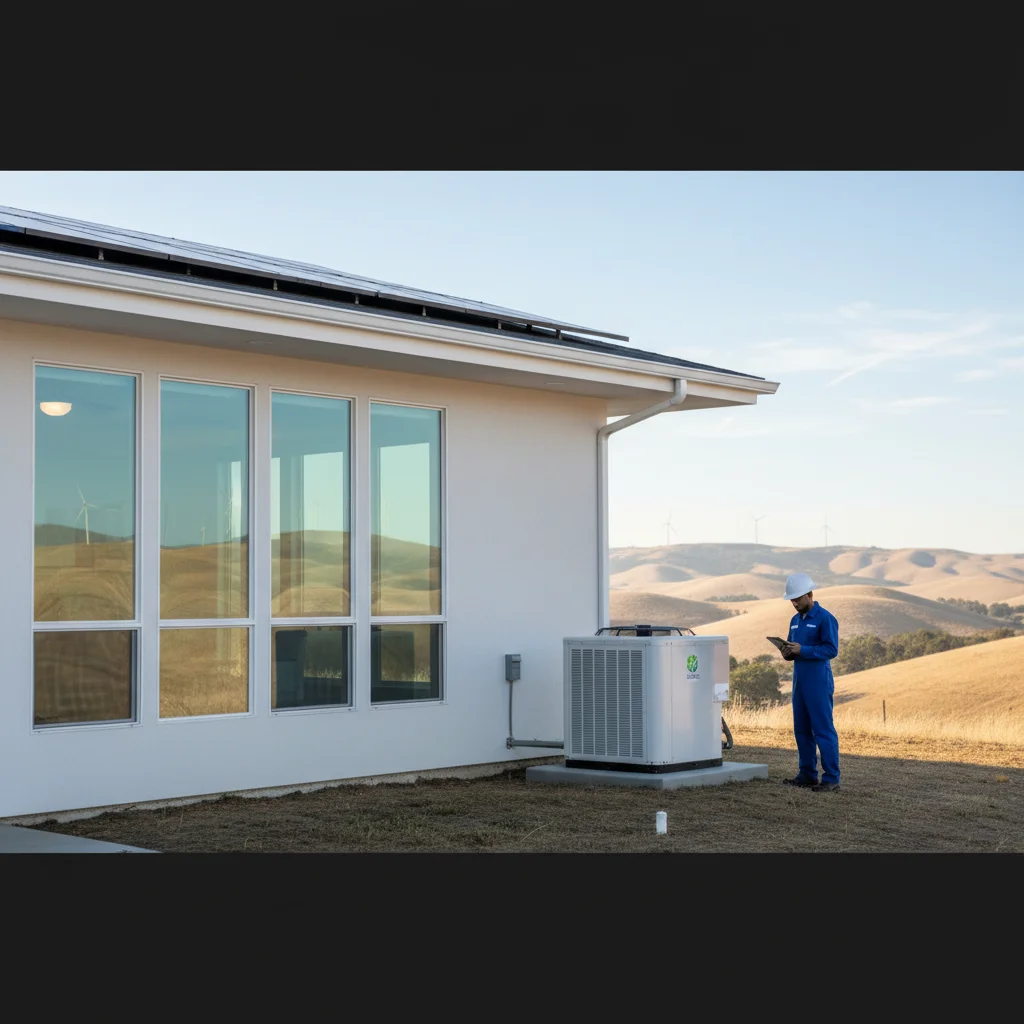
Central Valley homeowners paid between $5,800 and $14,200 for complete HVAC system replacements in 2026, with heat pump installations averaging $3,200 more than traditional furnace-and-AC combinations. And that gap narrows to just $1,400 after applying federal tax credits and California utility rebates. The region's extreme temperature swings—summer highs topping 105°F and winter lows near 30°F—push HVAC systems harder than coastal California markets, shortening equipment lifespan by 2-3 years and making efficiency upgrades more urgent than decorative renovations.
What Is the Average HVAC Installation Cost in the Central Valley?
HVAC installation costs in California's Central Valley range from $5,800 to $14,200 for complete system replacements in 2026, with heat pump systems averaging $9,400 and traditional furnace-plus-air-conditioner combinations averaging $7,100. Equipment accounts for 60% of total costs, labor represents 30%, and permits plus disposal fees make up the remaining 10%. Regional pricing runs 8-12% below Bay Area rates but 15-18% above national averages due to specialized cooling demands.
So why does the Central Valley command premium pricing despite lower labor costs than coastal markets? The answer lies in cooling capacity requirements. Fresno and Stockton homes need 25-30% more BTU capacity than San Francisco properties of identical square footage, driving equipment costs upward. And summer temperatures exceeding 100°F for 60-80 days annually force contractors to spec higher SEER2 ratings—18 minimum versus 14-16 in moderate climates—adding $1,200-$1,800 to baseline system costs.
But homeowners who install qualifying heat pumps in 2026 can claim the federal Energy Efficient Home Improvement Credit worth 30% of project costs up to $2,000 annually, reducing a $9,400 heat pump installation to $7,400 out-of-pocket. The California Tech Clean California initiative provides additional point-of-sale rebates of $2,000-$4,000 for moderate-income households, and Pacific Gas & Electric offers $3,000 incentives for ducted heat pump conversions in its service territory covering Fresno, Modesto, and Stockton.
Three-ton systems handle 1,200-1,800 square feet homes and cost $6,200-$8,900 installed. Four-ton units serve 1,800-2,400 square feet properties at $7,800-$10,600. Five-ton systems for 2,400-3,000 square feet homes run $9,400-$12,800. Contractors typically quote per-ton pricing between $2,100 and $2,600 for mid-efficiency equipment, with high-efficiency models adding $600-$900 per ton.
How Long Does It Take to Recoup Your HVAC Investment Through Energy Savings?
Central Valley homeowners recoup heat pump installation costs in 6-9 years through reduced utility bills, with annual savings averaging $840-$1,320 compared to 15-year-old furnace-and-AC systems. Payback periods drop to 4-6 years when factoring in available rebates and tax credits that reduce upfront costs by $4,000-$6,000. Homes converting from propane furnaces see faster returns of 3-5 years due to propane's $3.20-$3.80 per gallon pricing versus electricity's $0.28-$0.32 per kWh off-peak rates.
Natural gas heating costs Central Valley residents $680-$920 annually for typical 1,800 square foot homes, while ducted heat pumps operating on time-of-use electricity plans cost $420-$580 for identical heating loads. And summer cooling expenses drop 35-42% when replacing 10 SEER air conditioners with 18 SEER2 heat pumps, saving $340-$480 per cooling season in Fresno and Bakersfield markets where air conditioning runs May through October.
Pacific Gas & Electric's residential time-of-use rates charge $0.51 per kWh during 4-9 PM peak hours but just $0.28 per kWh from 12 AM to 3 PM, making heat pump water heating and smart thermostat programming essential for maximizing savings. Homeowners who shift heating to off-peak hours using programmable thermostats reduce operating costs an additional 18-24%, accelerating payback by 12-16 months.
Or consider propane conversions in rural Merced and Stanislaus counties where natural gas service isn't available. A propane furnace consuming 800 gallons annually costs $2,560-$3,040 at 2026 pricing, while an equivalent heat pump uses 8,400 kWh worth $1,680-$2,100 on blended electricity rates. The $880-$940 annual difference recoups a $9,400 installation in just 6 years after applying $4,000 in combined rebates.
Check your potential savings using our free rebate calculator to compare heating fuel costs and available incentives for your specific address and current system type.
How Does Central Valley HVAC Installation Compare to Other Heating and Cooling Alternatives?
Central Valley heating and cooling alternatives span $4,200 to $28,500 in total installation costs, with heat pumps offering the lowest 15-year total cost of ownership at $18,600 versus $24,800 for traditional furnace-plus-AC combinations and $31,200 for propane-based systems. Ductless mini-split heat pumps cost $3,800-$7,200 for single-zone installations serving 400-600 square feet, while whole-home ducted systems range from $8,200 to $14,200 depending on home size and ductwork condition.
Traditional natural gas furnace and electric air conditioner combinations cost $6,800-$9,400 installed but consume 40-55% more energy annually than heat pump systems in the Central Valley's moderate winter climate where temperatures rarely drop below 32°F. And gas furnaces require separate air conditioning equipment, doubling the number of mechanical systems requiring maintenance and eventual replacement.
Geothermal heat pumps deliver the highest efficiency ratings of 30-40 EER but demand $22,000-$28,500 installations due to horizontal loop fields requiring 300-500 feet of trenching or vertical boreholes reaching 200-300 feet deep. The Central Valley's clay soil conditions add $3,200-$4,800 to excavation costs versus sandy loam regions, pushing payback periods beyond 18-22 years even with $6,000 federal tax credits.
But window units and portable air conditioners cost just $280-$620 per room and provide acceptable cooling for renters or homeowners deferring whole-home investments. These single-room solutions consume 60-75% more electricity per BTU than central systems and offer zero heating capability, making them viable only for supplemental cooling in specific high-use rooms like home offices or bedrooms.
| System Type | Installation Cost | Annual Operating Cost | 15-Year Total Cost | Federal Tax Credit | Rebate Availability |
|---|---|---|---|---|---|
| Ducted Heat Pump (18 SEER2) | $8,200-$12,400 | $680-$920 | $18,600-$26,200 | $2,000 | $2,000-$4,000 |
| Furnace + AC (16 SEER) | $6,800-$9,400 | $1,180-$1,540 | $24,500-$32,500 | $600 | $0-$500 |
| Ductless Mini-Split (20 SEER2) | $3,800-$7,200 | $420-$640 | $10,100-$16,800 | $2,000 | $1,000-$2,000 |
| Geothermal Heat Pump | $22,000-$28,500 | $380-$560 | $27,700-$37,000 | $6,000 | $0-$1,500 |
| Propane Furnace + AC | $7,400-$10,200 | $2,240-$2,820 | $41,000-$52,500 | $0 | $0 |
Evaporative coolers cost $2,800-$4,600 installed and work effectively in the Central Valley's low-humidity climate, reducing cooling costs by 65-75% versus refrigerant-based air conditioning. But these "swamp coolers" provide no heating function and become ineffective during July and August when humidity occasionally climbs above 40%, requiring backup air conditioning during the hottest 3-4 weeks annually.
Learn more about system efficiency in our guide to HVAC efficiency standards and how they impact long-term operating costs.
What Factors Affect HVAC Installation Costs in the Central Valley?
Home size determines equipment capacity requirements, with Central Valley installation costs ranging from $5,800 for 1,200 square foot homes needing three-ton systems to $14,200 for 3,200 square foot properties requiring six-ton units. Existing ductwork condition adds $2,400-$4,800 when replacement becomes necessary, which affects 40-55% of homes over 25 years old with original metal duct systems showing rust perforation or 30%+ leakage rates measured during HERS testing.
Ceiling height multiplies cooling loads by 15-20% in Central Valley's popular vaulted-ceiling home designs, forcing contractors to upsize equipment from four-ton to five-ton systems at an additional cost of $1,600-$2,200. And homes with inadequate insulation—R-19 or less in attics versus California Title 24's R-38 requirement—need 25-30% more cooling capacity, adding another $1,400-$1,900 to equipment costs or requiring attic insulation upgrades at $1,800-$2,800 before rightsizing HVAC systems.
Equipment efficiency ratings directly impact pricing, with baseline 14 SEER2 heat pumps starting at $6,200 installed while 20 SEER2 models cost $9,800-$11,400 for identical tonnage. But higher efficiency systems qualify for larger rebates—California's TECH Clean California program provides $2,000 for 16 SEER2 systems versus $4,000 for 18 SEER2 models—narrowing the actual price gap to just $1,600-$2,200 after incentives.
Permit fees vary by jurisdiction from $180 in unincorporated Stanislaus County to $420 in Fresno city limits, with mechanical permits requiring electrical permits for new circuit installations adding $120-$180. Old system removal and disposal costs $280-$480 per unit, and refrigerant recovery fees for R-22 systems run $140-$220 due to phaseout regulations requiring EPA-certified technicians.
Or consider zoning systems that allow independent temperature control for different home areas, adding $2,800-$4,200 to baseline installations but reducing energy waste by 22-28% in homes where bedrooms remain unoccupied during daytime hours. Motorized dampers and zone control panels cost $680-$940 per zone, with most Central Valley homes implementing 2-3 zones for living areas, bedrooms, and bonus rooms.
Seasonal demand affects pricing and availability, with summer installations commanding 12-18% premiums during May through September when contractors operate at full capacity and equipment lead times stretch to 3-4 weeks. Winter installations from November through February offer negotiating leverage, with contractors providing 8-12% discounts during slow periods and completing work within 5-7 days of deposit.
Are You Eligible for Tax Credits or Rebates on Central Valley HVAC Installation?
The federal Energy Efficient Home Improvement Credit (Section 25C) ended for property placed in service after December 31, 2025 (IRS FS-2025-05). Federal tax credits for this work have ended, but state, local and utility rebates may still apply; check what is available at your address with the DuloCore rebate calculator. Form 5695 only covers qualifying work completed by December 31, 2025 and claimed on a 2025 return; the federal 25C and 25D credits ended after that date (IRS FS-2025-05).
California's TECH Clean California program delivers point-of-sale rebates of $2,000-$4,000 for ducted heat pump installations replacing furnace-and-AC systems in moderate-income households earning 80-120% of area median income—$62,400-$93,600 annually for Fresno County families of four in 2026. And low-income households below 80% AMI qualify for $4,000-$6,000 rebates when working with participating contractors who apply discounts directly to installation invoices.
Pacific Gas & Electric provides $3,000 incentives for heat pump conversions from natural gas or propane heating in its Central Valley service territory, with additional $500 bonuses for installations including smart thermostats with demand response capability. Sacramento Municipal Utility District offers $2,500 rebates in its coverage area, while Modesto Irrigation District provides $1,800 for qualifying heat pump upgrades replacing electric resistance heating.
But geothermal heat pump installations qualify for higher federal credits worth 30% of costs with no annual dollar cap, allowing homeowners to claim $6,600-$8,550 on $22,000-$28,500 installations. These systems must meet ENERGY STAR criteria with minimum 16.2 EER cooling and 3.6 COP heating ratings, and credits cover ground loop installation costs in addition to heat pump equipment and labor.
Income qualification for California rebate programs uses area median income thresholds published annually by HUD, with Fresno County's 2026 limits set at $78,000 for four-person households at 100% AMI and San Joaquin County at $84,500. Applicants provide two months of pay stubs or prior-year tax returns to verify eligibility, with self-employed homeowners submitting Schedule C forms or quarterly estimated tax payments as income documentation.
Stacking incentives maximizes savings, with Central Valley homeowners combining $2,000 federal credits, $4,000 TECH Clean California rebates, and $3,000 PG&E incentives to reduce a $12,400 heat pump installation to $3,400 out-of-pocket—a 73% discount. Rebate processing takes 4-8 weeks after installation completion.
Explore available incentives for your specific home using our rebate calculator to identify federal, state, and utility programs based on your income level and current heating system type.
What Is the HVAC Installation Process and Timeline in the Central Valley?
HVAC installation in Central Valley homes takes 1-3 days from equipment delivery to final testing, with straightforward heat pump replacements completing in 6-8 hours and complex whole-home retrofits requiring ductwork modifications extending to 16-24 hours across multiple days. Contractors schedule installations 2-4 weeks after signed proposals during moderate-demand spring and fall seasons, while summer emergency replacements may require 4-6 week lead times when supply chains tighten and contractor calendars fill.
Initial home assessments take 60-90 minutes as HVAC technicians measure square footage, evaluate ductwork condition, test existing equipment performance, and calculate Manual J load calculations accounting for insulation levels, window types, ceiling heights, and sun exposure. And contractors provide written proposals within 24-48 hours detailing equipment specifications, warranty coverage, rebate eligibility, and total costs including permits and old system disposal.
Permitting adds 3-7 business days in most Central Valley jurisdictions, with Fresno and Bakersfield building departments offering same-day plan checks for standard residential replacements while Stanislaus and Merced counties require 5-7 day review periods. Or homeowners working with licensed contractors benefit from expedited permitting since C-20 HVAC license holders submit stamped engineering calculations and installation diagrams meeting Title 24 compliance requirements.
Installation day begins with old equipment removal taking 2-3 hours including refrigerant recovery, electrical disconnection, duct detachment, and unit extraction through attic access or side yards. New equipment installation requires 3-4 hours for outdoor condenser placement on reinforced concrete pads, indoor air handler mounting in attics or closets, refrigerant line connections, condensate drain routing, and electrical wiring to dedicated 240-volt circuits with 30-40 amp breakers.
Ductwork modifications add 4-8 hours when existing systems undersized for new equipment capacity or when zone dampers install for multi-zone temperature control. Contractors seal all duct joints with mastic or approved tape, insulate supply and return plenums to R-8 minimum standards, and balance airflow using hood measurements ensuring 350-450 CFM per ton at supply registers.
System startup and testing takes 90-120 minutes as technicians charge refrigerant to manufacturer specifications, verify electrical connections deliver proper voltage and amperage, program thermostats for optimal efficiency settings, and measure temperature splits between return and supply air reaching 18-22°F for cooling mode and 30-40°F for heating mode. Final inspections by city or county building departments occur within 2-5 days, with inspectors verifying permit compliance, electrical safety, refrigerant leak testing, and proper condensate drainage.
Post-installation warranty registration requires homeowners to submit equipment serial numbers and installation dates to manufacturers within 60-90 days, extending baseline 5-year compressor warranties to 10 years and labor coverage from 1 year to 2-5 years depending on brand. And contractors schedule follow-up visits 30-45 days after installation to recheck refrigerant charge, clean or replace air filters, and verify customer satisfaction with system performance.
Official Sources
- ENERGY STAR Heat Pumps — Federal efficiency specifications and qualifying equipment database for tax credit eligibility (note: the federal 25C and 25D credits ended for projects completed after December 31, 2025)
- Database of State Incentives for Renewables & Efficiency — Comprehensive California rebate and incentive program listings updated quarterly with current requirements
- IRS Energy Incentives for Individuals — Official federal tax credit guidance including Form 5695 instructions and annual limits (note: the federal 25C and 25D credits ended for projects completed after December 31, 2025)
Frequently Asked Questions
How much does HVAC installation cost in the Central Valley?
Complete HVAC installations in California's Central Valley range from $5,800 to $14,200 in 2026, with heat pump systems averaging $9,400 and traditional furnace-plus-air-conditioner combinations averaging $7,100. Three-ton systems for 1,200-1,800 square foot homes cost $6,200-$8,900, while five-ton units for 2,400-3,000 square foot properties run $9,400-$12,800. Equipment accounts for 60% of total costs, labor represents 30%, and permits plus disposal fees make up 10%.
What rebates are available for HVAC installation in California?
The federal Energy Efficient Home Improvement Credit (Section 25C) ended for property placed in service after December 31, 2025 (IRS FS-2025-05). California's TECH Clean California program delivers $2,000-$4,000 point-of-sale rebates for moderate-income households. Pacific Gas & Electric offers $3,000 incentives for heat pump conversions in Fresno, Stockton, and Modesto service areas. Homeowners can stack these incentives to reduce a $12,400 installation to $3,400 out-of-pocket—a 73% total discount.
Are there income limits for HVAC rebate programs in the Central Valley?
California's TECH Clean California rebates require moderate-income households to earn 80-120% of area median income—$62,400-$93,600 annually for Fresno County families of four in 2026. Low-income households below 80% AMI qualify for higher $4,000-$6,000 rebates. Federal tax credits through the Inflation Reduction Act have no income limits and are available to all homeowners installing qualifying equipment in primary residences.
How long does it take to get an HVAC rebate after installation?
California utility and state rebates process in 4-8 weeks after contractors submit completed installation documentation including equipment serial numbers, photos, and homeowner income verification. Form 5695 only covers qualifying work completed by December 31, 2025 and claimed on a 2025 return; the federal 25C and 25D credits ended after that date (IRS FS-2025-05). Point-of-sale rebates through TECH Clean California apply immediately at installation, reducing upfront costs.
What's the difference between federal and state HVAC rebates in California?
The federal Energy Efficient Home Improvement Credit (Section 25C) ended for property placed in service after December 31, 2025 (IRS FS-2025-05). California state and utility rebates provide immediate point-of-sale discounts of $2,000-$6,000 based on household income levels, applied directly to installation invoices by participating contractors. Homeowners can combine both incentive types to maximize total savings reaching $9,000-$11,000 on qualifying heat pump installations.
Ready to calculate your exact installation cost and available rebates? Use our free rebate calculator to get personalized estimates based on your home size, current system type, and household income. Get instant results showing total project costs, federal tax credits, California rebates, and utility incentives for your specific Central Valley address.
Last updated: April 14, 2026. Reviewed by the DuloCore Editorial Team. About our authors.
Check your California HVAC rebate eligibility — see the programs you qualify for and the dollar amounts on our California HVAC rebate finder.