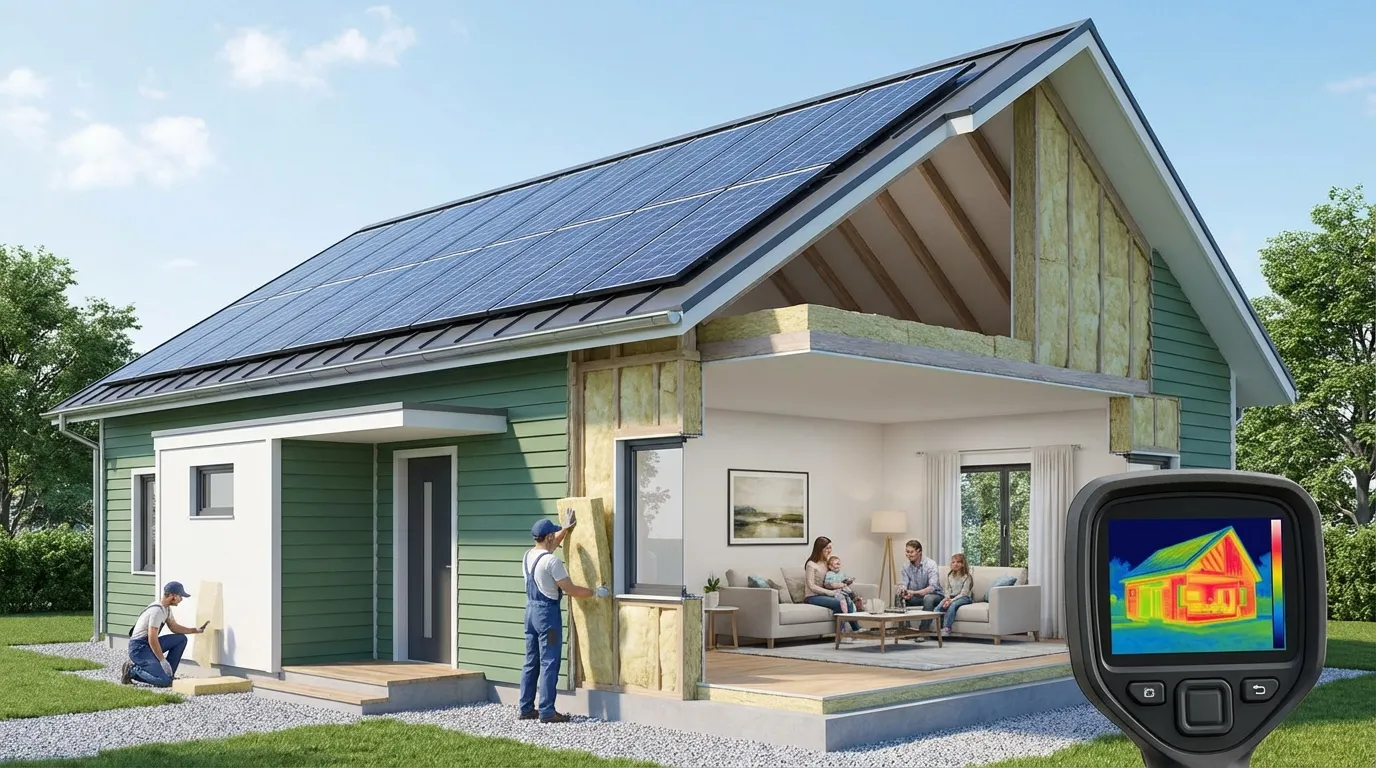
Up to 90% of U.S. homes are under-insulated, causing an average energy loss equivalent to leaving a window open every day of the year. The federal Energy Efficient Home Improvement Credit (Section 25C) ended for property placed in service after December 31, 2025 (IRS FS-2025-05). Federal tax credits for this work have ended, but state, local and utility rebates may still apply; check what is available at your address with the DuloCore rebate calculator. So this federal incentive makes upgrading your home's thermal envelope more affordable than ever before, directly lowering your monthly utility bills by up to 20%.
What IRA Rebates Are Available for Home Insulation, and How Much Can I Save on Typical Costs?
The Inflation Reduction Act's 25C (now expired, replaced by the Energy Efficient Home Improvement Credit) tax credit provides homeowners a 30% credit for insulation and air sealing projects, capped at $1,200 annually. So for a typical attic insulation project costing $2,500, this credit saves you $750 directly off your federal tax liability for that year.
The federal Energy Efficient Home Improvement Credit (Section 25C) ended for property placed in service after December 31, 2025 (IRS FS-2025-05). So this credit covers 30% of the project cost, including materials and professional installation, up to a maximum of $1,200 per year. For a common attic insulation upgrade costing between $1,500 and $3,500, the tax credit returns $450 to $1,050 to the homeowner. But the credit does not cover the cost of the home energy audit, which has its own separate $150 credit. Combining these energy tax credits with local utility rebates often reduces the total out-of-pocket expense by 40-50%.
Which Insulation Types, Efficiency Ratings, and Brands Qualify for IRA Rebates in My Climate Zone?
Qualifying insulation includes common types like fiberglass batts, blown-in cellulose, and spray foam that meet the 2021 International Energy Conservation Code (IECC) standards. So brands like Owens Corning, Johns Manville, and CertainTeed offer products that meet these specific R-value requirements for your climate zone.
The federal Energy Efficient Home Improvement Credit (Section 25C) ended for property placed in service after December 31, 2025 (IRS FS-2025-05). So this means the required R-value (a measure of thermal resistance) varies by your location. For example, homes in colder northern climate zones (5-8) require attic insulation with an R-value of R49 to R60. But homes in warmer southern zones (1-4) need R30 to R49. Common qualifying materials include spray foam, blown-in fiberglass or cellulose, and rigid foam boards. And leading brands like Knauf, Rockwool, and Greenfiber all manufacture products that comply with these standards. Homeowners should consult an insulation contractor to confirm the specific R-value needed for their climate zone to ensure eligibility.
"The credit is available for the purchase and installation of qualifying insulation and air sealing materials." — Internal Revenue Service (IRS.gov)
What Are the Total Installation Costs for IRA-Eligible Insulation, and What's My ROI Payback Period?
The total installation cost for IRA-eligible insulation ranges from $1.50 to $5.50 per square foot, depending on the material. So with the 30% tax credit (this federal credit ended for property placed in service after December 31, 2025), the average homeowner achieves a return on investment (ROI) with a payback period of just 5 to 8 years through energy savings.
The cost of an insulation project varies based on the type and area. For a 1,000-square-foot attic, blown-in fiberglass or cellulose installation costs between $1,500 and $2,500. And spray foam insulation is more expensive, costing $2,000 to $5,500 for the same area. Let's assume a $3,000 project cost. The federal Energy Efficient Home Improvement Credit (Section 25C) ended for property placed in service after December 31, 2025 (IRS FS-2025-05). So the net cost becomes $2,100. If the insulation saves the homeowner $30 per month ($360 annually) on energy bills, the payback period is 5.8 years ($2,100 / $360). After this period, the savings represent a direct financial return. Explore specific insulation rebates to accelerate this payback.
How Does IRA-Eligible Insulation Compare to Alternatives, and What Is Its Lifespan and Maintenance?
IRA-eligible insulation offers one of the highest ROIs among home energy upgrades, with a lifespan exceeding 80 years and requiring zero maintenance. So unlike mechanical systems like HVACs, which need regular servicing and have a 15-20 year lifespan, insulation is a one-time, passive investment. (See also: insulation rebates for veterans.) (See also: insulation rebates 2026.) (See also: whole home insulation upgrade rebates.) (See also: geothermal tax credit.)
While upgrades like high-efficiency windows or new heat pump rebates provide energy savings, insulation often delivers a faster payback. So windows cost between $8,000 and $24,000 with a payback period of 10+ years. But insulation costs $1,500 to $3,500 with a 5-8 year payback. Properly installed insulation, such as fiberglass or cellulose, has a lifespan of 80 to 100 years and is maintenance-free. And it won't degrade or lose its R-value unless it's damaged by moisture or pests. This longevity and lack of ongoing costs make insulation a foundational and highly effective energy efficiency investment compared to active systems that require eventual replacement.
"Sealing air leaks around your home and adding insulation are two of the most cost-effective ways to improve energy efficiency and comfort in your home." — U.S. Department of Energy (energy.gov)
| Program/Incentive | Max Amount | Key Eligibility | Expiration Date |
|---|---|---|---|
| IRA 25C Tax Credit | Ended Dec 31, 2025 | Ended Dec 31, 2025 | Ended Dec 31, 2025 |
| State Rebate (Varies) | $200 - $1,500 | Income or location-based | Varies by state |
| Utility Rebate (Varies) | $0.15 - $0.50/sq ft | Must be customer of participating utility | Often annual programs |
Frequently Asked Questions
Inflation Reduction Act insulation incentives are structured as a 30% tax credit, not an upfront rebate, capped at $1,200 per year through 2032. Form 5695 only covers qualifying work completed by December 31, 2025 and claimed on a 2025 return; the federal 25C and 25D credits ended after that date (IRS FS-2025-05).
The federal Energy Efficient Home Improvement Credit (Section 25C) ended for property placed in service after December 31, 2025 (IRS FS-2025-05). And the maximum credit is $1,200 annually, which allows for spreading larger projects across multiple years. Form 5695 only covers qualifying work completed by December 31, 2025 and claimed on a 2025 return; the federal 25C and 25D credits ended after that date (IRS FS-2025-05). So be sure to keep all receipts and the manufacturer's certification statement. All common insulation types, including blown-in, batts, and spray foam, qualify if they meet the required energy efficiency standards for your home's specific climate zone.
Who qualifies for Inflation Reduction Act insulation tax credits?
Any homeowner whose property is their principal residence in the United States qualifies. The credit is not available for new construction or for properties that are not the taxpayer's primary home, such as rental units.
How much is the maximum tax credit for insulation under the IRA?
The federal Energy Efficient Home Improvement Credit (Section 25C) ended for property placed in service after December 31, 2025 (IRS FS-2025-05). This annual limit resets each year.
What is the process to claim the Inflation Reduction Act insulation rebate?
You claim the credit when you file your federal income taxes. Form 5695 only covers qualifying work completed by December 31, 2025 and claimed on a 2025 return; the federal 25C and 25D credits ended after that date (IRS FS-2025-05). So you must retain your receipts and the manufacturer's certification statement for your records.
When do Inflation Reduction Act insulation incentives expire?
The federal Energy Efficient Home Improvement Credit (Section 25C) ended for property placed in service after December 31, 2025 (IRS FS-2025-05).
Does blown-in insulation qualify for the Inflation Reduction Act credit?
Yes, blown-in insulation (both fiberglass and cellulose) qualifies for the tax credit, provided it meets the performance and quality standards specified by the 2021 International Energy Conservation Code (IECC).
Stop guessing about your savings. Use our free tool to see exactly how much you can get back on your insulation project.
Ready to Save on Your Home Improvement?
Use our free rebate calculator to find every federal, state, and utility incentive you qualify for.
Updated: April 14, 2026 — fact-checked by DuloCore Research. About our editorial process.
Check your California insulation rebate eligibility — see the programs you qualify for and the dollar amounts on our California insulation rebate finder.