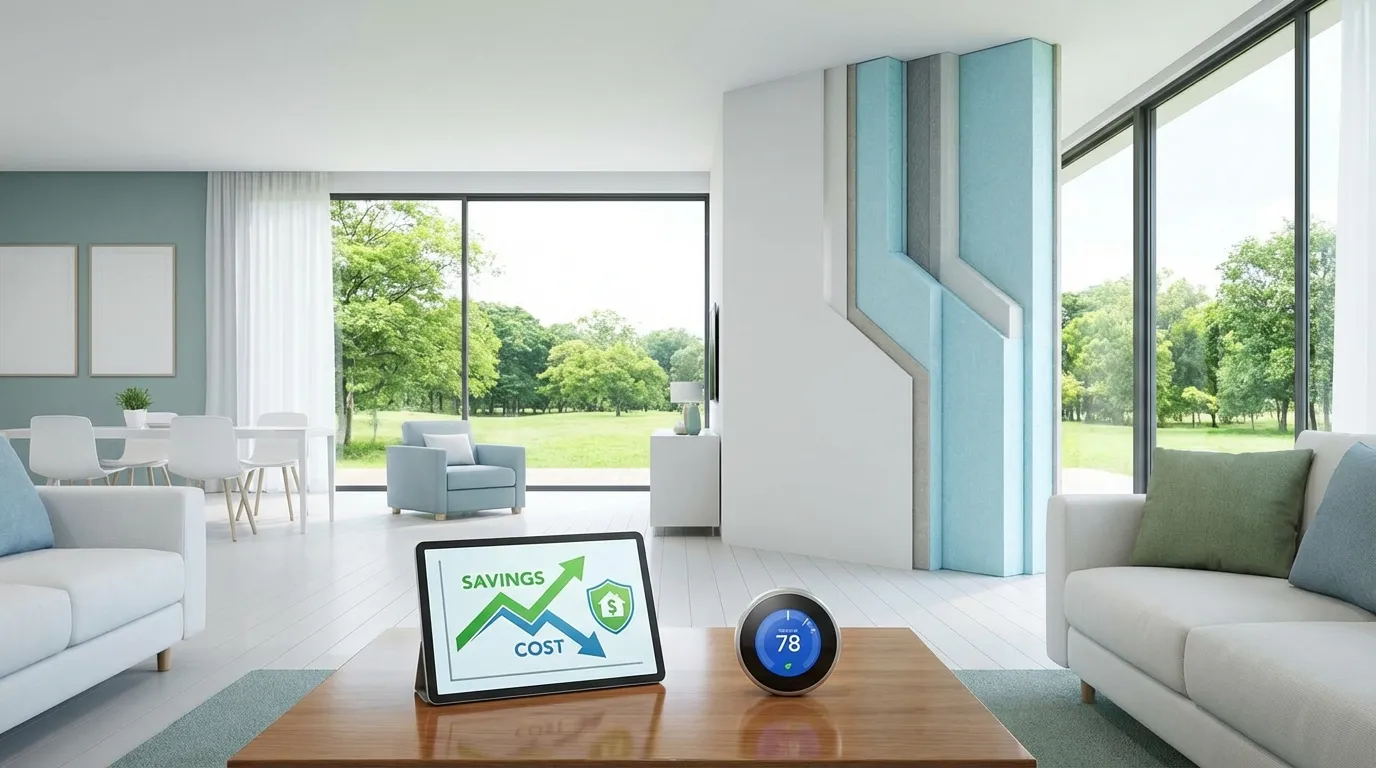
Up to 90% of U.S. homes are under-insulated, causing a constant drain on both your wallet and the energy grid. This isn't a minor leak; it's a gaping hole where heated and cooled air escapes, forcing your HVAC system to work overtime just to maintain a comfortable temperature. So this continuous energy loss directly translates into higher utility bills, month after month.
What is the typical upfront cost to install different types of insulation in my home?
Home insulation installation costs range from $1.50 to $7.00 per square foot, depending on the material and project complexity. Fiberglass batts are the most affordable at $1.50-$3.50 per square foot, while closed-cell spray foam represents a premium investment at $4.00-$7.00 per square foot installed.
The upfront cost of insulation varies based on material, R-value, and labor. Fiberglass batts, a common choice, cost between $1,500 and $3,500 for a 1,000-square-foot attic. But blown-in cellulose offers a comparable R-value for a similar price range of $1,600 to $3,800. So homeowners seeking higher performance often choose spray foam insulation. And open-cell spray foam costs between $3,000 and $5,500, while high-density closed-cell foam costs from $4,000 to $7,000 for the same area. These figures include professional installation, which accounts for 40-60% of the total project expense. The federal Energy Efficient Home Improvement Credit (Section 25C) ended for property placed in service after December 31, 2025 (IRS FS-2025-05).
The core tension for homeowners is balancing the initial installation expense against the long-term energy savings. An insulation upgrade costs, on average, between $2,500 and $6,800. But the U.S. Environmental Protection Agency (EPA) estimates that proper air sealing and insulation saves homeowners an average of 15% on heating and cooling costs. So for a home with an annual energy bill of $2,000, that's an immediate $300 back in your pocket each year. The question isn't whether insulation saves money, but how quickly the initial investment pays for itself.
How do efficiency ratings impact insulation savings and ROI payback periods?
Insulation's efficiency, measured in R-value, directly dictates energy savings and return on investment (ROI). A higher R-value, such as upgrading from R-19 to R-49 in an attic, reduces annual energy bills by up to 20%, shortening the ROI payback period to 5-7 years.
An insulation's R-value measures its resistance to heat flow. The higher the R-value, the better the thermal performance. So upgrading from an R-11 to an R-38 in your attic accelerates your payback period by several years. And the Department of Energy confirms that this level of upgrade provides a 107% return on investment upon resale. But simply choosing the highest R-value isn't always cost-effective. The key is to match the R-value to your specific climate zone and home construction. For example, a home in Miami (Zone 1) doesn't require the same R-60 attic insulation as a home in Minneapolis (Zone 6). So calculating the correct R-value ensures you don't overspend on insulation you don't need, optimizing your ROI.
"Save money and increase the comfort of your home by air sealing and adding insulation. Use the U.S. Department of Energy’s online home energy assessment tool to do a quick and easy evaluation of your home’s energy use." — U.S. Department of Energy
Which insulation brands and specifications qualify for rebates, and how do I apply for them?
Rebate-eligible insulation typically requires ENERGY STAR certification, with brands like Owens Corning, Johns Manville, and CertainTeed frequently qualifying. To apply, homeowners must purchase materials meeting specific R-value thresholds and submit receipts and product spec sheets through utility portals or platforms like DuloCore before program deadlines.
To secure insulation rebates, your project must meet specific criteria set by federal, state, or utility programs. Most programs require the insulation to be ENERGY STAR certified. And brands like Knauf, Rockwool, and the aforementioned Owens Corning consistently produce products that meet these standards. The application process usually involves completing an online or mail-in form, attaching itemized invoices from your contractor, and providing the manufacturer's specification sheet to prove the product's R-value. So it's critical to check program guidelines before purchase. Utility companies often require a pre-approval step or a post-installation inspection. But platforms like DuloCore streamline this by pre-qualifying products and simplifying the submission process.
Insulation Rebate Program Comparison
| Program Name | Maximum Amount | Key Eligibility Requirements |
|---|---|---|
| Federal Tax Credit (Section 25C) | Ended for property placed in service after December 31, 2025 (IRS FS-2025-05) | Not available for new installations |
| State Energy Programs | Varies ($200 - $2,000) | Varies by state; often requires a professional energy audit first. |
| Local Utility Rebates | Varies ($0.15 - $1.00/sq. ft.) | Must be a customer of the utility; often targets specific areas like attics or walls. |
How does my climate zone influence the best insulation choice for long-term savings and comfort?
Your climate zone dictates the Department of Energy's recommended R-value for optimal savings. Homes in colder zones (5-8) need attic insulation of R49-R60 for a 7-year payback, while homes in warmer zones (1-3) achieve similar ROI with R30-R38 insulation.
The United States is divided into eight climate zones, and your location is the single most important factor in choosing insulation. A home in Zone 7 (e.g., North Dakota) faces extreme cold and requires a minimum of R-49 in the attic and R-13+5 in the walls. But a home in Zone 2 (e.g., Florida) only needs R-38 in the attic and R-13 in the walls. So installing R-60 insulation in a Florida home provides diminishing returns and extends the payback period unnecessarily. And choosing the right R-value for your zone is the most direct path to maximizing comfort and achieving the fastest possible return on your investment. Ignoring these guidelines results in either insufficient performance or wasteful overspending.
"The Database of State Incentives for Renewables & Efficiency (DSIRE) is the most comprehensive source of information on incentives and policies that support renewables and energy efficiency in the United States." — DSIRE
What are the expected lifespan and maintenance requirements for various insulation alternatives?
Modern insulation alternatives offer extended lifespans with minimal maintenance. Spray foam and fiberglass insulation last 80-100 years or the life of the home. Cellulose insulation has a shorter lifespan of 20-30 years and is more susceptible to moisture, requiring periodic inspection.
Once installed, most insulation is maintenance-free. Fiberglass batts and spray foam are inorganic, making them resistant to mold and pests, and they won't settle over time. Their lifespan typically exceeds 80 years. So they are a "set it and forget it" solution. But cellulose, made from recycled paper, has a shorter lifespan of 20-30 years. And it can settle over time, creating gaps and reducing its R-value by up to 20% if not installed properly with the correct density. It is also more susceptible to moisture retention, which demands periodic checks for leaks or dampness in the attic or crawlspace. Therefore, while cellulose has strong environmental credentials, its maintenance needs are higher than fiberglass or spray foam. Some homeowners also find value in upgrading other systems, like exploring heat pump rebates for total home efficiency.
Frequently Asked Questions
How quickly does new insulation pay for itself through energy bill savings?
The payback period for new insulation is typically 5 to 7 years. This timeframe shortens in colder climates or for homes that were severely under-insulated, where annual energy savings can reach 20% or more. Rebates can further reduce the payback period.
What are the typical annual energy savings after upgrading my home's insulation?
Homeowners save an average of 15% on annual heating and cooling costs after an insulation upgrade, according to the EPA. For a typical household spending $2,000 per year on energy, this translates to $300 in annual savings.
How do insulation rebates and tax credits impact the overall cost-benefit analysis?
Rebates directly reduce the upfront installation cost, which improves the return on investment. The federal Energy Efficient Home Improvement Credit (Section 25C) ended for property placed in service after December 31, 2025 (IRS FS-2025-05).
What factors should I consider when calculating the return on investment for an insulation upgrade?
To calculate ROI, consider the total project cost (materials and labor), subtract any rebates, and divide that by your estimated annual energy savings. Also factor in your climate zone, local utility rates, and the R-value of the new insulation.
Is the upfront cost of better insulation justified by its long-term financial and comfort benefits?
Yes, the upfront cost is justified. Beyond the financial return from energy savings that average 15-20% annually, proper insulation provides immediate benefits in home comfort, reduced HVAC wear and tear, and improved indoor air quality, contributing to a higher home resale value.
Calculate Your Rebates. Use our free rebate calculator to find out how much you can save.
Ready to Save on Your Home Improvement?
Use our free rebate calculator to find every federal, state, and utility incentive you qualify for.
Official Sources
Last updated April 14, 2026 — reviewed by DuloCore Editorial. About our authors.
Check your California insulation rebate eligibility — see the programs you qualify for and the dollar amounts on our California insulation rebate finder.