The federal Residential Clean Energy Credit (Section 25D) ended for expenditures made after December 31, 2025, and the IRS treats an expenditure as made when installation is completed (IRS FS-2025-05). Federal tax credits for this work have ended, but state, local and utility rebates may still apply; check what is available at your address with the DuloCore rebate calculator. But accessing these incentives requires navigating multiple application processes, income verification rules, and equipment certification standards that vary by state and utility territory.
What is the current rebate amount for IRA geothermal heat pump incentives in 2026?
The federal Residential Clean Energy Credit (Section 25D) ended for expenditures made after December 31, 2025, and the IRS treats an expenditure as made when installation is completed (IRS FS-2025-05). Homeowners installing a $30,000 system claim $9,000 on their federal tax return.
Households earning below 80% of area median income qualify for up to $8,000 in direct rebates through the Home Efficiency Rebates program, which stacks with the tax credit. So a moderate-income household in Sacramento installing a $28,000 geothermal system receives $8,400 from the tax credit plus $8,000 from the rebate program—covering 58% of total costs. But rebate funds remain limited in most states, with California distributing just $42 million in the first quarter of 2026.
The Home Energy Rebates program also offers $8,000 for projects reducing household energy use by at least 35%. Geothermal installations typically exceed this threshold, making most projects eligible for the full amount.
What equipment qualifies for IRA geothermal heat pump rebates and tax credits?
Qualifying systems must meet ENERGY STAR standards with an Energy Efficiency Ratio of 17.1 or higher for closed-loop systems and 21.1 or higher for open-loop configurations. The IRS requires certification from the manufacturer confirming compliance with these performance standards. And the system must be installed in a primary residence located in the United States to qualify for federal incentives.
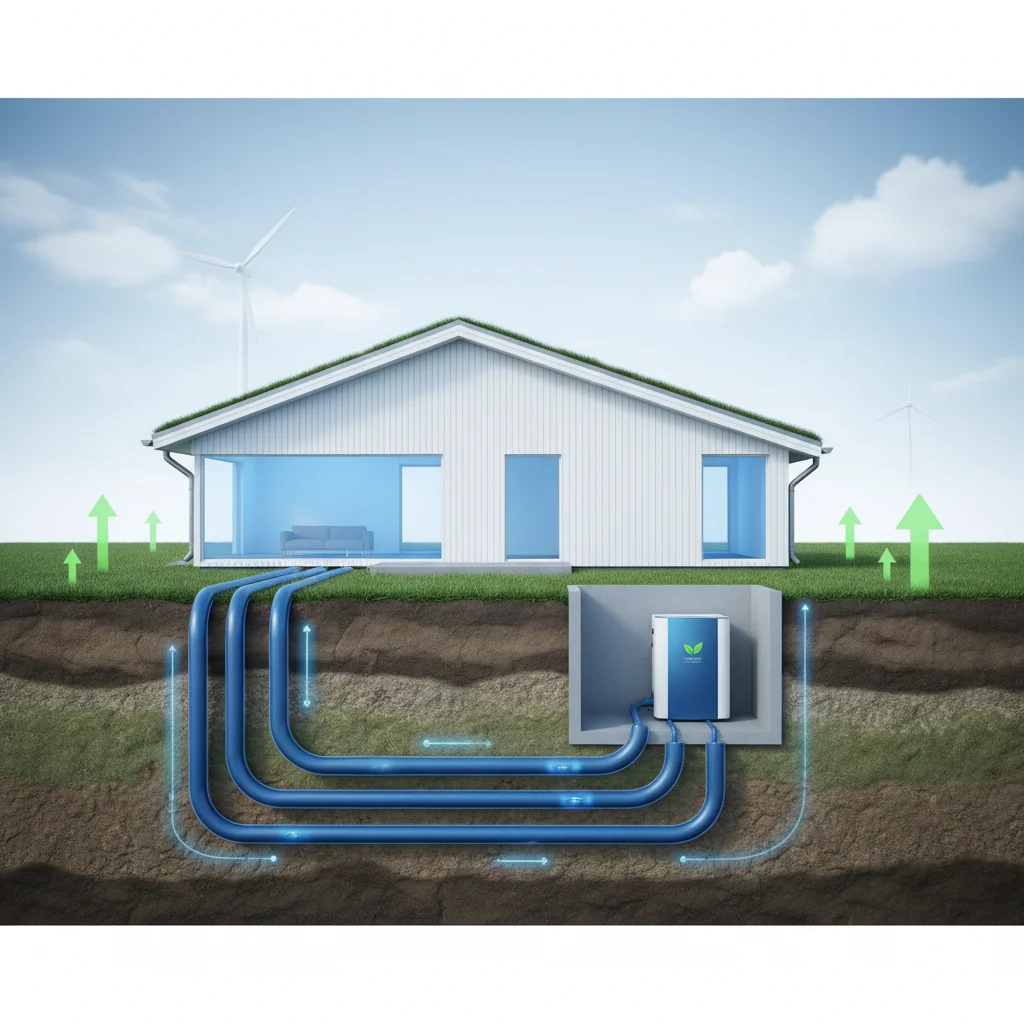
Open-loop systems use groundwater from a well or pond as the heat exchange medium, while closed-loop systems circulate refrigerant through buried pipes. Both types qualify for the 30% tax credit (this federal credit ended for expenditures made after December 31, 2025) if they meet efficiency thresholds. But closed-loop systems dominate residential installations because they avoid water quality concerns and regulatory restrictions on groundwater extraction.
Eligible costs include heat pump equipment, ground loop installation, distribution system upgrades, electrical service modifications, and labor. And some states allow homeowners to claim sales tax on equipment as part of the credit calculation. Or homeowners can bundle related upgrades like ductwork replacement and smart thermostats into the same project for credit purposes.
According to ENERGY STAR, geothermal heat pumps can reduce energy consumption by 25% to 50% compared to conventional HVAC systems.
Are there income limits to claim IRA geothermal heat pump incentives?
The federal Residential Clean Energy Credit (Section 25D) ended for expenditures made after December 31, 2025, and the IRS treats an expenditure as made when installation is completed (IRS FS-2025-05). But the Home Efficiency Rebates and Home Energy Rebates programs limit eligibility to households earning below 80% of area median income, with higher rebate amounts for those below 150% of the federal poverty line.
A family of four in Los Angeles earning $105,000 annually falls below the 80% AMI threshold of $106,300 and qualifies for the $8,000 rebate. And households earning below $44,000 (150% of poverty line) receive rebates covering up to 100% of project costs, capped at $14,000 total across all upgrades.
Income verification requires tax returns from the prior year and documentation of household size. So applicants should prepare IRS Form 1040 and state income tax returns before submitting rebate applications. Form 5695 only covers qualifying work completed by December 31, 2025 and claimed on a 2025 return; the federal 25C and 25D credits ended after that date (IRS FS-2025-05).
How do you apply for IRA geothermal heat pump rebates step by step?
Homeowners must first verify their state's rebate program has launched and allocated funding—only 34 states had active programs as of March 2026. Visit your state energy office website to confirm availability and download application forms. And most states require preapproval before starting installation work, making upfront planning essential.
Submit a preapproval application with contractor estimates, equipment specifications, and income documentation. State agencies review applications within 15 to 45 days and issue approval letters with reserved funding. Or agencies may deny applications if funds are depleted, requiring homeowners to reapply in the next funding cycle.
After installation, submit final invoices, manufacturer certifications, and inspection reports to claim the rebate. Agencies disburse payments within 30 to 90 days of final approval. Form 5695 only covers qualifying work completed by December 31, 2025 and claimed on a 2025 return; the federal 25C and 25D credits ended after that date (IRS FS-2025-05).
Use our free rebate calculator to estimate your total savings from federal, state, and utility incentives.
The federal Residential Clean Energy Credit (Section 25D) ended for expenditures made after December 31, 2025, and the IRS treats an expenditure as made when installation is completed (IRS FS-2025-05).
What are the 2026 deadline dates for claiming IRA geothermal heat pump incentives?
The federal Residential Clean Energy Credit (Section 25D) ended for expenditures made after December 31, 2025, and the IRS treats an expenditure as made when installation is completed (IRS FS-2025-05). Homeowners claim the credit on their tax return for the year the system was installed and operational. So a system installed in November 2026 but not activated until January 2027 qualifies for the 2027 tax year.
State rebate programs operate on fiscal year budgets with rolling application windows. California's program opened February 3, 2026 and depleted initial funding by March 28, requiring a waitlist for the next allocation. And states like Texas and Florida have not yet launched their programs as of April 2026, delaying access to rebates for residents in those states.
Some utility companies offer separate rebates with quarterly or annual deadlines independent of state and federal programs. But these deadlines vary by provider—Pacific Gas & Electric accepts applications year-round, while Southern California Edison operates seasonal funding cycles closing June 30 and December 31.
Can you stack IRA geothermal rebates with utility company and state incentives?
The IRS allows homeowners to stack the 30% federal tax credit with state rebates, utility incentives, and local programs without reducing the credit amount. A Sacramento homeowner can claim the federal credit, the $8,000 California rebate, and a $2,500 SMUD utility incentive on the same $30,000 installation—recovering $19,500 total.
But some state rebate programs prohibit stacking their funds with certain utility programs to prevent exceeding 100% of project costs. And California's program reduces rebate amounts dollar-for-dollar if combined incentives exceed total installation costs, capping maximum recovery at the invoice amount.
Check with your state energy office and utility provider before applying to confirm stacking rules. Or work with a certified contractor familiar with local program requirements who can structure the incentive combination to maximize total savings.
What contractor requirements and certifications are needed for IRA geothermal incentives?
Contractors must hold valid HVAC and plumbing licenses in the installation state to perform geothermal work eligible for federal credits. And most state rebate programs require contractors to complete specialized geothermal training through IGSHPA (International Ground Source Heat Pump Association) or equivalent certification programs.
The IRS does not mandate specific contractor credentials for the tax credit, but state rebate agencies typically maintain approved contractor lists. California's program requires contractors to pass a background check and demonstrate completion of at least three prior geothermal installations. And contractors must carry general liability insurance of $1 million and workers' compensation coverage to qualify for approved lists.
Homeowners should verify their contractor appears on the state's approved list before signing contracts. So requesting proof of IGSHPA certification, license numbers, and insurance certificates during the bidding process prevents disqualification later in the rebate application.
Check our geothermal tax credit guide for detailed contractor selection criteria and certification requirements by state.
Official Sources
- DOE Geothermal Heat Pumps — Federal guidance on geothermal technology, efficiency standards, and incentive programs
- IRS Residential Clean Energy Credit — Official tax credit documentation, Form 5695 instructions, and eligibility requirements (note: the federal 25C and 25D credits ended for projects completed after December 31, 2025)
- ENERGY STAR Heat Pumps — Equipment certification standards and qualified product lists
Frequently Asked Questions about IRA geothermal heat pump incentives
What are the income limits for geothermal heat pump tax credits?
The federal Residential Clean Energy Credit (Section 25D) ended for expenditures made after December 31, 2025, and the IRS treats an expenditure as made when installation is completed (IRS FS-2025-05). But state rebate programs restrict eligibility to households earning below 80% of area median income. And households below 150% of the federal poverty line receive enhanced rebates covering up to 100% of costs, capped at $14,000.
How much money can you get back for installing a geothermal heat pump?
Homeowners claim a 30% federal tax credit with no dollar cap, plus up to $8,000 from state rebate programs. A $30,000 installation generates $9,000 in tax credits and $8,000 in rebates—recovering $17,000 total. And utility companies offer additional rebates averaging $1,500 to $3,500, bringing total incentives to $18,500 to $20,500.
Are geothermal heat pumps eligible for the IRA tax credit in 2026?
The federal Residential Clean Energy Credit (Section 25D) ended for expenditures made after December 31, 2025, and the IRS treats an expenditure as made when installation is completed (IRS FS-2025-05). Systems must meet ENERGY STAR efficiency standards and be installed in a primary residence. And the credit covers equipment, labor, ground loop installation, and electrical upgrades.
What's the difference between geothermal heat pump rebates and tax credits?
Tax credits reduce federal tax liability dollar-for-dollar, claimed on annual tax returns. Rebates provide direct cash payments from state agencies or utilities within 30 to 90 days of installation. And tax credits have no income limits, while rebates restrict eligibility to moderate- and low-income households.
Do you need to install solar panels to qualify for the geothermal heat pump IRA credit?
No, geothermal heat pumps qualify for the 30% tax credit (this federal credit ended for expenditures made after December 31, 2025) as standalone installations. Solar panels are not required. And homeowners can claim separate credits for both systems if installed in the same year—the IRA provides 30% credits for solar, geothermal, battery storage, and other clean energy tax credits without interaction penalties.
Comparison Table: IRA Geothermal Incentives 2026
| Program | Amount | Income Limit | Deadline |
|---|---|---|---|
| Federal Tax Credit | Ended Dec 31, 2025 | — | Ended Dec 31, 2025 |
| Home Efficiency Rebates | Up to $8,000 | 80% AMI | Varies by state |
| Home Energy Rebates | Up to $8,000 | 80% AMI | Varies by state |
| Utility Rebates | $1,500-$3,500 | Varies | Quarterly/Annual |
Ready to calculate your geothermal incentives? Use the DuloCore rebate calculator to estimate your total savings from federal tax credits, state rebates, and utility programs based on your location and income. Get your personalized incentive breakdown in under 60 seconds.
Last updated April 14, 2026 — reviewed by DuloCore Editorial. About our authors.
Check your California heat pump rebate eligibility — see the programs you qualify for and the dollar amounts on our California heat pump rebate finder.