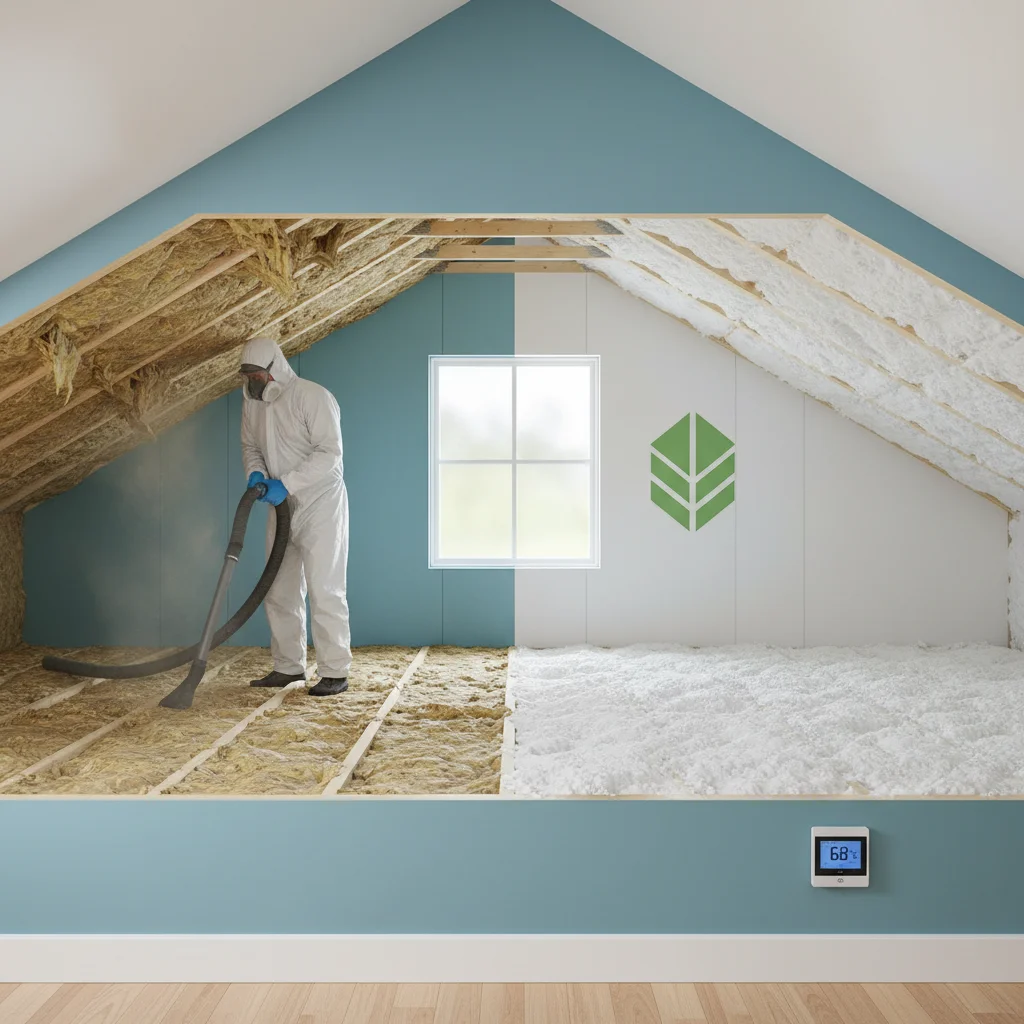
Most homeowners don't realize that removing contaminated or underperforming insulation costs $1,500-$4,500 before a single square foot of new material goes in. And with 2026 federal tax credits covering 30% of replacement projects, the math on whether to extract old batts or blow-in cellulose has shifted dramatically compared to past years when Section 25C capped rebates at $500.
How Much Does Old Insulation Removal Cost by Type and Square Footage?
Insulation removal pricing in 2026 ranges from $1-$3 per square foot for blown-in cellulose, $2-$4 per square foot for fiberglass batts with potential asbestos, and $7-$10 per square foot for vermiculite containing asbestos. Attic removal runs $1,200-$2,500 for 1,200 square feet, while crawl space extraction adds 40%-60% due to confined workspace constraints.
So why does blown-in material cost half as much to remove as batts? Vacuum extraction pulls loose cellulose through 4-inch hoses in 2-4 hours, while batt removal requires hand-pulling each piece, bagging contaminated fiberglass, and sealing disposal containers—a process that takes 6-12 hours for the same square footage. And asbestos testing adds $400-$800 upfront, with certified abatement pushing total costs to $15,000-$30,000 for homes built before 1980.
Contractors charge $65-$95 per hour for labor, with minimum project fees of $800-$1,200 regardless of square footage. But removal-only jobs rarely make financial sense—bundling extraction with new insulation installation saves 25%-35% compared to separate contracts, and qualifies the entire project for federal tax credits and utility rebates totaling $1,000-$8,000 depending on location.
California's TECH Clean California program provides $1,600-$3,200 rebates for whole-home insulation upgrades when paired with heat pump installations. And the IRA federal tax credit covers 30% of combined insulation removal and replacement costs through 2032, with no annual dollar cap on the credit amount homeowners can claim.
| Cost Component | Blown-In Cellulose | Fiberglass Batts | Vermiculite (Asbestos) |
|---|---|---|---|
| Price per sq ft | $1-$3 | $2-$4 | $7-$10 |
| 1,200 sq ft attic | $1,200-$3,600 | $2,400-$4,800 | $8,400-$12,000 |
| Labor time | 2-4 hours | 6-12 hours | 16-40 hours (certified crew) |
What's the ROI and Payback Period for Removing Old Insulation?
Homeowners removing failing R-11 attic insulation and upgrading to R-49 see energy bill reductions of $480-$960 annually in California climate zones, creating a payback period of 3-7 years when factoring in 2026 federal tax credits and utility rebates. Projects under $5,000 total cost with $2,000 in combined incentives break even in 36-48 months.
Or consider homes with compressed fiberglass that's lost 40%-60% of its original R-value—the energy waste from thermal bridging costs $80-$140 monthly in heating and cooling, making removal and replacement cash-flow positive within 4-6 years even without incentives. But projects involving asbestos abatement rarely pencil out on ROI alone, since removal costs of $15,000-$30,000 require 15-25 years to recoup through energy savings.
"Homeowners upgrading from R-11 to R-49 attic insulation reduce heating and cooling costs by 20%-50% depending on climate zone and existing HVAC efficiency." — U.S. Department of Energy
The heat pump rebates stack particularly well with insulation projects—California's $3,200 TECH rebate for ducted systems plus $1,600 for insulation creates $4,800 in upfront savings, cutting payback periods from 8 years to under 4 years for combined upgrades. And homes financed through PACE (Property Assessed Clean Energy) programs spread costs over 10-20 years via property tax assessments, eliminating upfront cash requirements entirely.
How Does Climate Zone Affect Insulation Removal and Replacement Decisions?
California's 16 climate zones create wildly different ROI calculations for insulation removal—Zone 16 alpine homes save $1,200-$1,800 annually upgrading to R-60 attic insulation, while Zone 6 coastal properties save just $300-$500 with the same upgrade due to mild year-round temperatures. Mountain and desert climates (Zones 14-16) justify removal costs within 3-5 years, but coastal fog belt homes need 8-12 years to break even.
So removal makes financial sense in extreme climate zones where temperature differentials exceed 40°F between indoor and outdoor air for 180+ days annually. But marine climates with 55°F-75°F outdoor temperatures year-round rarely justify extraction unless existing insulation contains mold, asbestos, or rodent contamination requiring health-driven removal regardless of energy economics.
Northern California climate zones 1, 2, and 16 see the fastest payback periods of 3-6 years for R-60 upgrades, while southern coastal zones 6, 7, and 10 require 9-14 years to recoup costs through HVAC savings alone. And Central Valley zones 12-13 fall in the middle at 5-8 year payback, with summer cooling loads driving half the annual energy savings potential.
Old Insulation Removal vs. Other Alternatives: Which Option Saves the Most Money?
Adding new insulation over compressed or underperforming material costs $1.20-$2.80 per square foot compared to $3-$7 per square foot for removal plus replacement, saving $2,400-$5,000 on a 1,200 square foot attic project. But layering new batts over moisture-damaged cellulose or rodent-contaminated fiberglass traps problems that degrade the new material within 2-4 years, eliminating long-term savings.
Encapsulation using spray foam over existing insulation runs $3-$7 per square foot and seals air gaps while adding R-6 to R-7 per inch of foam thickness. Or blown-in dense-pack cellulose fills voids around existing batts at $1.50-$3 per square foot, boosting R-values by 15-25% without full removal. But neither approach addresses moisture issues, pest infestations, or asbestos contamination that require extraction before new material goes in.
The insulation rebates available in 2026 reward complete removal and replacement over partial upgrades—California utility programs provide $0.15-$0.40 per square foot for R-38+ attic insulation only when existing material is removed first, excluding projects that overlay new batts on old material. And federal tax credits require energy modeling that proves 20%+ whole-home energy reduction, a threshold partial upgrades rarely achieve.
Air sealing alone costs $800-$2,200 and reduces HVAC bills by 10%-20% without touching existing insulation, creating a 4-6 year payback that beats removal projects in mild climates. But combining air sealing with insulation removal and replacement delivers 35%-50% energy reductions, justifying higher upfront costs in climate zones with extreme temperatures.
How Long Does New Insulation Last After Old Material Removal?
Professionally installed fiberglass batts last 80-100 years when protected from moisture and maintained at design R-values, while blown-in cellulose requires re-fluffing every 15-20 years to restore compressed material that settles 15%-20% over time. Spray foam lasts 80+ years without maintenance, but installation errors create permanent thermal bridging that can't be corrected without full removal.
So the lifespan advantage favors fiberglass batts and spray foam, but only when old material is completely extracted before installation. And attics with recurring roof leaks or condensation issues degrade new insulation within 5-10 years regardless of material type, making moisture remediation the critical first step before any insulation project.
Mineral wool batts last 100+ years and resist moisture, mold, and rodent damage better than fiberglass or cellulose, but cost $2-$4 per square foot installed compared to $1.20-$2.40 for fiberglass. Or recycled denim insulation lasts 30-50 years and provides natural pest resistance, though compression over time reduces R-values by 10%-15% within two decades.
Warranties on professional removal and replacement range from 1-5 years for labor and 20-50 years for materials, with spray foam contractors offering lifetime thermal performance guarantees that cover re-application if R-values drop below design specifications. But warranty claims require annual inspections and documentation, adding $150-$300 in annual costs that most homeowners skip.
What Maintenance Is Required After Insulation Removal to Protect Your Investment?
Annual attic inspections cost $200-$400 and identify moisture intrusion, pest activity, and insulation compression before problems degrade new material—skipping inspections voids most contractor warranties within 2-3 years. Homeowners in California's coastal zones (6, 7, 10) need semi-annual checks during winter months when condensation risk peaks from marine layer moisture.
So the real cost of insulation removal isn't the one-time extraction fee—it's the ongoing monitoring required to prevent re-contamination that forces a second removal project within 10-15 years. And attic ventilation upgrades costing $800-$2,500 prevent 80%-90% of moisture issues that damage new insulation, making proper airflow the most important maintenance task after removal.
Blown-in cellulose requires re-fluffing every 15-20 years at $0.40-$0.80 per square foot to restore compressed areas, while fiberglass batts need replacement only when visibly damaged or compressed below 75% of original thickness. But spray foam requires zero maintenance beyond visual inspections, creating lifetime ownership costs 30%-40% lower than cellulose despite higher installation prices.
Rodent exclusion costs $600-$1,800 and prevents mice, rats, and squirrels from re-infesting attics after insulation removal—skipping this step results in new contamination within 1-3 years in 65% of California homes according to pest control industry data. And quarterly pest monitoring subscriptions at $40-$80 per visit catch infestations before droppings and nesting damage new insulation.
Use our free rebate calculator to estimate your total project costs including removal, replacement, and available 2026 incentives.
Official Sources
- U.S. Department of Energy - Energy Saver — Federal guidance on insulation upgrades, R-values, and energy efficiency rebates
- DSIRE USA — Comprehensive database of state and utility insulation incentive programs updated for 2026
- EPA Indoor airPLUS — Standards for moisture control and ventilation during insulation removal projects
Related Reading: Learn more about Attic Insulation Cost.
Frequently Asked Questions
How much does it cost to remove old insulation?
Removing old insulation costs $1-$3 per square foot for blown-in cellulose, $2-$4 per square foot for fiberglass batts, and $7-$10 per square foot for asbestos-containing materials. A typical 1,200 square foot attic runs $1,200-$4,800 depending on material type, with asbestos abatement adding $15,000-$30,000 for certified removal crews and disposal.
Can I get a rebate for removing old insulation?
California utility programs and the federal IRA tax credit cover insulation removal when bundled with new insulation installation, providing $1,600-$3,200 in utility rebates plus 30% federal tax credits on combined project costs through 2032. But standalone removal without replacement doesn't qualify for energy efficiency incentives in 2026 programs.
Do I need to remove old insulation before installing new insulation?
Homeowners must remove old insulation when existing material contains asbestos, mold, rodent contamination, or moisture damage that will degrade new layers within 2-4 years. But attics with dry, uncompressed insulation below R-30 can add new material on top to reach R-49 or R-60 targets, saving $2,400-$5,000 compared to removal and replacement.
What's the difference between insulation removal and replacement costs?
Removal costs $1-$4 per square foot for labor, disposal, and contamination cleanup, while replacement adds $1.20-$7 per square foot for new material and installation depending on type—fiberglass batts cost $1.20-$2.40, blown-in cellulose runs $1.50-$3, and spray foam ranges $3-$7 per square foot installed.
Is old insulation removal covered by energy efficiency programs?
The federal Energy Efficient Home Improvement Credit (Section 25C) ended for property placed in service after December 31, 2025 (IRS FS-2025-05). California utility rebates provide $0.15-$0.40 per square foot for R-38+ upgrades that require old material extraction first. Standalone removal without new insulation doesn't qualify for tax credits or rebates.
Ready to see what you qualify for? Use the DuloCore rebate calculator to find federal tax credits, California utility rebates, and total project costs for your insulation removal and replacement in under 3 minutes.
Last updated: April 14, 2026. Reviewed by the DuloCore Editorial Team. About our authors.
Check your California insulation rebate eligibility — see the programs you qualify for and the dollar amounts on our California insulation rebate finder.