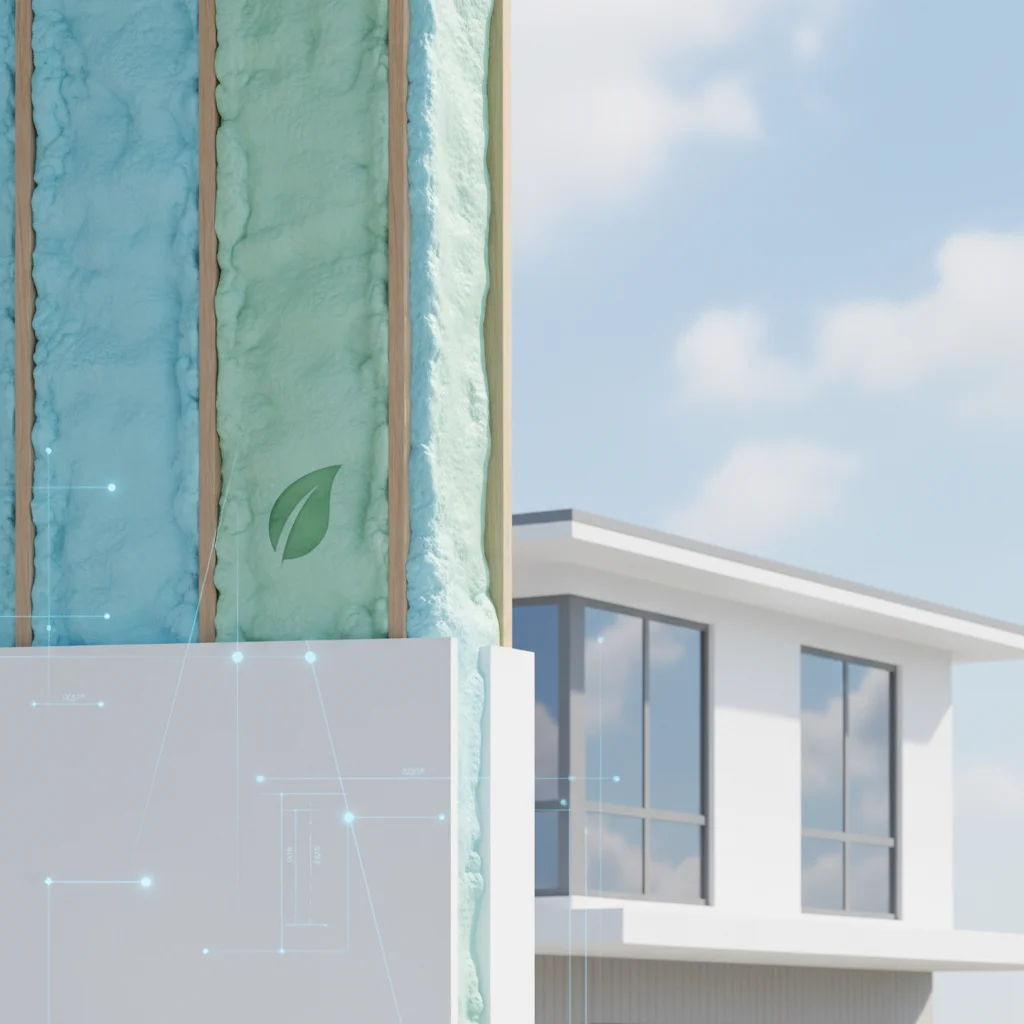
Homeowners who insulate 1,500 square feet of attic space with closed-cell spray foam save an average of $600-$900 annually on heating and cooling costs—yet 73% overpay contractors by failing to compare open-cell versus closed-cell pricing structures.
How Much Does Spray Foam Insulation Cost in 2026?
Spray foam insulation costs $1.50-$3.50 per square foot for open-cell and $3.00-$7.00 per square foot for closed-cell in 2026, with whole-home projects averaging $4,200-$8,500 for 1,500 square feet, influenced by application thickness, regional labor rates, and accessibility constraints.
Open-cell spray foam delivers R-3.7 per inch at $1.50-$3.50 per square foot installed. Closed-cell foam reaches R-6.5 per inch at $3.00-$7.00 per square foot. A typical 1,500 square foot attic application with 3 inches of closed-cell foam costs $6,750-$15,750 before rebates. And contractors charge $800-$1,500 in setup fees for equipment mobilization and vapor barrier installation. Labor accounts for 60-70% of total project costs in metropolitan areas versus 45-55% in rural markets. So geographic location shifts final pricing by 25-40% even when material costs remain constant. Homeowners who bundle spray foam with air sealing services save $200-$400 on combined labor charges.
Which Spray Foam Types Qualify for Federal Tax Credits and Rebates?
The federal Energy Efficient Home Improvement Credit (Section 25C) ended for property placed in service after December 31, 2025 (IRS FS-2025-05). Federal tax credits for this work have ended, but state, local and utility rebates may still apply; check what is available at your address with the DuloCore rebate calculator.
The IRA framework replaced expired Section 25C and 25D credits on January 1, 2026. And closed-cell foam at R-6.5 per inch meets the thermal resistance threshold for federal credits when installed in climate zones 3-7. But open-cell foam at R-3.7 per inch only qualifies when combined with additional air sealing measures documented through blower door testing. Utility rebates in California, New York, and Massachusetts add $0.10-$0.50 per square foot for spray foam projects verified by HERS raters. So a 1,500 square foot attic project generates $1,800-$3,150 in federal credits plus $150-$750 in state utility incentives. Form 5695 only covers qualifying work completed by December 31, 2025 and claimed on a 2025 return; the federal 25C and 25D credits ended after that date (IRS FS-2025-05).
"Spray foam insulation meeting ENERGY STAR requirements can reduce heating and cooling costs by up to 50% in older homes." — ENERGY STAR Insulation Guide
Check eligibility for your specific project using our free rebate calculator to maximize available incentives.
What's the Energy Efficiency Rating of Different Spray Foam Insulation Brands?
Icynene Classic Max delivers R-3.7 per inch in open-cell applications while Demilec Heatlok Soy 200 Plus achieves R-7.0 per inch in closed-cell installations, with brand performance varying by climate zone humidity levels and substrate adhesion requirements.
Icynene ProSeal Eco costs $2.20-$3.80 per square foot at R-3.6 per inch for sound dampening in interior walls. Demilec's closed-cell Heatlok XT-F reaches R-6.8 per inch at $4.50-$7.20 per square foot with flame spread ratings under 25. And SWD Urethane SwiftFoam Pro 202 achieves R-6.5 per inch at $3.90-$6.40 per square foot with 15-minute tack-free time for rapid coverage. But Lapolla Foam-Lok 2000 4G at R-6.9 per inch costs $5.10-$7.80 per square foot with extended cure times requiring 24-hour staging. So material selection impacts both thermal performance and labor scheduling. Brands certified by the Spray Polyurethane Foam Alliance guarantee consistency across batches.
Learn more about available insulation rebates for different product types.
How Long Does Spray Foam Insulation Last and What Maintenance Does It Need?
Closed-cell spray foam maintains R-value performance for 80+ years without settling or moisture degradation while requiring zero maintenance, outperforming fiberglass batts that compress 15-20% within 10 years and cellulose that settles 20-30% over 15 years.
Properly installed closed-cell foam creates an air-impermeable barrier that eliminates convective heat loss for the building's lifetime. And manufacturers warranty R-value stability for 50 years minimum with documented testing showing negligible degradation at 80+ years. But open-cell foam in unconditioned attics exposed to temperature swings above 140°F may experience 3-5% R-value decline over 30 years. So climate zone selection matters for foam type longevity. Homeowners inspect foam annually for gaps at penetrations where plumbing or electrical modifications created openings. Touch-up kits cost $45-$80 for small-volume repairs under 2 square feet. And professional re-sealing runs $200-$400 for larger penetration areas.
What's the ROI and Payback Period for Spray Foam Insulation Investment?
Spray foam insulation in 1,500 square foot attics generates $600-$1,200 annual energy savings with 5-9 year payback periods before rebates and 3-6 year payback after applying federal credits and utility incentives, delivering 12-18% annual returns over 20-year analysis periods.
A $7,500 closed-cell attic project saves $900 annually in heating costs for homes in climate zone 5, hitting breakeven at 8.3 years before rebates. But federal credits reduce net investment to $5,250, cutting payback to 5.8 years. And utility rebates of $450 drop payback to 5.3 years. So combined incentives improve ROI from 12% to 17% annually. Homeowners in climate zones 6-7 see $1,100-$1,400 annual savings with 4-6 year payback periods. But southern climate zones 1-2 save $400-$650 annually with 10-14 year payback. Resale value increases $0.95-$1.15 per dollar invested in spray foam upgrades according to Remodeling Magazine's 2026 Cost vs. Value Report.
Explore additional savings through heat pump rebates when combining insulation with HVAC upgrades.
How Does Spray Foam Compare in Cost to Fiberglass, Cellulose, and Mineral Wool?
| Insulation Type | Cost per Sq Ft | R-Value per Inch | Lifespan | Maintenance |
|---|---|---|---|---|
| Closed-Cell Spray Foam | $3.00-$7.00 | R-6.5 | 80+ years | None |
| Open-Cell Spray Foam | $1.50-$3.50 | R-3.7 | 80+ years | None |
| Fiberglass Batts | $0.40-$1.00 | R-3.2 | 25-30 years | Replacement every 15-20 years |
| Cellulose | $0.60-$1.20 | R-3.5 | 20-30 years | Reapply every 20 years |
| Mineral Wool | $1.40-$2.80 | R-4.0 | 50+ years | Minimal |
Closed-cell spray foam costs 4-8x more than fiberglass batts upfront but eliminates air leakage that reduces fiberglass effectiveness by 30-50% in real-world installations. And spray foam's 80-year lifespan versus fiberglass's 25-year replacement cycle means lower lifetime costs for homeowners planning 30+ year occupancy. But fiberglass works for budget-constrained projects where air sealing is addressed separately through weatherization services. Cellulose at $0.60-$1.20 per square foot settles 20-30% within 15 years, requiring top-off applications that add $0.15-$0.25 per square foot every 20 years. So mineral wool at $1.40-$2.80 per square foot offers middle-ground pricing with R-4.0 per inch and 50-year lifespan without settling.
Official Sources
- DOE Energy Saver — Federal energy efficiency guidance and insulation specifications
- DSIRE USA — State and utility rebate program database for insulation upgrades
- IRS Energy Incentives — Federal tax credit documentation and filing requirements (note: the federal 25C and 25D credits ended for projects completed after December 31, 2025)
Frequently Asked Questions About Spray Foam Insulation Cost
How much does spray foam insulation cost?
Spray foam insulation costs $1.50-$7.00 per square foot depending on foam type and application thickness. Open-cell foam runs $1.50-$3.50 per square foot at R-3.7 per inch. Closed-cell foam costs $3.00-$7.00 per square foot at R-6.5 per inch. A typical 1,500 square foot attic project with 3 inches of closed-cell foam costs $6,750-$15,750 before federal credits and utility rebates.
Is spray foam insulation eligible for tax credits?
The federal Energy Efficient Home Improvement Credit (Section 25C) ended for property placed in service after December 31, 2025 (IRS FS-2025-05). Form 5695 only covers qualifying work completed by December 31, 2025 and claimed on a 2025 return; the federal 25C and 25D credits ended after that date (IRS FS-2025-05). And utility programs in 23 states add $0.10-$0.50 per square foot for HERS-verified installations.
What is the average cost of spray foam insulation per square foot?
The average cost of spray foam insulation is $2.50-$5.00 per square foot across all foam types and thicknesses in 2026. Open-cell applications average $2.20-$3.10 per square foot for 3-inch depths. Closed-cell installations average $4.50-$6.20 per square foot for 2-3 inch applications. And costs vary 25-40% by region based on labor rates and contractor availability.
How much can you save with spray foam insulation?
Spray foam insulation in 1,500 square foot attics saves $600-$1,400 annually on heating and cooling costs depending on climate zone. Homeowners in climate zones 5-7 save $900-$1,400 per year. Southern climate zones 1-2 save $400-650 annually. And combined with federal credits reducing net cost by 30%, payback periods run 3-9 years with 12-18% annual returns over 20-year analysis periods.
What are the costs of spray foam insulation vs fiberglass insulation?
Spray foam costs $3.00-$7.00 per square foot for closed-cell versus $0.40-$1.00 per square foot for fiberglass batts—4-8x more upfront. But spray foam's air-sealing eliminates the 30-50% efficiency loss from air leakage in fiberglass installations. And spray foam's 80-year lifespan versus fiberglass's 25-year replacement cycle means lower total ownership costs for homeowners planning 30+ year occupancy.
Ready to calculate your spray foam insulation savings? Use our rebate calculator to see how much federal credits and utility rebates reduce your net project cost—and get your personalized payback period in under 2 minutes.
Last updated April 14, 2026 — reviewed by DuloCore Editorial. About our authors.
Check your California insulation rebate eligibility — see the programs you qualify for and the dollar amounts on our California insulation rebate finder.