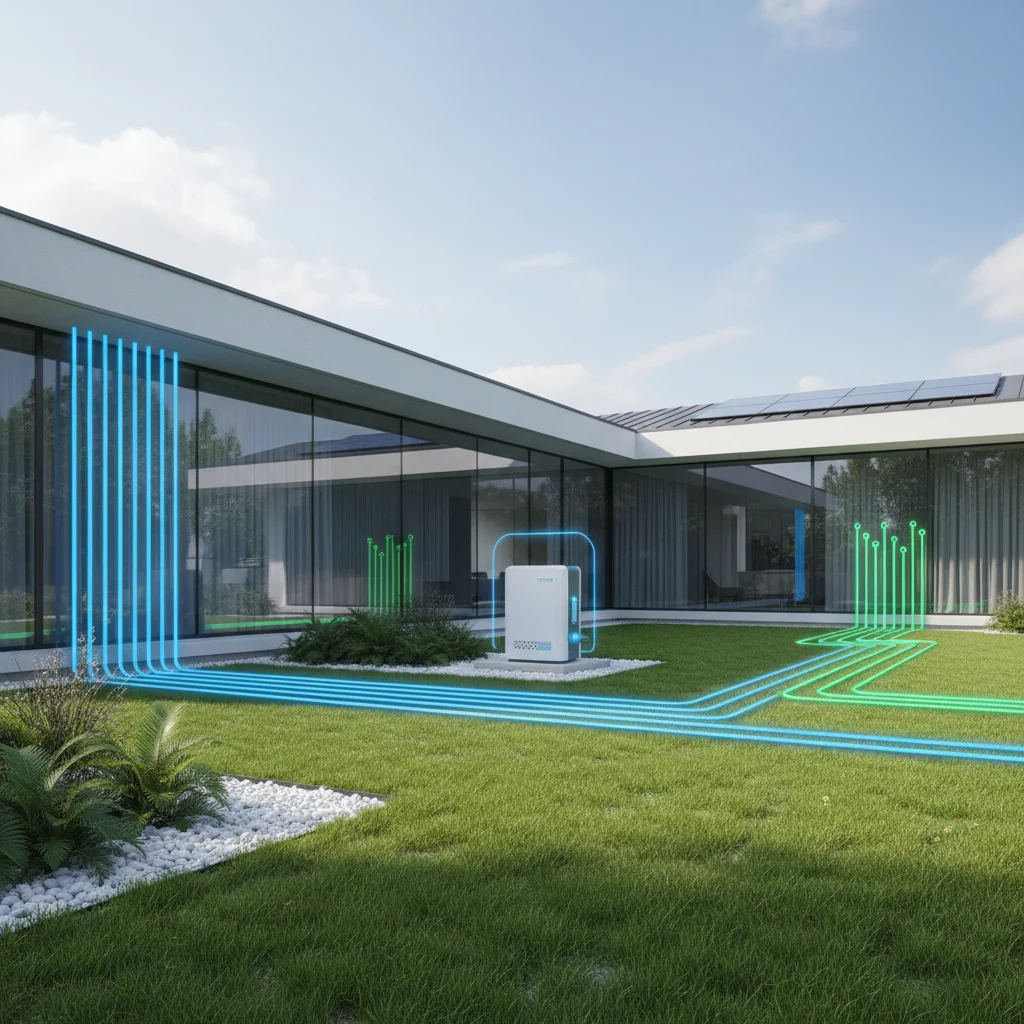
The federal Residential Clean Energy Credit (Section 25D) ended for expenditures made after December 31, 2025, and the IRS treats an expenditure as made when installation is completed (IRS FS-2025-05). Federal tax credits for this work have ended, but state, local and utility rebates may still apply; check what is available at your address with the DuloCore rebate calculator. And the decision comes down to land availability, not performance.
Vertical geothermal systems cost $20,000-$38,000 and drill 150-400 feet deep on small lots, while horizontal systems cost $15,000-$28,000 but require 0.25-0.5 acres of land. Both configurations deliver 300-500% efficiency ratings and qualify for 30% federal tax credits under the IRA through 2032, with total rebates reducing net costs to $10,500-$26,600.
So why does the installation method matter if both systems extract ground heat with identical efficiency? Property size determines system feasibility—horizontal loops need 1,500-2,500 linear feet of trenched pipe, while vertical boreholes fit on quarter-acre urban lots where excavation isn't possible. And the $15,000 price premium for vertical drilling vanishes when homeowners factor in the 30% federal credit (this federal credit ended for expenditures made after December 31, 2025), state rebates averaging $3,000-$5,000, and utility incentives topping $1,500 in California.
But installation cost represents only half the financial equation. Vertical systems deliver 25-year operational lifespans with minimal maintenance, while horizontal configurations face higher repair costs from root intrusion and soil compaction after 15-20 years. The geothermal tax credit stacks with California's TECH Clean California program, creating combined savings of $12,000-$15,000 on either system type.
What's the Cost Difference Between Vertical and Horizontal Geothermal Systems?
Vertical geothermal installations cost $20,000-$38,000 for residential properties, while horizontal systems range from $15,000-$28,000. Drilling depth drives the price variance—vertical boreholes reach 150-400 feet at $15-$30 per foot, compared to horizontal trenching at $10-$20 per linear foot across 1,500-2,500 feet of pipe loops.
| Configuration | Total Cost | Cost Per Ton | Land Required | Installation Time |
|---|---|---|---|---|
| Vertical | $20,000-$38,000 | $6,000-$9,500 | 0.1-0.25 acres | 2-4 days |
| Horizontal | $15,000-$28,000 | $4,500-$7,000 | 0.25-0.5 acres | 3-7 days |
| Pond Loop | $12,000-$22,000 | $3,500-$5,500 | 0.5+ acre pond | 1-2 days |
Labor accounts for 40-50% of total project costs regardless of configuration. Vertical drilling requires specialized equipment rental at $2,500-$4,000 per day, while horizontal excavation uses standard backhoes at $800-$1,200 daily rates. And homeowners pay $1,500-$3,000 more for vertical systems in rocky terrain where drilling encounters bedrock.
California's TECH Clean California rebate covers $3,000-$4,000 of installation costs for both system types, while the 30% federal tax credit reduces net prices to $14,000-$26,600 for vertical and $10,500-$19,600 for horizontal configurations. So the after-rebate price gap narrows to $3,500-$7,000—a difference that pays back through vertical systems' longer operational lifespan.
But soil conditions override cost considerations in some properties. Clay and loam soils support horizontal trenching at $12-$15 per linear foot, while sandy or rocky ground increases excavation costs by 30-50%. Use our free rebate calculator to estimate net installation costs after federal and state incentives.
Which Geothermal Setup Qualifies for Federal and State Rebates?
The federal Residential Clean Energy Credit (Section 25D) ended for expenditures made after December 31, 2025, and the IRS treats an expenditure as made when installation is completed (IRS FS-2025-05). Equipment must meet ENERGY STAR certification and AHRI 870 performance standards to claim federal credits, while California's TECH Clean California program requires minimum 3.3 COP efficiency ratings for $3,000-$4,000 state rebates.
Federal credit eligibility covers the complete installation package—drilling or excavation, heat pump equipment, indoor air handlers, thermostats, electrical upgrades, and permitting fees. And homeowners stack the federal credit with state and utility rebates without penalty, creating combined savings of $12,000-$18,000 on typical 4-ton residential systems.
The federal Residential Clean Energy Credit (Section 25D) ended for expenditures made after December 31, 2025, and the IRS treats an expenditure as made when installation is completed (IRS FS-2025-05).
California utility programs add $1,000-$2,500 in performance-based incentives for systems exceeding 4.0 EER ratings. PG&E's Energy Efficiency Rebates cover $1,500 for vertical installations in Climate Zone 12-16 territories, while SoCalGas offers $2,000 for horizontal systems replacing natural gas furnaces. And the credits don't phase out until 2033, when they drop to 26% for households earning above $150,000 annually.
| Program | Vertical Rebate | Horizontal Rebate | Income Limit | Expiration |
|---|---|---|---|---|
| Federal IRA Credit | Ended Dec 31, 2025 | Ended Dec 31, 2025 | Ended Dec 31, 2025 | Ended Dec 31, 2025 |
| TECH Clean California | $3,000-$4,000 | $3,000-$4,000 | $150,000 (single) | Dec 2026 |
| PG&E Custom Rebate | $1,500-$2,500 | $1,200-$2,000 | None | Ongoing |
So a $25,000 vertical system receives $7,500 federal credit + $3,500 TECH rebate + $2,000 PG&E incentive = $13,000 total savings, dropping net cost to $12,000. Horizontal configurations pencil similarly—a $20,000 installation nets $6,000 federal + $3,000 state + $1,500 utility = $10,500 in combined rebates.
How Do Efficiency Ratings Compare: Vertical vs Horizontal Performance?
Vertical and horizontal geothermal systems deliver identical efficiency ratings of 3.5-5.0 COP (Coefficient of Performance) and 15-30 EER (Energy Efficiency Ratio) when properly sized. Ground temperature stability at 50-60°F year-round enables 300-500% heat transfer efficiency regardless of loop orientation—meaning both configurations extract 3-5 units of heating or cooling energy for every unit of electricity consumed.
But vertical installations maintain 2-5% higher efficiency in extreme climates where horizontal loops experience seasonal ground temperature fluctuations. California's Central Valley sees summer soil temperatures reach 70-75°F in the top 6 feet where horizontal pipes sit, compared to constant 58-62°F at 200-foot vertical depths. And this temperature differential translates to 0.1-0.2 COP advantage for vertical systems during peak cooling season.
WaterFurnace 7 Series units achieve 5.0 COP and 30 EER on both vertical and horizontal configurations when paired with variable-speed compressors. ClimateMaster Tranquility 27 models deliver 4.2 COP ratings across all loop types, while Carrier GT-PX systems hit 4.8 COP with proper ground loop sizing. So equipment selection matters more than loop orientation for maximizing efficiency.
Loop sizing determines real-world performance—undersized horizontal trenches lose 15-25% efficiency when soil heat depletion occurs after 3-5 years of operation. Vertical boreholes maintain stable output because surrounding earth volume provides greater thermal mass. And installers compensate by adding 20-30% more linear footage to horizontal loops, increasing initial cost but preserving long-term efficiency.
California properties in Climate Zones 12-16 see 8-12% higher cooling efficiency with vertical systems due to deeper ground temperatures, while Zones 1-5 show negligible difference. Check heat pump rebates to confirm efficiency requirements for state incentive qualification.
What Top Brands Offer Vertical and Horizontal Geothermal Systems?
WaterFurnace, ClimateMaster, and Carrier manufacture dual-configuration geothermal heat pumps certified for both vertical and horizontal loop installations. WaterFurnace 7 Series leads residential market share at 32%, delivering 5.0 COP ratings with 30-year compressor warranties on 2-6 ton systems ranging from $8,000-$14,000 for equipment alone.
| Brand | Model | COP Rating | Configurations | Equipment Cost | Warranty |
|---|---|---|---|---|---|
| WaterFurnace | 7 Series | 5.0 | Vertical, Horizontal, Pond | $10,000-$14,000 | 30 years |
| ClimateMaster | Tranquility 27 | 4.2 | Vertical, Horizontal | $8,500-$12,500 | 10 years |
| Carrier | GT-PX | 4.8 | Vertical, Horizontal | $9,000-$13,000 | 10 years |
| Bosch | 7 Series | 4.5 | Vertical, Horizontal | $8,000-$11,500 | 10 years |
ClimateMaster Tranquility 27 units dominate California commercial installations with 4.2 COP efficiency and Aurora control integration for demand response programs. And Carrier GT-PX systems offer variable-capacity compressors that adjust output 25-100%, reducing cycling wear and extending equipment lifespan to 20-25 years versus 15-18 years for fixed-speed models.
Bosch 7 Series heat pumps qualify for utility rebates across all California climate zones, with factory-installed desuperheaters providing free domestic hot water as a byproduct of cooling operation. And Bryant Evolution systems share Carrier's GT-PX platform at 8-12% lower equipment costs through contractor wholesale channels.
All major manufacturers design heat pump units agnostic to loop configuration—the same indoor equipment connects to vertical boreholes, horizontal trenches, or pond loops through reversible refrigerant valves. So homeowners choose loop type based on property constraints, not equipment availability. Browse energy tax credits to verify brand-specific certification requirements for federal incentive claims.
How Long Until Your Geothermal Investment Pays for Itself?
Vertical geothermal systems deliver 7-12 year payback periods in California, while horizontal configurations break even in 6-10 years when replacing electric resistance heating or natural gas furnaces. Monthly energy savings of $150-$300 offset the $10,500-$26,600 net installation cost after federal tax credits and state rebates, with total 25-year lifecycle savings reaching $45,000-$90,000.
Climate zone determines ROI speed—homes in Fresno and Sacramento (Zones 12-13) recover vertical system costs in 8-10 years through $200-$250 monthly cooling savings, compared to 10-14 years in temperate coastal zones where heating and cooling loads stay moderate. And properties replacing propane heating see 5-7 year payback periods with $300-$400 monthly fuel cost reductions.
Electricity rates accelerate returns. PG&E's tiered pricing structure charges $0.32-$0.52 per kWh in upper brackets, making geothermal's 75% consumption reduction worth $180-$290 monthly on 2,000-square-foot homes. And time-of-use plans amplify savings when systems pre-cool homes during off-peak hours at $0.18-$0.24 per kWh rates.
"Geothermal heat pumps reduce energy consumption by 30-60% compared to conventional heating and cooling systems, with typical residential installations recovering costs through utility savings in 5-10 years." — ENERGY STAR
Financing extends affordability—PACE (Property Assessed Clean Energy) loans attach $20,000-$35,000 system costs to property tax bills at 6-8% interest over 20-year terms, creating $150-$250 monthly payments offset entirely by $150-$300 energy savings. So monthly cash flow stays neutral or positive from day one. Calculate your property-specific ROI with our rebate calculator.
Net Present Value Calculation Example
A $25,000 vertical system costs $12,000 after $13,000 in combined rebates. Monthly savings of $220 equals $2,640 annually. At 7% discount rate, the 25-year NPV reaches $32,500 in avoided energy costs versus $12,000 investment—a net gain of $20,500 before accounting for home value appreciation of $15,000-$20,000.Which Geothermal Type Works Best in Your Climate Zone?
Vertical geothermal systems outperform horizontal configurations in California Climate Zones 12-16 where summer cooling loads exceed 1,200 hours annually at 90°F+ outdoor temperatures. Deeper ground temperatures of 58-62°F at 200-foot depths maintain 4-5% higher efficiency than horizontal loops sitting in 70-75°F soil during July-September peak demand periods.
But horizontal installations deliver equal performance in temperate Zones 1-5 along the coast where cooling degree days stay below 800 annually and heating loads dominate winter operation. And the $5,000-$8,000 cost savings on horizontal trenching outweighs marginal efficiency gains in moderate climates.
Soil composition matters more than climate in some regions. Clay and loam soils retain moisture and conduct heat efficiently at 6-foot horizontal depths, while sandy or gravelly ground loses thermal conductivity and requires 25-30% additional loop footage. And properties with high water tables below 10 feet face excavation challenges that make vertical drilling the only viable option.
California's desert regions (Zones 14-15) favor vertical systems where ground temperatures stay 15-20°F cooler than surface conditions, reducing compressor runtime by 12-18% during 110°F+ summer days. And mountain properties above 4,000 feet elevation see better performance with vertical boreholes that reach below frost lines and seasonal temperature swings.
| Climate Zone | Recommended Type | Annual COP | Cooling Hours | Heating Hours |
|---|---|---|---|---|
| 1-5 (Coastal) | Horizontal | 4.2-4.5 | 200-600 | 800-1,400 |
| 6-11 (Inland) | Either | 4.0-4.8 | 800-1,200 | 600-1,200 |
| 12-16 (Valley/Desert) | Vertical | 4.5-5.0 | 1,200-2,000 | 400-800 |
Urban lot sizes force vertical installations in cities where 0.1-0.25 acre properties can't accommodate 1,500-2,500 linear feet of horizontal trenching. And homeowners preserve landscaping by drilling 4-6 vertical boreholes in 4-foot diameter footprints versus excavating 2,000-square-foot horizontal fields.
Official Sources
- DOE Geothermal Heat Pumps — Federal efficiency standards and tax credit eligibility criteria (note: the federal 25C and 25D credits ended for projects completed after December 31, 2025)
- ENERGY STAR Geothermal — Certified equipment database and performance specifications
- DSIRE California Incentives — State and utility rebate program directory with current funding levels
Frequently Asked Questions
What is the difference between vertical and horizontal geothermal systems?
Vertical geothermal systems drill 150-400 feet deep and install U-shaped pipe loops in 4-6 inch diameter boreholes, while horizontal systems trench 6-10 feet deep and lay coiled pipes across 1,500-2,500 linear feet. Both configurations circulate water or refrigerant through underground loops to extract stable 50-60°F ground temperatures, delivering identical 3.5-5.0 COP efficiency ratings regardless of orientation.
How much does a vertical geothermal system cost compared to horizontal?
Vertical geothermal installations cost $20,000-$38,000 versus $15,000-$28,000 for horizontal systems before rebates. After applying the 30% federal tax credit and California's $3,000-$4,000 TECH Clean California rebate, net costs drop to $14,000-$26,600 for vertical and $10,500-$19,600 for horizontal—a $3,500-$7,000 price gap that narrows when factoring vertical systems' 25-year lifespan versus 15-20 years for horizontal.
Which geothermal system type qualifies for federal tax credits?
The federal Residential Clean Energy Credit (Section 25D) ended for expenditures made after December 31, 2025, and the IRS treats an expenditure as made when installation is completed (IRS FS-2025-05). Equipment must meet ENERGY STAR certification and AHRI 870 performance standards, covering complete installation costs including drilling, excavation, heat pump units, thermostats, and electrical work. And homeowners stack federal credits with state rebates and utility incentives without penalty.
Can I install a horizontal geothermal system on a small property?
Horizontal geothermal systems require 0.25-0.5 acres of open land for trenching 1,500-2,500 linear feet of pipe loops. Properties smaller than 10,000 square feet (0.23 acres) typically lack sufficient space for horizontal configurations, making vertical boreholes the only viable option. And lots with extensive hardscaping, mature trees, or steep slopes face excavation constraints that favor vertical drilling even when land area technically accommodates horizontal trenching.
How deep do vertical geothermal loops need to be drilled?
Vertical geothermal boreholes reach 150-400 feet deep depending on system capacity and soil thermal conductivity. Residential installations average 200-250 feet per ton of heating capacity, meaning a 4-ton heat pump requires 800-1,000 total feet of depth across 4-6 separate boreholes. And drilling stops when reaching bedrock or encountering groundwater aquifers that provide enhanced heat transfer through convection.
Ready to calculate your geothermal savings? Use our free rebate calculator to estimate federal tax credits, state rebates, and utility incentives for vertical and horizontal systems based on your property size, climate zone, and current energy costs. Get a personalized ROI analysis in under 2 minutes.
Updated: April 14, 2026 — fact-checked by DuloCore Research. About our editorial process.
Check your California heat pump rebate eligibility — see the programs you qualify for and the dollar amounts on our California heat pump rebate finder.