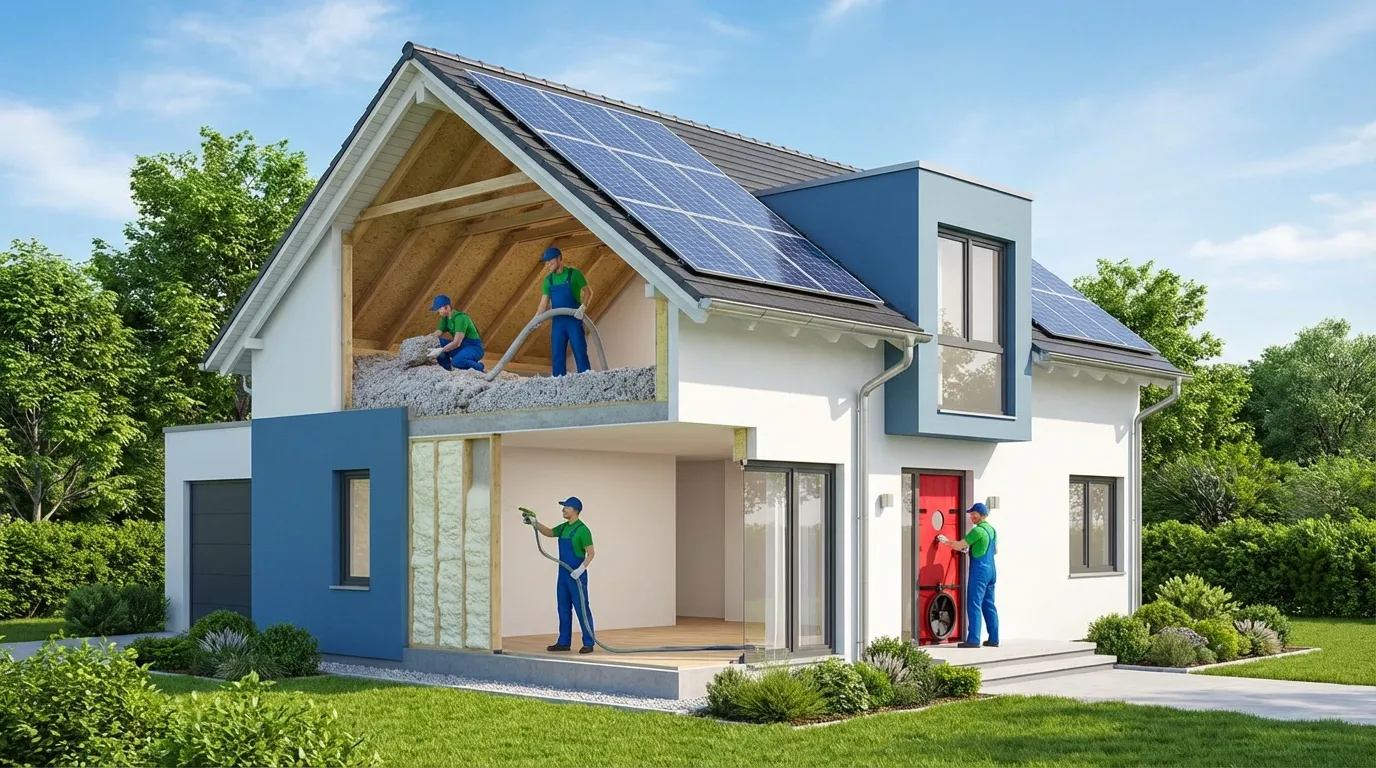
Nearly 35 million U.S. households struggle with a high energy burden, sometimes spending over 8% of their total income just to heat and cool their homes. This financial strain is most often a direct result of poor insulation and air leaks that allow conditioned air to escape, forcing HVAC systems to work overtime. So addressing these structural inefficiencies is the fastest way to reduce utility bills and improve home comfort.
Who Qualifies for Weatherization Assistance Program (WAP) Insulation, and What Costs Does It Cover?
The Weatherization Assistance Program (WAP) is a federal grant for low-income households, typically those at or below 200% of the federal poverty level. So it covers 100% of material and labor costs for approved insulation, air sealing, and minor energy-related repairs, prioritizing seniors and families with children.
Eligibility for WAP insulation is primarily determined by household income relative to the federal poverty guidelines. For 2024, a family of four generally qualifies with an income at or below $62,400. And priority is given to households with elderly individuals, persons with disabilities, or children under 6. The program is a grant, not a loan, so it covers 100% of the costs for all approved weatherization services. This includes a comprehensive home energy audit to identify key areas of energy loss. So based on the audit, WAP funds the installation of attic, wall, and floor insulation, along with critical air sealing around windows and doors. It also covers minor repairs necessary to ensure the effectiveness of these measures. These services are provided at zero cost to the homeowner, making it distinct from programs that offer heat pump rebates or tax credits.
What Types of Insulation Are Approved by WAP, What Are Their Efficiency Standards, and Which Brands Qualify for My Climate Zone?
WAP approves insulation types like cellulose, fiberglass, and spray foam that meet specific Department of Energy R-value standards for the home's climate zone. So brands like Owens Corning or Johns Manville are often used, but the final selection is made by the local WAP agency.
The program adheres to strict efficiency standards to maximize energy savings. So the type and amount of insulation installed are determined by a home energy audit, which recommends materials based on the home's construction and local climate zone. Common approved materials include blown-in cellulose, fiberglass batts, and rigid foam board. Each must meet a minimum R-value—a measure of thermal resistance—specified by the DOE for that part of the house (e.g., R-49 for attics in cold climates). While specific brands are not mandated at the federal level, local WAP agencies select products from manufacturers like CertainTeed, Knauf, or Johns Manville that comply with these federal performance and safety standards. The choice depends on cost-effectiveness and suitability for the specific application, ensuring the best performance for the investment.
"WAP requires that the weatherization work performed in a home meets a Savings-to-Investment Ratio (SIR) of 1.0 or greater, meaning that the value of the energy saved is greater than the cost of the improvements." — U.S. Department of Energy
What is the ROI and Lifespan of WAP-Installed Insulation, and What Maintenance is Required to Maximize Savings? (See also: insulation rebates for veterans.) (See also: insulation rebates 2026.) (See also: whole home insulation upgrade rebates.) (See also: geothermal tax credit.)
WAP-installed insulation delivers an immediate 100% return on investment because the homeowner pays $0. So it provides average annual energy savings of $372. And materials like fiberglass and cellulose have a lifespan of 80-100 years, requiring only minimal maintenance like avoiding moisture and compression.
Because the Weatherization Assistance Program covers 100% of the project cost, the return on investment for the homeowner is immediate and infinite. The primary financial benefit comes from sustained energy savings. The Department of Energy reports that households save an average of $372 per year after weatherization services are completed. The lifespan of the installed insulation is another benefit. So materials like fiberglass, cellulose, and mineral wool do not degrade under normal conditions and last for 80-100 years or more. Maintenance is minimal. Homeowners should conduct an annual visual inspection of their attic or crawlspace to ensure the insulation has not been disturbed, compressed, or exposed to moisture, as these conditions reduce its R-value. But beyond that, no active maintenance is required to continue realizing savings year after year.
How Do I Apply for Weatherization Assistance Program Insulation, and Are There Any Deadlines or Specific Process Steps?
To apply for WAP insulation, contact your state's weatherization office to find the local agency. So you submit an application with proof of income and household size. And if eligible, an energy audit is scheduled to determine the work needed; applications are generally accepted year-round.
The application process begins by identifying your local WAP provider, which is typically a community action agency or nonprofit organization. You find this provider through your state's energy or housing office. Next, you must complete an application and provide documentation verifying your household income, such as pay stubs or social security statements. Once your eligibility is confirmed, the agency schedules a professional energy audit of your home. This audit identifies the most cost-effective energy-saving measures, including insulation and air sealing needs. So the agency then hires and manages qualified contractors to perform the work at no cost to you. There are no national deadlines, as applications are accepted on a rolling basis. But funding is limited annually, so applying early in the fiscal year increases your chances of receiving assistance. Our rebate calculator helps find other options if you don't qualify.
What Are the Best Alternatives to WAP Insulation, and How Do They Compare in Typical Cost, Installation Cost, and Efficiency?
Key alternatives to WAP include federal energy tax credits and utility rebates. But the 25C (now expired, replaced by the Energy Efficient Home Improvement Credit) tax credit offers 30% back up to $1,200 on insulation costs, while utility rebates provide a direct discount of $200-$1,000. So these options require an upfront investment unlike WAP.
For homeowners who do not meet WAP's income requirements, several strong alternatives exist. The federal Energy Efficient Home Improvement Credit (Section 25C) ended for property placed in service after December 31, 2025 (IRS FS-2025-05). Federal tax credits for this work have ended, but state, local and utility rebates may still apply; check what is available at your address with the DuloCore rebate calculator. And this requires a significant upfront investment, as the average professional attic insulation project costs between $1,700 and $3,900. Another option is to pursue local utility insulation rebates. Many utility companies offer direct cash rebates of $0.15 to $0.75 per square foot for
Ready to Save on Your Home Improvement?
Use our free rebate calculator to find every federal, state, and utility incentive you qualify for.
Official Sources
Updated: April 14, 2026 — fact-checked by DuloCore Research. About our editorial process.
Check your California insulation rebate eligibility — see the programs you qualify for and the dollar amounts on our California insulation rebate finder.