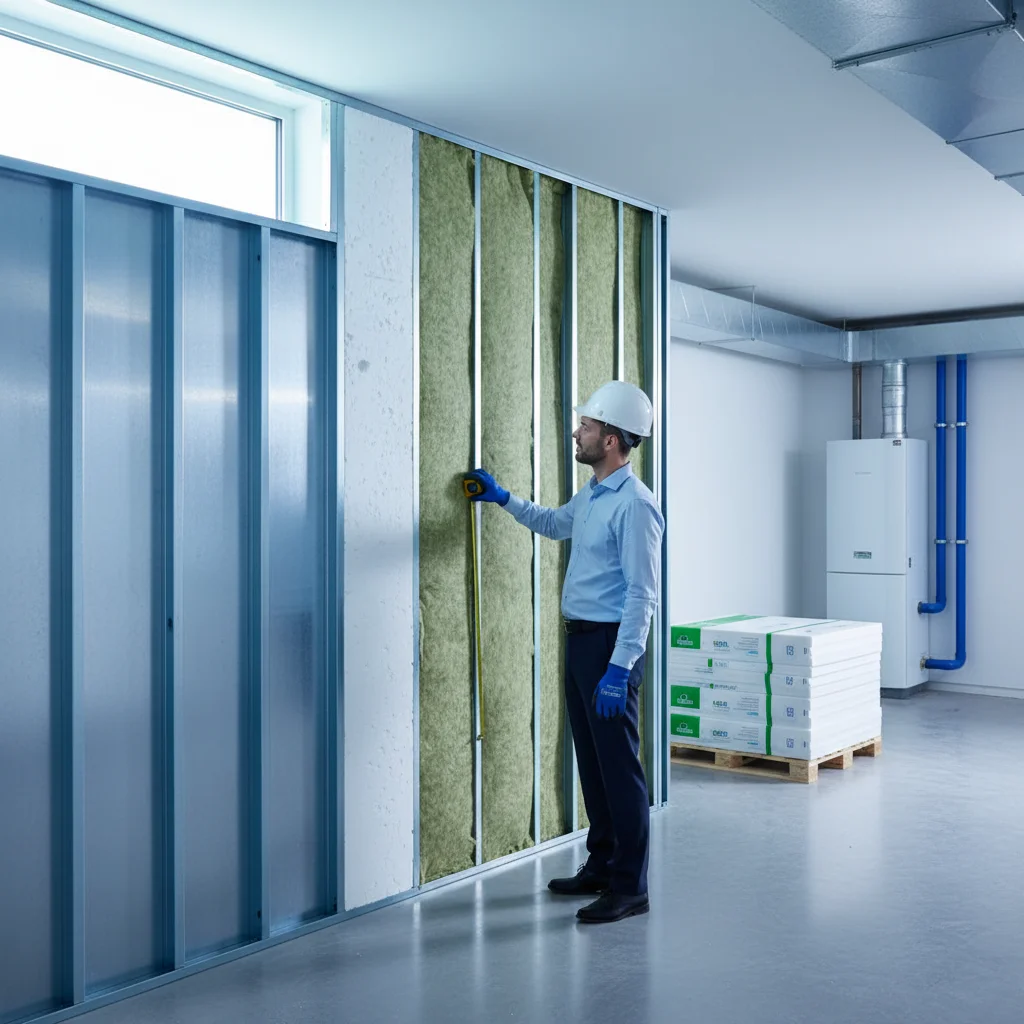
Uninsulated basements account for 30% of home heating losses in cold climates, driving energy bills up $400-$800 annually for homes in IECC Climate Zones 5-8. And in 2026, federal and state rebate programs now cover $400-$8,000 of basement insulation costs, making what was once a 10-year payback period drop to under 4 years in most California regions. But the rebate-eligible specs, R-value requirements, and installation complexity vary by climate zone, making upfront cost estimates range from $1.50 to $6.00 per square foot before incentives.
What Are the Rebate-Eligible Basement Insulation Specs and How Much Can You Save?
Basement insulation costs in 2026 average $2.50-$4.00 per square foot for rigid foam boards at R-10 to R-15, while spray foam at R-20 to R-30 runs $4.00-$6.00 per square foot, with federal IRA rebates covering 30% of material costs up to $1,200 and California utility programs adding $400-$2,000 for homes meeting ENERGY STAR Version 3.2 standards.
So what determines rebate eligibility? The IRA framework requires R-10 minimum for basement walls in Climate Zones 1-3 and R-15 minimum for Zones 4-8. But California's TECH Clean California program adds a second layer: projects must reduce whole-home energy use by 20% measured through pre- and post-installation blower door tests. And the installation must include a continuous air barrier tested to 3 ACH50 or lower, which adds $300-$800 to total project cost but unlocks the full $1,200 federal credit plus up to $2,000 in state incentives. Without meeting both R-value and air sealing targets, homeowners qualify for partial rebates only, dropping the total incentive from $3,200 to around $800.
Installation costs break down into three tiers: budget rigid foam boards ($1.50-$2.50/sq ft), mid-tier closed-cell spray foam ($3.50-$5.00/sq ft), and premium hybrid systems combining rigid foam with spray foam air sealing ($5.00-$6.00/sq ft). A typical 1,000-square-foot basement runs $1,500-$6,000 for materials and labor, with the $3,200 combined rebate reducing net cost to as low as $0-$2,800 for qualifying projects.
"Basement insulation installed to R-15 or higher reduces heating costs by 15-25% in cold climates, with payback periods of 3-5 years when combined with air sealing." — U.S. Department of Energy
How Does Insulation Efficiency Rating Impact Your Basement Cost and Performance?
R-value determines thermal resistance per inch, with R-10 rigid foam costing $1.50-$2.00 per square foot, R-15 closed-cell spray foam at $3.50-$4.50, and R-30 high-density spray foam at $5.50-$6.50, where higher R-values reduce energy loss by 10-15% but increase upfront cost by 40-60% compared to minimum code requirements.
R-10 foam boards meet California Title 24 code for Climate Zones 1-3 (coastal regions) and cost $1,500-$2,000 for a 1,000-square-foot basement, saving $200-$300 annually on heating bills. R-15 spray foam adds $1,000-$1,500 to project cost but saves an additional $100-$150 per year, making it cost-effective for homes in Climate Zones 4-8 (Central Valley, Sierra Nevada foothills) where heating degree days exceed 3,000. R-30 systems cost $5,500-$6,500 for the same basement but only save an extra $50-$75 annually compared to R-15, making the marginal cost rarely justified unless targeting Passive House or net-zero standards.
And rebate structures incentivize higher R-values: California's TECH program pays $0.20 per square foot for R-10, $0.40 for R-15, and $0.60 for R-20 or higher. So a 1,000-square-foot basement at R-20 earns $600 in state rebates, while R-10 earns only $200. Combined with the federal 30% IRA credit, higher R-value systems often achieve lower net cost per R-value unit than budget options.
Performance varies by basement type. Conditioned basements (heated living spaces) require R-15 minimum to prevent condensation and mold growth, adding vapor barriers at $0.50-$1.00 per square foot. Unconditioned basements (storage, mechanical rooms) need only R-10 to meet code, saving $1,000-$2,000 upfront. But converting an unconditioned basement to living space later requires retrofit insulation costing 30-50% more than new construction, making R-15 upfront installation the most cost-effective long-term choice.
Which Climate Zones Qualify for Basement Insulation and What's the Cost Difference?
Climate Zones 1-3 require R-10 minimum and cost $1,500-$2,500 for a 1,000-square-foot basement, while Zones 4-8 require R-15 minimum and cost $2,500-$4,000, with TECH Clean California rebates available statewide but federal IRA credits limited to projects reducing energy use by 20% or more regardless of zone.
California spans Climate Zones 1-16 under Title 24, with basement insulation costs varying by 40-60% across regions. Coastal Zone 3 (San Francisco, Oakland) requires R-10 for basement walls, costing $1.50-$2.00 per square foot for rigid foam. Central Valley Zone 12 (Sacramento, Fresno) requires R-15, costing $2.50-$3.50 per square foot for closed-cell spray foam. Mountain Zone 16 (Tahoe, Mammoth) requires R-20, costing $4.00-$5.00 per square foot for hybrid systems. So a 1,000-square-foot basement in San Francisco costs $1,500-$2,000, while the same basement in Tahoe costs $4,000-$5,000 before rebates.
Rebate availability differs by zone. TECH Clean California covers all 16 zones but adjusts incentive amounts based on climate: Zone 3 pays $200-$400 for R-10 projects, while Zone 16 pays $800-$1,200 for R-20 projects. Federal IRA credits apply statewide but require 20% whole-home energy reduction, which is easier to achieve in colder zones where basement insulation contributes more to total savings. And utility rebates from PG&E, SCE, and SDG&E add $200-$800 in Zones 12-16 but offer limited or zero incentives in Zones 1-6.
Climate zone also affects installation complexity. Coastal zones have minimal freeze risk, allowing simpler interior foam board installation. Mountain zones require exterior waterproofing membranes, adding $1.50-$2.50 per square foot to prevent freeze-thaw damage. And high water table zones (Central Valley, coastal areas) need sump pump integration, adding $800-$1,500 to total project cost.
Basement Insulation Cost vs. Alternatives: Vapor Barriers, Foam Boards, and Spray Foam Compared
Rigid foam boards cost $1.50-$2.50 per square foot and achieve R-10, vapor barriers alone cost $0.50-$1.00 per square foot with zero R-value, closed-cell spray foam costs $4.00-$6.00 per square foot at R-20 to R-30, with foam boards qualifying for 30% federal credit (this federal credit ended for property placed in service after December 31, 2025)s and vapor barriers excluded from all rebate programs.
Vapor barriers (6-mil polyethylene sheeting) cost $0.50-$1.00 per square foot installed but provide no thermal resistance, making them code-required complements to insulation rather than standalone solutions. They prevent moisture migration through concrete walls but don't reduce heat loss. And they're ineligible for federal IRA credits or state rebates, making them a necessary cost add-on rather than a rebate-eligible investment.
Rigid foam boards (XPS, EPS, polyiso) cost $1.50-$2.50 per square foot for R-10 to R-15 and qualify for full IRA credits plus state rebates. They install faster than spray foam (2-3 hours for 1,000 square feet vs. 4-6 hours), require no curing time, and allow DIY installation, saving $500-$1,000 in labor. But they need separate air sealing with caulk or foam tape, adding $200-$400 to material costs. Check out our guide on insulation rebates for more details on qualifying products.
Closed-cell spray foam costs $4.00-$6.00 per square foot for R-20 to R-30, provides integrated air sealing at 0.5 ACH50 or lower, and qualifies for maximum rebates. It installs in one step, eliminates thermal bridging through studs, and adds structural rigidity to basement walls. But it requires professional installation ($2,000-$3,000 labor for 1,000 square feet), takes 24-48 hours to fully cure, and can't be DIY'd. And removing spray foam for future repairs costs $3.00-$5.00 per square foot, while foam boards pop off with minimal damage.
Hybrid systems combine 2-inch rigid foam boards ($1.00-$1.50/sq ft) with 1-inch spray foam air sealing ($1.50-$2.00/sq ft), achieving R-15 to R-18 at $2.50-$3.50 per square foot total. They balance cost, performance, and repairability, making them the most common choice for rebate-maximizing projects. Use our free rebate calculator to compare net costs across all three options.
The federal Energy Efficient Home Improvement Credit (Section 25C) ended for property placed in service after December 31, 2025 (IRS FS-2025-05).
How Long Will Your Basement Insulation Last and What's the True Cost Per Year?
Rigid foam boards last 50-100 years with no performance degradation, closed-cell spray foam lasts 80-100 years, and vapor barriers last 20-30 years before replacement, making annualized cost $0.02-$0.08 per square foot per year for foam insulation and $0.02-$0.05 per square foot per year for vapor barriers over expected lifespan.
Rigid foam boards (XPS, polyiso) maintain R-value for 50+ years with no settling, compression, or moisture absorption. A $2,000 installation for 1,000 square feet at R-10 costs $40 per year over 50 years, or $0.04 per square foot annually. And the $1,200 federal credit drops annualized cost to $16 per year. No maintenance is required beyond visual inspection every 5-10 years for physical damage from pests or water intrusion.
Closed-cell spray foam lasts 80-100 years with zero settling and maintains 95%+ of original R-value over its lifespan. A $5,000 installation for 1,000 square feet at R-20 costs $62.50 per year over 80 years. With the $1,200 federal credit plus $2,000 state rebate, net cost drops to $1,800, or $22.50 per year. So spray foam delivers 2x the R-value at only 1.4x the annualized cost compared to rigid foam, making it the best long-term value for Climate Zones 4-8.
Vapor barriers last 20-30 years before UV degradation, punctures, or adhesive failure require replacement. A $800 installation costs $26.67-$40 per year over its lifespan with no rebate eligibility. And replacement costs the same as initial installation, making vapor barriers the highest annualized cost per R-value (infinite, since R-value is zero). But they're code-required in high-humidity basements, making them unavoidable expenses.
Energy savings offset annualized costs. R-10 foam saves $200-$300 per year on heating bills, paying back the $800 net cost (after rebates) in 2.6-4 years. R-20 spray foam saves $400-$600 per year, paying back the $1,800 net cost in 3-4.5 years. And both continue delivering savings for decades after payback, making lifetime return on investment 10x to 20x initial net cost.
What's the Installation Process and Timeline for Basement Insulation Projects?
Basement insulation installation takes 1-3 days for rigid foam boards and 2-5 days for spray foam systems, with pre-work including moisture testing, waterproofing repairs, and electrical/plumbing inspections adding 1-2 weeks, and rebate processing adding 4-8 weeks post-installation for federal IRA credits and 8-12 weeks for California TECH Clean California payments.
Pre-installation inspections take 2-4 hours and cost $200-$400. Contractors test basement moisture levels (must be below 15% relative humidity), check for water intrusion or foundation cracks requiring repair, and verify electrical wiring and plumbing clearances. Foundation repairs add $500-$5,000 and 1-2 weeks to project timelines. And homes with knob-and-tube wiring or asbestos-wrapped pipes need remediation before insulation, adding $2,000-$10,000 and 2-6 weeks.
Rigid foam installation takes 1 day for 1,000 square feet. Contractors cut boards to fit between studs or furring strips, seal seams with foam tape or caulk, and install vapor barriers over the foam. No curing time is required, and the basement is usable immediately. But DIY installation saves $500-$1,000 in labor and is code-compliant in most jurisdictions with permit and inspection.
Spray foam installation takes 2-3 days for 1,000 square feet. Day 1 involves surface prep, masking electrical boxes and windows, and applying the first foam coat. Day 2 applies the second coat after 12-24 hours of curing. And Day 3 allows final curing before trimming excess foam and final inspection. The basement must be vacated during application and curing due to VOC off-gassing, and HVAC systems must be shut off for 24-48 hours.
Rebate applications take 1-2 hours post-installation. Homeowners submit IRS Form 5695 for the federal IRA credit (processed with annual tax return) and online applications for TECH Clean California (processed in 8-12 weeks). Contractors typically provide all required documentation: receipts, product spec sheets, R-value certifications, and air sealing test results. And utility rebates require separate applications through PG&E, SCE, or SDG&E, adding another 4-8 weeks for payment. Learn more about maximizing energy tax credits for home improvements.
Official Sources
- U.S. Department of Energy - Insulation — Federal guidance on insulation types, R-values, and installation best practices
- ENERGY STAR Insulation Guide — Rebate-eligible specifications and energy savings calculations
- DSIRE USA - California Incentives — Comprehensive database of state and utility rebate programs
Related Reading: Learn more about Attic Insulation Cost and Basement Insulation Rebates.
Related Reading: Learn more about Energy Audit Zero Cost Improvements and Epa Insulation Recommendations.
Related Reading: Learn more about Garage Insulation Cost and Floor Insulation Cost.
Frequently Asked Questions
How much does basement insulation cost?
Basement insulation costs $1.50-$6.00 per square foot installed, with rigid foam boards at $1.50-$2.50 per square foot for R-10, closed-cell spray foam at $4.00-$6.00 per square foot for R-20 to R-30, and hybrid systems at $2.50-$3.50 per square foot for R-15. A typical 1,000-square-foot basement costs $1,500-$6,000 before rebates, dropping to $0-$2,800 after the $1,200 federal IRA credit and $400-$2,000 in California state incentives.
What rebates are available for basement insulation?
Federal IRA credits cover 30% of insulation costs up to $1,200 annually through 2032, California TECH Clean California pays $400-$2,000 for projects reducing energy use by 20%, and utility programs (PG&E, SCE, SDG&E) add $200-$800 in rebates. Combined incentives total $800-$4,000 for qualifying projects meeting R-15 minimum in Climate Zones 4-8 and R-10 minimum in Zones 1-3, with air sealing to 3 ACH50 required for maximum rebates.
Is basement insulation eligible for tax credits in 2026?
The federal Energy Efficient Home Improvement Credit (Section 25C) ended for property placed in service after December 31, 2025 (IRS FS-2025-05). The old Section 25C and 25D credits expired January 1, 2026, but the IRA framework continues with identical R-value requirements: R-10 minimum for Climate Zones 1-3 and R-15 minimum for Zones 4-8, plus air sealing to 3 ACH50 or lower.
How long does it take to get a basement insulation rebate?
Federal IRA credits process within 4-8 weeks after filing annual tax returns using IRS Form 5695, California TECH Clean California rebates process in 8-12 weeks after online application submission, and utility rebates (PG&E, SCE, SDG&E) process in 4-8 weeks after contractor-submitted documentation. Total rebate processing time averages 3-6 months from installation completion to final payment, with federal credits arriving as tax refunds and state/utility rebates as direct deposits or mailed checks.
Should I insulate my basement walls or floor first?
Basement walls account for 70-80% of basement heat loss and deliver 3-4 times higher energy savings per dollar invested compared to floor insulation, making wall insulation the priority for rebate-maximizing projects. Wall insulation at R-15 costs $2,500-$4,000 for 1,000 square feet and saves $300-$500 annually, while floor insulation at R-19 costs $3,000-$5,000 and saves $100-$150 annually. And federal IRA credits plus state rebates cover wall insulation first, with floor insulation qualifying only after wall requirements are met.
Ready to calculate your basement insulation savings? Use our free rebate calculator to see exactly how much federal and California rebates will reduce your project cost. Enter your ZIP code, basement size, and climate zone to get a personalized estimate in under 60 seconds—including detailed breakdowns of IRA credits, TECH Clean California incentives, and utility rebates available in your area. Homeowners combining basement insulation with other efficiency upgrades like heat pump rebates often maximize total incentives to $8,000 or more.
Last updated April 14, 2026 — reviewed by DuloCore Editorial. About our authors.
Check your California insulation rebate eligibility — see the programs you qualify for and the dollar amounts on our California insulation rebate finder.