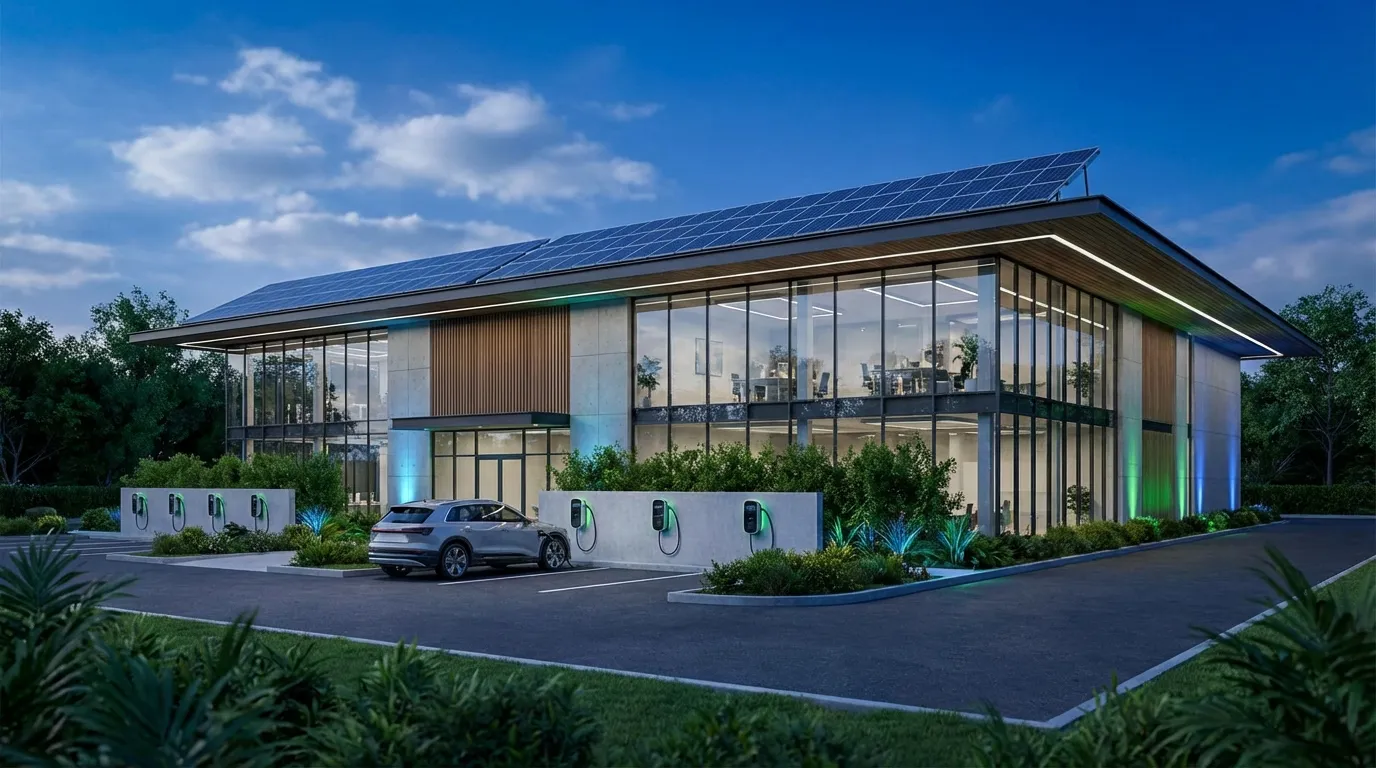
The U.S. will need 1.2 million public EV chargers by 2030 to support the projected 26.4 million electric vehicles on the road. Yet, as of early 2024, only about 170,000 are in operation, creating a 1-million-charger gap that businesses are now incentivized to fill. This isn't just about sustainability; it's about capturing a rapidly growing customer base and future-proofing commercial properties. So, businesses that act now position themselves to meet this explosive demand, attracting high-value EV-driving customers and employees before their competitors.
How Much Can Your Business Save on Commercial EV Chargers and What Equipment Qualifies for Rebates?
Commercial EV charger rebate programs, offered by federal, state, and utility entities, provide thousands of dollars in savings for qualifying equipment. The federal 30C charger credit ended for chargers placed in service after June 30, 2026 (IRS FS-2025-05). Federal tax credits for this work have ended, but state, local and utility rebates may still apply; check what is available at your address with the DuloCore rebate calculator. State and utility rebates often add another $2,000 to $8,000 per port.
The federal 30C charger credit ended for chargers placed in service after June 30, 2026 (IRS FS-2025-05). But this credit is only available for projects in eligible census tracts. And state programs, like California's CALeVIP, offer up to $80,000 for DC fast charger installations in disadvantaged communities. Utility rebates from providers like Con Edison in New York add thousands more per port. Qualifying equipment typically includes Level 2 (240V) and DC Fast Chargers that are ENERGY STAR certified and network-enabled for data collection. So, businesses must select smart chargers to be eligible for the most lucrative programs. These combined incentives can reduce total project costs by over 75%, transforming a capital expenditure into a strategic investment with a rapid payback period. Explore more about available energy tax credits to maximize savings.
Where Can Your Business Find EV Charger Rebates: A State-by-State and Utility Program Comparison?
Businesses can find commercial EV charger rebates through federal government databases, state energy office websites, and local utility portals. These programs vary drastically by location, with states like California, New York, and Colorado offering the most robust incentives, often exceeding $5,000 per charging port through 2024.
Finding the right incentive requires a multi-layered search. The primary federal resource is the Alternative Fuels Data Center, but the most comprehensive database is DSIRE, which lists state, local, and utility-specific programs. For example, Austin Energy in Texas offers commercial customers up to $4,000 per port, while Xcel Energy in Colorado provides up to $2,500 for Level 2 chargers. But these programs are geographically restricted.
"The Database of State Incentives for Renewables & Efficiency (DSIRE) is the most comprehensive source of information on incentives and policies that support renewables and energy efficiency in the United States." — DSIRE
So, a business in Los Angeles will access different funds than one in Boston. A national business must navigate this complex patchwork of programs, each with its own funding pool and rules. DuloCore's rebate calculator simplifies this by aggregating local and state incentives.
What's the Application Process, Deadlines, and Current Funding Status for Commercial EV Charger Rebate Programs?
The application process for commercial EV charger rebates typically involves a multi-step sequence: pre-application for fund reservation, installation by a qualified professional, and a final application with proof of purchase. Deadlines are strict, and funding is often first-come, first-served, making prompt action critical for securing incentives.
Most programs require pre-approval before any equipment is purchased or installed. This step reserves your funding. After approval, you proceed with the installation. So, once the chargers are operational, you submit a final application with invoices, photos, and inspection reports to receive the rebate check, a process that can take 60-90 days. But funding status is the most critical variable. Popular programs, like Maryland's EVSE Rebate Program, often exhaust their annual funding within months. Businesses must check the program’s website for real-time funding availability before starting a project. Missing a deadline or applying to an exhausted fund means losing out on thousands of dollars in savings. Many businesses find navigating these complex ev charger rebates challenging without expert help.
Commercial EV Charger Program Comparison
| Program | Rebate Amount | Eligibility Highlights | Typical Deadline |
|---|---|---|---|
| Federal 30C Tax Credit | Ended June 30, 2026 | — | Ended June 30, 2026 |
| California CALeVIP | Up to $80,000 per DCFC; $6,000 per L2 | Varies by air district; often requires public access. | Varies; funds are first-come, first-served. |
| Con Edison (NY) | Up to $8,500 per DCFC port; $4,500 per L2 port | Must be a Con Edison commercial customer. | Ongoing, but subject to funding availability. |
Are There Income Limits or Specific Contractor Requirements for Commercial EV Charger Rebate Eligibility?
Commercial EV charger programs don't have income limits for the business applicant, but many programs do link eligibility to the project's location, prioritizing installations in low-income or underserved communities. And virtually all programs mandate that installation is performed by a licensed and certified electrician.
While a business's revenue isn't a factor, geography is. The federal 30C charger credit ended for chargers placed in service after June 30, 2026 (IRS FS-2025-05). State programs often use similar geographic targeting to promote equity.
"To be eligible for the credit, the property must be placed in service within a low-income community... or a non-urban census tract." — Internal Revenue Service (IRS)
Furthermore, contractor requirements are non-negotiable. Installation must be completed by a licensed electrician to ensure safety and code compliance. So, some programs require the electrician to hold specific certifications from the EV charger manufacturer or a national body like the Electric Vehicle Infrastructure Training Program (EVITP). Using an unqualified contractor will result in an automatic denial of the rebate application, wasting both time and money. Similar strict requirements apply to other incentives like heat pump rebates.
Can You Stack Commercial EV Charger Rebates and Other Incentives to Maximize Your Savings?
Yes, businesses can stack multiple incentives, combining the 30% federal tax credit with state rebates and local utility programs to cover up to 75% of total project costs. However, some programs contain "anti-stacking" clauses that limit the total incentive amount, requiring careful review of each program's terms.
Stacking is the key to maximizing return on investment. A business can layer the federal 30C tax credit on top of a state-level grant and a per-port rebate from their electric utility. For instance, a $50,000 project could receive a $15,000 federal credit (30%), a $10,000 state rebate, and a $5,000 utility incentive, reducing the business's out-of-pocket cost to just $20,000. But program administrators are aware of stacking. So, some utility rebates are reduced if the applicant also receives state funding. It is essential to read the fine print of every program to understand the stacking rules. Failing to do so can lead to a smaller-than-expected total incentive or even disqualification from one of the programs.
Related Reading: Learn more about Ev Charger Rebate 2026 and Ev Charger Rebate California.
Related Reading: Learn more about Ev Charger Utility Rebate and Federal Ev Charger Rebate.
Frequently Asked Questions
What types of businesses are eligible for commercial EV charger rebates?
Most businesses are eligible, including retail locations, multi-family housing complexes, workplaces, and fleet operators. Eligibility often depends on public accessibility or providing charging for tenants and employees.
How much funding can I receive through commercial EV charger rebate programs?
Funding varies widely. The federal 30C charger credit ended for chargers placed in service after June 30, 2026 (IRS FS-2025-05). State and utility rebates add thousands more, often ranging from $2,000 to $8,000 per charging port, with some programs for DC fast chargers exceeding $80,000.
What is the typical application process for a commercial EV charger rebate?
The process usually involves three steps: 1) A pre-approval application to reserve funds before purchase, 2) Installation of qualifying chargers by a licensed electrician, and 3) A final application with invoices and proof of installation to receive payment.
Are there specific deadlines to apply for commercial EV charger rebate programs?
Yes, deadlines are strict. Many programs operate on an annual cycle or until funds are depleted, which often happens months before the official deadline. Applying early is critical as most funding is awarded on a first-come, first-served basis.
Can I combine multiple commercial EV charger rebate programs for one project?
Yes, stacking incentives is often allowed and is the best way to maximize savings. A business can typically combine a federal tax credit with state and local utility rebates, but
Updated on April 14, 2026. Fact-checked by DuloCore Editors. About our research team.
Check your California EV charger rebate eligibility — see the programs you qualify for and the dollar amounts on our California EV charger rebate finder.