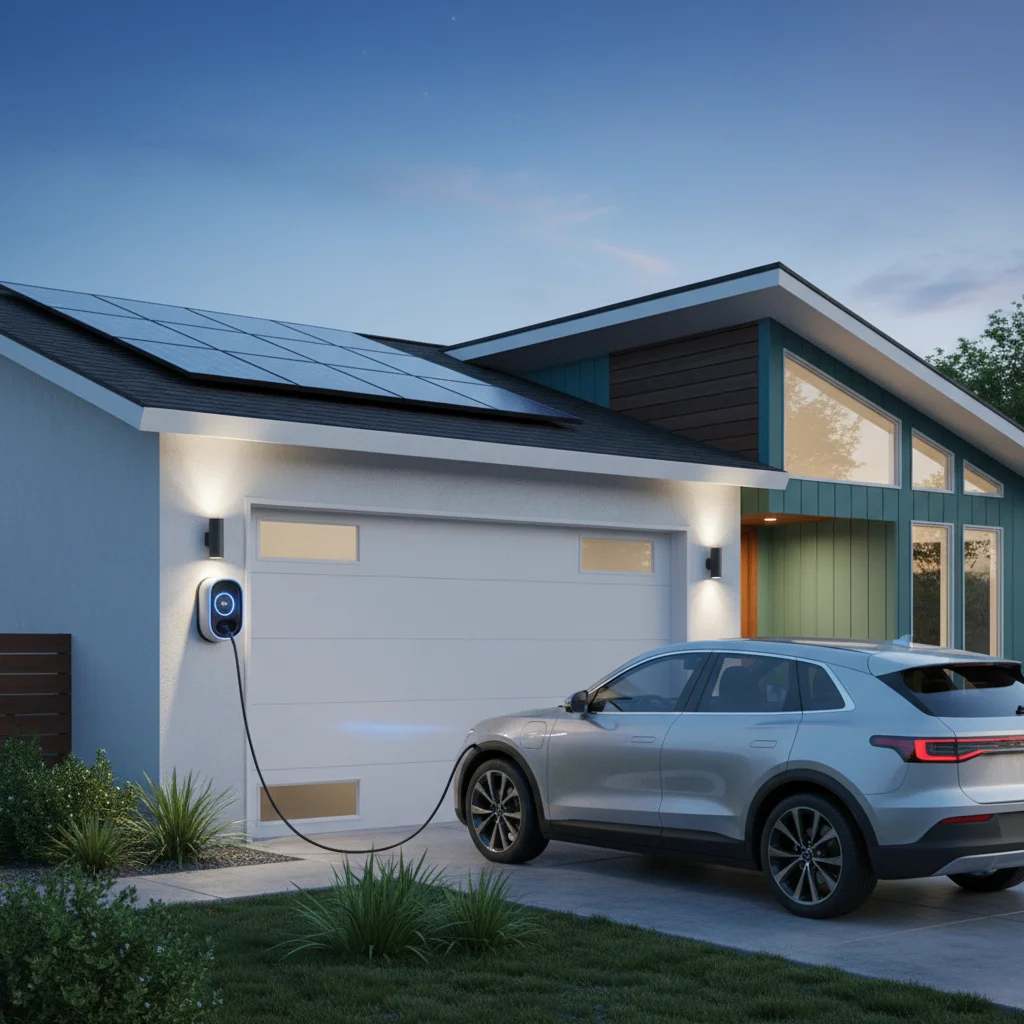
Sacramento EV owners spent an average of $1,847 on Level 2 home charger installations in 2026, but federal tax credits and SMUD rebates can cut that figure by more than half. And with California's 2035 gas car sales ban approaching, home charging infrastructure is shifting from luxury to necessity for the region's 47,000 registered electric vehicles.
How Much Does EV Charger Installation Cost in Sacramento?
Sacramento homeowners pay $1,200 to $2,800 for Level 2 EV charger installation in 2026, with $1,847 as the median cost. Installation costs include the charging unit ($400-$1,200), electrical panel upgrades if needed ($500-$1,500), and labor ($300-$600). And homes built before 1990 typically require panel upgrades to support the 240-volt, 40-amp circuit.
But here's the core tension: Sacramento's aging housing stock means 62% of homes need electrical work beyond basic charger mounting. So a straightforward installation in a newer Natomas home runs $1,200, while a Midtown Victorian requiring panel replacement hits $2,800. The distance from your electrical panel to the garage adds $6-$8 per linear foot for conduit and wiring.
SMUD customers receive a $500 rebate for qualified charger installations, dropping the effective cost to $1,347 for median installations. The federal 30C charger credit ended for chargers placed in service after June 30, 2026 (IRS FS-2025-05). Combined incentives can reduce out-of-pocket expenses to $847 for a standard installation.
Climate Zone 12 (Sacramento's designation) requires outdoor chargers to meet UL-listed weather resistance standards, adding $100-$200 to equipment costs compared to garage installations. Use our free rebate calculator to estimate your specific installation cost after incentives.
What's the Lifespan of an EV Charger and When Will You Need to Replace It?
Level 2 residential EV chargers last 10 to 15 years with proper maintenance, based on 2026 manufacturer warranty data and field performance reports. Chargers installed in Sacramento garages typically reach 12-year lifespans, while outdoor units exposed to 110°F summer heat average 10 years before connector wear or circuit board degradation requires replacement.
The charging cable and connector handle degrade faster than the electronics—expect connector replacement at year 7-9 ($150-$300) regardless of installation location. And Sacramento's minimal precipitation compared to coastal regions reduces moisture-related failures, extending component life by 18-24 months versus Bay Area installations.
Total cost of ownership over 12 years includes the initial $1,847 installation, one connector replacement at $200, and $15 annual electrical inspection fees, totaling $2,227. But this delivers approximately 36,000 charging sessions at 40 kWh per session, costing $0.06 per session in equipment depreciation—far below the $4.50 average cost of DC fast charging in Sacramento.
Chargers installed in 2026 qualify for extended warranties through SMUD's rebate program, covering parts and labor for 5 years versus the standard 3-year manufacturer warranty. So participants save $400-$600 in potential repair costs during the coverage period.
Is Your Sacramento Home's Climate Zone Suitable for EV Charger Installation?
Sacramento's Climate Zone 12 classification supports year-round EV charging without temperature-related performance degradation affecting modern Level 2 chargers rated for -22°F to 122°F operation. And summer temperatures reaching 106°F fall well within operational tolerances, though charging speeds decrease by 8-12% above 100°F as thermal management systems reduce current flow to protect battery chemistry.
Sacramento receives 58 days annually above 90°F, triggering thermal throttling in older first-generation Nissan Leaf and BMW i3 models that lack active battery cooling. But 2024-2026 EV models from Tesla, Ford, Chevrolet, and Hyundai include liquid-cooled battery packs that maintain full charging speeds through Sacramento summers.
Outdoor charger installations require NEMA 3R or higher weatherproof enclosures to handle Sacramento's 18 inches of annual rainfall and occasional winter freeze events dropping to 31°F. And south-facing or west-facing garage walls exposed to afternoon sun need thermal gap mounting (2-inch standoff) to prevent enclosure temperatures exceeding 140°F, which voids most manufacturer warranties.
"Climate Zone 12 designations require residential charging equipment to meet UL 2594 certification for outdoor use in areas experiencing temperature swings of 100°F or more annually." — ENERGY STAR EV Charger Specifications
SMUD offers free site assessments for Climate Zone 12 installations to verify electrical capacity and recommend weatherproofing requirements before permitting. So homeowners avoid the $200-$400 cost of installation rework when initial setup fails inspection.
Are You Eligible for Federal Tax Credits and Local Rebates on EV Charger Installation?
The federal 30C charger credit ended for chargers placed in service after June 30, 2026 (IRS FS-2025-05). And SMUD customers receive an additional $500 rebate for Level 2 charger installations completed by licensed electricians on the utility's approved contractor list.
The federal 30C charger credit ended for chargers placed in service after June 30, 2026 (IRS FS-2025-05). Federal tax credits for this work have ended, but state, local and utility rebates may still apply; check what is available at your address with the DuloCore rebate calculator. But the credit phases down to 22% in 2033 and 15% in 2034 before expiring, creating urgency for installations planned within the next 24 months.
SMUD's rebate program requires enrollment in the Time-of-Use rate plan and installation of a networked charger capable of smart charging during off-peak hours (midnight to 6 AM). And participants save an additional $0.08 per kWh on overnight charging, adding $312 annually for drivers covering 12,000 miles at 3.5 miles per kWh efficiency.
The federal 30C charger credit ended for chargers placed in service after June 30, 2026 (IRS FS-2025-05).
California's Clean Vehicle Rebate Project (CVRP) ended charger rebates in 2024, but Sacramento County's EV Charging Infrastructure Program offers $300 rebates for income-qualified households earning below 80% of area median income ($89,200 for a family of four in 2026). So low- to moderate-income families stack three incentives—federal credit ($1,000) + SMUD rebate ($500) + county rebate ($300)—reducing effective installation costs to $547 for median projects.
Check the Database of State Incentives for Renewables & Efficiency (DSIRE) to verify current program availability and application deadlines before scheduling installation.
What's the Installation Process and Timeline for Getting Your EV Charger Set Up?
Sacramento EV charger installations take 4 to 8 weeks from initial quote to final inspection, broken into permitting (7-14 days), electrical work (1-3 days), and inspection scheduling (14-21 days). And Sacramento County's online permitting system cuts processing time by 3-5 days versus paper applications, with 87% of standard installations approved within 10 business days.
The process starts with a licensed electrician assessing your electrical panel capacity—most installations require a dedicated 40-amp, 240-volt circuit. Homes with 100-amp service panels typically need upgrades to 200-amp capacity, adding $1,200-$1,800 and extending timelines by 5-7 days for utility meter replacement coordination with SMUD.
Installation day involves mounting the charger enclosure, running conduit from the panel to the charging location, installing the circuit breaker, and connecting the unit. And the work takes 3-6 hours for straightforward garage installations but extends to 8-12 hours when running 50+ feet of conduit or upgrading service panels.
Sacramento County requires final electrical inspection before energizing the circuit, with inspectors scheduling visits 2-3 weeks out during peak construction seasons (March-September). But expedited inspection fees ($150) reduce wait times to 3-5 business days for homeowners needing faster completion.
SMUD rebate applications must be submitted within 90 days of final inspection, with funds distributed via check 4-6 weeks after approval. So the total timeline from signing a contract to receiving rebate payment spans 12-16 weeks, requiring upfront payment of the full installation cost before reimbursement.
Level 2 vs. DC Fast Charging: Which Option Makes Financial Sense for Sacramento Homeowners?
Level 2 home chargers deliver 25-30 miles of range per hour at $1,847 average installation cost, while DC fast chargers add 180-200 miles per hour but require $15,000-$40,000 in equipment and electrical infrastructure unsuitable for residential use. And Sacramento's public DC fast charging network (43 stations within city limits) eliminates the need for home-based rapid charging for daily driving patterns averaging 29 miles per day.
Level 2 charging at SMUD's Time-of-Use overnight rate costs $0.13 per kWh, delivering a full 75 kWh battery charge for $9.75 and 260 miles of range. But DC fast charging at Electrify America or EVgo stations runs $0.43-$0.56 per kWh, costing $32-$42 for the same charge—a 228% premium over home charging.
Sacramento homeowners driving 12,000 miles annually spend $540 on home Level 2 charging versus $1,944 on public DC fast charging for the same mileage. So home charging saves $1,404 annually, recovering the $1,847 installation cost in 15.8 months even without factoring federal credits or SMUD rebates.
DC fast charging degrades lithium-ion battery capacity 0.5-1% faster annually compared to Level 2 charging due to heat generation during high-current transfers. And Tesla recommends limiting Supercharger use to long-distance travel, with 90% of charging occurring at home or workplace Level 2 stations to maximize battery lifespan beyond 200,000 miles.
Level 2 installations qualify for federal tax credits and SMUD rebates totaling $1,500, while residential DC fast chargers receive no incentives due to their commercial classification. Learn more about available incentives in our guide to EV charger rebates.
Official Sources
- ENERGY STAR EV Charger Resources — Federal standards for residential charging equipment efficiency and climate ratings
- Department of Energy Alternative Fuels Data Center — Comprehensive database of federal and state EV incentives including tax credits and rebates (note: the federal 25C and 25D credits ended for projects completed after December 31, 2025)
- Database of State Incentives for Renewables & Efficiency — Up-to-date tracking of California utility programs and local rebate availability
Related Reading: Learn more about Ev Charger Installation Cost With Rebates and Federal Ev Charger Rebate.
Related Reading: Learn more about Ev Charger Installation Cost and Ev Charger Installation Cost Guide.
Frequently Asked Questions
How much does it cost to install an EV charger in Sacramento?
Sacramento EV charger installations cost $1,200 to $2,800 in 2026, with $1,847 as the median price including equipment, electrical work, and permitting. Homes requiring electrical panel upgrades from 100-amp to 200-amp service add $1,200-$1,800 to base costs. The federal 30C charger credit ended for chargers placed in service after June 30, 2026 (IRS FS-2025-05). SMUD rebates provide an additional $500, reducing effective costs to $847-$2,147 depending on project complexity.
What rebates are available for EV charger installation in Sacramento?
SMUD customers receive $500 rebates for Level 2 charger installations paired with Time-of-Use rate enrollment in 2026. The federal 30C charger credit ended for chargers placed in service after June 30, 2026 (IRS FS-2025-05). Sacramento County offers $300 rebates for income-qualified households earning below 80% area median income ($89,200 for families of four), creating potential combined savings of $1,800 when stacking all three programs.
Do I qualify for EV charger installation rebates in Sacramento?
The federal 30C charger credit ended for chargers placed in service after June 30, 2026 (IRS FS-2025-05). SMUD rebates require customers to enroll in Time-of-Use rates and use approved contractors installing networked chargers. Sacramento County rebates target households earning below 80% area median income, verified through tax returns or pay stubs submitted with applications within 90 days of installation completion.
How long does it take to install an EV charger in Sacramento?
Sacramento installations take 4 to 8 weeks from contract signing to final inspection, including 7-14 days for permitting, 1-3 days for electrical work, and 14-21 days for inspection scheduling. Homes requiring panel upgrades add 5-7 days for SMUD meter replacement coordination. And expedited inspection fees ($150) reduce post-installation wait times from 2-3 weeks to 3-5 business days during peak construction seasons.
What is the difference between Level 1 and Level 2 EV charger installation costs?
Level 1 chargers use standard 120-volt outlets requiring no installation beyond plugging in the manufacturer-supplied cable, costing $0 for setup but delivering only 3-5 miles of range per hour. Level 2 chargers require dedicated 240-volt circuits and professional installation costing $1,200-$2,800 in Sacramento but provide 25-30 miles per hour—6 to 10 times faster charging. And Level 2 installations qualify for $1,500 in combined federal and SMUD incentives, while Level 1 setups receive no rebates.
Ready to see how much you can save? Use our rebate calculator to get a personalized estimate of your EV charger installation costs after federal tax credits, SMUD rebates, and local incentives. Enter your zip code and project details to discover available programs and calculate your total savings in under 2 minutes.
Last updated: April 14, 2026. Reviewed by the DuloCore Editorial Team. About our authors.
Check your California EV charger rebate eligibility — see the programs you qualify for and the dollar amounts on our California EV charger rebate finder.