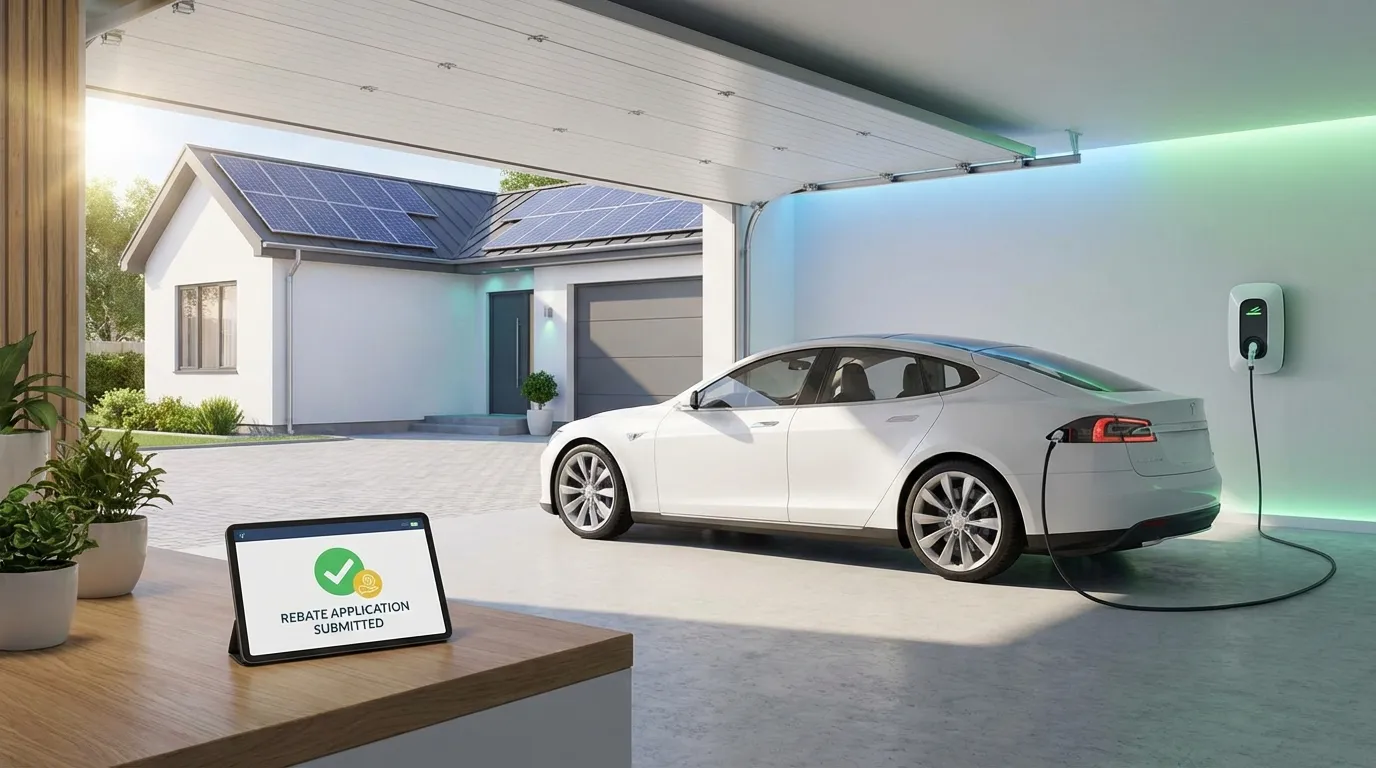
Over 2.5 million electric vehicles are now on U.S. roads, yet fewer than 15% of their owners have a Level 2 home charger, slowing charging times by up to 800%. This gap between EV ownership and home charging infrastructure creates a bottleneck for drivers who expect convenience and speed. So utility and state rebate programs are aggressively pushing to close this gap by funding the installation of faster, more efficient home charging stations.
What EV Charger Rebates Are Available from My State or Utility?
State and utility EV charger rebate programs provide homeowners with direct financial incentives, often between $250 and $1,000, to offset the cost of purchasing and installing a Level 2 home charging station. These programs exist in over 45 states, administered by local utilities or state energy offices.
Most rebates for EV chargers are offered directly by your electric utility company, like Con Edison in New York or PG&E in California. And these programs are designed to encourage off-peak charging to reduce grid strain, often requiring enrollment in a specific time-of-use electricity rate. But some states, like Colorado and Vermont, also offer statewide rebates that can be combined with utility offers. So you must check both your state energy office and your local utility provider to find all available incentives. The Database of State Incentives for Renewables & Efficiency (DSIRE) is a primary source for this information. Finding the right EV charger rebates for your location is the first critical step in the application process.
How Much Can I Get and What EV Charger Models Qualify?
EV charger rebate amounts typically cover 50-75% of the total project cost, with maximum cash-back offers ranging from $250 to over $1,000 depending on the program. The specific amount is determined by your utility, location, and sometimes your income level.
The core tension for homeowners is the upfront installation cost, which averages $1,300 nationwide for a Level 2 charger. But a $500 rebate from a utility like Xcel Energy cuts that initial expense by nearly 40%, dramatically shortening the payback period. So understanding the specific rebate amount you qualify for is essential for budgeting your project.
"Many states and utilities offer rebates and other incentives for the purchase and installation of Level 2 charging." — U.S. Department of Energy
Most programs mandate that the charger be a new, Level 2 (240-volt) model and carry an ENERGY STAR certification to ensure energy efficiency. And popular brands like ChargePoint, JuiceBox, and Wallbox frequently appear on approved equipment lists. So always verify your chosen model is on your specific utility's qualifying products list before making a purchase. Or you won't receive the rebate.
Are There Income Limits or Specific Contractor Requirements for Rebate Eligibility?
Many EV charger rebate programs include income limits and strict contractor requirements to ensure funds are distributed equitably and installations are performed safely. These rules often require applicants to have a household income at or below 80-120% of the Area Median Income (AMI).
These income-based qualifications are common in programs that offer enhanced rebates, providing an additional $200 to $500 for low-to-moderate income households. But not all programs have income caps, so it's critical to check the specific terms for your local utility. Additionally, nearly all rebate programs require that the EV charger be installed by a licensed electrician. And some utilities go a step further, mandating the use of a contractor from their own pre-approved network. So hiring an uncertified installer is the fastest way to get your application denied. Always confirm contractor credentials before any work begins. This is just as important as selecting qualifying equipment.
What's the Step-by-Step EV Charger Rebate Application Process?
The EV charger rebate application process typically involves five key steps: confirming eligibility, purchasing and installing qualifying equipment, gathering documentation, and submitting the application before the deadline. The entire process, from application to receiving a check or bill credit, takes between 4 and 8 weeks.
The application journey is straightforward but requires attention to detail. So follow these steps precisely: 1. Verify Eligibility: Use your utility's online portal or our rebate calculator to confirm you and your chosen equipment qualify. 2. Get Pre-Approval (If Required): Some programs require you to reserve your rebate funds before installation. 3. Purchase & Install: Buy a qualifying Level 2 charger and have it installed by a licensed electrician. 4. Collect Documents: Gather the dated sales receipt, contractor's invoice, a photo of the installed charger, and a photo of the serial number. 5. Submit Application: Complete the online or mail-in application form and upload all required documents.
And remember to keep copies of everything for your records.
What Are the Deadlines, Funding Status, and Stacking Rules for EV Charger Rebates?
EV charger rebate programs operate with strict deadlines, limited annual funding, and specific rules on combining incentives, all of which impact an applicant's success. Most programs are funded on a first-come, first-served basis and close once the allocated $1 million to $10 million is depleted.
"Incentives can change, so check for the latest information before you buy." — DSIRE
Application deadlines are non-negotiable, typically requiring submission within 60-120 days of the installation date. But the most important factor is the program's funding status; if the money runs out, no more rebates are issued for that fiscal year. So applying early is critical. "Stacking" is the practice of combining multiple incentives. And most utility rebates can be stacked with the federal 30C Alternative Fuel Vehicle Refueling Property Credit, which provides up to $1,000 in energy tax credits. However, you usually can't stack two different utility rebates for the same charger.
EV Charger Rebate Program Comparison
| Program Name | Rebate Amount | Key Eligibility | Application Deadline |
|---|---|---|---|
| Austin Energy (TX) | Up to $1,200 | Level 2, Wi-Fi enabled charger; licensed electrician install | Within 60 days of purchase |
| Con Edison (NY) | $500 | Smart-charging capable, ENERGY STAR certified | Rolling, fund-dependent |
| PG&E (CA) | $500 | Residential customer, qualifying Level 2 charger | Within 180 days of install |
Related Reading: Learn more about Ev Charger Rebate Near Me and Ev Charger Utility Rebate.
Related Reading: Learn more about Ev Charger Rebate 2026 and Ev Charger Rebate California.
Related Reading: Learn more about California Rebate Application Process Timeline.
Frequently Asked Questions
EV charger rebate eligibility is primarily determined by your location, electric utility provider, and sometimes household income, with most programs requiring a Level 2, ENERGY STAR certified charger. The application process necessitates submitting invoices and photos post-installation, typically within 90 days, to receive rebates up to $1,000.
What are the eligibility requirements for an EV charger rebate?
Eligibility typically requires you to be a residential customer of the sponsoring utility, purchase a new Level 2 ENERGY STAR certified charger, and have it installed by a licensed electrician. Some programs also have income requirements, often targeting households at or below 80% of the Area Median Income.
How much can I expect to receive from an EV charger rebate?
Rebate amounts vary widely by location but generally fall between $250 and $750. Some programs with income-based adders or special promotions offer up to $1,200. The rebate often covers about 50% of the total project cost, which includes the charger and installation.
What is the step-by-step process to apply for an EV charger rebate?
The process is: 1) Confirm your eligibility and the equipment's qualification with your utility. 2) Purchase and have the charger installed by a professional. 3) Gather your documents, including the sales receipt, contractor invoice, and photos of the installation. 4) Submit the completed application online or by mail.
Is there a deadline to submit my EV charger rebate application?
Yes, deadlines are strict. Most utilities require you to submit your application within a specific window after the charger is installed, commonly between 60 and 180 days. So don't delay submitting your paperwork after the job is complete.
Can I combine an EV charger rebate with other home improvement incentives?
Yes, you can often "stack" a local utility rebate with the federal 30C tax credit, which covers 30% of the cost up to $1,000. But you typically cannot combine two separate utility rebates for the same device. So it is different from stacking heat pump rebates where state and utility incentives are often designed to be combined.
Last updated April 14, 2026 — reviewed by DuloCore Editorial. About our authors.
Check your California EV charger rebate eligibility — see the programs you qualify for and the dollar amounts on our California EV charger rebate finder.