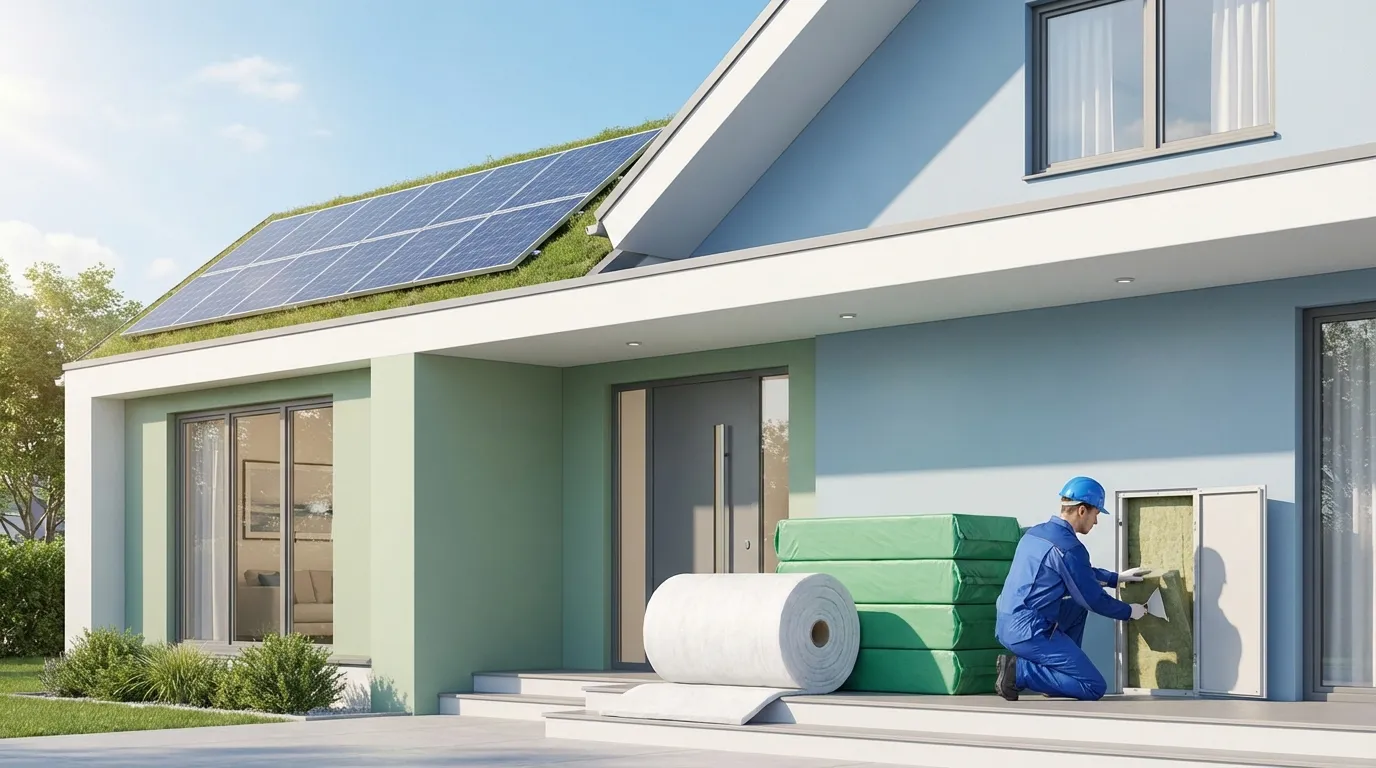
Nearly 90% of U.S. homes are under-insulated, leading to an average energy loss of 20-30% through walls, floors, and attics. This constant energy leak forces HVAC systems to work overtime, inflating utility bills month after month. So federal programs are now available to directly address this waste by helping homeowners finance crucial insulation and air sealing upgrades.
How Much Can I Save with Federal Insulation Rebates and Do I Qualify by Income?
The federal government offers insulation incentives through tax credits and direct rebates with varying income requirements. The 25C (now expired, replaced by the Energy Efficient Home Improvement Credit) Energy Efficient Home Improvement Credit provides a 30% tax credit up to $1,200 annually. But the HEEHRA program offers up to $1,600 as a point-of-sale rebate for low-income households.
The federal Energy Efficient Home Improvement Credit (Section 25C) ended for property placed in service after December 31, 2025 (IRS FS-2025-05). Federal tax credits for this work have ended, but state, local and utility rebates may still apply; check what is available at your address with the DuloCore rebate calculator. So this credit is not income-restricted and is available to most homeowners. And for lower-income households, the High-Efficiency Electric Home Rebate Act (HEEHRA) program provides a direct rebate of up to $1,600 for weatherization projects, including insulation. But qualification for HEEHRA is strict, limited to households earning less than 150% of the area median income. The HOMES Rebate Program also offers performance-based rebates starting at $2,000 for whole-house energy savings, which often includes insulation upgrades. You can check your eligibility for these programs with a rebate calculator.
"Homeowners who complete upgrades that improve the energy efficiency of their existing home can receive a tax credit of up to $3,200 per year." — U.S. Department of Energy
What Types of Insulation and Equipment Are Eligible for Federal Rebates?
Eligible insulation materials for the 25C tax credit and HEEHRA rebate include bulk products like batts, rolls, and blow-in fibers. And specific types such as spray foam, rigid foam board, and cellulose qualify. So the programs also cover air sealing materials like weather stripping, caulk, and house wrap.
Federal programs cover a broad range of insulation products designed to improve a home's thermal envelope. So common eligible types include fiberglass, cellulose, mineral wool, and spray foam insulation. The federal Energy Efficient Home Improvement Credit (Section 25C) ended for property placed in service after December 31, 2025 (IRS FS-2025-05). But the cost of installation labor does not qualify for the insulation-specific portion of the credit, only the material cost. These improvements directly support other upgrades like heat pump rebates.
What is the Step-by-Step Application Process for Federal Insulation Rebates?
The application process for federal insulation incentives involves purchasing qualifying materials, completing the installation, and filing specific tax forms. Form 5695 only covers qualifying work completed by December 31, 2025 and claimed on a 2025 return; the federal 25C and 25D credits ended after that date (IRS FS-2025-05). But direct rebate programs require state-level applications once they launch.
The federal Energy Efficient Home Improvement Credit (Section 25C) ended for property placed in service after December 31, 2025 (IRS FS-2025-05). First, you purchase and install qualifying insulation and air sealing materials. So you must retain all receipts and the manufacturer's certification statement for your records. Form 5695 only covers qualifying work completed by December 31, 2025 and claimed on a 2025 return; the federal 25C and 25D credits ended after that date (IRS FS-2025-05). For the forthcoming HEEHRA and HOMES rebates, the process will be managed by state energy offices. So these will likely involve point-of-sale discounts or a separate application submitted to the state agency, but specific procedures are still being finalized by each state.
What Are the Deadlines and Current Funding Status for Federal Insulation Rebate Programs?
The federal Energy Efficient Home Improvement Credit (Section 25C) ended for property placed in service after December 31, 2025 (IRS FS-2025-05). But the HEEHRA and HOMES direct rebate programs are not yet nationally available, as funding is still being distributed to individual state energy offices.
The federal Energy Efficient Home Improvement Credit (Section 25C) ended for property placed in service after December 31, 2025 (IRS FS-2025-05). So any qualifying project completed before the end of 2032 is eligible. And the funding for this credit is not capped. The direct rebate programs, however, have a different status. The federal government has allocated $8.8 billion to state energy offices to administer the HEEHRA and HOMES programs. But each state must develop and launch its own program, a process that is ongoing. So homeowners should check their state energy office website for the most current funding status and application launch dates. You can track all federal and state incentives through comprehensive energy tax credits databases. (See also: attic insulation rebate programs.) (See also: attic insulation cost and savings.) (See also: insulation rebates for manufactured homes.) (See also: geothermal tax credit.) (See also: geothermal federal tax credit.)
"Many states and utilities offer rebates or other incentives for energy-efficient products and improvements. DSIRE is the most comprehensive source of information on these incentives." — DSIREUSA.org
Can I Combine Federal Rebates with State, Utility Programs, and Are There Specific Contractor Requirements?
Yes, federal insulation tax credits and rebates are designed to be combined, or "stacked," with incentives from state governments and local utility companies. And while the 25C tax credit has no contractor requirements, some state or utility programs may mandate the use of licensed or certified professionals.
Stacking incentives is a powerful strategy to reduce project costs. For example, a homeowner can claim the $1,200 federal 25C tax credit for an insulation project and also receive a $500 rebate from their local utility company for the same upgrade. So this effectively lowers the out-of-pocket cost by $1,700. But it's crucial to check the rules for each program. Some utility rebates require installation by a BPI (Building Performance Institute) certified contractor or a professional from the utility's approved network. The federal Energy Efficient Home Improvement Credit (Section 25C) ended for property placed in service after December 31, 2025 (IRS FS-2025-05). Always verify requirements before starting a project covering insulation rebates.
Federal Insulation Incentive Comparison
| Program | Maximum Amount | Income Requirement | Type |
|---|---|---|---|
| 25C Tax Credit | Ended Dec 31, 2025 | — | Ended Dec 31, 2025 |
| HEEHRA Rebate | $1,600 for weatherization | <150% Area Median Income | Direct Rebate |
| HOMES Rebate | $2,000 - $8,000 | None | Direct Rebate |
Frequently Asked Questions
What are the eligibility requirements for the federal insulation rebate?
Eligibility depends on the program. The federal Energy Efficient Home Improvement Credit (Section 25C) ended for property placed in service after December 31, 2025 (IRS FS-2025-05). And there are no income limits. For the HEEHRA direct rebate, your household income must be below 150% of the area median income.
How much can I save with the federal insulation rebate?
The federal Energy Efficient Home Improvement Credit (Section 25C) ended for property placed in service after December 31, 2025 (IRS FS-2025-05). And the HEEHRA program offers a direct rebate of up to $1,600 for weatherization, which includes insulation and air sealing.
What is the process to claim the federal insulation rebate?
Form 5695 only covers qualifying work completed by December 31, 2025 and claimed on a 2025 return; the federal 25C and 25D credits ended after that date (IRS FS-2025-05). But for the upcoming HEEHRA and HOMES rebates, you will apply through your state's energy office once their programs are active.
What is the deadline to apply for federal insulation rebates?
The federal Energy Efficient Home Improvement Credit (Section 25C) ended for property placed in service after December 31, 2025 (IRS FS-2025-05). So deadlines for the HEEHRA and HOMES direct rebates will vary by state and depend on when program funds are depleted.
Is the federal insulation rebate a tax credit or a direct rebate?
The federal government offers both. The federal Energy Efficient Home Improvement Credit (Section 25C) ended for property placed in service after December 31, 2025 (IRS FS-2025-05). And the HEEHRA and HOMES programs are direct rebates that provide upfront discounts or cash back, managed at the state level.
Ready to Save on Your Home Improvement?
Use our free rebate calculator to find every federal, state, and utility incentive you qualify for.
Updated: April 14, 2026 — fact-checked by DuloCore Research. About our editorial process.
Check your California insulation rebate eligibility — see the programs you qualify for and the dollar amounts on our California insulation rebate finder.