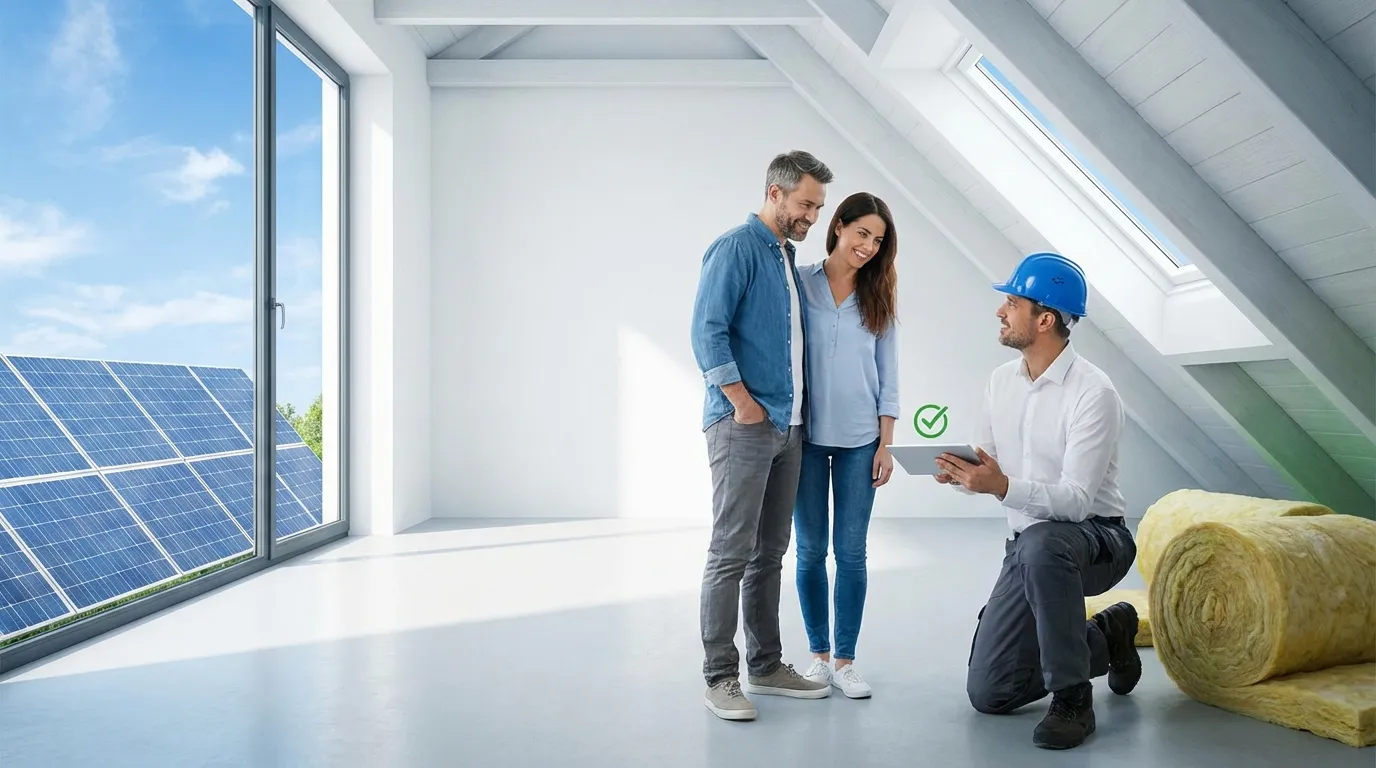
Up to 90% of U.S. homes are under-insulated, leading to an average energy waste of 15% from heating and cooling. This isn't just a comfort issue; it's a direct drain on your bank account every single month. So addressing inadequate insulation is one of the most effective ways for homeowners to immediately cut utility bills and improve home efficiency.
How Much Can I Save with Fiberglass Insulation Rebates and What Equipment Qualifies?
Fiberglass insulation rebates are state and utility incentives offering homeowners direct cash back, from $100 to over $1,500, for upgrading attic, wall, or crawl space insulation. These programs, which vary by location, specify qualifying R-values and materials like batts, rolls, and loose-fill fiberglass purchased in 2026.
Savings from fiberglass insulation rebates directly offset the initial project cost, which averages between $1,500 and $3,500 for a typical home. Rebates are typically calculated per square foot or as a fixed amount. For example, a utility program offers $0.75 per square foot for attic insulation, which translates to a $750 rebate for a 1,000-square-foot attic. And eligible equipment includes ENERGY STAR certified fiberglass batts, rolls, and blown-in insulation that meet specific R-value requirements, often R-38 for attics and R-13 for walls. But you must verify the exact R-value needed for your climate zone. So checking your utility's program details is the first step. These direct rebates complement the broader federal energy tax credits available for insulation projects.
Are There Income Limits or Specific Contractor Requirements for Insulation Rebates?
Income-based insulation rebates are financial incentives targeted at low-to-moderate income households, offering rebates up to $1,600 or covering 100% of the project cost. These programs often require using program-approved contractors and have specific income thresholds, such as 80% of the Area Median Income (AMI).
Many utility and state-run programs have specific contractor requirements to ensure quality installation. And this often means you must use a licensed, insured contractor from a pre-approved network. So DIY installations typically don't qualify for these rebates. For income-qualified programs like the federal Weatherization Assistance Program (WAP), eligibility is strict.
"The U.S. Department of Energy's (DOE) Weatherization Assistance Program (WAP) enables low-income families to reduce their energy bills by making their homes more energy efficient." — U.S. Department of Energy
But standard utility rebates are generally available to all customers regardless of income. So you must always review the terms to see if income limits apply or if a specific type of contractor is required for your chosen insulation rebates.
How Do I Find and Apply for Fiberglass Insulation Rebates in My State or Through My Utility?
State and utility fiberglass insulation rebates are location-specific incentives found through online databases or direct utility portals. The application process typically involves pre-approval, installation by a certified contractor, and submission of an invoice and a completed rebate form, with processing times of 6-8 weeks.
The most effective way to find available rebates is to use a centralized database. The DSIRE (Database of State Incentives for Renewables & Efficiency) is a comprehensive source maintained by North Carolina State University. And you can also visit your specific gas or electric utility's website and search for "rebates" or "energy efficiency." The application process is straightforward but requires attention to detail. So you'll need to download the correct rebate form, fill it out completely, and attach a copy of the dated invoice from your contractor. Some programs require pre-authorization before work begins. But others allow for post-installation applications. Always confirm the exact steps with your program administrator before purchasing materials.
| Program / Incentive | Rebate Amount | Key Eligibility | Typical Deadline |
|---|---|---|---|
| Federal Tax Credit (25C (now expired, replaced by the Energy Efficient Home Improvement Credit)) | 30% of cost, up to $1,200 | Must meet IRS requirements | December 31, Annually |
| Local Utility Rebate | $0.25 - $1.50 per sq. ft. | Customer of the utility, specific R-value | Varies, often year-end |
| State Energy Program | $200 - $2,000+ | State resident, income limits apply | Varies by funding |
What Are the Deadlines and Current Funding Status for Fiberglass Insulation Rebate Programs? (See also: attic insulation cost and savings.) (See also: insulation rebates for manufactured homes.) (See also: whole home insulation upgrade rebates.) (See also: geothermal tax credit.)
Fiberglass insulation rebate programs are time-sensitive incentives with deadlines typically falling on December 31st or when program funds are depleted. Funding status is dynamic, with popular state and utility programs often running out of their allocated $5 million to $20 million budgets by the third or fourth quarter.
Rebate programs operate on a first-come, first-served basis. So waiting until the end of the year to apply is a risk, as the funds are often exhausted by then. For example, many state energy offices receive a fixed budget at the start of the fiscal year. And once that money is claimed by homeowners, the program closes until the next funding cycle. You can check the current funding status on your utility's rebate portal or by calling their energy efficiency hotline.
"Many state and local governments offer tax incentives for energy efficiency improvements. The Database of State Incentives for Renewables & Efficiency (DSIRE) is a comprehensive source of information on state, local, utility and federal incentives and policies that promote renewable energy and energy efficiency." — ENERGY STAR
The federal Energy Efficient Home Improvement Credit (Section 25C) ended for property placed in service after December 31, 2025 (IRS FS-2025-05). Federal tax credits for this work have ended, but state, local and utility rebates may still apply; check what is available at your address with the DuloCore rebate calculator.
Can I Stack Fiberglass Insulation Rebates with Other Energy Efficiency Programs?
Stacking rebates involves combining a federal tax credit with a state or utility incentive for a single insulation project, which is allowed by most programs. This strategy reduces the total out-of-pocket project cost by over 50% by layering a 30% federal credit with a local rebate of $500 or more.
You can absolutely stack most fiberglass insulation incentives. For instance, a homeowner completes a $3,000 attic insulation project. First, they apply for a $500 rebate from their local utility. And after receiving that rebate, their net cost is $2,500. The federal Energy Efficient Home Improvement Credit (Section 25C) ended for property placed in service after December 31, 2025 (IRS FS-2025-05). The total savings become $1,250. But some local programs have rules against combining their offers with others. So you must read the fine print on the rebate application, which will explicitly state if stacking is prohibited. Combining insulation rebates with other incentives, like heat pump rebates, as part of a whole-home energy upgrade is a common and effective strategy.
Frequently Asked Questions
What are the eligibility requirements for fiberglass insulation rebates?
Eligibility typically requires the property to be a primary residence, the insulation to meet specific R-value minimums for your climate zone, and often, installation by a licensed or program-approved contractor. Some programs also have income-based requirements.
How much can you save with fiberglass insulation rebates?
Savings vary widely by location. Utility rebates often range from $0.25 to $1.50 per square foot, which can total $200 to $1,500. The federal Energy Efficient Home Improvement Credit (Section 25C) ended for property placed in service after December 31, 2025 (IRS FS-2025-05).
What is the application process for fiberglass insulation rebates?
The process generally involves confirming eligibility, completing the project with a qualified contractor, and submitting a rebate application form along with a dated, itemized invoice. Some programs require pre-approval before work begins.
Are there deadlines for applying for fiberglass insulation rebates?
Yes. Most utility and state programs have annual deadlines, often December 31st, or they expire when the program's funding is exhausted for the year. The federal Energy Efficient Home Improvement Credit (Section 25C) ended for property placed in service after December 31, 2025 (IRS FS-2025-05).
How do fiberglass insulation rebates compare to other home energy incentives?
Fiberglass insulation rebates offer one of the fastest paybacks, as they address a primary source of energy loss. While incentives for solar panels or heat pumps are higher, insulation provides foundational savings that improve the efficiency of those other systems.
Calculate Your Rebates Ready to see how much you can save? Use our free rebate calculator to find every fiberglass insulation incentive you qualify for.
Ready to Save on Your Home Improvement?
Use our free rebate calculator to find every federal, state, and utility incentive you qualify for.
Updated: April 14, 2026 — fact-checked by DuloCore Research. About our editorial process.
Check your California insulation rebate eligibility — see the programs you qualify for and the dollar amounts on our California insulation rebate finder.