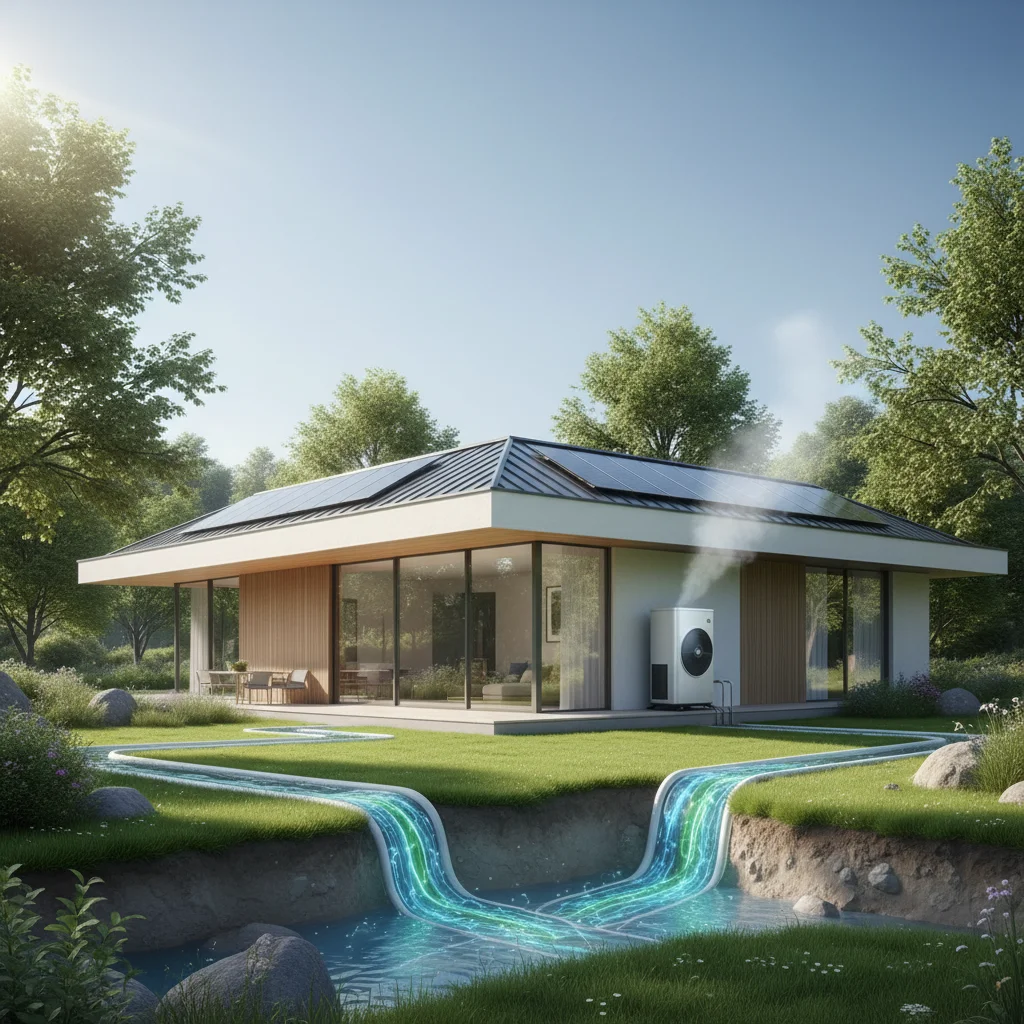
California homeowners paid an average of $412 per month on electricity bills during summer 2025, with air conditioning consuming 65% of that cost. And geothermal cooling systems cut those expenses by 40-60% while maintaining consistent indoor temperatures through the hottest months. The technology uses the Earth's stable underground temperature of 50-60°F to absorb heat from homes, transferring it into the ground through a network of underground pipes filled with water or refrigerant.
How Does Geothermal Cooling Compare to Air Conditioning and Other Cooling Systems?
Geothermal cooling systems deliver 3-5 units of cooling energy for every unit of electricity consumed, compared to 1.5-2.5 units from conventional air conditioning. Operating costs run $30-$50 per month for a 2,000-square-foot home in California's Central Valley, while traditional AC systems cost $120-$180 monthly during peak summer. And the ground loop system eliminates the outdoor condenser unit that traditional AC requires, reducing noise by 75% and freeing up exterior space for landscaping or solar panels.
But the upfront investment creates a decision point for homeowners. Geothermal systems cost $18,000-$30,000 installed in California, compared to $5,000-$8,000 for central air conditioning. So the payback period stretches 8-12 years without rebates, though federal tax credits and utility incentives reduce that timeline to 5-7 years for qualifying households.
The equipment footprint differs substantially. Traditional AC systems require rooftop or ground-level outdoor units exposed to weather and temperature extremes, while geothermal heat pumps sit entirely indoors. And the underground loop field needs 400-600 square feet of yard space for horizontal installations or just 100 square feet for vertical drilling. California's drought restrictions favor closed-loop systems that recirculate fluid rather than open-loop designs that draw groundwater.
"Geothermal heat pumps are the most energy-efficient, environmentally clean, and cost-effective space conditioning systems available today." — U.S. Department of Energy
What Is the Typical Lifespan of a Geothermal Cooling System?
Geothermal heat pumps operate 20-25 years before requiring replacement, while the underground loop field lasts 50+ years with zero maintenance. Indoor heat pump components match the lifespan of premium HVAC equipment, but ground loops outlive multiple generations of heating and cooling hardware. And manufacturers warrant the loop field for 25-50 years, compared to 10-15 year warranties on traditional air conditioning compressors.
The extended equipment life translates directly to lifecycle cost savings. A homeowner installing a system in 2026 at age 40 replaces the heat pump once by age 65, but the $8,000-$12,000 loop field installation serves the home through multiple ownership cycles. Traditional AC systems require full replacement every 12-15 years at $5,000-$8,000 per cycle, totaling $15,000-$24,000 over 40 years just for equipment replacement.
Component failure rates run lower than conventional systems. Geothermal heat pumps contain fewer moving parts and operate in climate-controlled indoor spaces, eliminating exposure to rain, hail, UV degradation, and temperature extremes that damage outdoor AC condensers. So annual breakdown rates average 2-3% for geothermal equipment compared to 8-12% for traditional cooling systems. Learn more about efficiency standards in our guide to heat pump rebates.
How Much Does Geothermal Cooling Cost to Install in California?
California geothermal installations range from $22,000-$35,000 for a typical 2,000-square-foot home, with costs varying by system type and property conditions. Horizontal loop fields cost $18,000-$25,000 and require 400-600 square feet of yard space at 4-6 feet depth. Vertical systems run $25,000-$35,000 but need only 100 square feet of surface area, drilling 150-300 feet into bedrock. And pond or lake loop installations cost $15,000-$20,000 when properties have suitable water features within 300 feet of the home.
Site-specific factors drive price variation. Rocky soil adds $3,000-$8,000 for drilling equipment and labor, while clay soils reduce costs 15-20% due to easier excavation. Urban lots with limited access for drilling rigs incur $2,000-$5,000 surcharges for manual trenching. And homes requiring ductwork installation add $4,000-$8,000 to project costs, though existing forced-air systems integrate directly with geothermal heat pumps.
The federal Residential Clean Energy Credit (Section 25D) ended for expenditures made after December 31, 2025, and the IRS treats an expenditure as made when installation is completed (IRS FS-2025-05). Federal tax credits for this work have ended, but state, local and utility rebates may still apply; check what is available at your address with the DuloCore rebate calculator. So a $25,000 system generates $7,500 in federal credits, reducing net investment to $17,500. California's Self-Generation Incentive Program provides $800-$1,200 per ton of cooling capacity, adding $3,200-$4,800 for typical 4-ton residential systems. And utility rebates from PG&E, SDG&E, and SoCal Edison contribute $2,000-$4,000 for qualifying installations, bringing total incentives to $12,500-$17,300.
Use our free rebate calculator to estimate your specific incentives based on system size and location.
| Incentive Program | Amount | Eligibility | Deadline |
|---|---|---|---|
| Federal IRA Tax Credit | Ended Dec 31, 2025 | — | Ended Dec 31, 2025 |
| California SGIP | $800-$1,200/ton | Income-qualified or storage | Rolling enrollment |
| PG&E Energy Upgrade | $2,000-$3,500 | PG&E service territory | June 30, 2026 |
| SoCal Edison Home Upgrade | $1,500-$3,000 | Edison customers | December 31, 2026 |
Can You Use Geothermal Cooling in Summer if You Already Have a Heat Pump?
Homeowners with existing air-source heat pumps can add geothermal cooling, but the integration requires replacing the air-source unit rather than running systems in parallel. Geothermal heat pumps handle both heating and cooling through the same equipment, eliminating the need for separate AC condensers or air-source heat pump outdoor units. And the ground loop installation connects directly to a new indoor heat pump that replaces the existing air handler and outdoor components.
The retrofit process takes 3-5 days for horizontal installations or 1-2 days for vertical drilling. Contractors excavate trenches or drill boreholes, install the closed-loop piping system, and connect it to a new geothermal heat pump that mounts in the same location as the previous air handler. Existing ductwork, thermostats, and electrical panels require minimal modification. But older homes with undersized 100-amp electrical service need $1,500-$3,000 panel upgrades to support the heat pump's 30-50 amp circuit breaker requirement.
Trade-in value for functioning air-source equipment rarely exceeds $500-$800, making early replacement before equipment failure an economic decision based on utility savings rather than equipment value recovery. A household spending $180 monthly on AC with a 12-year-old air-source heat pump saves $90-$110 monthly by switching to geothermal, recovering the $18,000-$25,000 net investment in 6-9 years after incentives. So homeowners nearing equipment replacement age see faster payback than those with recently installed air-source systems.
What Maintenance Do Geothermal Cooling Systems Require Year-Round?
Geothermal heat pumps need filter changes every 1-3 months and professional inspections annually, costing $150-$300 per year for routine maintenance. The underground loop field requires zero maintenance after installation, with closed-loop systems circulating the same refrigerant or water-antifreeze mixture for 50+ years. And heat pump components operate in indoor environments protected from weather, reducing wear compared to outdoor AC equipment exposed to sun, rain, and temperature swings.
Annual service visits cover five inspection points. Technicians verify refrigerant charge levels, test electrical connections, inspect ductwork for leaks, measure temperature differentials across the heat exchanger, and confirm proper airflow rates of 400 cubic feet per minute per ton of capacity. Filter replacement costs $15-$40 depending on size and MERV rating, while refrigerant top-offs run $150-$300 if minor leaks develop over time.
But repair frequency runs 60-70% lower than conventional cooling systems. Traditional AC condensers fail at rates of 8-12% annually due to compressor burnout from overheating, fan motor failure from weather exposure, and coil damage from hail or debris. Geothermal heat pumps experience 2-3% annual failure rates, with most issues involving electronic controls or circulator pumps rather than major component failures. So 10-year maintenance costs total $1,500-$3,000 for geothermal systems versus $4,500-$7,500 for traditional AC with multiple compressor replacements.
"Geothermal heat pumps can reduce energy consumption—and corresponding emissions—up to 44% compared to air-source heat pumps and up to 72% compared to electric resistance heating with standard air-conditioning equipment." — U.S. Environmental Protection Agency
Are You Eligible for Tax Credits or Rebates on Geothermal Cooling in 2026?
The federal Residential Clean Energy Credit (Section 25D) ended for expenditures made after December 31, 2025, and the IRS treats an expenditure as made when installation is completed (IRS FS-2025-05). Homeowners claim the credit on IRS Form 5695 when filing federal taxes, reducing tax liability dollar-for-dollar up to $7,500-$10,500 for typical $25,000-$35,000 installations. And the credit covers equipment, labor, ground loop installation, and related electrical work, unlike previous programs that excluded labor costs. (Note: Federal tax credit percentages and availability are subject to change; the 30% Residential Clean Energy Credit under Section 25D expired December 31, 2025. Verify current incentives at energy.gov.)
California's Self-Generation Incentive Program provides $800-$1,200 per ton of cooling capacity for geothermal heat pumps paired with battery storage or installed in income-qualified households. A 4-ton system generates $3,200-$4,800 in SGIP rebates, paid directly to homeowners within 60-90 days of project completion. But non-storage installations in non-income-qualified households don't qualify for SGIP funds as of March 2026.
Major California utilities operate separate rebate programs with varying eligibility requirements. PG&E's Energy Upgrade program pays $2,000-$3,500 for whole-home energy retrofits that include geothermal cooling, requiring a minimum 20% reduction in total home energy use. SoCal Edison provides $1,500-$3,000 for geothermal installations in homes built before 2010. And SDG&E offers $2,500 rebates for systems sized at 4+ tons in Climate Zone 10 (inland valleys). Explore additional incentives in our energy tax credits guide.
Local government programs add incremental benefits. The Bay Area Air Quality Management District provides $3,000 rebates for geothermal systems that replace natural gas furnaces, reducing air pollution from combustion heating. And Property-Assessed Clean Energy (PACE) financing through Ygrene or Renew Financial allows homeowners to finance installations through property tax assessments, with zero upfront costs and 20-year repayment at 5-7% interest. Calculate your total savings with our rebate calculator.
Official Sources
- U.S. Department of Energy: Geothermal Heat Pumps — Federal guidance on geothermal technology, efficiency standards, and system types
- Database of State Incentives for Renewables & Efficiency — Comprehensive database of federal, state, and utility rebates for geothermal installations
- IRS Form 5695 Instructions — Official tax credit claim procedures and qualifying equipment requirements for residential energy improvements (note: the federal 25C and 25D credits ended for projects completed after December 31, 2025)
Related Reading: Learn more about Post-Summer Energy Audit Review and Summer Energy Audit Cooling Focus.
Frequently Asked Questions
Does geothermal cooling work in hot climates?
Geothermal cooling performs efficiently in California's Central Valley where summer temperatures exceed 105°F for 30-60 days annually. The Earth's stable 50-60°F underground temperature provides consistent heat absorption regardless of surface air temperature. And systems maintain 300-400% efficiency even during 110°F heat waves, compared to 150-200% efficiency for air-source heat pumps that struggle when outdoor temperatures exceed 95°F. Desert and inland valley installations see the highest energy savings due to the large temperature differential between outdoor air and ground temperature.
How much can you save with geothermal cooling in summer?
California homeowners save $90-$130 monthly on summer electricity bills by switching from central air conditioning to geothermal cooling, totaling $540-$780 annually during the June-September cooling season. Households in Climate Zone 13 (inland valleys) with 2,000-square-foot homes reduce summer electricity consumption from 1,800-2,200 kWh monthly to 600-900 kWh. And winter heating savings add $60-$100 monthly for homes replacing natural gas furnaces, bringing total annual energy savings to $1,200-$1,800. Review more about related incentives in our geothermal tax credit article.
What's the difference between geothermal and air conditioning?
Geothermal systems move heat between homes and the ground using underground pipes, while air conditioning moves heat between homes and outdoor air using rooftop or ground-level condensers. Geothermal heat pumps achieve 300-500% efficiency because ground temperature remains constant at 50-60°F year-round, requiring less energy to transfer heat than AC systems that must overcome 95-110°F outdoor air temperatures. And geothermal equipment operates quietly indoors without exposed outdoor units that generate 70-80 decibels of compressor and fan noise in yards and on rooftops.
How long does it take to install a geothermal cooling system?
Horizontal loop field installations take 3-5 days including excavation, pipe installation, backfilling, and indoor heat pump connection. Vertical drilling projects complete in 1-2 days due to faster boring equipment that drills 150-300 feet in 4-6 hours. And pond loop installations finish in 1-2 days when properties have suitable water features. Electrical panel upgrades add 1 day, while ductwork installation extends timelines 2-3 days for homes without existing forced-air systems. Permits typically process in 7-14 business days through California municipal building departments.
Is geothermal cooling eligible for tax credits?
Yes. The federal Residential Clean Energy Credit (Section 25D) ended for expenditures made after December 31, 2025, and the IRS treats an expenditure as made when installation is completed (IRS FS-2025-05). California utility rebates add $1,500-$4,000 depending on service territory, and the Self-Generation Incentive Program contributes $3,200-$4,800 for qualifying households. Total incentives reach $12,500-$17,300 on typical $25,000-$35,000 installations, reducing net investment to $12,500-$17,500. And Property-Assessed Clean Energy financing spreads costs over 20 years with zero upfront payment requirements.
Ready to lower your summer cooling bills by 40-60%? Use our rebate calculator to discover your exact incentive amounts and start your geothermal cooling project with up to $17,300 in combined federal, state, and utility rebates available through December 2026.
Last updated April 14, 2026 — reviewed by DuloCore Editorial. About our authors.
Check your California heat pump rebate eligibility — see the programs you qualify for and the dollar amounts on our California heat pump rebate finder.