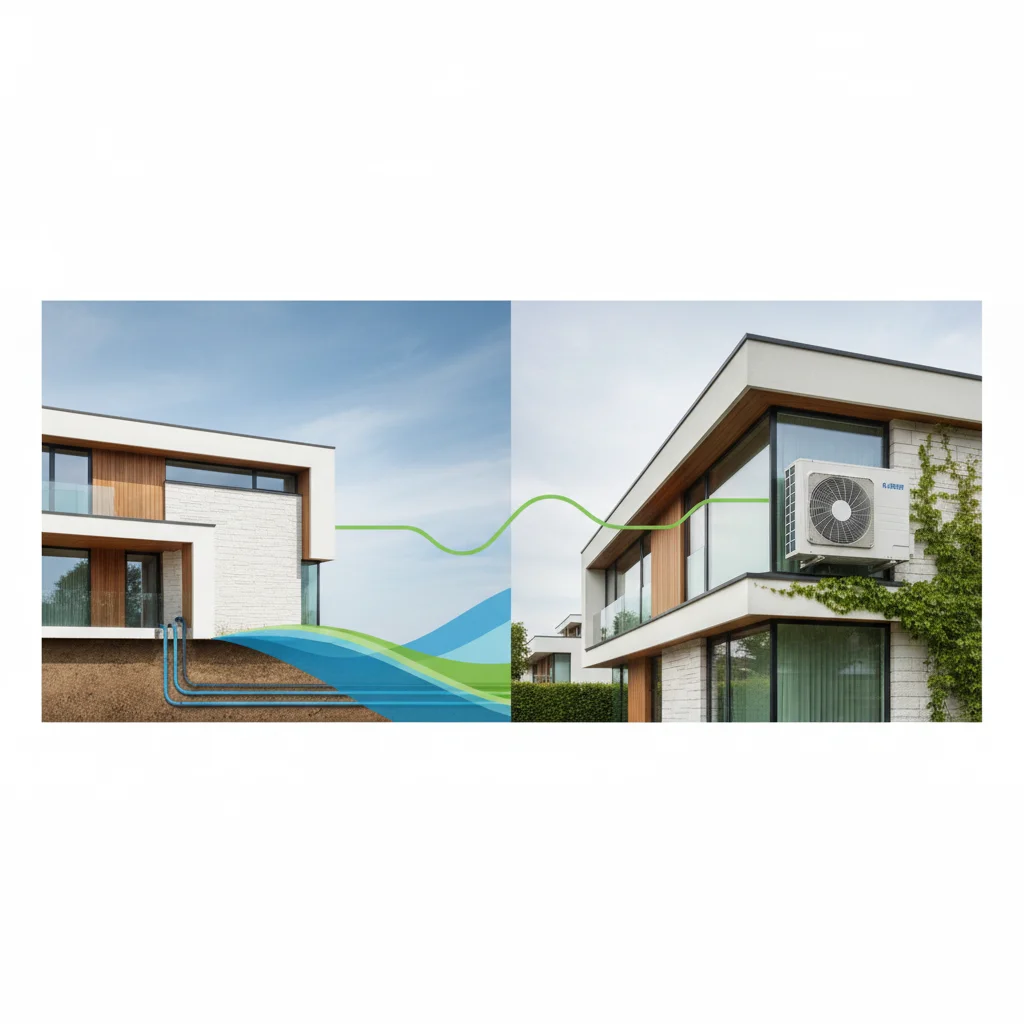
California homeowners who install a geothermal heat pump in 2026 pay $25,000 to $45,000 upfront and recover costs over time through monthly energy savings. Mini split systems cost $3,000 to $15,000 and break even in 3 to 7 years. The choice hinges on available land area, upfront capital, and long-term ownership plans.
What's the actual payback period for geothermal vs mini split heat pumps?
Geothermal heat pumps achieve payback in 7 to 12 years for most California homes. Mini split systems recoup installation costs in 3 to 7 years. Payback timelines depend on local electricity rates, climate zone, and existing heating fuel costs.
Geothermal systems save $800 to $1,400 annually on heating and cooling bills compared to conventional HVAC. Mini splits save $500 to $900 annually when replacing electric resistance heat or propane furnaces. The federal home energy tax credits (Sections 25C and 25D) ended for projects completed after December 31, 2025 (IRS FS-2025-05).
Homes in climate zones 3 and 4 (inland California) see faster payback because heating demand exceeds cooling demand. Coastal homes in zone 10 with mild winters recover costs more slowly because annual savings remain below $600. So upfront cost and annual savings determine which system delivers better financial performance.
How long does each system last and what affects lifespan?
Geothermal heat pumps last 20 to 25 years for indoor components and 50+ years for ground loops. Mini split systems last 15 to 20 years with regular maintenance. Lifespan differences drive total cost of ownership calculations.
Ground loop systems buried 4 to 6 feet deep operate in stable temperatures year-round, reducing thermal cycling stress. Indoor geothermal units experience less wear than air-source equipment because loop fluid arrives at consistent temperatures. But mini split outdoor condensers endure temperature swings from 20°F to 115°F in California's inland valleys, accelerating compressor degradation.
"Geothermal heat pumps can reduce energy use by 25% to 50% compared to conventional heating and cooling systems, and the ground loop can last more than 50 years." — U.S. Department of Energy
Maintenance schedules impact both systems. Geothermal units require filter changes every 3 months and annual loop pressure checks. Mini splits need quarterly filter cleaning and biannual refrigerant level inspections. And coastal salt air corrodes mini split coils faster than inland installations, reducing lifespan to 12 to 15 years without protective coatings.
What are the total installation costs and available rebates for each?
Geothermal heat pump installations cost $25,000 to $45,000 for a 3-ton system in California. Mini split systems cost $3,000 to $15,000 depending on the number of zones and capacity. Installation complexity drives the 5× to 10× cost difference.
Geothermal projects require excavation for horizontal loops (1,500 to 2,500 square feet of land) or vertical drilling to 150 to 400 feet depth. Labor accounts for 40% to 50% of total costs. Mini split installations need only wall penetrations, refrigerant line runs, and electrical upgrades, reducing labor to 20% to 30% of project costs.
The federal Residential Clean Energy Credit (Section 25D) ended for expenditures made after December 31, 2025, and the IRS treats an expenditure as made when installation is completed (IRS FS-2025-05). Federal tax credits for this work have ended, but state, local and utility rebates may still apply; check what is available at your address with the DuloCore rebate calculator. And utility rebates through the Tech Clean California program add $2,000 to $4,000 for heat pumps replacing natural gas furnaces. (Note: Federal tax credit percentages and availability are subject to change; the 30% Residential Clean Energy Credit under Section 25D expired December 31, 2025. Verify current incentives at energy.gov.)
Use our free rebate calculator to find your exact savings from local utility programs.
How much can you save annually on energy bills with geothermal vs mini splits?
Geothermal heat pumps save $800 to $1,400 annually compared to natural gas furnaces and central air conditioning. Mini splits save $500 to $900 annually when replacing electric resistance heat or window air conditioners. Savings depend on local electricity rates and replaced equipment efficiency.
Geothermal systems achieve Coefficient of Performance (COP) values of 3.5 to 5.0, meaning they deliver 3.5 to 5 units of heat for every unit of electricity consumed. Mini splits achieve COP values of 2.5 to 4.0. So geothermal systems consume 20% to 30% less electricity for the same heating output.
California electricity rates average $0.28 to $0.38 per kWh in 2026 depending on utility territory and rate tier. A 3-ton geothermal system uses 6,000 to 8,000 kWh annually. A comparable mini split system uses 7,500 to 10,000 kWh. The difference translates to $420 to $760 in annual savings favoring geothermal.
"ENERGY STAR certified geothermal heat pumps have higher efficiency than minimum standards, reducing annual energy costs by an average of $550 per year." — ENERGY STAR
But mini splits outperform geothermal in homes with zoned heating needs. Running mini splits in occupied rooms only rather than heating the entire home saves 25% to 40% compared to central systems.
Do geothermal or mini split systems still qualify for federal tax credits?
The federal home energy tax credits (Sections 25C and 25D) ended for projects completed after December 31, 2025 (IRS FS-2025-05).
Form 5695 only covers qualifying work completed by December 31, 2025 and claimed on a 2025 return; the federal 25C and 25D credits ended after that date (IRS FS-2025-05).
Qualifying equipment must meet ENERGY STAR efficiency standards. Geothermal systems need Energy Efficiency Ratio (EER) ≥16 and COP ≥3.6. Mini splits require SEER2 ≥16 and HSPF2 ≥9.0. Manufacturers provide certification statements confirming compliance.
Form 5695 only covers qualifying work completed by December 31, 2025 and claimed on a 2025 return; the federal 25C and 25D credits ended after that date (IRS FS-2025-05).
Geothermal vs mini split: which ROI makes financial sense for your home?
Geothermal heat pumps deliver better ROI for homeowners planning 15+ years of ownership with available land for loop installation. Mini splits provide faster ROI for homes with 5 to 10 year ownership timelines or limited outdoor space. Total ROI depends on upfront costs, annual savings, system lifespan, and resale value impact.
A $30,000 geothermal system costs the full $30,000 because federal tax credits no longer apply (IRS FS-2025-05). Annual savings of $1,200 yield a 25-year simple payback. But the 50-year ground loop outlasts typical homeownership, and buyers pay $5,000 to $8,000 more for homes with geothermal systems. Energy savings and the resale premium both count toward long-term return.
A $10,000 mini split system costs the full $10,000 because federal tax credits no longer apply (IRS FS-2025-05). Annual savings of $700 yield a 14-year simple payback. The system requires replacement after 15 to 20 years, adding $8,000 to $12,000 in future costs.
Homes without natural gas access favor geothermal because replacing propane or oil heat accelerates payback to 5 to 8 years. Properties under 0.25 acres struggle with horizontal loop installations, making mini splits the only viable heat pump option. And the federal geothermal tax credit ended for expenditures made after December 31, 2025 (IRS FS-2025-05), so utility rebates now carry the cost reduction.
Official Sources
- U.S. Department of Energy Geothermal Heat Pumps — Federal guidance on geothermal technology, efficiency, and financial incentives
- ENERGY STAR Heat Pumps — Certification standards and qualified equipment database for federal tax credits (note: the federal 25C and 25D credits ended for projects completed after December 31, 2025)
- DSIRE USA — Comprehensive database of state and utility rebate programs for renewable energy systems
Related Reading: Learn more about Mini Split Energy Audit Assessment.
Frequently Asked Questions
What is the difference between a geothermal heat pump and a mini split heat pump?
Geothermal heat pumps extract heat from the ground using buried loops filled with water or refrigerant. Mini split heat pumps extract heat from outdoor air using a condensing unit. Geothermal systems maintain efficiency in extreme temperatures because ground temperatures stay constant at 50°F to 60°F year-round. Mini splits lose heating capacity when outdoor temperatures drop below 25°F. Installation costs differ by 5× to 10× because geothermal requires excavation or drilling while mini splits need only wall mounting and refrigerant lines.
How much can you save with a geothermal heat pump compared to a mini split?
Geothermal heat pumps save $300 to $500 more annually than mini splits in California homes. A geothermal system saves $800 to $1,400 per year compared to conventional HVAC. A mini split saves $500 to $900 per year. The difference comes from higher COP values (3.5 to 5.0 vs 2.5 to 4.0) and consistent performance across temperature ranges. But upfront costs favor mini splits, reducing net savings over typical ownership periods.
Are geothermal heat pumps eligible for federal tax credits in 2026?
The federal Residential Clean Energy Credit (Section 25D) ended for expenditures made after December 31, 2025, and the IRS treats an expenditure as made when installation is completed (IRS FS-2025-05). Form 5695 only covers qualifying work completed by December 31, 2025 and claimed on a 2025 return; the federal 25C and 25D credits ended after that date (IRS FS-2025-05). Check current heat pump rebates for available incentives.
What is the installation cost for a geothermal heat pump versus a mini split system?
Geothermal heat pump installations cost $25,000 to $45,000 for a 3-ton system. Mini split systems cost $3,000 to $15,000 depending on zones and capacity. Geothermal requires excavation (1,500 to 2,500 square feet) or vertical drilling (150 to 400 feet depth), driving labor to 40% to 50% of total costs. Mini splits need wall penetrations and refrigerant lines only, limiting labor to 20% to 30%. Federal tax credits no longer apply to either technology (IRS FS-2025-05).
Which heat pump system is more energy efficient for homes in California?
Geothermal heat pumps achieve 20% to 30% higher efficiency than mini splits in California homes. Geothermal COP values reach 3.5 to 5.0 compared to mini split COP values of 2.5 to 4.0. A 3-ton geothermal system consumes 6,000 to 8,000 kWh annually. A comparable mini split uses 7,500 to 10,000 kWh. Annual electricity cost differences range from $420 to $760 favoring geothermal. But mini splits with zone control save 25% to 40% by heating occupied rooms only.
Ready to calculate your savings? Use our free rebate calculator to compare total costs, utility rebates, and long-term ROI for geothermal and mini split systems based on your home's location and energy usage.
Updated on April 14, 2026. Fact-checked by DuloCore Editors. About our research team.
Check your California heat pump rebate eligibility — see the programs you qualify for and the dollar amounts on our California heat pump rebate finder.