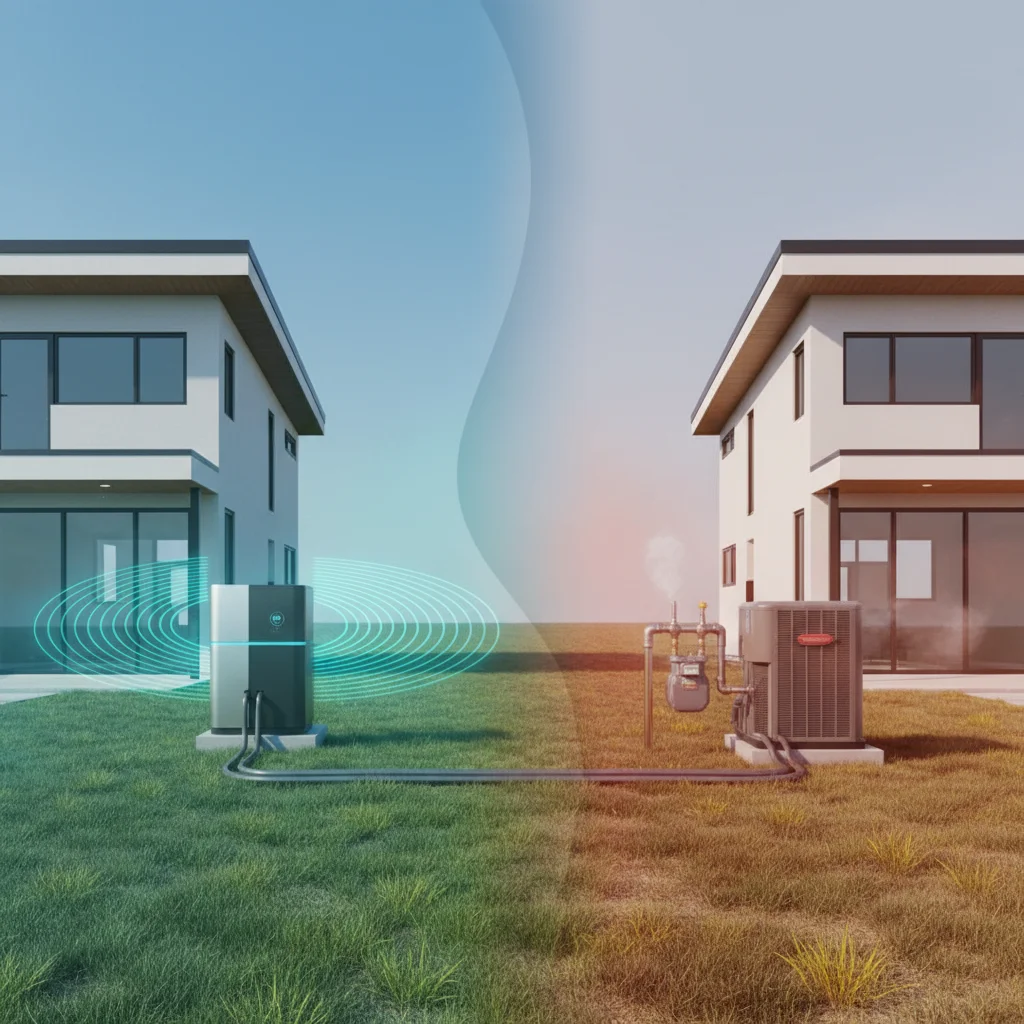
A geothermal system costs $15,000-$25,000 upfront but delivers $800-$1,200 annual savings compared to natural gas heating. The federal Residential Clean Energy Credit (Section 25D) ended for expenditures made after December 31, 2025, and the IRS treats an expenditure as made when installation is completed (IRS FS-2025-05). Federal tax credits for this work have ended, but state, local and utility rebates may still apply; check what is available at your address with the DuloCore rebate calculator. Natural gas furnaces cost just $3,500-$7,500 to install but face rising fuel prices and shorter equipment lifespans. The choice hinges on how long homeowners plan to stay in their homes.
What's the Total Cost Difference Between Geothermal and Natural Gas Systems?
Geothermal heat pumps cost $15,000-$25,000 installed versus $3,500-$7,500 for natural gas furnaces in 2026. Geothermal systems offset this gap through 400% efficiency ratings that convert one kilowatt of electricity into four kilowatts of heating. Natural gas furnaces operate at 80-97% efficiency, wasting 3-20% of fuel as exhaust.
But operating costs flip the equation. Geothermal systems run on electricity at $600-$900 annually for a 2,000-square-foot home. Natural gas heating costs $1,400-$2,100 annually for the same space in California, where natural gas prices average $1.50-$2.20 per therm. So the annual difference ranges from $500 to $1,200 in favor of geothermal.
And federal tax credits narrow the upfront gap. The IRA residential clean energy credit covers 30% of geothermal installation costs through 2032, reducing a $20,000 system to $14,000 after tax benefits. Natural gas furnaces don't qualify for federal credits unless they're part of a hybrid system with a heat pump.
Or homeowners finance through energy efficiency loans that convert upfront costs into monthly payments below monthly energy savings. California's HERO program and FHA PowerSaver loans spread geothermal costs over 10-20 years at rates below 5%.
"Geothermal heat pumps can reduce energy use—and corresponding emissions—up to 44% compared to air-source heat pumps and up to 72% compared to electric resistance heating with standard air-conditioning equipment." — U.S. Department of Energy
How Long Does It Take to Recover Your Investment in Geothermal Heating?
Geothermal systems achieve payback in 7-12 years based on $800-$1,200 annual savings versus natural gas heating. California homeowners with utility rates above $0.30 per kWh see faster payback of 6-8 years. The federal Residential Clean Energy Credit (Section 25D) ended for expenditures made after December 31, 2025, and the IRS treats an expenditure as made when installation is completed (IRS FS-2025-05).
And payback accelerates when natural gas prices rise. California natural gas costs increased 18% from 2024 to 2026, while electricity rates from solar-heavy grids dropped 4%. So the savings gap widens each year natural gas prices climb.
But rural areas with low natural gas costs see slower payback of 12-15 years. Homeowners in these regions need supplemental incentives like state rebates or TECH Clean California rebates that add $1,000-$3,000 to federal credits.
Or property value gains shorten effective payback. Zillow data shows homes with geothermal systems sell for 4-6% premiums over comparable properties with conventional HVAC. On a $600,000 California home, that's $24,000-$36,000 in equity.
So payback calculations need three inputs: annual savings, tax credits, and property value lift. Use our free rebate calculator to model your specific scenario with local utility rates and available incentives.
How Do Installation Costs Compare Between Geothermal and Natural Gas?
Geothermal installation costs $20,000-$30,000 including ground loop excavation, heat pump equipment, and indoor distribution. Natural gas furnace installation runs $5,000-$10,000 with existing gas lines or $8,000-$15,000 requiring new line installation. The $12,000-$20,000 gap represents the ground loop drilling expense.
And ground loop costs vary by soil type. Vertical drilling in hard rock costs $25-$35 per linear foot versus $15-$25 in soft soil. A typical 2,000-square-foot California home needs 1,200-1,800 feet of drilling, totaling $18,000-$63,000 for loop installation alone.
But horizontal loops cut costs 30-50% on properties with available land. Trenching 400-600 feet of horizontal loops costs $10,000-$20,000 versus $25,000-$40,000 for vertical drilling. So lot size determines installation feasibility.
Or pond loops eliminate drilling on waterfront properties. Coiled loops in ponds or lakes cost $6,000-$12,000 installed, making geothermal competitive with natural gas on these sites.
Natural gas costs spike when homes lack existing gas service. Running new gas lines 100+ feet costs $2,000-$5,000 plus utility connection fees of $500-$2,000. And some California municipalities ban new natural gas hookups under building electrification ordinances.
The federal Residential Clean Energy Credit (Section 25D) ended for expenditures made after December 31, 2025, and the IRS treats an expenditure as made when installation is completed (IRS FS-2025-05).
What's the Lifespan of Geothermal vs. Natural Gas Systems?
Geothermal heat pumps last 20-25 years with ground loops lasting 50+ years. Natural gas furnaces operate 15-20 years before requiring replacement. So geothermal systems provide 5-10 additional years of service while avoiding a second ground loop installation.
And longer lifespans reduce lifetime costs. Two natural gas furnaces over 40 years cost $16,000-$30,000 installed versus one geothermal system at $20,000-$30,000 after tax credits. The geothermal option saves $6,000-$10,000 on replacement equipment alone.
But heat pump compressors need replacement at 15-20 years while ground loops remain functional. Compressor replacement costs $3,000-$6,000 versus $5,000-$10,000 for complete natural gas furnace replacement.
Or maintenance costs differ. Geothermal systems need annual filter changes ($50-$100) and refrigerant checks every 3-5 years ($150-$300). Natural gas furnaces require annual inspections ($100-$200), flame sensor cleaning, and heat exchanger monitoring for carbon monoxide leaks.
So lifecycle costs favor geothermal by $15,000-$25,000 over 25 years when combining equipment replacement, energy savings, and maintenance. And this gap widens to $30,000-$50,000 over 50-year ground loop lifespans.
Are You Eligible for Tax Credits or Rebates When Switching to Geothermal?
The federal Residential Clean Energy Credit (Section 25D) ended for expenditures made after December 31, 2025, and the IRS treats an expenditure as made when installation is completed (IRS FS-2025-05). The credit covers equipment, installation labor, ground loop drilling, and indoor distribution. No income limits apply and homeowners claim credits when filing federal tax returns.
And California adds state-level incentives. The California Solar Initiative Thermal Program provided rebates up to $7,500 for geothermal systems until funding exhaustion in 2024. But utility programs like TECH Clean California offer $3,000-$6,000 for heat pump installations in 2026.
But natural gas systems don't qualify for standalone federal credits. The IRA framework excludes fossil fuel heating equipment. Or homeowners install dual-fuel systems combining heat pumps with natural gas backup to capture partial credits.
So geothermal projects access 5-7 stacked incentives. Bay Area homeowners stack $12,000-$18,000 in combined benefits.
Check Database of State Incentives for Renewables & Efficiency for current programs. And income-qualified homeowners access enhanced rebates through the Federal Home Energy Rebate Program covering up to $8,000 for heat pump installations.
Geothermal vs. Natural Gas: Long-Term Savings Over 25+ Years
Geothermal systems save $20,000-$30,000 over 25 years versus natural gas heating at current California utility rates. This calculation assumes $900 annual savings, 3% energy inflation, one compressor replacement at year 18, and property sale at year 25 capturing the resale premium.
And savings accelerate under carbon pricing scenarios. If California extends cap-and-trade costs to residential natural gas, prices increase $0.40-$0.80 per therm. This adds $200-$400 annually to natural gas bills while geothermal costs remain stable.
But low-use households see smaller benefits. Homes using less than 400 therms annually save just $300-$500 yearly with geothermal, extending payback to 15-20 years. So climate zone matters—coastal mild climates show slower returns than Central Valley heating-dominated regions.
Or solar pairing doubles savings. Geothermal systems running on solar electricity cut operating costs to $100-$300 annually. And the IRA covers 30% of combined solar-plus-geothermal installations, reducing net costs by $15,000-$25,000.
So 25-year net present value calculations favor geothermal by $18,000-$35,000 when including energy savings, tax credits, avoided replacements, and resale premiums. But homeowners planning to move within 5-7 years benefit more from lower-cost natural gas installations.
Official Sources
- U.S. Department of Energy Geothermal Heat Pumps — Technical specifications and efficiency data for ground-source systems
- IRS Residential Clean Energy Credit — Federal tax credit rules and qualifying equipment under IRA (note: the federal 25C and 25D credits ended for projects completed after December 31, 2025)
- DSIRE Database — State and utility rebate programs for renewable heating systems
Related Reading: Learn more about Spray Foam Vs Fiberglass Insulation Cost.
Frequently Asked Questions
Is geothermal heating more expensive than natural gas?
Geothermal systems cost $15,000-$25,000 installed versus $3,500-$7,500 for natural gas furnaces. But annual operating costs reverse the equation—geothermal runs $600-$900 yearly while natural gas heating costs $1,400-$2,100 in California. The 30% federal tax credit reduces geothermal (this federal credit ended for expenditures made after December 31, 2025)'s upfront gap to $10,000-$17,500 after credits. (Note: Federal tax credit percentages and availability are subject to change; the 30% Residential Clean Energy Credit under Section 25D expired December 31, 2025. Verify current incentives at energy.gov.)
How much can you save switching from natural gas to geothermal?
California homeowners save $800-$1,200 annually switching from natural gas to geothermal heating. Savings reach $20,000-$30,000 over 25 years including avoided furnace replacements and property value increases. And homes with solar panels cut geothermal operating costs to $100-$300 yearly for combined savings above $35,000.
What are the upfront costs of installing a geothermal system?
Geothermal installation costs $20,000-$30,000 including vertical drilling at $25-$35 per linear foot for 1,200-1,800 feet of ground loops. Horizontal loops cost 30-50% less at $10,000-$20,000 on properties with space for trenching. The 30% federal credit reduces net costs to $14,000-$21,000.
Do geothermal systems qualify for federal tax credits?
The federal Residential Clean Energy Credit (Section 25D) ended for expenditures made after December 31, 2025, and the IRS treats an expenditure as made when installation is completed (IRS FS-2025-05). The credit applies to primary residences and second homes with no income limits or maximum credit caps. Homeowners claim credits when filing annual tax returns.
How long does it take to recoup geothermal installation costs?
Geothermal systems achieve payback in 7-12 years based on $800-$1,200 annual savings versus natural gas. The 30% federal credit (this federal credit ended for expenditures made after December 31, 2025) shortens recovery to 6-9 years. And property value premiums of 4-6% provide immediate equity gains of $24,000-$36,000 on typical California homes.
Ready to calculate your geothermal savings? Use our free rebate calculator to compare total costs, available incentives, and payback periods for geothermal versus natural gas heating based on your specific property and utility rates.
Updated on April 14, 2026. Fact-checked by DuloCore Editors. About our research team.
Check your California heat pump rebate eligibility — see the programs you qualify for and the dollar amounts on our California heat pump rebate finder.