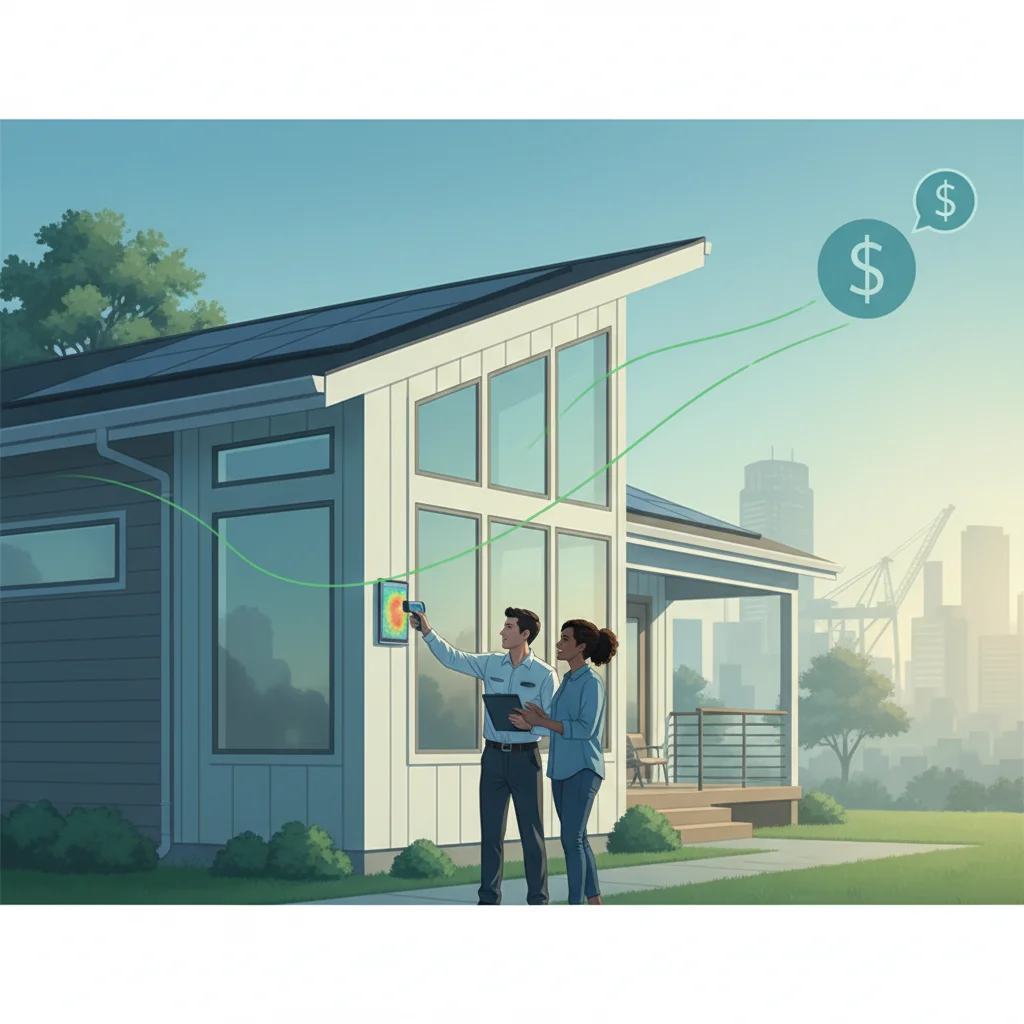
Oakland homeowners left $4.2 million in unclaimed energy rebates on the table in 2025 according to Bay Area Regional Energy Network data. And most didn't realize that a simple energy audit worth $75-$150 unlocks access to rebates totaling $8,000-$14,000 for whole-home retrofits. The 2026 program landscape changed in January when federal Section 25C and 25D credits expired and new IRA-backed incentives took effect.
What home energy audit rebates are available in Oakland right now?
Oakland residents access energy audit rebates through three primary 2026 programs: Pacific Gas & Electric's Home Upgrade Program ($75 instant rebate), BayREN's Single Family Home Upgrade Program ($150 audit rebate), and the federal Home Efficiency Rebates (HOMES program) which requires a pre-retrofit audit to qualify for up to $8,000 in post-retrofit rebates.
PG&E covers 100% of the audit cost for income-qualified households earning below 80% area median income. And the audit itself becomes free when homeowners complete at least one recommended upgrade worth $1,000 or more within 12 months. But non-income-qualified households pay $75-$150 upfront and receive the rebate after completing recommended improvements.
The federal HOMES program doesn't rebate the audit directly. So homeowners use the audit to establish baseline energy use, complete upgrades, then claim $2,000-$8,000 based on measured energy savings of 20%-35% or more. The audit serves as the required documentation proving actual consumption reduction.
BayREN's program stacks with PG&E rebates. And income-qualified households access both programs simultaneously, receiving the audit at no cost plus enhanced rebate amounts for heat pumps, insulation, and air sealing work. Calculate your combined savings with our rebate calculator to see total available incentives.
How much money can you get back for an energy audit in Oakland?
The direct audit rebate ranges from $75 to $150 depending on program and income status. But the audit unlocks access to $8,000-$14,000 in combined federal, state, and utility rebates for recommended improvements completed in 2026.
Income-qualified Oakland households (earning below 80% AMI, or $91,600 for a family of four in Alameda County) receive 100% audit cost coverage plus enhanced rebates: $8,000 federal HOMES rebate, $4,000 PG&E heat pump rebate, and $2,000 BayREN weatherization rebate. So total available incentives reach $14,000 for comprehensive retrofits achieving 35% energy reduction.
Non-income-qualified households access $75-$150 audit rebates, $2,000-$8,000 federal HOMES rebates based on measured savings, and standard PG&E equipment rebates of $500-$2,500 for heat pumps and water heaters. And the 30% federal energy tax credits apply to installation costs not covered by rebates, adding $3,000-$6,000 in tax savings for typical whole-home upgrades.
"The HOMES program provides up to $8,000 for projects achieving at least 35 percent energy savings as measured by a home energy audit" — U.S. Department of Energy
The audit itself costs $75-$150 but generates an average return of $11,400 in combined rebates and tax credits when homeowners complete recommended improvements within the 12-month eligibility window.
What are the eligibility requirements for Oakland energy audit rebates?
Oakland homeowners qualify for audit rebates if the property is a single-family home, duplex, or townhome built before 2020 and served by Pacific Gas & Electric. And the property owner must occupy the home as their primary residence to access income-qualified enhanced rebates.
Income verification requires recent tax returns or three consecutive pay stubs showing household earnings below 80% area median income ($91,600 for four-person households in Alameda County as of 2026). But non-income-qualified homeowners access standard rebates without income documentation.
Renters don't qualify for most audit rebates because program rules require property owners to apply. So landlords complete the audit and claim rebates, though some programs mandate passing savings to tenants through reduced rent or included utility costs. Multifamily buildings with 5+ units access separate programs not covered here.
Mobile homes and properties built after 2020 typically don't qualify for PG&E or BayREN programs. And homes that completed comprehensive energy retrofits in the past 36 months face reduced rebate amounts or full exclusion from repeat participation. Check specific program rules at application time because eligibility criteria update quarterly.
The federal HOMES program accepts any primary residence regardless of construction date. But the property must be located in a participating state, and California launched its HOMES implementation in February 2026 with Oakland in the initial service area.
Do you need pre-approval before scheduling your home energy audit?
Most Oakland audit programs don't require pre-approval, but income-qualified applicants must verify eligibility before scheduling to access no-cost audits. And the federal HOMES program requires enrollment before completing the initial audit to ensure proper baseline documentation.
PG&E's Home Upgrade Program operates on a first-come, first-served basis without pre-approval for standard rebates. But income-qualified households submit an application with income documentation 7-10 business days before scheduling to receive approval confirmation and no-cost audit access.
BayREN requires online registration before audit scheduling. And the system generates an approval code within 48 hours that homeowners provide to approved contractors. This registration doesn't verify income, just establishes program participation and tracks the 12-month rebate window.
The federal HOMES program mandates pre-enrollment through California's designated administrator (launched February 2026). So homeowners submit basic property information and receive a participation number before scheduling the pre-retrofit audit. This ensures the audit meets program requirements for energy modeling and savings verification.
Skipping pre-approval steps costs homeowners money. And audits completed before HOMES enrollment or income verification don't qualify for enhanced rebates, forcing homeowners to pay full audit costs and lose access to thousands in additional incentives. Our home energy audit guide covers the complete approval process.
What documentation do you need to claim your Oakland energy audit rebate?
Claiming audit rebates requires proof of audit completion (audit report with recommendations), proof of residence (utility bill or property tax statement), and proof of completed improvements (itemized contractor invoices showing equipment installed).
The audit report must come from a BPI-certified energy auditor approved by PG&E or BayREN. And the report must include specific data: blower door test results showing air leakage in CFM50, thermal imaging identifying insulation gaps, combustion safety testing for gas appliances, and prioritized upgrade recommendations with estimated costs and savings.
Income-qualified households submit additional documentation: federal tax return (Form 1040) from the most recent filing year, or three consecutive pay stubs covering the 90 days before application. And self-employed applicants provide a signed income affidavit with supporting bank statements.
Post-improvement documentation includes itemized invoices showing equipment model numbers, installation dates, and labor costs. But rebate applications also require product specification sheets proving installed equipment meets program efficiency requirements (SEER2 ratings for heat pumps, U-factors for windows, R-values for insulation).
The federal HOMES program adds another layer: post-retrofit energy modeling showing measured consumption reduction. So the same auditor returns after improvements to conduct follow-up testing, compare energy use against the baseline audit, and certify the percentage reduction that determines rebate amounts of $2,000 (20% savings) to $8,000 (35%+ savings).
Keep digital copies of all documentation. And submit rebate applications within 90 days of project completion because late applications lose priority and risk hitting annual funding caps that shut down programs before fiscal year-end.
Can you stack multiple rebates for home energy improvements in Oakland?
Oakland homeowners stack federal, state, and utility rebates for the same improvements as long as total incentives don't exceed 100% of project cost. And 2026 rules specifically allow combining PG&E rebates, BayREN incentives, and federal HOMES rebates without penalty.
A typical heat pump installation costing $12,000 stacks three incentives: $2,000 PG&E equipment rebate, $8,000 federal HOMES rebate (for projects achieving 35% whole-home savings), and a 30% federal tax credit worth $600 on the remaining $2,000 not covered by rebates. So total incentives reach $10,600, reducing homeowner cost to $1,400.
But stacking rules prohibit double-dipping on the same cost basis. And homeowners can't claim the federal tax credit on costs already covered by rebates. So the tax credit applies only to the net expense after all rebates subtract from the total project cost.
The federal HOMES rebate stacks with equipment-specific rebates from utilities. But it doesn't stack with the federal Home Electrification and Appliance Rebates (HEAR program) for the same equipment. So homeowners choose between HOMES (up to $8,000 for whole-home performance) or HEAR (up to $14,000 for specific appliances), not both.
Income-qualified households access enhanced stacking: 100% audit cost coverage, maximum equipment rebates from all programs, and the full 30% tax credit (this federal credit ended for property placed in service after December 31, 2025). And total incentives can exceed project cost in some cases, though programs reconcile overpayments by reducing the largest rebate amount. Learn more about heat pump rebates and stacking strategies.
What are the deadlines for claiming energy audit rebates in Oakland?
The 2026 PG&E and BayREN audit rebates operate on a rolling basis with applications accepted through December 31, 2026, or until annual funding depletes. And the federal HOMES program runs through 2031 with annual state allocation limits that trigger enrollment caps.
Oakland homeowners face a critical 12-month window: complete the audit, finish recommended improvements, and submit rebate applications within 365 days of the initial audit date. So an audit conducted March 15, 2026 requires all improvements and applications submitted by March 14, 2027 to maintain eligibility.
The federal HOMES program uses a different deadline structure. And homeowners must complete the pre-retrofit audit, finish improvements, complete the post-retrofit verification audit, and submit the final application within 24 months of enrollment. But California's 2026 HOMES allocation of $410 million serves approximately 51,000 households, creating a likely funding depletion by Q3 2027 based on current enrollment rates.
Quarterly funding caps create invisible deadlines. And PG&E's income-qualified program historically depletes funding by September each year, shutting down new applications until the next fiscal year. So homeowners applying after August face 60%-70% rejection rates due to exhausted annual budgets.
Tax credit deadlines differ from rebate deadlines. And the 30% federal credit (this federal credit ended for property placed in service after December 31, 2025) applies to improvements placed in service during the tax year, claimed on the following year's return. So improvements completed in 2026 appear on the 2026 tax return filed in April 2027, independent of rebate application timing.
Official Sources
- U.S. Department of Energy Save Energy, Save Money — Federal rebate programs including HOMES and energy efficiency guidance
- DSIRE USA California Incentives — Comprehensive database of state, local, and utility energy rebate programs
- Pacific Gas & Electric Home Upgrade Program — PG&E audit rebates and eligibility requirements
Related Reading: Learn more about Can I Do My Own Energy Audit and Cooling Season Energy Audit Checklist.
Related Reading: Learn more about Diy Home Energy Audit and Ductwork Inspection Energy Audit.
Frequently Asked Questions
What qualifies for a home energy audit rebate in Oakland?
Single-family homes, duplexes, and townhomes built before 2020 and served by PG&E qualify for audit rebates. And the property must be owner-occupied as a primary residence to access income-qualified enhanced rebates worth $150 versus standard $75 rebates. Renters don't qualify because property owners must apply. Mobile homes and recent construction (post-2020) face restricted eligibility, though the federal HOMES program accepts any primary residence regardless of age.
How much money can I get back from an energy audit rebate?
Direct audit rebates range from $75 to $150 depending on income status. But the audit unlocks $8,000-$14,000 in combined federal, state, and utility rebates for completed improvements. Income-qualified households receive 100% audit cost coverage plus maximum equipment rebates. And the average Oakland household completing recommended improvements receives $11,400 in total incentives including the 30% federal tax credit on unreimbursed costs.
How long does it take to receive a home energy audit rebate in Oakland?
PG&E processes audit rebates within 6-8 weeks of receiving complete applications with required documentation. And BayREN rebates arrive within 45-60 days. The federal HOMES program takes longer at 90-120 days because it requires post-retrofit verification audits and energy savings calculations before issuing payments. Income-qualified applications add 10-15 days for verification processing. Submit applications within 90 days of project completion to avoid delays from annual funding depletion.
Are there deadlines for applying for energy audit rebates in Oakland?
Yes. And homeowners must complete improvements and submit applications within 12 months of the initial audit date for PG&E and BayREN programs. The federal HOMES program allows 24 months from enrollment to complete all improvements and verification. But annual funding caps create invisible deadlines, with income-qualified programs typically depleting by September each year. The 2026 programs accept applications through December 31, 2026, or until funding exhausts.
What is the difference between a home energy audit rebate and other energy efficiency programs?
The audit rebate reimburses the assessment cost ($75-$150) while equipment rebates reimburse installation costs for specific improvements like heat pumps or insulation. And the audit serves as required documentation for accessing larger rebates totaling $8,000-$14,000. Performance-based programs like federal HOMES pay rebates based on measured whole-home energy reduction (20%-35%) rather than specific equipment installed. Tax credits differ from rebates by reducing tax liability rather than providing direct payments.
Ready to claim your Oakland energy audit rebates? Use our free rebate calculator to find every incentive you qualify for, estimate your total savings, and get a step-by-step application roadmap customized to your home. Calculate your savings in 60 seconds →
Updated on April 14, 2026. Fact-checked by DuloCore Editors. About our research team.