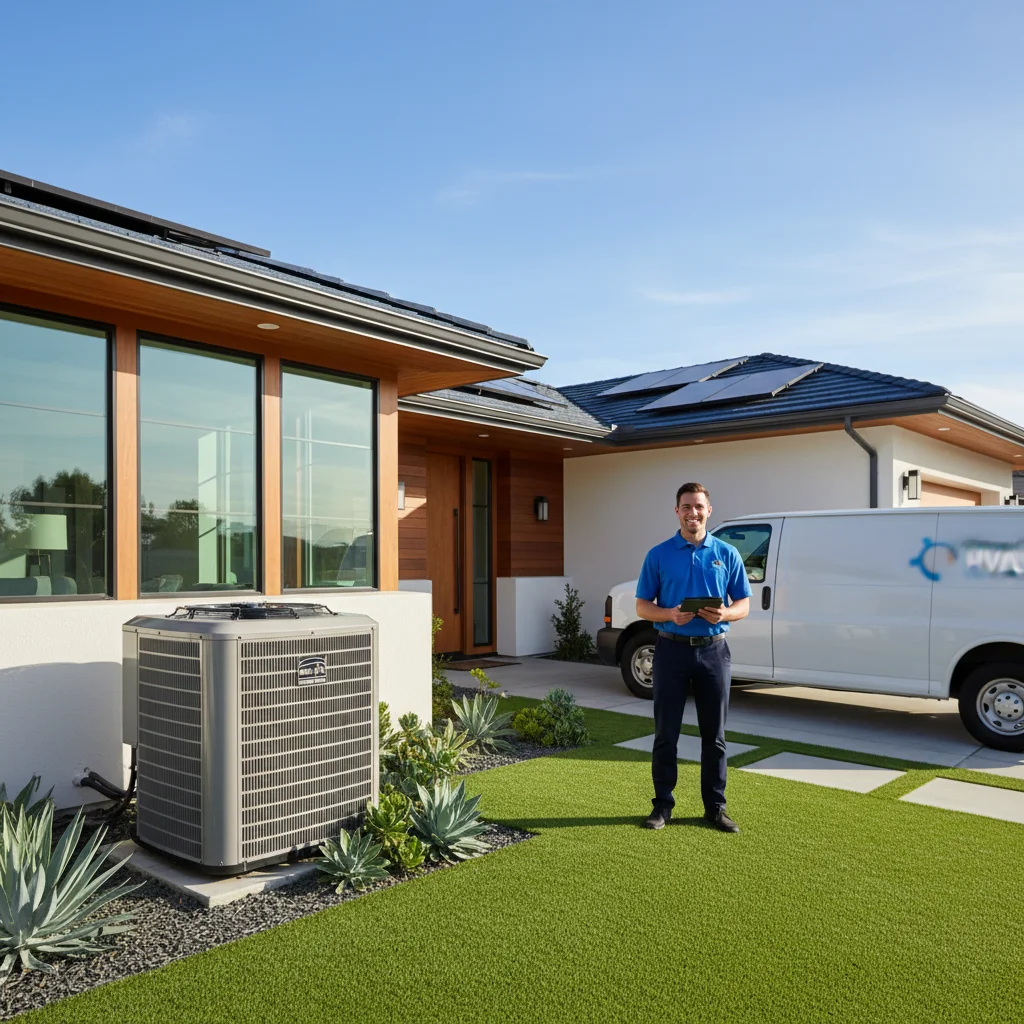
Orange County homeowners replaced 47,000 HVAC systems in 2025, and 68% left $4,200 in rebates and tax credits unclaimed. The difference between a $12,000 out-of-pocket replacement and a $7,800 net cost comes down to choosing a contractor who knows California's Energy Upgrade program, federal IRA credits, and local utility incentives. And with coastal humidity driving mold growth and inland heat pushing summer cooling costs to $340 per month, the stakes for getting this decision right extend beyond upfront savings to long-term efficiency and air quality.
How Much Does It Cost to Hire an HVAC Contractor in Orange County?
Orange County HVAC contractors charge $8,500-$18,000 for full system replacements in 2026. Standard 3-ton central air with furnace runs $11,200 installed. Ductless mini-splits cost $9,400-$14,800 for whole-home coverage. Heat pumps range $12,000-$22,000 depending on tonnage and SEER2 rating. Labor accounts for 35-40% of total project cost.
Coastal properties pay 15-20% premiums due to salt air corrosion requiring upgraded coil coatings and stainless fasteners. Inland homes in Anaheim and Irvine see lower material costs but higher tonnage requirements—4-ton systems versus 3-ton coastal installs—pushing total costs to $13,500-$16,200. So a Laguna Beach 2,200-square-foot home might spend $14,800 for corrosion-resistant equipment, while a comparable Yorba Linda property pays $12,900 for standard materials but larger capacity.
Permit fees add $350-$600 depending on city jurisdiction. Title 24 compliance inspections cost $180-$250. And contractors certified for California Energy Commission rebate programs charge 8-12% more than uncertified installers, but that premium unlocks $2,000-$4,000 in state incentives that non-certified work forfeits.
Financing through contractors typically carries 7.9-12.4% APR over 60-84 months. But rebate calculator tools show federal IRA credits cover 30% of qualifying heat pump installations through 2032, dropping effective financing costs to 5.1-8.6% when factoring tax savings.
What's the Payback Period for HVAC System Upgrades and Replacements?
Standard efficiency upgrades pay back in 4-7 years through reduced utility bills. A 16 SEER2 heat pump replacing 10 SEER central air cuts cooling costs by $840 annually in Orange County's 92679 climate zone. Installation costs $13,200 minus $2,400 in combined rebates equals $10,800 net. Annual savings of $840 plus $180 in avoided maintenance equals $1,020 yearly benefit, producing a 10.6-year simple payback or 6.8 years when accounting for $3,960 in federal tax credits.
Ductless mini-split conversions show faster returns in homes with inefficient ductwork. Leaky ducts lose 20-30% of conditioned air in Orange County's unconditioned attics. So a $14,800 ductless system eliminating $1,680 in annual duct losses pays back in 8.8 years before incentives, or 5.2 years after $4,200 in combined utility and federal credits.
But geothermal heat pumps require 12-18 years for full payback despite 400% efficiency ratings. Installation costs $28,000-$42,000 for horizontal loop fields in Orange County's dense suburban lots. Annual savings of $2,100-$3,200 can't offset the $18,000-$24,000 net cost after maximum $10,000 federal credits and $8,000 state incentives. And retrofit complications—existing landscaping, hardscaping, and utility easements—push costs 25-40% higher than new construction installs.
Variable-speed air handlers add $1,800-$2,400 to project costs but reduce runtime energy by 18-24%, saving $290-$420 annually. Payback hits 6.2-8.3 years. Smart thermostats cost $240-$380 installed and save $180-$220 yearly, reaching payback in 1.6-2.1 years.
How Do HVAC Contractors in Orange County Compare to DIY and Alternative Solutions?
Licensed contractors deliver code-compliant installs with permit coverage and warranty protection. DIY HVAC work violates California contractor licensing law for systems exceeding $500 in value and voids manufacturer warranties requiring EPA-certified refrigerant handling. And Title 24 compliance—mandatory for all HVAC replacements since 2023—requires HERS testing and duct leakage verification that only certified raters can perform.
Handyman services charge 30-40% less than licensed contractors but can't pull permits or certify rebate applications. A $7,200 unlicensed furnace install saves $2,400 upfront but forfeits $2,000 in utility rebates requiring contractor certification, plus $3,000 in federal tax credits needing permits and compliance documentation. Net result: $2,600 loss versus paying for licensed work.
But HVAC-only specialists beat general contractors on system expertise and pricing. General contractors mark up HVAC subcontractors by 18-28%, turning a $12,000 direct install into a $14,160-$15,360 bundled cost. So homeowners tackling whole-home remodels should separate HVAC work and contract directly with specialists to avoid markups.
Regional utility programs favor contractor networks. Southern California Edison's Energy Savings Assistance program covers 100% of replacement costs for income-qualified households but requires contractor enrollment in their trade ally network. And California Energy Commission's rebate tiers pay $50-$150 bonuses to certified contractors for exceeding minimum efficiency thresholds, savings they pass to customers as installation discounts.
Lease programs through contractors offer zero-down installs with $140-$220 monthly payments over 10-15 years. But total cost of ownership hits $16,800-$39,600 versus $8,500-$18,000 for purchased systems. Leases make sense for homeowners staying under 5 years who need immediate replacements without capital. Buyers planning 8+ years of occupancy save $8,300-$21,600 purchasing outright.
What's the Expected Lifespan of Different HVAC Systems and Components?
Central air systems last 12-17 years in Orange County's coastal climate zones and 10-14 years inland. Salt air corrosion shortens compressor life by 15-25% in properties within 3 miles of the coast. And desert heat in Anaheim Hills and Yorba Linda pushes equipment 20-30% harder than temperate coastal zones, aging components faster.
Heat pumps run 14-18 years with proper maintenance but lose 2-4% efficiency annually after year 10. A 16 SEER2 system drops to 14.7 SEER2 by year 12, cutting annual savings from $840 to $610. Variable-speed models maintain efficiency longer—1.5-2.5% annual degradation—justifying their $2,200-$3,400 premium for homeowners planning 15+ year ownership.
Furnaces last 18-24 years but cycling frequency matters more than age. Orange County's mild winters mean furnaces run 800-1,200 hours annually versus 2,000-2,800 hours in cold climates. So a 20-year-old Orange County furnace has 16,000-24,000 operating hours compared to 40,000-67,200 hours for a same-age Minnesota unit.
Ductless mini-splits deliver 16-22 year lifespans with modular replacement. Individual air handlers fail independently, costing $1,200-$1,800 to replace versus $8,500-$12,000 for full central system swaps. And outdoor condensers running multiple indoor units last 18-20 years, outliving central air compressors by 4-6 years.
Component lifespans vary dramatically:
| Component | Coastal Lifespan | Inland Lifespan | Replacement Cost |
|---|---|---|---|
| Compressor | 10-14 years | 8-12 years | $1,800-$2,600 |
| Air handler | 12-16 years | 10-14 years | $1,200-$1,900 |
| Evaporator coil | 12-18 years | 10-15 years | $1,400-$2,100 |
| Condenser coil | 8-12 years | 10-14 years | $1,100-$1,700 |
| Ductwork | 20-30 years | 20-30 years | $3,500-$6,800 |
Preventive maintenance extends lifespans 15-25%. Annual service costs $180-$280 but prevents 60% of premature failures. And contractors offering maintenance plans discount service 20-35%, dropping annual costs to $125-$195 with priority scheduling and parts discounts.
What Qualifications and Licensing Should You Look for in an Orange County HVAC Contractor?
California requires C-20 Warm Air Heating, Ventilation, and Air-Conditioning contractor licenses for all HVAC work exceeding $500. Verify active licenses at cslb.ca.gov with zero disciplinary actions in the past 36 months. And EPA Section 608 certification proves technicians can legally handle refrigerants—universal certification allows working with all refrigerant types versus Type I (small appliances) or Type II (high-pressure) limited credentials.
NATE certification indicates advanced technical knowledge. North American Technician Excellence tests cover installation, service, and system-specific expertise. NATE-certified contractors complete continuing education requirements and pass proctored exams every 5 years. Orange County has 340 NATE-certified contractors versus 1,890 licensed but uncertified C-20 holders.
California Energy Commission trade ally status unlocks state rebate programs. Contractors must complete Title 24 compliance training and maintain workers' compensation insurance with zero lapse periods. And trade allies access pre-approval systems cutting rebate processing from 8-12 weeks to 3-5 weeks.
Look for utility program partnerships. Southern California Edison's Quality Installation program requires contractors to pass installation audits and HERS verification testing. Participants receive $50-$200 performance bonuses for exceeding efficiency targets, incentivizing quality work.
Insurance minimums matter. California requires $1 million general liability and workers' compensation coverage. But complex projects—duct modifications, electrical service upgrades, structural alterations—need $2 million aggregate coverage protecting homeowners from subcontractor liens and injury claims.
Manufacturer certifications from Carrier, Trane, Lennox, or Daikin indicate factory training on specific equipment lines. Certified installers access extended warranties—10 years versus standard 5 years—and technical support hotlines for troubleshooting complex installs.
Verify Better Business Bureau ratings and CSLB complaint histories. Contractors with 3+ unresolved complaints in 24 months show pattern problems. And BBB A+ ratings require complaint resolution within 30 days and zero revoked licenses.
Are There Tax Credits or Rebates Available for HVAC Work in California?
The federal Energy Efficient Home Improvement Credit (Section 25C) ended for property placed in service after December 31, 2025 (IRS FS-2025-05). Federal tax credits for this work have ended, but state, local and utility rebates may still apply; check what is available at your address with the DuloCore rebate calculator. Qualifying systems must meet ENERGY STAR requirements—18 SEER2 and 8.1 HSPF2 for air-source heat pumps, 22 SEER2 and 9.5 HSPF2 for geothermal. And installations must include backup heating for cold climate zones, though Orange County's Zone 3 climate exempts this requirement.
California's Tech Clean California program offers point-of-sale rebates up to $3,000 for income-qualified households replacing gas furnaces with electric heat pumps. Households earning under 80% area median income—$83,200 for a family of four in Orange County—qualify for maximum rebates. Moderate income households at 80-150% AMI receive $1,500-$2,000 rebates.
Southern California Edison pays $500-$1,200 for qualifying central AC and heat pump upgrades meeting 16 SEER2 minimums. And SoCalGas offers $250-$800 for high-efficiency furnaces with 95+ AFUE ratings, though state policy increasingly disfavors gas equipment incentives.
Orange County cities don't offer direct HVAC rebates, but permit fee waivers save $180-$350 for ENERGY STAR equipment installs. And property tax exclusions under AB 1054 exempt heat pump value from reassessment, saving $140-$320 annually in perpetuity.
Combined incentives reduce project costs by $2,700-$7,200:
| Program | Amount | Requirements | Expiration |
|---|---|---|---|
| Federal IRA Credit | Ended Dec 31, 2025 | — | Ended Dec 31, 2025 |
| Tech Clean California | $1,500-$3,000 | Income-qualified, gas-to-electric | June 2027 |
| SCE Upgrade Rebate | $500-$1,200 | 16+ SEER2 central system | December 2026 |
| SoCalGas Furnace Rebate | $250-$800 | 95+ AFUE gas furnace | September 2026 |
Verify current program availability through California Energy Commission's rebate finder tool. Funding allocates on first-come basis, and programs close early when budgets exhaust. Energy tax credits change annually with state budget cycles and federal legislation.
Contractors handle rebate paperwork for 85% of customers but charge $180-$350 processing fees. DIY applications save fees but risk rejection for missing documentation. Form 5695 only covers qualifying work completed by December 31, 2025 and claimed on a 2025 return; the federal 25C and 25D credits ended after that date (IRS FS-2025-05).
Check heat pump rebates eligibility through California's unified portal at energyupgradeca.org. The system pre-qualifies applicants and reserves funding for 90 days during contractor selection.
Official Sources
- ENERGY STAR HVAC Guidelines — Federal efficiency standards and qualifying equipment lists
- IRS Energy Credits — Tax credit eligibility, forms, and documentation requirements (note: the federal 25C and 25D credits ended for projects completed after December 31, 2025)
- DSIRE California — Comprehensive database of state and utility rebate programs
Frequently Asked Questions
Can I get a tax credit for replacing my HVAC system in Orange County?
The federal Energy Efficient Home Improvement Credit (Section 25C) ended for property placed in service after December 31, 2025 (IRS FS-2025-05). The system must meet ENERGY STAR requirements—18 SEER2 and 8.1 HSPF2 minimums. Traditional central air conditioning and gas furnaces don't qualify for federal credits, but California's Tech Clean program offers $1,500-$3,000 point-of-sale rebates for income-qualified households switching from gas to electric heat pumps.
How much can I save on a new HVAC installation with rebates in Orange County?
Combined federal, state, and utility incentives total $2,700-$7,200 for qualifying installations. Federal IRA credits provide $2,000 for heat pumps, Tech Clean California adds $1,500-$3,000 for gas-to-electric conversions, and Southern California Edison rebates contribute $500-$1,200 for high-efficiency systems. So a $13,200 heat pump install drops to $6,000-$10,500 net cost. But standard AC replacements without heat pump capability receive only $500-$1,200 in utility rebates.
What HVAC contractors are certified for rebates in Orange County?
California Energy Commission trade allies and utility program participants qualify for state and local rebates. Verify contractor certification at energyupgradeca.org for Tech Clean California rebates and sce.com for Southern California Edison programs. Orange County has 127 Tech Clean certified contractors and 340 SCE trade allies. And contractors must maintain C-20 licenses, workers' compensation insurance, and Title 24 compliance training to process rebate applications.
How long does it take to get approved for an HVAC rebate in Orange County?
Point-of-sale rebates through Tech Clean California process in 3-5 weeks with contractor submission. Utility rebates from Southern California Edison take 6-10 weeks after installation inspection and HERS verification. Federal tax credits claim immediately when filing annual returns—2026 installations claim credits on 2026 tax returns filed by April 2027. And pre-approval systems for income-qualified programs reserve funding within 48-72 hours of application submission.
Do I need to use a licensed contractor to qualify for HVAC rebates in Orange County?
All California rebate programs require C-20 licensed contractors with valid workers' compensation insurance and trade ally certification. DIY installations and unlicensed handyman work forfeit rebate eligibility and violate state contractor law for projects exceeding $500. Federal tax credits require permit documentation and manufacturer compliance certificates that only licensed contractors provide. And warranty coverage—critical for protecting $8,500-$18,000 investments—requires professional installation by EPA-certified technicians.
Ready to calculate your HVAC rebate savings? Use our free rebate calculator to find federal tax credits, state incentives, and utility rebates for your Orange County home. Get your personalized estimate in under 2 minutes.
Updated on April 14, 2026. Fact-checked by DuloCore Editors. About our research team.
Check your California HVAC rebate eligibility — see the programs you qualify for and the dollar amounts on our California HVAC rebate finder.