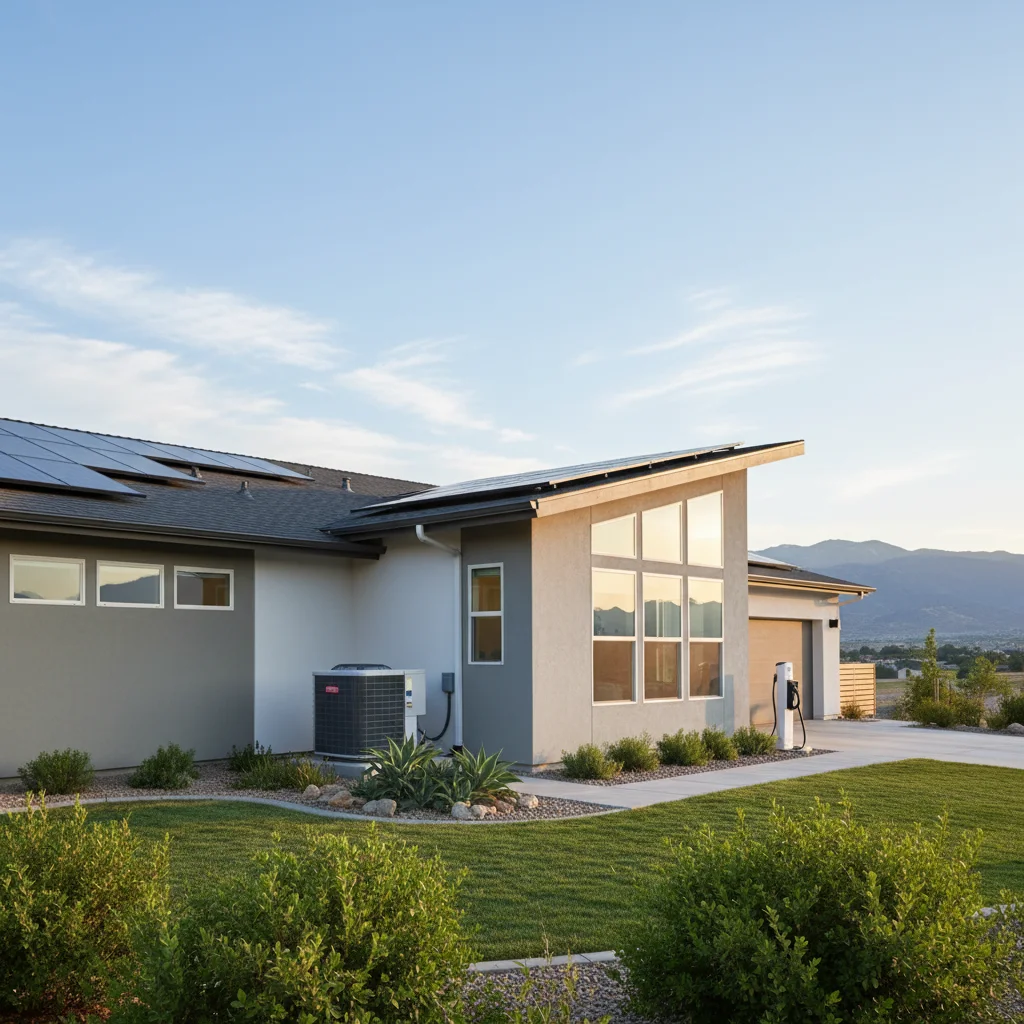
A new HVAC system in Bakersfield costs $12,000-$18,000 for a complete installation, but homeowners who install high-efficiency equipment in 2026 can claim up to $2,000 in federal tax credits and $4,000-$8,000 in utility rebates. That's a potential $10,000 reduction on a $15,000 system. And Bakersfield's extreme summer heat—averaging 97°F in July—makes HVAC efficiency a financial decision, not just a comfort preference.
What's the Average HVAC Installation Cost in Bakersfield?
HVAC installation costs in Bakersfield range from $5,500 for a basic 2-ton AC unit to $28,000 for a dual-fuel heat pump system with variable-speed technology. A standard 3-ton central air conditioner with a 16 SEER2 rating costs $8,000-$12,000 installed, while a high-efficiency 20 SEER2 heat pump runs $14,000-$18,000. Gas furnace installations cost $4,500-$7,000, and complete dual-fuel systems—combining a heat pump with a gas furnace backup—reach $16,000-$25,000. So the total cost depends on equipment type, efficiency rating, system size, ductwork condition, and whether the home requires electrical panel upgrades.
Labor accounts for 30-40% of total installation costs in Bakersfield, with HVAC contractors charging $75-$125 per hour. Permits add $150-$400. And homes with outdated ductwork or insufficient electrical capacity face an additional $2,000-$5,000 in preparatory work before the new HVAC system can operate at peak efficiency.
Which HVAC Systems Qualify for Rebates and Tax Credits in Bakersfield?
HVAC systems installed in 2026 qualify for federal tax credits if they meet minimum efficiency standards: 16 SEER2 and 13 EER2 for central air conditioners, or 16 SEER2 and 9 HSPF2 for heat pumps. The federal Energy Efficient Home Improvement Credit (Section 25C) ended for property placed in service after December 31, 2025 (IRS FS-2025-05). Federal tax credits for this work have ended, but state, local and utility rebates may still apply; check what is available at your address with the DuloCore rebate calculator. Gas furnaces with AFUE ratings of 97% or higher qualify for a $600 credit. But the credit applies only to primary residences, and homeowners claim it when filing federal taxes for the installation year.
Pacific Gas and Electric (PG&E) offers rebates of $2,000-$4,000 for qualifying heat pumps installed in 2026, with higher amounts for income-qualified households. And the California Tech Clean Energy Fund provides zero-interest financing for HVAC upgrades, allowing homeowners to spread the $15,000 installation cost over 60 months with no upfront payment. So combining federal credits, utility rebates, and financing reduces the effective cost from $15,000 to $7,000-$9,000 for qualifying systems.
| Program | Rebate Amount | Efficiency Requirement | Income Limit | Application Deadline |
|---|---|---|---|---|
| IRA Federal Tax Credit | Ended Dec 31, 2025 | — | — | Ended Dec 31, 2025 |
| PG&E Heat Pump Rebate | $2,000-$4,000 | 16 SEER2 / 9 HSPF2 | Varies by tier | December 31, 2026 |
| CA Tech Clean Energy Financing | 0% interest | 14.3 SEER2 minimum | 80% AMI | Rolling |
How Do SEER2 and AFUE Ratings Affect Your Installation Cost and Long-Term Savings?
SEER2 (Seasonal Energy Efficiency Ratio 2) measures cooling efficiency, while HSPF2 (Heating Seasonal Performance Factor 2) measures heating efficiency for heat pumps. AFUE (Annual Fuel Utilization Efficiency) measures gas furnace efficiency. A 16 SEER2 air conditioner costs $8,000-$10,000 installed, while a 20 SEER2 unit costs $12,000-$15,000—a $4,000 premium. But the 20 SEER2 unit uses 20% less electricity, saving Bakersfield homeowners $300-$450 annually on cooling costs.
And Bakersfield's climate—with 3,350 cooling degree days and only 2,340 heating degree days—favors high-SEER systems over high-HSPF systems. A home with a 20 SEER2 heat pump saves $500-$700 per year compared to a 14 SEER2 unit. Over 15 years, that's $7,500-$10,500 in total savings, exceeding the $4,000 upfront premium. So homeowners who plan to stay in their home for 7+ years recover the efficiency upgrade cost through lower utility bills.
Gas furnaces with 97% AFUE ratings cost $1,200-$2,000 more than 80% AFUE models, but they waste only 3% of fuel compared to 20%. Use our free rebate calculator to compare lifetime costs of different efficiency tiers based on your current energy bills.
What's the Payback Period for Upgrading to a High-Efficiency HVAC System?
Payback period—the time required for energy savings to equal the upfront cost premium—ranges from 4 to 12 years depending on system type, efficiency gain, and local energy rates. A homeowner replacing a 10 SEER air conditioner with a 20 SEER2 heat pump pays a $6,000-$8,000 premium but saves $700-$900 annually on combined heating and cooling costs. That's a 7-9 year payback period without rebates. But with $6,000 in combined federal and utility incentives, the payback period drops to 0-2 years.
And Bakersfield's electricity rates—averaging $0.26 per kWh in 2026—accelerate payback for high-efficiency systems. A 3-ton 20 SEER2 heat pump uses 4,500 kWh less per year than a 14 SEER2 unit, saving $1,170 annually at current rates. So homeowners who install qualifying systems in 2026 recoup the efficiency premium within 3-5 years and save $15,000-$20,000 over the system's 15-18 year lifespan.
"Heat pumps can reduce electricity use for heating by approximately 50% compared to electric resistance heating such as furnaces and baseboard heaters." — U.S. Department of Energy
How Does a New HVAC System Compare to Repairing or Replacing Your Current Unit?
Repairing an existing HVAC system costs $300-$1,500 per service call, while replacing a failing unit costs $8,000-$18,000. But systems older than 12 years with 10 SEER ratings waste $800-$1,200 annually compared to 16 SEER2 models. And the $5,000 rule applies: if repair costs exceed 50% of replacement cost and the unit is over 10 years old, replacement delivers better long-term value.
A 15-year-old furnace with a cracked heat exchanger requires $2,500-$4,000 in repairs, but a new 97% AFUE furnace costs $5,500-$7,000 and qualifies for a $600 federal tax credit. So the net cost difference is $1,500-$3,000, and the new furnace saves $250-$400 annually on gas bills. Homeowners who repair the old system spend $2,500 upfront and continue losing $400 per year, while replacement costs $3,000 net and eliminates waste.
Or consider a dual-fuel system: a heat pump handles 95% of heating and cooling, while a gas furnace provides backup during rare cold snaps below 35°F. That combination costs $16,000-$22,000 installed but qualifies for $8,000-$10,000 in combined incentives, reducing the net cost to $8,000-$12,000. And dual-fuel systems use 40-60% less energy than gas-only or electric-only configurations.
How Long Will Your New HVAC System Last in Bakersfield's Climate?
HVAC systems installed in Bakersfield last 12-20 years depending on equipment type, maintenance frequency, and operating environment. Central air conditioners average 15-18 years, gas furnaces last 18-22 years, and heat pumps operate for 12-16 years. But Bakersfield's extreme summer heat—with 100+ days above 90°F—stresses cooling equipment, reducing lifespan by 2-3 years compared to milder climates.
And variable-speed systems last 3-5 years longer than single-stage units because they run at lower capacity most of the time, reducing wear on compressors and motors. A $15,000 variable-speed heat pump operating for 18 years costs $833 per year of service, while a $10,000 single-stage unit lasting 13 years costs $769 per year—but the variable-speed system saves $700-$900 annually on energy bills, making it $100-$200 cheaper per year in total cost of ownership.
Preventive maintenance extends system lifespan by 4-6 years. Annual filter changes, coil cleaning, and refrigerant checks cost $150-$300 per year but prevent 80% of premature failures. So homeowners who budget $200 annually for maintenance get 18-20 years from a heat pump instead of 12-14 years, saving $8,000-$12,000 in premature replacement costs.
Official Sources
- U.S. Department of Energy: Energy Saver — Federal guidance on HVAC efficiency, rebates, and tax credits for 2026 (note: the federal 25C and 25D credits ended for projects completed after December 31, 2025)
- DSIRE USA — Comprehensive database of state and utility incentive programs for energy-efficient HVAC systems
- ENERGY STAR HVAC Guide — Efficiency ratings, qualified equipment lists, and savings calculators for heat pumps and air conditioners
Related Reading: Learn more about Hvac Installation Cost Inland Empire.
Related Reading: Learn more about Hvac Installation Cost Orange County.
Frequently Asked Questions
How much does HVAC installation cost in Bakersfield?
HVAC installation costs in Bakersfield range from $5,500 for a basic 2-ton air conditioner to $28,000 for a high-efficiency dual-fuel heat pump system. A standard 3-ton central air conditioner with a 16 SEER2 rating costs $8,000-$12,000 installed, while a 20 SEER2 heat pump runs $14,000-$18,000. Labor accounts for 30-40% of total cost, and homes requiring ductwork upgrades or electrical panel replacements add $2,000-$5,000.
What rebates are available for HVAC installation in Bakersfield?
Homeowners in Bakersfield qualify for up to $2,000 in federal tax credits for heat pumps or central air conditioners meeting 16 SEER2 / 9 HSPF2 standards, plus $2,000-$4,000 in PG&E utility rebates for 2026 installations. Gas furnaces with 97% AFUE ratings qualify for $600 federal credits. And the California Tech Clean Energy Fund offers zero-interest financing for qualifying HVAC upgrades, spreading the $15,000 cost over 60 months with no upfront payment.
Are there financing options for HVAC installation in Bakersfield?
California Tech Clean Energy Fund provides zero-interest loans for HVAC upgrades to homeowners earning up to 80% of area median income. Many HVAC contractors offer third-party financing at 5.99-9.99% APR for 36-84 month terms. And PG&E's On-Bill Financing allows homeowners to repay HVAC upgrade costs through monthly utility bills, with repayment periods of 1-10 years depending on project cost.
How long does HVAC installation take in Bakersfield?
HVAC installation takes 1-3 days for straightforward replacements in homes with existing ductwork and adequate electrical capacity. A basic air conditioner or furnace swap takes 6-10 hours, while a complete dual-fuel heat pump system with ductwork modifications requires 2-3 days. And homes needing electrical panel upgrades or asbestos abatement add 1-2 days before HVAC installation begins.
What is the average lifespan of a new HVAC system in Bakersfield?
HVAC systems in Bakersfield last 12-20 years depending on equipment type and maintenance. Central air conditioners average 15-18 years, gas furnaces last 18-22 years, and heat pumps operate for 12-16 years. But Bakersfield's extreme summer heat reduces cooling equipment lifespan by 2-3 years compared to milder climates. Annual maintenance extends system life by 4-6 years, and variable-speed systems last 3-5 years longer than single-stage units.
Ready to find out how much you can save? Use our free rebate calculator to see your total incentives for high-efficiency HVAC systems in Bakersfield. Enter your home details and current energy bills to get a personalized estimate of federal tax credits, utility rebates, and long-term energy savings.
Updated: April 14, 2026 — fact-checked by DuloCore Research. About our editorial process.
Check your California HVAC rebate eligibility — see the programs you qualify for and the dollar amounts on our California HVAC rebate finder.