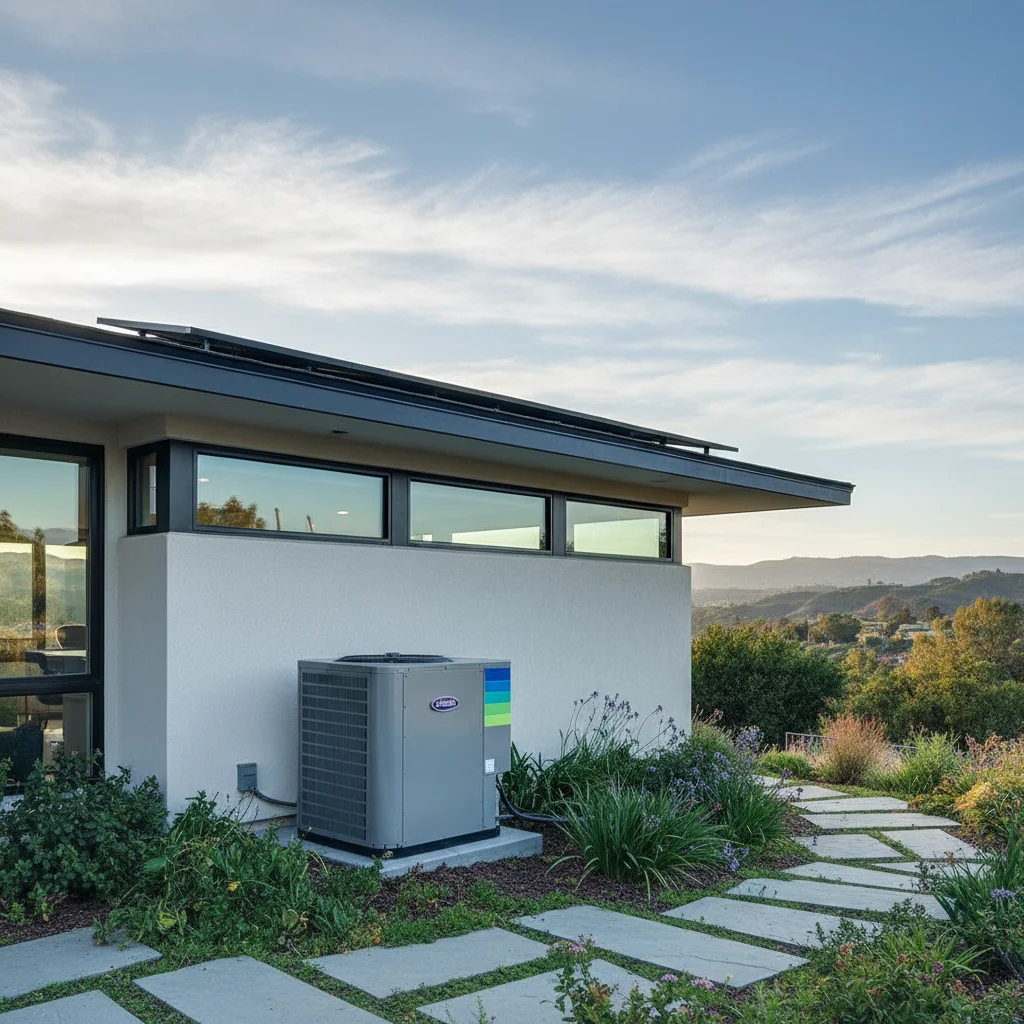
The federal Residential Clean Energy Credit (Section 25D) ended for expenditures made after December 31, 2025, and the IRS treats an expenditure as made when installation is completed (IRS FS-2025-05). Federal tax credits for this work have ended, but state, local and utility rebates may still apply; check what is available at your address with the DuloCore rebate calculator. And utility rebates from Southern California Edison can stack on top of that tax credit, knocking another $2,000 off the final bill.
How Much Does HVAC Installation Cost in Riverside?
HVAC installation costs in Riverside range from $5,800 for a basic 2-ton air conditioning system to $14,200 for a 5-ton heat pump with ductwork modifications, with typical installations averaging $8,900 for a 3-ton split system in 2026. Labor accounts for 35-40% of total costs, while equipment quality and SEER2 efficiency ratings drive the remaining price variation.
So what drives this price spread? Riverside's desert climate demands higher-capacity systems than coastal California cities, pushing average tonnage requirements to 3.5-4 tons for homes over 2,000 square feet. But the real cost impact comes from the invisible infrastructure: homes built before 1990 often need $2,200-$3,800 in duct sealing and insulation upgrades to prevent the 25-30% efficiency loss that older ductwork causes. And those efficiency losses mean higher utility bills that can cost homeowners $340-$580 annually compared to a properly sealed system.
Basic central air conditioning systems start at $5,800 for 14 SEER2 units, while 18 SEER2 high-efficiency models run $7,400-$9,200. Heat pump installations cost $8,200-$14,200 depending on backup heating requirements and HSPF2 ratings. Ductless mini-split systems range from $3,600 for single-zone installations to $12,500 for whole-home multi-zone configurations.
"Installing high-efficiency HVAC equipment can reduce energy consumption by 20-40% compared to minimum-efficiency models, with the greatest savings in hot climates like California's Inland Empire." — Department of Energy
Or consider financing: contractors typically add 6.9-8.9% APR to projects, which translates to $89-$127 monthly on a $10,000 system over 5 years. But energy tax credits can reduce that principal by $3,000-$4,200, dropping monthly payments to $60-$95.
What's the ROI and Payback Period for a New HVAC System?
High-efficiency HVAC systems in Riverside deliver a 12-18% annual return on investment through energy savings of $720-$1,340 per year, with payback periods of 5.4-8.2 years for heat pump installations and 7.8-11.5 years for premium air conditioning systems after accounting for federal tax credits and utility rebates that reduce upfront costs by $3,200-$6,260.
The math changes dramatically when you account for Riverside's extreme summer temperatures. Homes running 14 SEER2 systems pay $2,180-$2,840 annually in cooling costs, while 18 SEER2 heat pumps cut that to $1,460-$1,820 — a savings of $720-$1,020 per year. And those savings compound: over a 15-year equipment lifespan, the cumulative benefit reaches $10,800-$15,300.
So the payback calculation looks like this: a $9,200 heat pump installation minus $2,760 in federal tax credits and $2,000 in utility rebates leaves $4,440 in net cost. Divided by $920 in annual energy savings, the system pays for itself in 4.8 years. But air conditioning systems without heating capability see longer payback periods of 7.8-11.5 years because they deliver savings only 6-8 months annually instead of year-round.
Property value impacts add another dimension. Real estate appraisers assign $0.85-$1.20 in home value for every $1.00 in annual energy cost reduction, meaning a $920 annual savings translates to $782-$1,104 in immediate equity gain. Or think of it this way: upgrading from a 12 SEER system to an 18 SEER2 heat pump adds $4,600-$6,900 to resale value while simultaneously cutting $1,150 annually from utility bills.
And maintenance costs factor in: high-efficiency variable-speed systems require $180-$240 in annual service, while basic single-stage units cost $120-$160 to maintain. But the variable-speed units experience 40% fewer emergency repairs due to reduced mechanical stress, saving $420-$680 in avoided service calls over 10 years.
How Does HVAC Installation Compare to Alternatives Like Heat Pumps or Ductless Systems?
Heat pumps cost $8,200-$14,200 for whole-home installations versus $5,800-$9,200 for air conditioning systems, but heat pumps qualify for 30% federal tax credits that air conditioners don't, reducing net costs to $5,740-$9,940 while delivering both heating and cooling — making them $1,940-$3,680 cheaper than buying separate AC and furnace systems.
Ductless mini-splits offer the lowest installation costs at $3,600-$5,200 for single-zone systems or $8,900-$12,500 for whole-home setups with 3-5 zones. But their operating costs run 8-12% higher than ducted heat pumps in homes over 1,800 square feet due to zoning inefficiencies. So a 2,400-square-foot Riverside home pays $1,820-$2,140 annually for ductless cooling versus $1,460-$1,680 for a ducted heat pump.
Geothermal systems represent the premium option at $18,000-$28,000 installed, but they deliver the lowest operating costs at $840-$1,120 annually for cooling and heating combined. The federal Energy Efficient Home Improvement Credit (Section 25C) ended for property placed in service after December 31, 2025 (IRS FS-2025-05). Or calculate it this way: geothermal saves $1,060-$1,720 annually versus conventional heat pumps, producing a 10.8-14.2 year payback period.
"Heat pump technology has advanced significantly, with modern cold-climate models maintaining 100% heating capacity down to 5°F and delivering efficiency ratios of 10-14 HSPF2 in moderate climates." — ENERGY STAR
Equipment lifespan matters: ductless systems last 15-18 years, ducted heat pumps run 15-20 years, and geothermal systems operate 25-30 years with ground loops lasting 50+ years. So the geothermal system's $19,600 net cost divided by 28 years of service equals $700 annual amortization versus $560-$663 for heat pumps — a surprisingly small premium for triple the efficiency.
What Federal and California Tax Credits Can Offset Your Installation Costs?
The federal Residential Clean Energy Credit (Section 25D) ended for expenditures made after December 31, 2025, and the IRS treats an expenditure as made when installation is completed (IRS FS-2025-05). California's TECH Clean California program adds $2,000-$3,000 in instant rebates for income-qualified households replacing gas furnaces with electric heat pumps.
And those credits stack. A $12,000 heat pump installation qualifies for $3,600 in federal tax credits plus $2,500 from TECH Clean California, reducing net cost to $5,900. But air conditioning systems without heat pump functionality don't qualify for the 30% federal credit — they're limited to the now-expired Energy Efficient Home Improvement Credit that capped out December 31, 2025.
Southern California Edison offers additional rebates of $500-$1,500 for ENERGY STAR certified equipment upgrades, with higher amounts for income-qualified customers. So the full incentive stack looks like this: $12,000 installation minus $3,600 federal credit minus $2,500 TECH rebate minus $1,000 SCE rebate equals $4,900 net cost — a 59% reduction from list price.
But timing matters. The federal tax credit applies to installations completed and paid for in the tax year claimed, meaning December 31, 2026 installations qualify for 2026 tax returns filed by April 15, 2027. And TECH Clean California operates on a first-come, first-served budget that historically depletes by September each year, making early-year installations critical for securing rebates.
Income-qualified households earning below 80% of area median income ($74,800 for a family of four in Riverside County) qualify for enhanced rebates through the IRA's Home Efficiency Rebates program launching in California in late 2026, offering up to $8,000 for heat pump installations on top of existing tax credits. Or calculate your potential savings with our free rebate calculator that accounts for all federal, state, and utility incentives.
What's the Timeline and Process for Getting Your HVAC Installed in Riverside?
HVAC installation in Riverside takes 6-8 weeks from initial quote to system activation, including 3-5 days for contractor bids, 10-14 days for permit approval from Riverside's Building and Safety Division, 2-3 days for equipment delivery, and 6-10 hours for physical installation and commissioning — with permitting delays extending timelines to 10-12 weeks during summer peak season.
The process starts with Manual J load calculations that determine correct system sizing based on home square footage, insulation levels, window placement, and local climate data. And undersizing costs money: a 2.5-ton system in a home requiring 3.5 tons runs continuously during summer, increasing energy consumption by 18-24% while delivering inadequate cooling. So contractors charge $180-$320 for professional load calculations that prevent $380-$540 in annual energy waste.
Permit fees in Riverside run $240-$420 depending on system size and complexity, with inspections required before drywall closure and at final commissioning. But permit approval times vary: simple equipment replacements clear in 10-12 days, while installations requiring electrical panel upgrades or duct modifications take 18-26 days during peak summer season when permit volume spikes.
Equipment delivery schedules determine project pacing. Stock 14-16 SEER2 systems ship within 3-5 days, while custom 18+ SEER2 heat pumps require 12-18 days for manufacturer build and delivery. And supply chain disruptions still impact high-efficiency models: homeowners should add 7-10 days buffer to quoted delivery times.
Physical installation spans 1-2 days for straightforward replacements or 3-5 days for systems requiring duct modifications, electrical upgrades, or condensate drain rerouting. Or break it down hourly: removing old equipment takes 2-3 hours, installing new indoor and outdoor units requires 4-6 hours, and commissioning with refrigerant charging and airflow balancing needs 90-150 minutes.
Post-installation, contractors must provide documentation for tax credit claims including Manufacturer Certification Statements and IRS Form 8908 worksheets. The federal Energy Efficient Home Improvement Credit (Section 25C) ended for property placed in service after December 31, 2025 (IRS FS-2025-05).
Are There Financing Options to Make HVAC Installation More Affordable?
HVAC contractors in Riverside offer 0% APR promotional financing for 12-18 months through partners like GreenSky and Synchrony, while traditional installment loans carry 6.9-10.9% APR over 5-10 year terms — but Property Assessed Clean Energy (PACE) financing through CaliforniaFIRST delivers the longest terms at 10-20 years with 5.5-7.5% fixed rates tied to property tax bills rather than personal credit scores.
And the payment math varies dramatically. A $10,000 heat pump installation financed at 0% APR for 18 months costs $556 monthly, while a 5-year loan at 7.9% APR drops payments to $201 monthly but adds $2,060 in interest. But PACE financing spreads that same $10,000 over 15 years at 6.5% APR for $87 monthly payments with $5,660 in total interest.
So which option makes sense? Short-term 0% financing works for homeowners with immediate cash flow who can pay off balances before promotional periods end — otherwise, deferred interest charges apply retroactively to the full original balance at rates of 17.9-24.9% APR. But PACE programs require property owner consent and add assessment liens that must be repaid before property sales.
Credit unions like Altura Credit Union and Riverside County Federal Credit Union offer home improvement loans at 5.9-8.4% APR with no origination fees, providing a middle ground between expensive contractor financing and PACE liens. And loan amounts up to $50,000 let homeowners bundle HVAC installation with duct sealing, insulation upgrades, and electrical panel improvements for comprehensive efficiency retrofits.
Income-qualified households should explore California's GoGreen Home financing program offering 0-3% APR loans up to $25,000 for energy efficiency upgrades, with loan forgiveness provisions for borrowers completing approved projects. Or investigate utility on-bill financing through Southern California Edison that repays loans through monthly utility bill charges, eliminating separate payment tracking.
Official Sources
- Department of Energy - Energy Saver — Federal guidance on energy-efficient HVAC systems and available tax credits (note: the federal 25C and 25D credits ended for projects completed after December 31, 2025)
- Database of State Incentives for Renewables & Efficiency (DSIRE) — Comprehensive database of California and federal rebate programs
- ENERGY STAR HVAC Guidelines — Equipment efficiency standards and product certification information
Frequently Asked Questions
How much does HVAC installation cost in Riverside?
HVAC installation in Riverside costs $5,800-$14,200 depending on system type, size, and efficiency ratings. Basic 14 SEER2 air conditioning systems start at $5,800 for 2-ton units, while 18 SEER2 heat pumps range from $8,200 to $14,200 for whole-home installations. Ductless mini-splits cost $3,600-$5,200 for single zones or $8,900-$12,500 for multi-zone setups. But homes requiring duct modifications add $2,200-$3,800 to any installation.
What rebates are available for HVAC installation in Riverside?
The federal Energy Efficient Home Improvement Credit (Section 25C) ended for property placed in service after December 31, 2025 (IRS FS-2025-05). TECH Clean California adds $2,000-$3,000 in instant rebates for income-qualified households, while Southern California Edison offers $500-$1,500 for ENERGY STAR equipment upgrades. And the IRA's Home Efficiency Rebates launching in late 2026 provide up to $8,000 additional support for households below 80% area median income.
Do I qualify for HVAC rebates in Riverside?
All Riverside homeowners qualify for the federal 30% tax credit (this federal credit ended for property placed in service after December 31, 2025) on heat pump installations regardless of income. TECH Clean California rebates require replacing gas heating with electric heat pumps and meeting income limits of 80% area median income ($74,800 for a family of four). SCE rebates apply to all customers upgrading to ENERGY STAR certified equipment. And PACE financing requires property ownership with sufficient home equity and current property tax payments.
When is the deadline to apply for HVAC installation rebates in Riverside?
The federal 30% tax credit (this federal credit ended for property placed in service after December 31, 2025) applies to installations completed and paid for in the tax year claimed, with returns due April 15 of the following year — so 2026 installations qualify for 2026 tax returns filed by April 15, 2027. TECH Clean California operates on annual budgets that historically deplete by September, making spring installations critical for securing rebates. And SCE rebates have no deadline but require applications within 90 days of installation completion.
What's the difference between HVAC rebates and tax credits in Riverside?
Rebates provide instant point-of-sale discounts or checks within 6-10 weeks of installation, reducing upfront costs immediately — TECH Clean California and SCE programs both operate as rebates. Tax credits reduce federal income tax liability dollar-for-dollar but require waiting until the following year's tax return, with credits applied against taxes owed or increasing refunds. So a $3,600 tax credit doesn't provide immediate cash but reduces 2026 tax bills when filed in April 2027.
Ready to see how much you can save on HVAC installation? Use our free rebate calculator to get an instant estimate of your federal tax credits, state rebates, and utility incentives based on your home's location and system type. Calculate your savings in under 60 seconds.
Last reviewed: April 14, 2026. Reviewed by DuloCore Energy Specialists. About the team.
Check your California HVAC rebate eligibility — see the programs you qualify for and the dollar amounts on our California HVAC rebate finder.