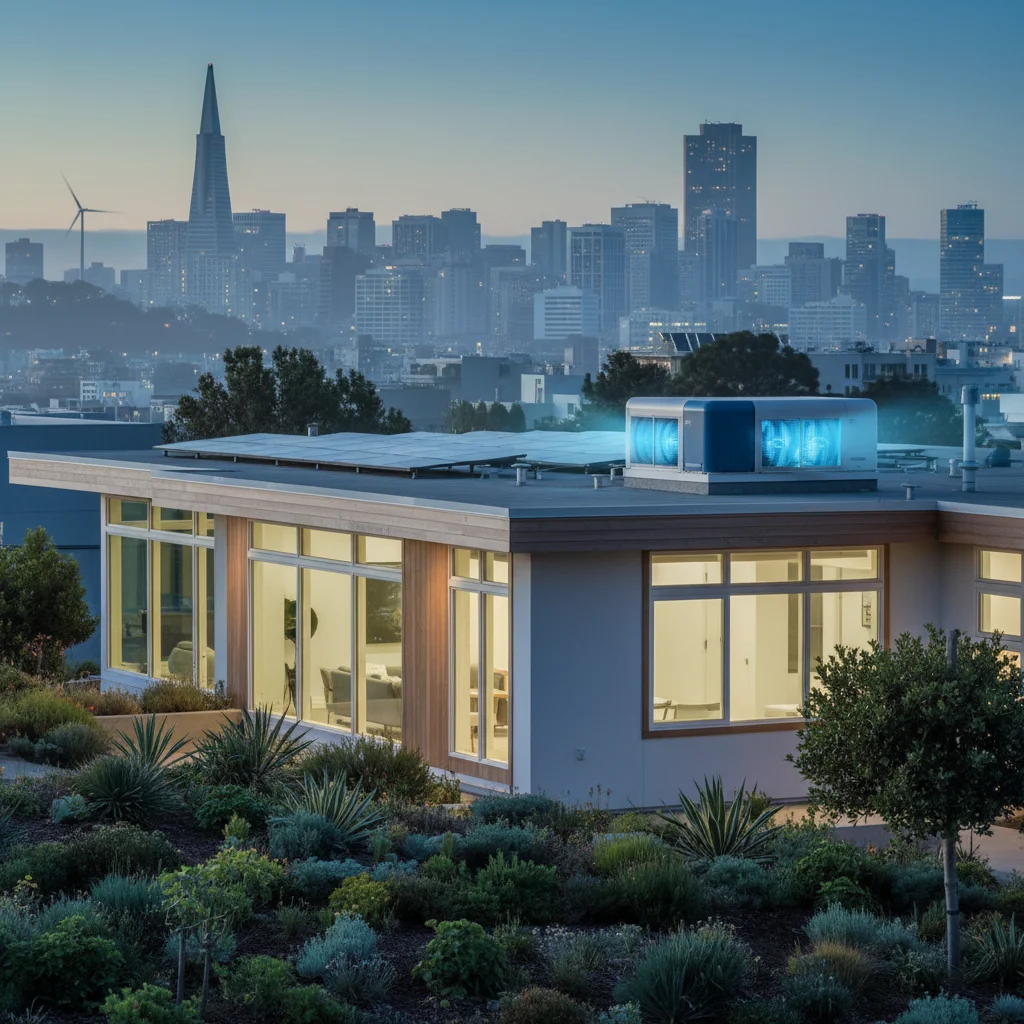
San Francisco homeowners paid between $8,500 and $22,000 for complete HVAC installations in 2025, with the median landing at $14,300—but most left $3,000 to $6,000 in federal tax credits and utility rebates unclaimed. The city's microclimates, strict permitting requirements, and earthquake retrofitting codes drive costs 18-25% higher than the California average, while energy incentive programs through PG&E and the Inflation Reduction Act offer the strongest rebate stacks on the West Coast.
How much does HVAC installation cost in San Francisco?
San Francisco HVAC installations in 2026 range from $8,500 for basic forced-air systems to $22,000 for high-efficiency heat pumps with zone controls. The median installation cost is $14,300, including equipment, labor, permitting, and ductwork modifications. Central air conditioning systems average $9,200-$13,500, gas furnaces run $6,800-$10,200, and ducted heat pumps cost $12,000-$18,000 before rebates.
Labor represents 35-42% of total installation costs in San Francisco due to union wages averaging $95-$125 per hour and strict licensing requirements under San Francisco Building Code Article 13A. Permits add $450-$850 depending on system type and whether structural modifications trigger seismic bracing requirements. And ductwork replacement or modification—necessary in 60% of installations in homes built before 1980—adds $2,500-$6,000 to the project total.
Equipment costs vary by efficiency rating and brand. A 2.5-ton 16 SEER central AC unit costs $2,800-$4,200 wholesale, while a 20 SEER variable-speed heat pump runs $5,500-$7,800. But higher-efficiency systems qualify for larger rebate amounts and deliver faster payback through reduced energy bills in PG&E territory, where residential electricity rates averaged $0.38 per kWh in early 2026.
"The average lifespan of a central air conditioner is 15-20 years, while heat pumps last 15-25 years with proper maintenance." — U.S. Department of Energy
So the effective cost after incentives drops significantly. Federal tax credits under the Inflation Reduction Act cover 30% of qualifying heat pump installations up to $2,000, and PG&E's Energy Efficiency Program offers $2,500-$4,000 for ducted heat pump upgrades replacing gas furnaces. Use our free rebate calculator to estimate your specific incentive stack.
What factors determine the total price of your HVAC system installation?
System capacity, efficiency rating, home size, existing infrastructure, and permit requirements determine San Francisco HVAC installation costs. Homes under 1,500 square feet typically need 2-3 ton systems ($8,500-$12,000), while 2,000-2,500 square foot homes require 3-4 ton units ($11,000-$16,000). Victorian and Edwardian homes with radiator heating and no existing ductwork face $6,000-$9,000 in additional ductwork installation costs.
Efficiency ratings directly impact equipment pricing. A 14 SEER minimum-efficiency AC costs $2,200-$3,400, a 16 SEER mid-tier unit runs $3,100-$4,600, and a 20+ SEER high-efficiency heat pump costs $5,200-$7,800 before installation. But higher SEER ratings reduce monthly energy costs by $35-$90 in San Francisco's mild climate, where cooling degree days average only 145 annually compared to 1,300+ in inland California cities.
Installation complexity varies by neighborhood and home age. Homes in seismic retrofit zones require additional structural bracing adding $800-$1,500 to installation costs. And properties in San Francisco Landmark Districts need architectural review adding 4-8 weeks to project timelines and $350-$600 in review fees. So total project costs span a $14,000 range depending on these variables.
Labor costs fluctuate by season and contractor availability. January-March installations average 12-18% lower than June-August peak season pricing due to reduced demand. Obtaining three competitive bids from licensed C-20 contractors reduces costs by an average of $1,800-$2,600 according to California Contractors State License Board data.
How long will your HVAC system last and what's the payback period on your investment?
Central air conditioning systems last 15-20 years in San Francisco's mild coastal climate, while heat pumps operate 15-25 years with biannual maintenance. Gas furnaces deliver 18-22 years of service, and ductless mini-split systems run 20-25 years. But equipment longevity depends on installation quality, maintenance frequency, and annual runtime hours—San Francisco's moderate temperatures extend system life 20-30% compared to extreme-climate regions.
Investment payback periods range from 8-14 years for standard HVAC upgrades and 5-9 years for heat pump conversions replacing gas furnaces. A homeowner replacing a 12 SEER AC with a 20 SEER heat pump saves $780-$1,100 annually on combined heating and cooling costs at 2026 PG&E rates. And federal tax credits plus PG&E rebates totaling $4,500-$6,000 shorten payback to 6.5-8.5 years on a $14,000 installation.
Energy savings compound over system lifetime. A 16 SEER heat pump saves $12,800-$18,400 over 16 years compared to a 12 SEER AC plus 80% efficiency gas furnace at projected 3.2% annual utility rate increases. So total cost of ownership—including installation, maintenance, and energy—favors high-efficiency systems despite higher upfront costs.
"ENERGY STAR certified heat pumps use 50% less energy than standard electric resistance heating." — ENERGY STAR
Maintenance costs average $280-$420 annually for biannual tune-ups, filter changes, and refrigerant checks. Systems without regular maintenance fail 3-5 years earlier and operate 15-25% less efficiently according to Department of Energy studies. Or homeowners can explore maintenance package options from licensed contractors averaging $240-$360 per year with priority service guarantees.
How does a new HVAC installation compare to alternatives like mini-splits or heat pumps?
Ducted central HVAC systems cost $8,500-$18,000 installed while ductless mini-split systems run $4,200-$12,000 for multi-zone configurations in San Francisco. Mini-splits eliminate ductwork costs saving $2,500-$6,000 in homes without existing ducts but provide less even temperature distribution across larger floor plans. And heat pump systems deliver both heating and cooling in one unit replacing separate AC and furnace systems at $12,000-$18,000 installed.
Mini-split systems excel in Victorian and Edwardian homes where ductwork installation requires cutting through ornate plaster and historical millwork. A three-zone mini-split covering 1,800 square feet costs $8,500-$11,200 versus $16,000-$19,500 for ducted HVAC in the same home. But mini-splits require wall-mounted indoor units visible in each room conflicting with historical preservation guidelines in some landmark districts.
Heat pumps outperform traditional AC-plus-furnace combinations in total cost of ownership. A ducted heat pump replacing a 12 SEER AC and 80% efficiency gas furnace saves $920-$1,280 annually on energy costs while qualifying for $4,500-$6,000 in combined federal and utility incentives. So the payback period drops to 5-7 years compared to 10-14 years for standard efficiency upgrades.
Window AC units and portable heaters cost $800-$2,400 for whole-home coverage but increase energy costs by 40-65% compared to central systems and provide no resale value. Homes with window units sell for 3-6% less than comparable properties with central HVAC according to San Francisco Multiple Listing Service data from 2023-2025.
Learn more about efficiency ratings and system types in our guide to HVAC efficiency.
What financing options and rebates can reduce your San Francisco HVAC installation costs?
The federal Energy Efficient Home Improvement Credit (Section 25C) ended for property placed in service after December 31, 2025 (IRS FS-2025-05). Federal tax credits for this work have ended, but state, local and utility rebates may still apply; check what is available at your address with the DuloCore rebate calculator. PG&E's Energy Efficiency Rebate Program provides $2,500 for ducted heat pump installations and $4,000 for heat pump upgrades replacing natural gas furnaces in 2026. And California's TECH Clean California initiative adds $1,000-$3,000 for qualified heat pump installations in low-income households.
Contractor financing through PACE (Property Assessed Clean Energy) programs allows homeowners to finance HVAC installations through property tax assessments with terms up to 20 years at 5.5-7.9% APR. Repayment attaches to the property rather than the individual enabling transfers at home sale. Or FHA Title I loans offer $7,500-$25,000 for energy efficiency improvements at 6.2-8.5% APR with no equity requirement.
Income-qualified programs expand access. The Bay Area Regional Energy Network offers zero-interest loans up to $15,000 for households at 80% Area Median Income or below. And PG&E's Energy Savings Assistance Program provides no-cost HVAC replacement for households at 200% of federal poverty level or below—$60,000 for a family of four in 2026.
Rebate stacking maximizes savings. A homeowner installing a $14,500 ducted heat pump receives a $2,000 federal tax credit, $4,000 PG&E rebate, and $1,500 TECH Clean California incentive reducing net cost to $7,000. So effective installation costs drop 52% through available programs. Calculate your specific savings with our rebate calculator.
For more details on available incentives see our comprehensive guide to energy tax credits.
What's the installation timeline and process for getting HVAC in San Francisco?
San Francisco HVAC installations take 3-8 weeks from contractor selection to final inspection including design, permitting, installation, and inspection phases. Simple equipment replacements using existing ductwork complete in 1-2 days of active installation, while whole-home installations with new ductwork require 3-5 days of work. But permitting and inspection scheduling add 2-6 weeks to total project duration.
The installation process begins with load calculations determining proper system sizing based on home square footage, insulation levels, window area, and orientation. Contractors perform Manual J load calculations required under San Francisco Building Code ensuring systems neither oversized—wasting energy and shortening equipment life—nor undersized causing comfort issues. And permit applications submit to SF Department of Building Inspection requiring approved plans before work begins.
Permit processing takes 10-25 business days depending on project complexity and department workload. Projects requiring seismic bracing, electrical service upgrades, or gas line modifications undergo plan review adding 2-4 weeks. Or expedited review costs $850-$1,200 reducing turnaround to 5-10 business days for straightforward installations.
Installation day activities include equipment removal, new unit placement, refrigerant line installation, electrical connections, ductwork modifications, thermostat installation, and system commissioning. Crews typically arrive 7:30-8:30 AM and complete single-day installations by 4-6 PM. And final inspections occur 3-14 days after installation requiring contractor presence to demonstrate proper operation and code compliance.
"Proper HVAC system sizing through Manual J load calculations improves efficiency by 15-30% compared to rule-of-thumb sizing methods." — Database of State Incentives for Renewables & Efficiency
Peak season installations scheduled May-August face longer timelines due to contractor backlogs. Booking January-April installations reduces wait times by 60-75% and often secures 10-15% lower pricing through off-season promotions.
Official Sources
- U.S. Department of Energy - Energy Saver — Federal guidance on energy-efficient heating and cooling systems
- ENERGY STAR - Heat Pumps — Certification criteria and energy savings data for qualified heat pump systems
- Database of State Incentives for Renewables & Efficiency — Comprehensive database of federal, state, and utility energy efficiency incentives
Frequently Asked Questions
How much does HVAC installation cost in San Francisco?
San Francisco HVAC installations cost $8,500-$22,000 in 2026 with a median of $14,300 for complete systems. Basic forced-air AC systems start at $8,500-$11,000, mid-efficiency installations run $11,500-$15,500, and high-efficiency ducted heat pumps cost $14,000-$22,000 before rebates. Labor represents 35-42% of total costs at union wage rates of $95-$125 per hour. And ductwork modifications add $2,500-$6,000 in homes without existing ducts.
What HVAC rebates are available in San Francisco?
The federal Energy Efficient Home Improvement Credit (Section 25C) ended for property placed in service after December 31, 2025 (IRS FS-2025-05). PG&E provides $2,500-$4,000 for ducted heat pump installations replacing gas heating in 2026. TECH Clean California adds $1,000-$3,000 for income-qualified households. And Bay Area Regional Energy Network offers zero-interest loans up to $15,000 for households at 80% Area Median Income. Stacking these programs reduces net installation costs by 40-60%.
How long does HVAC installation take in San Francisco?
HVAC installations take 3-8 weeks total including permitting and 1-5 days of active installation work. Equipment replacements using existing ductwork complete in 1-2 days while whole-home installations with new ductwork require 3-5 days. Permit processing adds 10-25 business days and final inspections schedule 3-14 days after installation. Projects requiring seismic bracing or electrical upgrades extend timelines by 2-4 weeks for plan review and specialized contractor coordination.
What is the average lifespan of an HVAC system in San Francisco?
HVAC systems last 15-25 years in San Francisco's mild coastal climate with proper maintenance. Central air conditioners operate 15-20 years, heat pumps run 15-25 years, gas furnaces deliver 18-22 years, and ductless mini-splits last 20-25 years. Regular biannual maintenance extends lifespan 20-30% compared to neglected systems. And San Francisco's moderate temperatures reduce annual runtime hours increasing equipment longevity versus extreme-climate regions where systems operate 40-60% more hours annually.
Is HVAC installation covered by California rebates?
California HVAC rebates in 2026 include PG&E's $2,500-$4,000 for ducted heat pumps, TECH Clean California's $1,000-$3,000 for income-qualified households, and Energy Savings Assistance Program no-cost replacements for households at 200% federal poverty level. These state and utility programs stack with federal tax credits covering 30% of costs up to $2,000. Total rebate amounts range from $3,500-$8,000 depending on household income and system type. Explore available programs in our heat pump rebates guide.
Ready to calculate your HVAC installation savings? Use our free rebate calculator to find federal, state, and utility incentives available for your San Francisco home. Get your personalized estimate in under 2 minutes and connect with licensed C-20 contractors offering competitive quotes.
Last updated April 14, 2026 — reviewed by DuloCore Editorial. About our authors.
Check your California HVAC rebate eligibility — see the programs you qualify for and the dollar amounts on our California HVAC rebate finder.