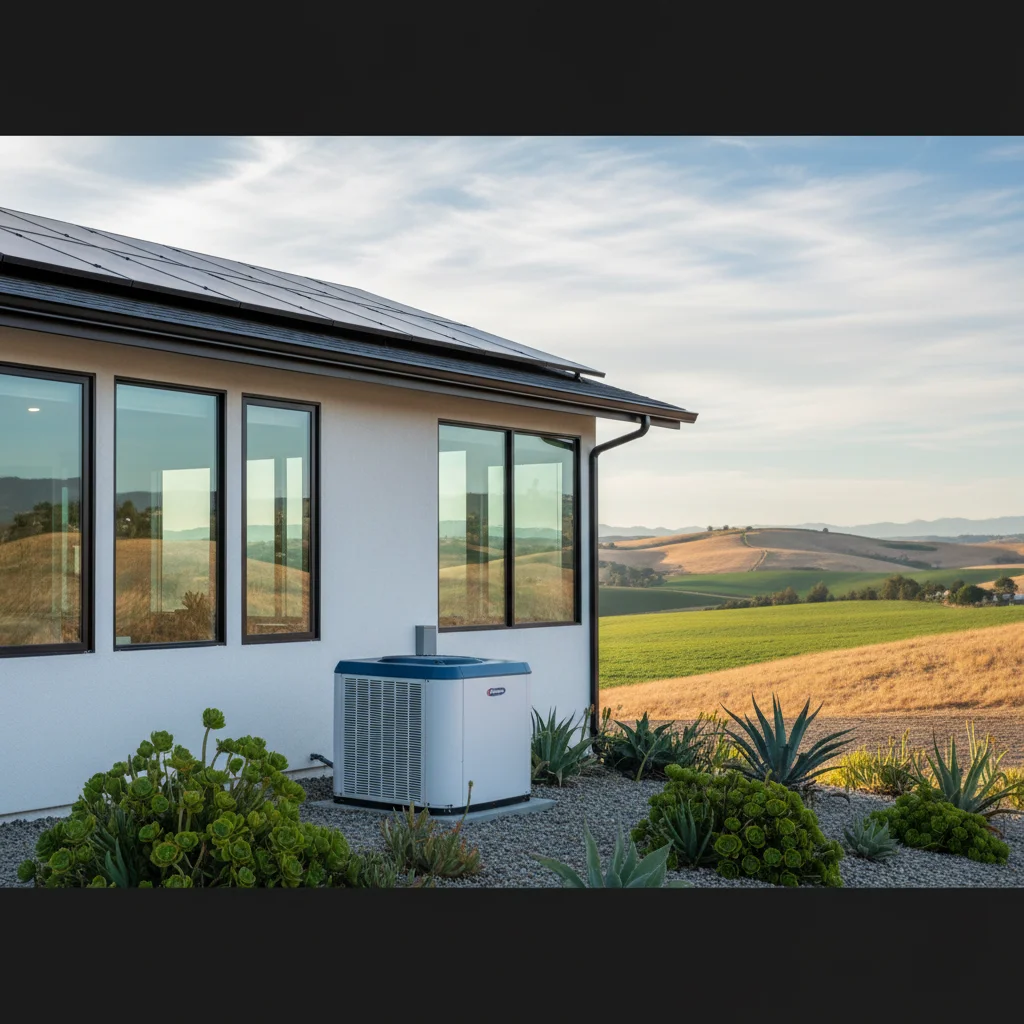
HVAC rebates in the Central Valley depend on who sends your electric or gas bill, and on whether the home has a wood-burning fireplace or stove. DuloCore checked the official pages of the Valley air district, two irrigation districts, PG&E, SCE, SoCalGas and two state programs on October 13, 2026.
What HVAC Rebates Can Central Valley Homeowners Get in 2026?
As of October 13, 2026, the Valley air district lists up to $5,000 toward a heat pump that replaces a wood-burning device. Turlock Irrigation District lists $1,000 or $1,500 for a central heat pump, and Modesto Irrigation District lists $450 or $700.
| Source | What its official page states (October 13, 2026) | Amount |
|---|---|---|
| Valley air district | Voucher toward an electric heat pump that replaces a wood-burning device | Up to $3,500 or $5,000 |
| Turlock Irrigation District | Central heat pump; central air conditioner | $1,000 or $1,500; $500 |
| Modesto Irrigation District | Central heat pump; central air conditioner | $450 or $700; $350 or $600 |
| PG&E | Rebates page lists no heating or cooling equipment rebate | None listed |
| SoCalGas | ENERGY STAR certified furnace | $1.40 to $25 per kBTUh |
| TECH Clean California and HEEHRA, single-family | Both fully reserved | Fully reserved |
Each utility's offer is for its own customers or service area. This page does not say which utility serves which city, so check your bill. The San Joaquin Valley Air Pollution Control District's Fireplace & Woodstove Change-Out page showed an Apply link and no closure notice on October 13, 2026.
Does the Valley Air District Pay Toward a Heat Pump?
Yes. Its Change-Out guidelines list up to $5,000 for an electric heat pump at homes with piped natural gas access, and up to $3,500 without.
In the district's program guidelines, dated Sept. 2026, the incentive table also lists an additional $1,500 for qualified low-income applicants. That line sits in the section for residences without access to piped natural gas. The amounts for residences with access are marked as applying regardless of income. Main conditions:
- The voucher replaces a wood- or pellet-burning device. Old gas and electric heating devices are not eligible for replacement.
- The home must be in San Joaquin, Stanislaus, Merced, Madera, Fresno, Kings or Tulare County, or the Valley portion of Kern County.
- You need an approved voucher before buying, and the device must come from a program retailer.
- The heat pump must be a permanently installed ducted or ductless mini-split unit. For ductless projects, only one head is eligible for reimbursement. Air conditioners are not eligible.
The eligibility check gives an estimate from a ZIP code and project details.
What Do the Modesto and Turlock Irrigation Districts Pay?
Turlock lists $1,000 or $1,500 for a central heat pump and $500 for central air. Modesto lists $450 or $700 and $350 or $600.
On Turlock Irrigation District's residential rebates page, the central heat pump rebate is $1,500 when the contractor invoice shows propane or natural gas capped off or removed and an electric connection installed. The page also lists $350 per ton for a ductless mini split and $50 for an HVAC tuneup. The unit must be installed in a residence in the TID service area, and applications must be received within six months of purchase.
Modesto Irrigation District's residential rebates page links its 2026 Home Rebate Catalog. The catalog's two amounts for each central unit are its Tier 1 and Tier 2 efficiency levels. A ductless mini split heat pump is $350 per indoor head. A contractor with a C-20 license must install central units, and the application is due within 90 days of purchase.
What Do PG&E, SCE and SoCalGas Offer Their Customers?
PG&E's rebates page lists no heating or cooling equipment rebate. SoCalGas lists a furnace rebate of $1.40 to $25 per kBTUh.
- PG&E rebates. The Rebates & Incentives page names no furnace, air conditioner or heat pump.
- PG&E low or no cost upgrades. The Building Electrification page says eligible customers can upgrade heating and cooling systems at low or no cost. It names Powerful Neighborhoods for parts of Fresno and Kern counties, and Empower My Home for parts of Fresno, Bakersfield and Stockton.
- PG&E Energy Savings Assistance. The program page offers free home improvements to income-qualified customers in homes at least five years old. See DuloCore's free HVAC replacement page.
- SoCalGas. The rebate table requires an ENERGY STAR certified furnace with AFUE of 92% or higher, installed by a licensed contractor with proof of permit closure.
- SCE. The rebates page describes Comfortably California, a program for HVAC distributors that does not offer direct customer rebates.
Are State Heat Pump Rebates Still Open in the Central Valley?
No. On October 13, 2026, TECH Clean California single-family heat pump incentives and HEEHRA single-family rebates were both fully reserved, with unapproved HEEHRA requests waitlisted.
The TECH Clean California incentives page says that as of November 14, 2025, its single-family heat pump HVAC incentives are fully reserved and not accepting new reservations. The California Energy Commission's rebate programs page says HEEHRA single-family rebates are fully reserved statewide as of February 24, 2026. The California HVAC rebates guide covers the rest of the state.
Frequently Asked Questions
Which HVAC rebates apply in Fresno?
Fresno County is on the air district's county list, so its heat pump voucher can apply to a Fresno County home with an eligible wood-burning device. PG&E's Building Electrification page names parts of Fresno for Empower My Home and parts of Fresno County for Powerful Neighborhoods, both for eligible customers. PG&E's rebates page lists no heating or cooling equipment rebate.
Can I get a rebate for a new air conditioner alone?
The two irrigation districts list central air conditioner rebates: Turlock for units installed in its service area, Modesto for its residential customers. The air district's guidelines say air conditioners are not eligible for its voucher.
Do I have to apply before I buy?
For the air district voucher, yes. Its guidelines say buying before an approved voucher may make the application ineligible. The irrigation districts take applications after purchase.
Replacing heating or cooling equipment? Estimate rebates for your ZIP code with the rebate calculator.