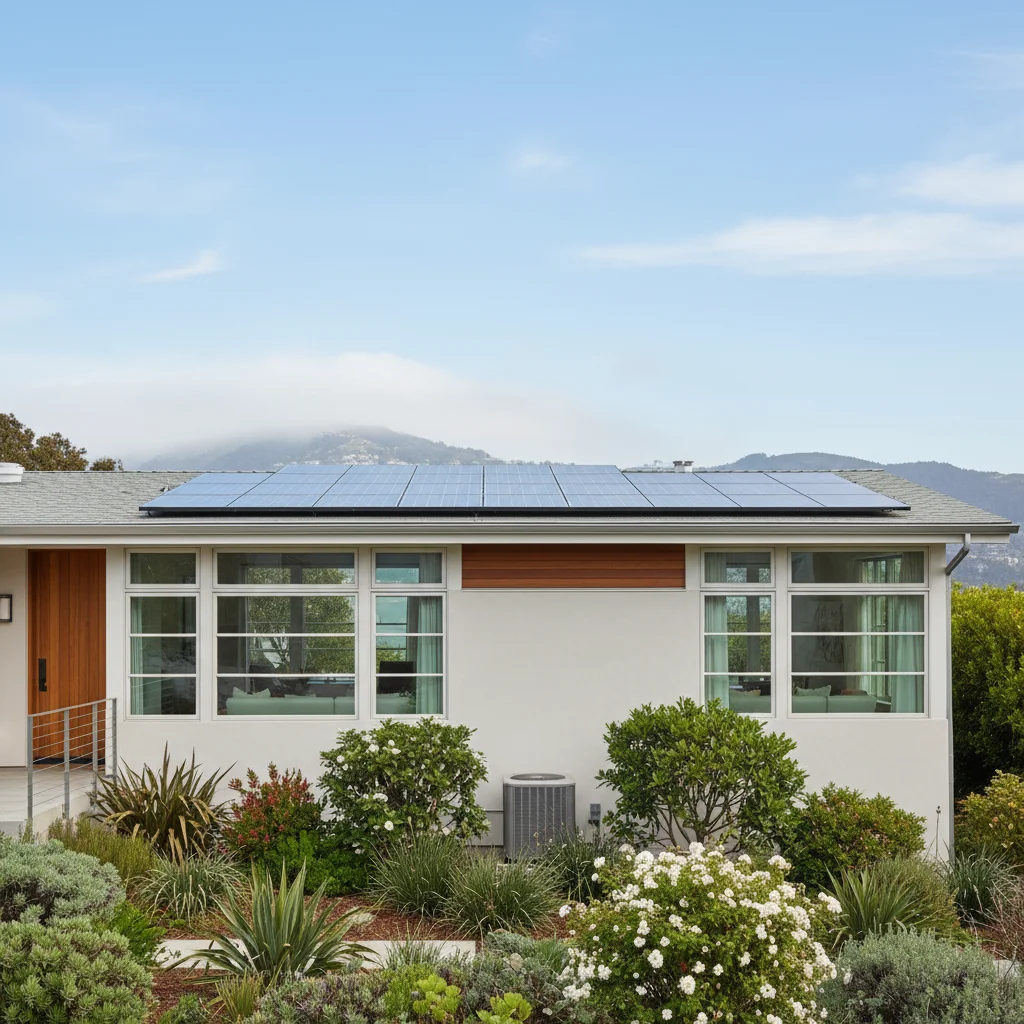
San Francisco homeowners who upgraded their heating and cooling systems in 2026 claimed an average of $11,400 in combined rebates and federal tax credits—enough to cut installation costs nearly in half. And the city's aggressive electrification push means more rebate dollars are flowing this year than ever before.
What HVAC Rebates Are Available in San Francisco Right Now?
San Francisco homeowners in 2026 qualify for three major rebate programs: BayREN's $6,000 heat pump incentive, PG&E's $2,000 Energy Efficiency Rebate, and the federal IRA tax credit covering 30% of installation costs through 2032. Combined, these programs cover $8,000 to $14,000 for qualifying heat pump installations, with higher amounts for income-qualified households.
BayREN (Bay Area Regional Energy Network) leads the pack with direct-install rebates for ductless mini-split systems and central heat pumps. The program targets homes replacing gas furnaces with electric heat pumps—a priority under California's building decarbonization mandates. And the rebate amount scales with system efficiency: $4,000 for standard heat pumps, $6,000 for cold-climate models rated for sub-zero performance.
PG&E's program stacks on top, offering $2,000 for ENERGY STAR-certified heat pumps installed between January 1 and December 31, 2026. But the utility rebate requires pre-approval through PG&E's online portal before installation begins. So homeowners who skip that step forfeit the $2,000—no retroactive claims allowed.
The federal Energy Efficient Home Improvement Credit (Section 25C) ended for property placed in service after December 31, 2025 (IRS FS-2025-05). Federal tax credits for this work have ended, but state, local and utility rebates may still apply; check what is available at your address with the DuloCore rebate calculator. A $20,000 heat pump installation qualifies for a $6,000 tax credit claimed on Form 5695 when filing 2026 taxes.
The federal Residential Clean Energy Credit (Section 25D) ended for expenditures made after December 31, 2025, and the IRS treats an expenditure as made when installation is completed (IRS FS-2025-05).
Income-qualified households earning below 80% of area median income unlock bonus tiers: BayREN adds $3,000 to base rebates, and PG&E doubles its incentive to $4,000. A low-income family installing a cold-climate heat pump can claim $13,000 in rebates plus the 30% federal credit—covering nearly 80% of a $25,000 project.
How Much Can You Save with San Francisco HVAC Rebates?
San Francisco HVAC rebates in 2026 deliver $8,000 to $14,000 in direct savings for standard installations and $17,000 to $22,000 for income-qualified households. A typical 3-ton heat pump costing $18,000 triggers $6,000 from BayREN, $2,000 from PG&E, and $5,400 from the federal IRA credit, cutting net cost to $4,600.
But savings vary by system type. Ductless mini-splits cost $12,000 to $18,000 installed and qualify for the full rebate stack. Central ducted heat pumps run $18,000 to $28,000 but deliver whole-home heating and cooling. And cold-climate models add $3,000 to $5,000 to upfront costs but unlock the highest BayREN rebate tier at $6,000.
Electrical upgrades eat into savings—panel upgrades to support heat pump loads cost $2,500 to $5,000. The federal Energy Efficient Home Improvement Credit (Section 25C) ended for property placed in service after December 31, 2025 (IRS FS-2025-05). So a $22,000 project (heat pump plus panel upgrade) nets $6,600 in federal credits, $6,000 from BayREN, and $2,000 from PG&E—total savings of $14,600, or 66% of project cost.
Operating cost savings compound over time. Heat pumps cut annual heating and cooling bills by $800 to $1,400 compared to gas furnaces and AC units, according to data from ENERGY STAR. Over a 15-year lifespan, that's $12,000 to $21,000 in utility savings on top of installation rebates.
For context, San Francisco's median household income hit $136,700 in 2025, placing most homeowners above the income-qualified threshold. But those who qualify unlock an additional $7,000 in bonus rebates—BayREN's $3,000 adder and PG&E's $2,000 boost—pushing total rebates to $21,000 before the federal credit.
What Documentation Do You Need to Claim Your HVAC Rebate?
San Francisco HVAC rebate applications require proof of purchase, contractor license verification, AHRI certificate for equipment efficiency ratings, and pre-installation approval for PG&E rebates. BayREN demands photos of old equipment before removal and new installation within 30 days of project completion. Form 5695 only covers qualifying work completed by December 31, 2025 and claimed on a 2025 return; the federal 25C and 25D credits ended after that date (IRS FS-2025-05).
Start with contractor documentation. The installing company must hold an active C-20 HVAC license in California—unlicensed installers disqualify the entire rebate. And the contractor provides the AHRI (Air-Conditioning, Heating, and Refrigeration Institute) certificate proving the heat pump meets minimum efficiency standards: 16 SEER2 for cooling, 9 HSPF2 for heating.
BayREN's application portal requires uploading before-and-after photos: one showing the old furnace or AC unit with serial number visible, one showing the new heat pump nameplate. The utility bills from the past 12 months verify account holder status. And the signed contract itemizing equipment and labor costs must match the rebate claim within $500—discrepancies trigger manual review delays of 4 to 6 weeks.
PG&E's pre-approval step generates a reservation number valid for 180 days. Miss that deadline and the rebate expires. After installation, submit the final invoice, paid receipt, and completed Form 439-E (Energy Efficiency Rebate Application) within 30 days. Late submissions forfeit the $2,000.
For the federal credit, the Manufacturer Certification Statement—available from the equipment maker's website—confirms IRA compliance. Form 5695 only covers qualifying work completed by December 31, 2025 and claimed on a 2025 return; the federal 25C and 25D credits ended after that date (IRS FS-2025-05). The IRS doesn't require contractor invoices upfront but recommends keeping them for 7 years in case of audit.
Income-qualified applicants need pay stubs or tax returns proving household income below 80% AMI ($109,360 for a family of four in San Francisco as of 2026). BayREN verifies income through the California Alternate Rates for Energy (CARE) program enrollment or manual income documentation review.
What Are the Deadlines for San Francisco HVAC Rebate Programs?
BayREN's heat pump rebate runs through December 31, 2026, with funds allocated on a first-come basis until the $48 million budget depletes. PG&E's rebate requires pre-approval submission by November 15, 2026, and installation completion by December 31, 2026. The federal IRA credit has no annual deadline but must be claimed on tax returns filed by April 15, 2027, for 2026 installations.
BayREN historically exhausts funding by late October in high-demand years. The program launched January 1, 2026, with $48 million allocated across nine Bay Area counties. San Francisco and Alameda County account for 40% of applications, burning through roughly $20 million in the first eight months. So November and December applications face waitlist risk if funds run dry.
PG&E's two-step deadline system trips up late planners. Pre-approval reservations close November 15—no exceptions, even if installation is scheduled earlier. That gives homeowners 46 days to complete the project before the December 31 installation deadline. Miss either date and the $2,000 evaporates.
The federal credit operates on a tax-year basis. Install the heat pump anytime between January 1 and December 31, 2026, then claim the credit on your 2026 tax return filed by April 15, 2027. Extensions push the filing deadline to October 15, 2027, but don't delay the credit—just the paperwork. And the 30% rate holds steady through 2032, so there's no urgency penalty for waiting until next year.
BayREN's application processing takes 6 to 8 weeks after installation photos and final invoices are uploaded. Rebate checks arrive via mail 10 to 12 weeks post-approval. PG&E processes claims in 8 to 10 weeks, issuing payments as bill credits or direct deposit. So homeowners financing installations need to budget for 3-month reimbursement lag times.
How Does the San Francisco HVAC Rebate Process Work Step-by-Step?
San Francisco's HVAC rebate process requires four stages: pre-approval through PG&E 45 days before installation, contractor selection with C-20 license verification, equipment installation with AHRI-certified heat pump, and post-installation application submission to BayREN within 30 days. The federal IRA credit is claimed separately on tax returns after receiving rebate payments.
Start 60 days before installation. Log into PG&E's rebate portal at pge.com/rebates and submit the heat pump model number, contractor license, and estimated install date. The system generates a reservation number within 3 to 5 business days. That locks in the $2,000 rebate for 180 days.
Next, vet contractors. Verify the C-20 HVAC license at cslb.ca.gov—expired or suspended licenses void rebates. Request three quotes itemizing equipment, labor, permits, and electrical work. And confirm the contractor participates in BayREN's network (check bayren.org/contractors) to streamline application processing.
Installation day: the contractor removes old equipment, installs the new heat pump, and upgrades the electrical panel if needed. Snap photos of the old furnace serial number before removal and the new heat pump nameplate after installation. BayREN's application portal flags missing photos, delaying approval by 2 to 4 weeks.
Within 30 days of project completion, submit three applications:
- BayREN: Upload before/after photos, signed contract, paid invoice, and AHRI certificate at bayren.org/heatpump
- PG&E: Submit Form 439-E, reservation number, and final receipt at pge.com/rebates
- Federal IRA: Save Manufacturer Certification Statement and receipts for tax filing
BayREN processes claims in 6 to 8 weeks, issuing checks by mail. PG&E applies bill credits in 8 to 10 weeks or direct deposits within 12 weeks. Form 5695 only covers qualifying work completed by December 31, 2025 and claimed on a 2025 return; the federal 25C and 25D credits ended after that date (IRS FS-2025-05).
Common delays: mismatched invoice amounts between BayREN and PG&E applications, missing AHRI certificates (request duplicates from the equipment manufacturer), and expired PG&E reservation numbers. So triple-check documents before uploading to avoid 4-week resubmission cycles.
San Francisco HVAC Rebates vs. Federal Tax Credits: Which Should You Use?
San Francisco homeowners in 2026 should stack BayREN and PG&E rebates with the federal IRA credit to maximize savings, claiming $8,000 in local rebates plus 30% of remaining costs through the tax credit. Rebates reduce upfront expense immediately.
The math works like this: a $20,000 heat pump installation triggers $6,000 from BayREN and $2,000 from PG&E, reducing net cost to $12,000. The federal Energy Efficient Home Improvement Credit (Section 25C) ended for property placed in service after December 31, 2025 (IRS FS-2025-05). Total savings hit $14,000, cutting final cost to $6,000.
But the order matters. Local rebates are processed first, arriving as checks or bill credits within 8 to 12 weeks. The federal credit reduces your tax bill when filing in April 2027. So homeowners financing installations pay the full $20,000 upfront, receive $8,000 back from rebates by spring 2026, and claim the $6,000 credit on 2026 taxes filed in early 2027.
One key difference: rebates have income thresholds and funding caps. BayREN's $48 million budget runs out by late October most years. The federal Energy Efficient Home Improvement Credit (Section 25C) ended for property placed in service after December 31, 2025 (IRS FS-2025-05).
So the strategic move is applying for local rebates first. Lock in PG&E's reservation by summer, complete installation before BayREN funds deplete in fall, and pocket the federal credit as a bonus at tax time. Homeowners who delay until November risk losing $8,000 in rebates while the federal credit remains available.
And there's no double-dipping penalty. The IRS calculates the credit based on total project cost before rebates. A $20,000 installation yields a $6,000 credit even if BayREN and PG&E rebates cut your out-of-pocket to $12,000. That's $14,000 total savings on a $20,000 project—a 70% effective discount.
For deeper context on combining incentives, see our guide to energy tax credits.
Official Sources
- U.S. Department of Energy Save Hub — Federal rebate and tax credit information for residential energy upgrades (note: the federal 25C and 25D credits ended for projects completed after December 31, 2025)
- DSIRE Database — Comprehensive state and utility incentive tracker for California HVAC programs
- IRS Energy Incentives — Official guidance on claiming the Inflation Reduction Act residential clean energy credit
Frequently Asked Questions
What HVAC systems qualify for San Francisco rebates?
San Francisco rebates in 2026 cover electric heat pumps (ductless mini-splits and central ducted systems) that meet minimum efficiency standards of 16 SEER2 cooling and 9 HSPF2 heating. Gas furnaces, traditional AC units, and hybrid systems don't qualify. Cold-climate heat pumps rated for sub-zero operation unlock the highest BayREN rebate at $6,000. The equipment must appear on ENERGY STAR's certified product list and carry an AHRI certificate proving efficiency ratings. Installation by a California-licensed C-20 contractor is mandatory for all rebate programs.
How much money can you get from HVAC rebates in San Francisco?
Standard San Francisco households in 2026 claim $8,000 in combined rebates ($6,000 BayREN, $2,000 PG&E) plus a federal tax credit covering 30% of total project costs. A $20,000 heat pump installation nets $14,000 total: $8,000 in rebates and $6,000 from the IRA credit. Income-qualified households earning below 80% area median income receive $15,000 in rebates ($9,000 BayREN, $4,000 PG&E) plus the 30% federal credit, totaling $21,000 on the same $20,000 project.
What is the deadline to apply for San Francisco HVAC rebates?
BayREN's rebate program runs through December 31, 2026, but the $48 million budget historically depletes by late October on a first-come basis. PG&E requires pre-approval submission by November 15, 2026, and installation completion by December 31, 2026—late applications forfeit the $2,000 rebate. The federal IRA credit has no deadline but must be claimed on 2026 tax returns filed by April 15, 2027. BayREN applications must be submitted within 30 days of installation completion with before/after photos and final invoices.
Do I need a permit to claim HVAC rebates in San Francisco?
San Francisco requires building permits for all heat pump installations, and both BayREN and PG&E verify permit status during rebate application review. The installing contractor pulls the permit before work begins—permit numbers must appear on final invoices submitted with rebate claims. Unpermitted installations are disqualified from all rebate programs, even if equipment meets efficiency standards. Permit fees run $250 to $600 depending on system size and electrical panel upgrades. The federal IRA credit doesn't require permit documentation, but the IRS recommends retaining permits for audit defense.
Are HVAC rebates available for renters in San Francisco?
San Francisco HVAC rebates in 2026 require applicants to be the property owner listed on utility bills and building permits, disqualifying most renters from direct claims. Renters can negotiate with landlords to install heat pumps and transfer rebate savings as rent credits or cost-sharing agreements, but the landlord must submit applications. Rent-controlled buildings face additional restrictions under San Francisco Rent Ordinance provisions limiting capital improvement pass-throughs to tenants. Income-qualified renters in master-metered buildings may qualify for BayREN's multifamily program, which operates separately from single-family rebates and requires landlord participation.
Ready to calculate your San Francisco HVAC rebate savings? Use our free rebate calculator to estimate total incentives based on your system type, income, and installation costs. Get a personalized breakdown of BayREN, PG&E, and federal IRA credits in under 2 minutes—no signup required.
Updated on April 14, 2026. Fact-checked by DuloCore Editors. About our research team.
Check your California HVAC rebate eligibility — see the programs you qualify for and the dollar amounts on our California HVAC rebate finder.