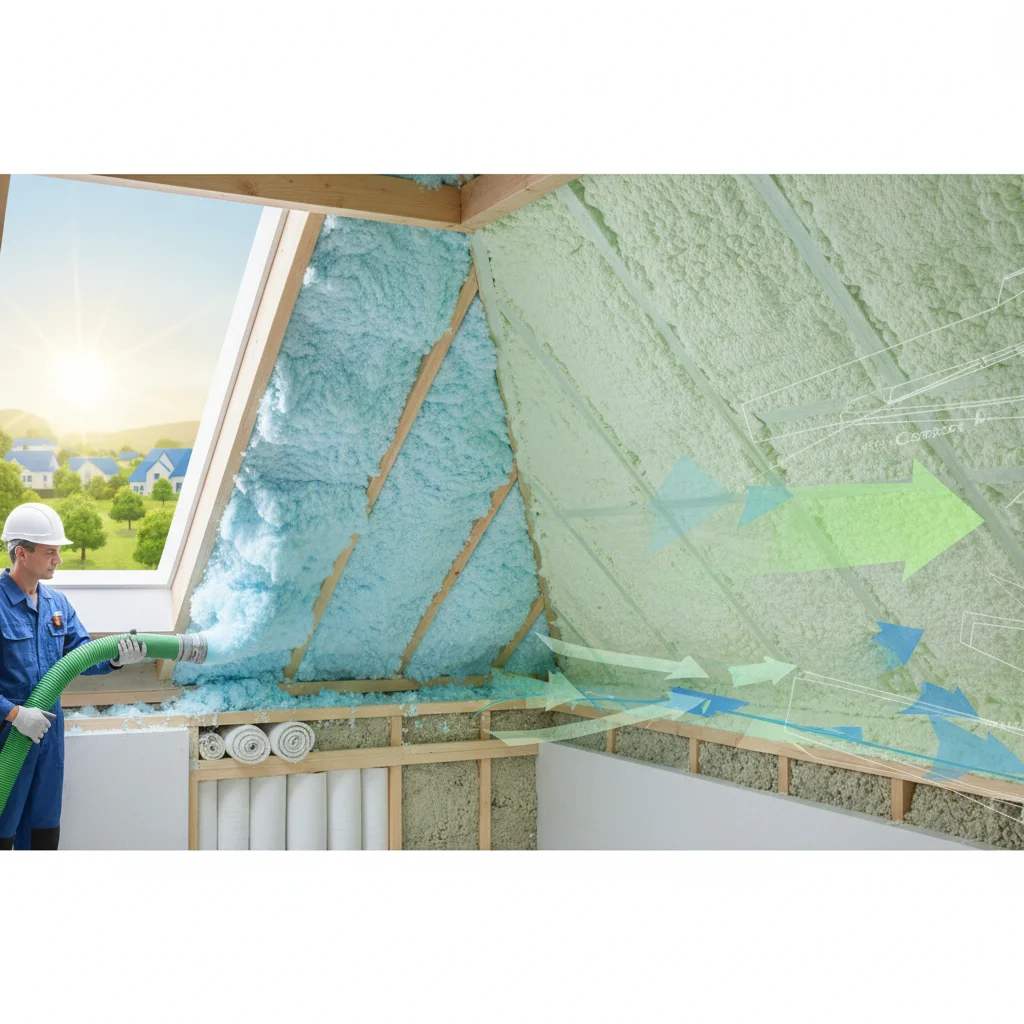
Homeowners spend $1.50 to $3.00 per square foot on blown-in insulation in 2026, but federal rebates and state incentives can cut that cost by 30% to 50% when paired with energy efficiency upgrades. A 1,500-square-foot attic insulation project runs $2,250 to $4,500 before rebates, and households in cold climates see energy bill reductions of $300 to $600 annually after installation.
How Much Does Blown-In Insulation Cost Per Square Foot?
Blown-in insulation costs $1.50 to $3.00 per square foot installed in 2026, with fiberglass averaging $1.50 to $2.00 and cellulose ranging from $2.00 to $3.00. Installation depth, R-value targets, and attic accessibility drive the final price. Professional installation adds $0.75 to $1.25 per square foot compared to DIY approaches.
Material choice determines cost per square foot. Fiberglass blown-in insulation costs $0.50 to $0.75 per square foot for materials alone, while cellulose runs $0.70 to $1.00 per square foot. Labor accounts for 50% to 60% of total project costs. And attic projects under 1,000 square feet pay 15% to 20% more per square foot than larger jobs due to fixed setup costs.
Climate zone requirements affect material volume. California homeowners targeting R-38 for attic insulation need 10 to 13 inches of cellulose or 12 to 15 inches of fiberglass. But R-49 installations in northern climates require 14 to 17 inches of cellulose, increasing material costs by 25% to 35%. Use our free rebate calculator to estimate project costs with federal and state incentives applied.
"Insulation upgrades deliver median energy savings of 15% annually for existing homes." — U.S. Department of Energy
Which Blown-In Insulation Brands Qualify for Tax Credits and Rebates in 2026?
ENERGY STAR certified blown-in insulation qualifies for IRA tax credits and state rebates in 2026 when installed as part of whole-home energy upgrades. Johns Manville, Owens Corning, CertainTeed, and GreenFiber manufacture products meeting federal efficiency standards. Installation receipts must show R-value certifications and ENERGY STAR labels for rebate claims.
The federal Energy Efficient Home Improvement Credit (Section 25C) ended for property placed in service after December 31, 2025 (IRS FS-2025-05). Federal tax credits for this work have ended, but state, local and utility rebates may still apply; check what is available at your address with the DuloCore rebate calculator. California's TECH Clean California program offers $500 to $2,000 rebates for attic insulation paired with heat pump installations. And PG&E, SCE, and SDG&E provide utility rebates ranging from $0.10 to $0.25 per square foot for verified energy savings.
Product certifications determine rebate eligibility. Johns Manville Climate Pro and Owens Corning ProCat meet ENERGY STAR thermal resistance standards for R-38 and R-49 installations. So homeowners purchasing non-certified products forfeit federal tax credits and most state incentives. GreenFiber Sanctuary cellulose qualifies for California fire safety rebates in wildfire zones due to Class 1 fire ratings.
| Program | Rebate Amount | Eligibility Requirement | Application Deadline |
|---|---|---|---|
| Federal IRA Tax Credit | Ended Dec 31, 2025 | — | Ended Dec 31, 2025 |
| TECH Clean California | $500-$2,000 | Paired with heat pump installation | Ongoing (2026 funds) |
| PG&E Energy Upgrade | $0.10-$0.25/sq ft | Verified 15%+ energy savings | Rolling enrollment |
What's the Installation Cost and How Long Does the Project Take?
Installation costs $1,125 to $3,750 for a 1,500-square-foot attic, with professional crews completing projects in 3 to 6 hours. Setup accounts for 45% to 60% of labor time as contractors seal air leaks, install baffles, and protect existing fixtures. DIY installations save $800 to $1,500 but require $250 to $400 in equipment rental and safety gear.
Professional installation includes pre-work critical for rebate eligibility. Contractors seal attic bypasses, install rafter vents, and verify ventilation meets building codes before blowing insulation. And air sealing adds $300 to $800 to project costs but increases federal tax credit eligibility from $0 to $1,200. So skipping air sealing eliminates 75% of available federal incentives.
Project timelines vary by attic complexity. Standard attic installations take 4 to 5 hours for 1,500 square feet, while cathedral ceilings or multi-level homes require 6 to 8 hours. But equipment breakdowns, weather delays, or code compliance issues extend timelines by 1 to 2 days. California contractors report 12% longer installation times in 2026 due to Title 24 verification requirements.
Labor rates differ by region. Northern California contractors charge $75 to $110 per hour, while Central Valley installers average $55 to $85 per hour. Two-person crews complete most residential projects, totaling $450 to $880 in labor for standard attics. Check insulation rebates for contractor networks offering rebate-qualified installations.
How Quickly Will Blown-In Insulation Pay for Itself Through Energy Savings?
Blown-in insulation pays for itself in 4 to 8 years through reduced heating and cooling costs, with California homeowners saving $240 to $480 annually on energy bills. Climate zone 3 households see 12% to 18% energy bill reductions, while zone 16 mountain regions achieve 20% to 28% savings. Homes built before 1980 with minimal existing insulation reach payback in 3 to 5 years.
Existing insulation levels determine savings potential. Attics with R-11 or less upgrading to R-38 save $35 to $50 monthly on natural gas and electricity bills. But homes with R-19 upgrading to R-38 save $18 to $28 monthly, extending payback periods by 60% to 90%. And central air conditioning systems in Sacramento and Fresno see 22% to 31% cooling cost reductions after R-49 installations.
Federal and state incentives accelerate payback timelines. A $3,000 insulation project drops to $1,800 after 30% federal tax credits and $600 in utility rebates, cutting payback from 7 years to 4 years. So households stacking IRA credits with California TECH rebates recover costs in 3 to 5 years versus 6 to 9 years without incentives.
Energy price volatility affects ROI calculations. California natural gas prices averaging $2.10 to $2.80 per therm in 2026 make insulation upgrades 40% more valuable than during 2020-2022 price lows. But households switching from gas furnaces to heat pumps double energy savings to $480 to $720 annually. Visit heat pump rebates for combined upgrade strategies.
"Homes with proper attic insulation reduce HVAC energy consumption by 20% to 30% compared to under-insulated structures." — ENERGY STAR
Which Climate Zones Benefit Most from Blown-In Insulation, and What R-Value Do You Need?
Climate zones 14 through 16 in Northern California and mountain regions achieve the highest energy savings from blown-in insulation, with R-49 installations reducing heating costs by $400 to $650 annually. Coastal zones 3 and 6 see smaller gains of $180 to $280 yearly due to milder temperature swings. Title 24 requires R-38 minimum for most California attics, but R-49 installations pay for themselves 35% faster in cold climates.
R-value requirements scale with heating and cooling degree days. Sacramento (zone 12) needs R-38 for code compliance but achieves optimal payback at R-49 when winter gas heating dominates energy costs. And San Diego (zone 7) meets efficiency targets at R-30 but gains minimal financial benefit upgrading beyond R-38. So climate zone 16 households in Truckee or Big Bear save $520 to $780 annually with R-60 installations versus R-38 baselines.
Existing insulation depth determines upgrade value. Homes with zero attic insulation in Redding or Chico see $45 to $65 monthly savings after R-49 cellulose installation. But coastal homes with R-19 upgrading to R-38 save $12 to $22 monthly, making ROI marginal without rebates. Los Angeles and San Francisco households prioritize air sealing over R-value increases when existing insulation exceeds R-30.
Seasonal temperature extremes drive insulation ROI. Fresno and Bakersfield experience 95°F to 105°F summer peaks and 32°F to 40°F winter lows, creating 18% to 24% annual energy savings from R-49 upgrades. But moderate coastal climates like Santa Barbara save 8% to 12% annually, making insulation a lower priority than duct sealing or heat pump installations. Review energy tax credits for climate-specific incentive stacking strategies.
Blown-In Insulation vs. Fiberglass Batts vs. Spray Foam: Which Is Most Cost-Effective?
Blown-in cellulose costs $2.00 to $3.00 per square foot installed and delivers the fastest payback in most California climates, beating fiberglass batts ($1.25 to $2.00) in irregular attic spaces and spray foam ($3.50 to $6.50) in upfront costs. Fiberglass batts save $600 to $1,200 on material costs for standard joist layouts but leave 15% to 25% more air gaps than blown-in applications. Spray foam provides superior air sealing but costs 2.5 to 3 times more than cellulose.
Air sealing performance separates blown-in from batts. Cellulose and fiberglass blown-in insulation fill irregular cavities around wiring, pipes, and framing, reducing air infiltration by 30% to 45% compared to batts. And spray foam creates vapor barriers preventing moisture intrusion, making it ideal for crawl spaces and rim joists. But attic applications rarely justify spray foam's $5,250 to $9,750 cost premium over cellulose for 1,500 square feet.
Fire safety and moisture resistance favor cellulose in California. GreenFiber and Nu-Wool cellulose products carry Class 1 fire ratings due to borate treatments, meeting wildfire zone requirements in Title 24. Fiberglass batts absorb moisture in coastal climates, losing 15% to 20% of R-value when damp. So cellulose maintains thermal performance in humid attics while fiberglass requires vapor barriers adding $0.30 to $0.50 per square foot.
Installation speed affects labor costs. Blown-in insulation installs 40% to 60% faster than batts in complex attic layouts with multiple penetrations and irregular joist spacing. But batts cost 20% to 30% less in new construction with standardized framing. Spray foam requires 8 to 12 hours for full attic coverage versus 4 to 6 hours for blown cellulose, doubling labor expenses.
How Long Does Blown-In Insulation Last, and What Maintenance Does It Require?
Blown-in cellulose and fiberglass insulation last 20 to 30 years in California attics when properly installed and protected from moisture, with minimal maintenance beyond annual visual inspections. Settling reduces R-value by 1% to 3% annually during the first 5 years, then stabilizes at 85% to 92% of original depth. Roof leaks, pest intrusion, and attic ventilation failures cause 80% of premature insulation degradation requiring partial or full replacement.
Annual inspections prevent costly failures. Homeowners check for compressed insulation around recessed lights, water stains indicating roof leaks, and rodent nests disturbing material distribution. And attic temperatures exceeding 150°F signal ventilation problems causing fiberglass to degrade 40% faster than design specifications. So California wildfire zones inspect for ember intrusion every 6 months, as smoldering cellulose creates fire risks despite borate treatments.
Moisture damage requires immediate remediation. Fiberglass loses 50% to 70% of insulating value when saturated and doesn't recover after drying. Cellulose absorbs water but regains 90% to 95% of R-value once dried if treated within 48 hours. But mold growth on wet cellulose forces complete removal and replacement, costing $2.50 to $4.00 per square foot versus $1.50 to $2.50 for new installations.
Pest control extends insulation lifespan. Rodents compress and contaminate blown-in materials, reducing effectiveness by 30% to 50% in affected areas. Borate-treated cellulose deters insects but doesn't prevent rodent nesting. So attic exclusion work costs $800 to $1,500 but protects $3,000 to $5,000 insulation investments for 15 to 20 additional years.
Official Sources
- U.S. Department of Energy - Save Energy, Save Money — Federal energy efficiency guidance and rebate information
- ENERGY STAR Insulation Standards — R-value requirements and certified product listings
- DSIRE USA — State and utility rebate program database
Related Reading: Learn more about Insulation Cost Per Square Foot 2026.
Related Reading: Learn more about Cellulose Insulation Cost Per Square Foot.
Frequently Asked Questions
How much does blown in insulation cost per square foot?
Blown-in insulation costs $1.50 to $3.00 per square foot installed in 2026, with fiberglass averaging $1.50 to $2.00 and cellulose $2.00 to $3.00. Material accounts for 40% to 50% of costs, while labor and setup comprise the remainder. A 1,500-square-foot attic runs $2,250 to $4,500 before federal tax credits and state rebates.
What factors affect the cost of blown in insulation?
Material type, R-value target, attic accessibility, and regional labor rates determine blown-in insulation costs. Cellulose costs 25% to 35% more than fiberglass but settles less over time. Climate zones requiring R-49 versus R-38 use 30% to 40% more material. Northern California labor rates run $75 to $110 per hour versus $55 to $85 in the Central Valley.
Is blown in insulation cheaper than fiberglass batts?
Blown-in insulation costs $0.50 to $1.00 more per square foot than fiberglass batts but delivers 15% to 25% better air sealing in irregular attic spaces. Batts save $600 to $1,200 on material costs for 1,500 square feet but require 40% to 60% more labor in complex layouts. And blown-in applications qualify for higher rebates due to superior thermal performance.
Do I qualify for rebates on blown in insulation installation?
The federal Energy Efficient Home Improvement Credit (Section 25C) ended for property placed in service after December 31, 2025 (IRS FS-2025-05). TECH Clean California offers $500 to $2,000 for installations combined with heat pump upgrades. Utility programs like PG&E provide $0.10 to $0.25 per square foot for verified 15% energy savings. Verify current programs at DSIRE USA.
How long does it take to install blown in insulation?
Professional crews install blown-in insulation in 3 to 6 hours for standard 1,500-square-foot attics, with setup and air sealing accounting for 45% to 60% of project time. Complex layouts with cathedral ceilings or multi-level attics require 6 to 8 hours. DIY installations take 8 to 12 hours including equipment rental, material transport, and safety preparation. Title 24 verification adds 1 to 2 hours in California.
Ready to lower your energy bills and claim thousands in rebates? Use our free rebate calculator to find every federal, state, and utility incentive available for your blown-in insulation project. Get your personalized savings estimate in 60 seconds.
Last updated: April 14, 2026. Reviewed by the DuloCore Editorial Team. About our authors.
Check your California insulation rebate eligibility — see the programs you qualify for and the dollar amounts on our California insulation rebate finder.