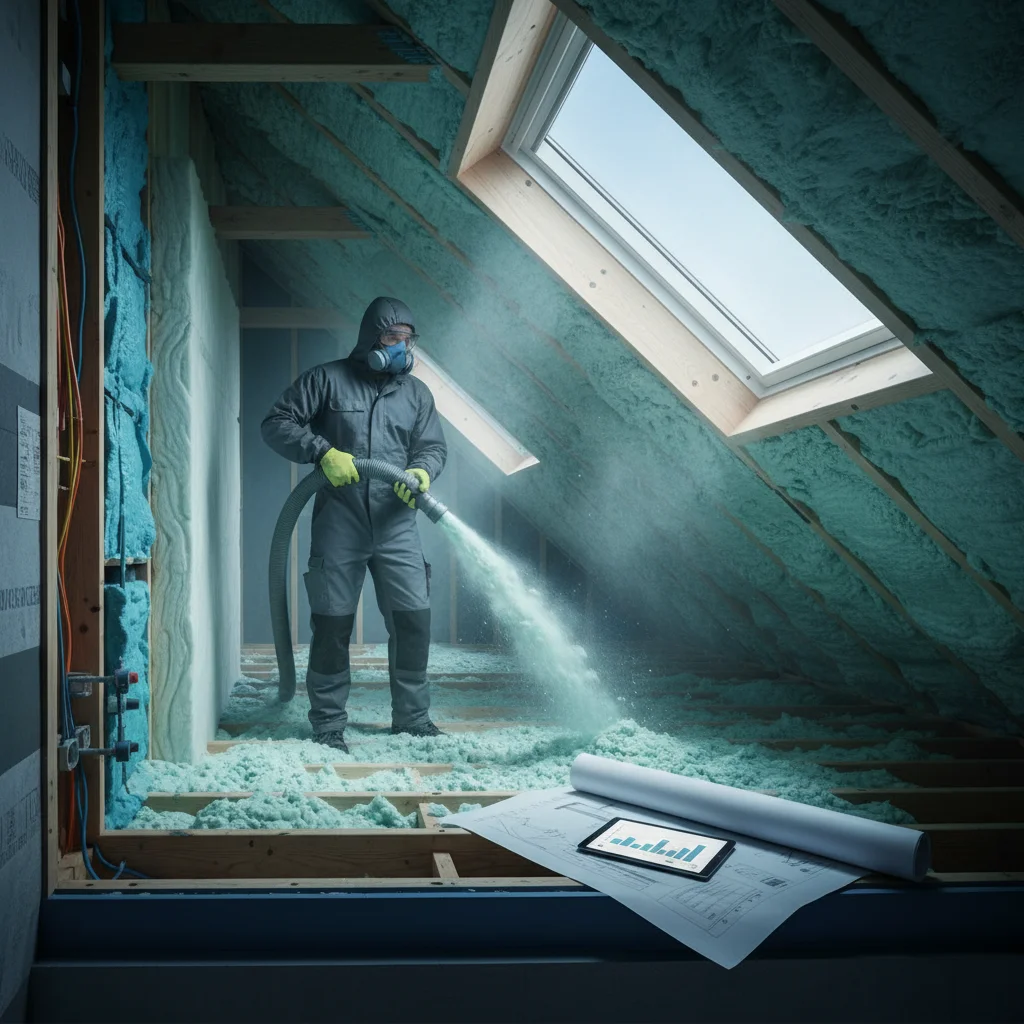
Cellulose insulation costs $0.60 to $2.30 per square foot installed in 2026, with blown-in attic applications averaging $1.20 per square foot and dense-pack wall installations reaching $2.30 per square foot. The federal Energy Efficient Home Improvement Credit (Section 25C) ended for property placed in service after December 31, 2025 (IRS FS-2025-05). Federal tax credits for this work have ended, but state, local and utility rebates may still apply; check what is available at your address with the DuloCore rebate calculator.
How Much Does Cellulose Insulation Cost Per Square Foot in 2026?
Cellulose insulation averages $1.20 per square foot for blown-in attic installations and $2.30 per square foot for dense-pack wall applications in 2026. Material costs range from $0.30 to $0.50 per square foot, while labor adds $0.30 to $1.80 per square foot depending on application method and project complexity.
So what drives the 283% price difference between attic and wall installations? Dense-pack wall applications require specialized equipment to achieve the 3.5 pounds per cubic foot density needed for R-value stability, while attic blow-ins use standard pneumatic equipment. Installation depth affects total costs—achieving R-38 in an attic requires 10.8 inches of cellulose at $1.20 per square foot, totaling $1,296 for a 1,080-square-foot space.
The federal Energy Efficient Home Improvement Credit (Section 25C) ended for property placed in service after December 31, 2025 (IRS FS-2025-05). A $1,296 attic project drops to $907 after claiming the credit. California's Energy Upgrade California program adds rebates of $0.10 to $0.30 per square foot for whole-house upgrades that include cellulose insulation meeting Title 24 standards.
Material quality affects pricing—premium fire-retardant treatments add $0.05 to $0.10 per square foot compared to standard borate-treated cellulose. And regional labor rates create geographic price variations, with San Francisco Bay Area installations costing 40% more than Central Valley projects at $1.68 versus $1.20 per square foot.
"Cellulose insulation provides an R-value of 3.5 per inch and reduces air infiltration by up to 38% compared to fiberglass batts." — Department of Energy
What Cellulose Insulation Specs Qualify for Federal Tax Rebates and Credits?
The federal Energy Efficient Home Improvement Credit (Section 25C) ended for property placed in service after December 31, 2025 (IRS FS-2025-05).
Installation must achieve specific R-values per climate zone—California's Zone 3 requires R-38 attic insulation minimum, while Zone 16 mountain regions require R-49. Cellulose density specifications matter for rebate eligibility: blown attic applications need 1.5 to 2.2 pounds per cubic foot, while dense-pack walls require 3.0 to 3.5 pounds per cubic foot to prevent settling that reduces R-value over time.
So certification documentation becomes critical for claiming credits. Manufacturers like Applegate, GreenFiber, and Nu-Wool provide ASTM C739 compliance certificates showing fire resistance ratings (Class 1 or A), corrosion resistance (ASTM C739 Section 8), and settled density specifications. Form 5695 only covers qualifying work completed by December 31, 2025 and claimed on a 2025 return; the federal 25C and 25D credits ended after that date (IRS FS-2025-05).
But state programs add requirements beyond federal standards. California's Title 24 compliance demands HERS rater verification for whole-house upgrades, adding $300 to $500 in testing costs that aren't covered by federal credits. And utility rebates through Pacific Gas & Electric or Southern California Edison require pre-approval before installation starts—retroactive applications get rejected.
The $1,200 annual federal cap applies to all insulation materials combined, not per project. Installing cellulose in both attics and walls in the same tax year hits this limit quickly—a 1,500-square-foot combined project at $1.75 average cost totals $2,625, but only $1,200 qualifies for the 30% credit, saving $360 instead of the full $788.
Which Cellulose Insulation Brands Meet Energy Efficiency Ratings?
GreenFiber Sanctuary, Applegate Cellulose, and Nu-Wool Premium brands meet ENERGY STAR requirements with R-values of 3.6 to 3.8 per inch and fire ratings of Class 1 or Class A per ASTM E84 testing. These brands qualify for federal tax credits and state rebate programs in 2026.
Brand selection affects long-term performance beyond initial R-value—GreenFiber Sanctuary uses 85% post-consumer recycled content with advanced fire retardants that maintain effectiveness for 50+ years without reapplication. Applegate Cellulose achieves R-3.7 per inch with proprietary density control that prevents settling by more than 2% over 20 years, compared to 5% to 8% for standard cellulose products.
| Brand | R-Value Per Inch | Fire Rating | Settled Density | Recycled Content |
|---|---|---|---|---|
| GreenFiber Sanctuary | 3.8 | Class 1 | 1.8 lb/ft³ | 85% |
| Applegate Cellulose | 3.7 | Class A | 2.0 lb/ft³ | 80% |
| Nu-Wool Premium | 3.6 | Class 1 | 1.9 lb/ft³ | 82% |
But certification requirements vary by rebate program. ENERGY STAR certification covers federal tax credits, while California Title 24 compliance requires additional CDPH emissions testing for volatile organic compounds. So manufacturers provide separate certification documents—GreenFiber's CDPH certificate shows formaldehyde emissions 50% below California limits at 16.5 micrograms per cubic meter.
And moisture resistance affects climate suitability. Nu-Wool Premium includes mold inhibitors that prevent growth at humidity levels up to 85%, making it suitable for coastal California installations where marine layer creates persistent moisture. Applegate's borate treatment provides both fire resistance and pest deterrence, eliminating wood-boring insects without separate chemical treatments.
Installation specifications affect whether brands meet rated performance—loose-fill attic applications need 10.8 inches of GreenFiber to achieve R-38, while dense-pack walls require professional equipment calibrated to 3.2 pounds per cubic foot. Use our free rebate calculator to determine which brand specifications maximize your federal tax credit and state rebate eligibility.
How Does Cellulose Installation Cost Compare to Other Insulation Types?
Cellulose installation costs $1.20 per square foot for attic applications compared to $0.95 for fiberglass batts, $1.80 for spray foam, and $2.40 for rigid foam boards in 2026. But cellulose provides superior air sealing that reduces HVAC costs by 20% to 30% annually compared to fiberglass.
Material performance per dollar invested shows cellulose delivering R-3.7 per inch at $1.20 per square foot versus fiberglass R-3.1 at $0.95 and spray foam R-6.5 at $1.80. So achieving R-38 in a 1,080-square-foot attic costs $1,296 with cellulose, $988 with fiberglass, or $1,064 with spray foam—but energy savings analysis changes the equation.
And air infiltration reduction separates cellulose from alternatives. Department of Energy testing shows cellulose reduces air leakage by 38% compared to fiberglass batts, translating to $180 to $270 annual HVAC savings in California's mixed climate zones. Over a 20-year lifespan, cellulose's superior air sealing saves $3,600 to $5,400 despite costing $308 more upfront than fiberglass.
| Insulation Type | Cost Per Sq Ft | R-Value Per Inch | Air Leakage Reduction | 20-Year Energy Savings |
|---|---|---|---|---|
| Cellulose | $1.20 | 3.7 | 38% | $4,500 |
| Fiberglass Batts | $0.95 | 3.1 | 12% | $1,800 |
| Spray Foam | $1.80 | 6.5 | 95% | $7,200 |
But installation speed affects total project costs. Cellulose blown-in applications take 4 to 6 hours for a standard attic compared to 8 to 12 hours for fiberglass batt installation, reducing labor costs by $240 to $480 at California's average $60 per hour contractor rates. Spray foam requires 6 to 8 hours but adds 24-hour cure time before occupancy, increasing project disruption costs.
So environmental factors matter for material selection. Cellulose uses 85% recycled paper with 10 times less embodied energy than fiberglass and doesn't off-gas formaldehyde during or after installation. California's Title 24 indoor air quality requirements favor cellulose for LEED certification projects where VOC emissions affect compliance.
The federal Energy Efficient Home Improvement Credit (Section 25C) ended for property placed in service after December 31, 2025 (IRS FS-2025-05). But insulation rebates from California utilities pay $0.10 to $0.30 per square foot specifically for whole-house upgrades that include air sealing—cellulose's inherent air sealing properties help qualify for these additional incentives without separate sealing work.
What's the ROI and Payback Period for Cellulose Insulation?
Cellulose insulation delivers 15% to 25% annual returns through HVAC cost reductions, with payback periods of 4 to 7 years in California depending on climate zone and existing insulation levels. A $1,296 attic upgrade saves $216 to $324 annually, recovering costs in 4.0 to 6.0 years before federal tax credits.
But climate zone dramatically affects payback speed. Zone 16 mountain regions with 5,000+ heating degree days see $324 annual savings from R-10 to R-38 attic upgrades, while Zone 3 coastal areas with 1,500 heating degree days save $180 annually from the same upgrade. So mountain homeowners recover costs in 4.0 years versus 7.2 years for coastal installations.
And existing insulation levels determine upgrade value. Adding cellulose to uninsulated attics (R-0 to R-38) saves $324 annually, while upgrading from R-19 to R-38 saves only $144 annually—a 125% difference in ROI. Department of Energy calculators show diminishing returns above R-38 in California's moderate climate, making R-49 upgrades cost-ineffective except in Zone 16.
Federal tax credits accelerate payback by reducing net costs 30%. A $1,296 project costs $907 after claiming credits, dropping payback periods from 4.0 years to 2.8 years in high-heating zones or 7.2 years to 5.0 years in coastal areas. California utility rebates add $0.10 to $0.30 per square foot for whole-house upgrades, reducing a 1,080-square-foot project by $108 to $324 and cutting another 0.5 to 1.5 years from payback.
"Proper attic insulation can reduce heating and cooling costs by 15% on average, with savings reaching 30% in poorly insulated homes." — ENERGY STAR
So long-term value extends beyond energy savings. Cellulose insulation increases home resale value by $20 per square foot of living space in California markets where energy efficiency drives buyer demand. And improved HERS ratings qualify homes for Energy Efficient Mortgages that allow 5% higher debt-to-income ratios, expanding buyer pools and supporting premium pricing.
Compare your specific savings potential using California climate zone data and current utility rates with our rebate calculator that factors federal credits, state rebates, and regional energy costs.
How Long Does Cellulose Insulation Last and What Maintenance Does It Need?
Cellulose insulation lasts 20 to 30 years in attic applications and 50+ years in wall cavities when installed at proper density and protected from moisture. Premium brands with advanced fire retardants maintain R-value performance for 50 years with less than 5% settling in walls and 8% in attics.
So maintenance requirements stay minimal compared to mechanical systems. Annual attic inspections check for moisture stains, pest intrusion, or compression from stored items—compression reduces R-value by 20% to 40% when cellulose gets compacted from R-38 to R-22. But properly installed dense-pack wall applications require zero maintenance because wall cavities prevent settling and exclude moisture.
And moisture exposure creates the primary failure mode. Roof leaks or plumbing failures that saturate cellulose reduce R-value by 50% until material dries, and repeated wetting cycles degrade fire retardants over 10 to 15 years. Installing vapor barriers in high-humidity applications prevents moisture accumulation—Pacific coastal installations benefit from 6-mil polyethylene barriers that maintain cellulose performance in marine layer conditions.
Performance degradation timelines vary by application method. Blown attic insulation settles 2% to 8% over 20 years depending on initial density—installations at 1.5 pounds per cubic foot settle 8% while 2.2 pounds per cubic foot products settle only 2%. Dense-pack wall applications at 3.2 pounds per cubic foot settle less than 1% over 50 years because cavity confinement prevents compression.
But fire retardant effectiveness determines long-term safety compliance. Borate-treated cellulose maintains Class 1 fire ratings for 50+ years, while ammonium sulfate treatments degrade after 20 years and require reapplication or replacement to maintain code compliance. GreenFiber and Applegate use stable borate formulations that never need retreatment, while budget brands with sulfate treatments need replacement at year 20.
Reinsulation costs in year 20 to 30 run $0.80 to $1.20 per square foot because existing cellulose doesn't require removal—new material blows on top to restore original R-values. The federal Energy Efficient Home Improvement Credit (Section 25C) ended for property placed in service after December 31, 2025 (IRS FS-2025-05). Check current energy tax credits to maximize your insulation investment returns.
Official Sources
- Department of Energy - Insulation — Federal guidance on insulation types, R-values, and installation standards
- ENERGY STAR Insulation — Certification requirements and energy savings estimates for qualifying products
- DSIRE USA — Database of state incentives for renewable energy and energy efficiency programs
Related Reading: Learn more about Insulation Cost Per Square Foot 2026.
Frequently Asked Questions
How much does cellulose insulation cost per square foot?
Cellulose insulation costs $0.60 to $2.30 per square foot installed in 2026, with blown-in attic applications averaging $1.20 per square foot and dense-pack wall installations reaching $2.30 per square foot. Material costs range from $0.30 to $0.50 per square foot, while labor adds $0.30 to $1.80 depending on application method. Federal tax credits reduce net costs by 30% through 2032.
What factors affect the cost of cellulose insulation installation?
Application method drives the largest cost variation—dense-pack wall installations cost 92% more than attic blow-ins at $2.30 versus $1.20 per square foot due to specialized equipment requirements. Regional labor rates create 40% price differences between high-cost Bay Area markets and Central Valley installations. Project size affects per-square-foot pricing, with jobs under 500 square feet costing 25% to 35% more than 1,000+ square foot installations due to equipment mobilization costs.
Is cellulose insulation cheaper than fiberglass or foam insulation?
Cellulose costs $1.20 per square foot compared to $0.95 for fiberglass batts and $1.80 for spray foam in 2026 California installations. But cellulose delivers superior air sealing that reduces HVAC costs by 20% to 30% annually, saving $180 to $270 per year compared to fiberglass's 12% air leakage reduction. Over 20 years, cellulose saves $3,600 to $5,400 in energy costs despite costing $308 more upfront than fiberglass for a standard attic.
Does cellulose insulation qualify for tax credits or rebates?
The federal Energy Efficient Home Improvement Credit (Section 25C) ended for property placed in service after December 31, 2025 (IRS FS-2025-05). The Inflation Reduction Act caps annual insulation credits at $1,200 for all materials combined. California utility companies offer additional rebates of $0.10 to $0.30 per square foot for whole-house energy upgrades that include cellulose insulation meeting Title 24 standards.
How long does cellulose insulation last and is it worth the cost?
Cellulose insulation lasts 20 to 30 years in attic applications and 50+ years in wall cavities when installed at proper density. Premium brands with borate fire retardants maintain full R-value performance for 50 years with less than 5% settling. The investment pays back in 4 to 7 years through HVAC cost reductions of $216 to $324 annually, delivering 15% to 25% annual returns before federal tax credits accelerate payback to 2.8 to 5.0 years.
Ready to see how much you can save on cellulose insulation? Use our free rebate calculator to find federal tax credits, California utility rebates, and local incentives that reduce your project costs by 30% to 50% in 2026.
Updated: April 14, 2026 — fact-checked by DuloCore Research. About our editorial process.
Check your California insulation rebate eligibility — see the programs you qualify for and the dollar amounts on our California insulation rebate finder.