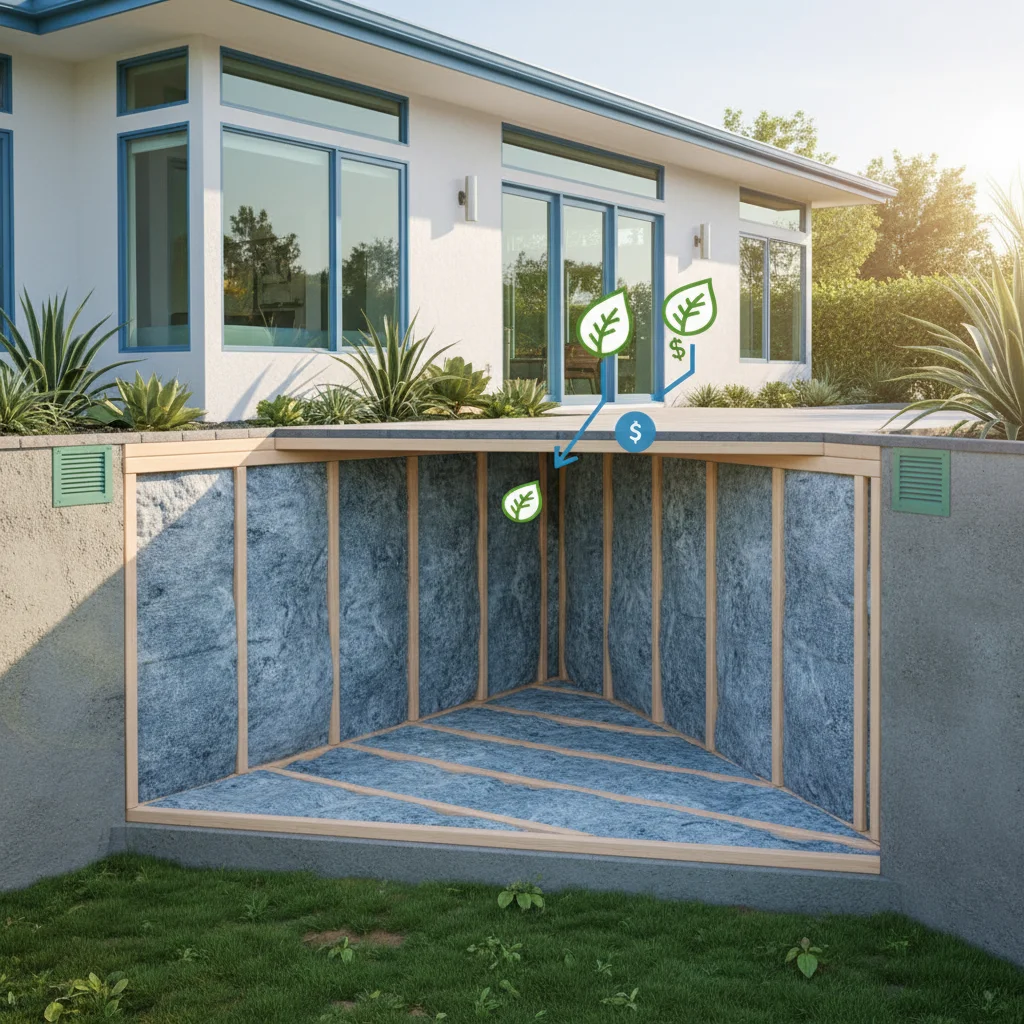
A typical California home loses 15-20% of its heating and cooling through an uninsulated crawl space—translating to $400-$800 in wasted energy annually. And that loss becomes a gain when state and utility programs pay homeowners $0.25-$1.00 per square foot to seal and insulate these neglected zones.
What crawl space insulation rebates are available in California right now?
California homeowners access crawl space insulation rebates through three primary channels in 2026: utility-sponsored Energy Upgrade California programs offering $200-$800 per project, the statewide TECH Clean California initiative providing $400-$1,200 for whole-home weatherization packages, and county-specific low-income weatherization assistance programs delivering $2,000-$5,000 in direct installation subsidies. Utility incentives vary by provider—PG&E pays $0.30 per square foot for R-19 or higher insulation, while SoCal Edison offers tiered rebates of $300-$600 based on total square footage treated.
But the rebate landscape shifts annually. The 2026 Energy Upgrade California program expanded eligibility to include manufactured homes built after 1990, a reversal from 2025's stick-built-only restriction. And TECH Clean California now requires simultaneous air sealing to qualify—crawl space insulation alone no longer meets program requirements as of January 2026.
So homeowners treating 800-1,200 square feet of crawl space typically combine utility rebates ($240-$360 at $0.30/sq ft) with TECH Clean California incentives ($800 for bundled weatherization) to offset 40-60% of total project costs. Some utility territories offer premium rates—SMUD pays $0.45 per square foot in designated climate zones, while LADWP provides flat $500 rebates for any crawl space insulation meeting minimum R-19 standards.
"Energy efficiency rebates help California homeowners reduce utility bills while supporting the state's climate goals." — California Energy Commission
How much can you save with California's crawl space insulation rebates?
California crawl space insulation rebates reduce net project costs by $600-$2,400 in 2026, depending on square footage, climate zone, and income qualification status. Standard utility rebates deliver $0.25-$0.45 per square foot, so a 1,000-square-foot crawl space generates $250-$450 in incentives. Stacking TECH Clean California's $400-$1,200 weatherization bonus with utility payments increases total rebates to $650-$1,650 for middle-income households and $1,800-$3,200 for low-income applicants qualifying for weatherization assistance programs.
And the savings compound beyond rebate checks. Installing R-19 insulation in a 1,000-square-foot crawl space cuts annual heating and cooling costs by $280-$520 in Northern California and $320-$600 in Southern California's inland valleys, according to DSIRE USA. But payback periods vary—homes in climate zones 12-16 see 2-4 year returns, while coastal zone 6 properties require 5-7 years to recoup installation costs through energy savings alone.
So a Fresno homeowner insulating 900 square feet at $3.50 per square foot ($3,150 total) receives $405 from PG&E ($0.45/sq ft) plus $800 from TECH Clean California, reducing net cost to $1,945. Annual energy savings of $475 deliver a 4.1-year payback period. Or a San Diego homeowner treating 1,200 square feet receives $360 from SDG&E plus $600 from a weatherization bundle, cutting costs from $4,200 to $3,240 with $410 in annual savings and a 7.9-year return.
Use our free rebate calculator to model your specific savings based on crawl space size, insulation depth, and local utility rates.
What are the eligibility requirements for crawl space insulation rebates?
California crawl space insulation rebates require homeowners meet four core criteria in 2026: primary residence status, minimum insulation R-value of R-19 or higher, professional installation by a licensed contractor, and pre-approval application submission before project start. Utility programs add territory-specific rules—PG&E restricts rebates to homes built before 2005, while SoCal Edison accepts any structure meeting current Title 24 ventilation standards for crawl spaces.
But income thresholds unlock enhanced incentives. Households earning below 80% of area median income (AMI) qualify for TECH Clean California's premium tier, increasing rebates from $800 to $1,200 for bundled weatherization projects. And low-income weatherization assistance programs (LIWAP) serving families below 200% of federal poverty level provide $2,000-$5,000 in direct installation funding with zero cost-sharing requirements.
So eligibility verification demands specific documentation: recent utility bills proving service address matches primary residence, contractor license verification through CSLB lookup, and W-2 or tax return forms for income-qualified tiers. PG&E processes standard applications in 14-21 business days, while LIWAP applications require 30-45 days for income certification and contractor assignment.
"Weatherization assistance programs prioritize health, safety, and energy efficiency improvements for California's most vulnerable households." — California Department of Community Services and Development
What's the application process and timeline for getting your rebate?
California crawl space insulation rebate applications follow a four-stage sequence in 2026: pre-approval submission (7-14 days), contractor installation with inspection (1-4 weeks), post-installation documentation upload (within 60 days), and rebate disbursement (30-90 days from approval). Utility programs process applications through online portals—PG&E uses the Energy Advisor platform, SoCal Edison operates through Marketplace, and municipal utilities maintain separate application systems with varying submission requirements.
And the timeline depends on program type. Standard utility rebates deliver checks 30-45 days after final inspection approval, while TECH Clean California processes bundled incentives in 60-75 days due to multi-measure verification requirements. Or LIWAP direct-install programs complete projects in 90-120 days but homeowners pay zero upfront costs—contractors bill the program directly.
So the typical sequence runs: Day 1-3, homeowner submits pre-approval with contractor estimate and home details; Day 10-14, utility approves application and issues authorization code; Day 20-35, contractor completes installation and schedules inspection; Day 40-45, homeowner uploads photos, invoices, and inspection certificate; Day 75-90, rebate check arrives. But delays occur—missing documentation extends timelines 14-21 days, while inspection failures require re-work and restart the post-installation clock.
Maximize approval speed by submitting complete applications: include contractor CSLB license number, detailed material specifications showing R-value compliance, and high-resolution photos of existing crawl space conditions. And track your application—most utility portals provide status updates every 3-5 business days from submission through payment.
When are the deadlines for crawl space insulation rebates in 2026?
California crawl space insulation rebate deadlines in 2026 vary by program, with three critical cutoff dates: utility fiscal year-end caps (June 30 or December 31 depending on provider), TECH Clean California's rolling monthly funding limits (applications close when monthly allocation exhausts), and federal weatherization assistance deadlines (September 30 for 2026 funding cycle). PG&E historically exhausts rebate budgets by October-November in high-demand years, while SoCal Edison maintains funding through December in most service territories.
But application dates differ from project completion dates. Utility rebates require pre-approval before installation starts but accept post-installation documentation up to 180 days after approval date. And TECH Clean California enforces stricter timelines—projects must reach final inspection within 120 days of approval or forfeit rebate eligibility.
So strategic timing matters. Applications submitted January-March face 10-14 day processing times with full funding availability, while August-October applications encounter 21-30 day delays as programs approach budget limits. Or low-income weatherization assistance operates on federal fiscal cycles—applications submitted after July 1 may roll into the following year's funding allocation, extending wait times from 90 days to 180+ days.
Check current funding status before starting projects: PG&E posts monthly rebate availability at energy.gov/save, while TECH Clean California publishes real-time allocation data through participating contractor networks. And don't miss the documentation deadline—utility programs reject late submissions even when pre-approval was granted, forfeiting the entire rebate amount.
Can you stack crawl space insulation rebates with other California incentives?
California allows crawl space insulation rebate stacking in 2026 with specific restrictions: utility incentives combine with TECH Clean California weatherization bonuses but not with duplicate measure-specific rebates from the same funding source. Homeowners can't double-dip by claiming both PG&E's crawl space rebate and a separate PG&E whole-home weatherization incentive covering the same square footage. But stacking across different program types is permitted and encouraged—utility rebates plus state weatherization incentives plus low-income assistance grants deliver cumulative benefits of $1,200-$3,800 for eligible households.
The federal Energy Efficient Home Improvement Credit (Section 25C) ended for property placed in service after December 31, 2025 (IRS FS-2025-05). A $3,500 crawl space insulation project generates $600 in utility rebates and $800 from TECH Clean California, reducing net cost to $2,100—a 40% total discount.
But stacking rules require documentation. Homeowners must disclose all applied-for incentives during each program's application process, and final rebate amounts may adjust if total incentives exceed 100% of project cost. PG&E caps combined rebates at 85% of invoice total, while TECH Clean California allows up to 90% coverage for income-qualified applicants.
So maximizing stacks demands coordination: submit utility rebate applications first (14-21 day processing), then apply for TECH Clean California using the utility approval as proof of project scope (30-45 day processing). And track deadlines—state programs accept projects into early 2027 for 2026 funding allocations.
Explore heat pump rebates and other weatherization incentives to build comprehensive upgrade packages that maximize stacking potential.
Official Sources
- DOE Energy Saver — Federal energy efficiency guidance and rebate program directories
- DSIRE USA — Database of state and utility incentives for renewables and efficiency
- California Energy Commission — State energy policy, programs, and incentive updates
Related Reading: Learn more about Crawl Space Insulation Guide and Crawl Space Insulation Rebates.
Frequently Asked Questions
What are the eligibility requirements for California crawl space insulation rebates?
California crawl space insulation rebates require primary residence status, minimum R-19 insulation installation, licensed contractor completion, and pre-approval application submission before project start. Utility programs add territory rules—PG&E limits rebates to pre-2005 homes while SoCal Edison accepts any structure meeting Title 24 ventilation standards. Income-qualified tiers demand W-2 or tax return verification showing household earnings below 80% area median income for premium incentive rates.
How much rebate money can I get for crawl space insulation in California?
California crawl space insulation rebates deliver $600-$2,400 in combined incentives for 2026 projects, depending on square footage and income status. Standard utility programs pay $0.25-$0.45 per square foot, generating $250-$540 for typical 1,000-1,200 square foot crawl spaces. Stacking TECH Clean California's $400-$1,200 weatherization bonus increases totals to $650-$1,740, while low-income weatherization assistance provides $2,000-$5,000 in direct installation subsidies with zero homeowner cost-sharing.
What is the process for applying for a crawl space insulation rebate in California?
California crawl space insulation rebate applications require four steps: pre-approval submission through utility online portals (7-14 days processing), contractor installation with inspection (1-4 weeks), post-installation documentation upload within 60 days, and rebate disbursement in 30-90 days. Submit complete applications with contractor CSLB license numbers, material R-value specifications, and existing crawl space photos to minimize 14-21 day delays from missing documentation. Track application status through utility portals providing updates every 3-5 business days.
Are there any deadlines for submitting crawl space insulation rebate applications in California?
California crawl space insulation rebate deadlines in 2026 include utility fiscal year-end caps (June 30 or December 31), TECH Clean California's monthly funding limits closing when allocations exhaust, and federal weatherization assistance cutoffs on September 30. PG&E typically exhausts budgets by October-November while SoCal Edison maintains funding through December. Applications require pre-approval before installation but accept post-installation documentation up to 180 days after approval, with TECH Clean California enforcing stricter 120-day project completion windows.
What is the difference between crawl space insulation and other types of home insulation rebates?
Crawl space insulation rebates in California pay $0.25-$0.45 per square foot for R-19 or higher floor insulation in ventilated under-floor spaces, while attic insulation rebates deliver $0.15-$0.30 per square foot for ceiling R-38+ treatments and wall insulation incentives provide $0.50-$1.00 per square foot for cavity fill or exterior continuous insulation. Crawl space programs require simultaneous air sealing as of 2026 under TECH Clean California rules, whereas attic rebates permit insulation-only upgrades without ventilation or sealing mandates.
Ready to claim your crawl space insulation rebates? Use our free rebate calculator to estimate your total incentives, compare program options, and generate a customized application roadmap based on your home's location, size, and income qualification status. Calculate your savings in under 60 seconds.
Updated: April 14, 2026 — fact-checked by DuloCore Research. About our editorial process.
Check your California insulation rebate eligibility — see the programs you qualify for and the dollar amounts on our California insulation rebate finder.